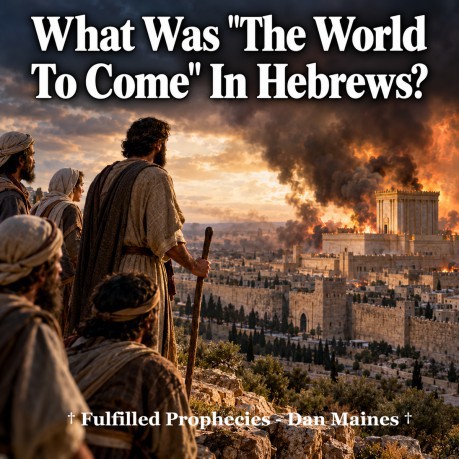
What Was "The World To
Come" In Hebrews? Introduction Hebrews 2:5 Hebrews 2:8-9 Hebrews 6:4-5 Hebrews 8:13 Hebrews 9:8-10 Hebrews 9:26 Hebrews 10:1 Hebrews 10:37 Hebrews 12:26-28 Hebrews 13:14 Historical References How It Applies To Us Today Q & A Appendix Q: Did the world to come mean a new physical planet? Q: Why did Hebrews call it the age to come if believers
were already experiencing its blessings? Q: Was the world to come fulfilled at the cross or in AD
70? Q: Does Hebrews teach that Jesus is still waiting to
become King? Q: Why did the writer say they were seeking a city to
come? Q: Did the destruction of Jerusalem mean the physical
world ended? Q: Are Christians still waiting for another world to
come? Q: What is the greatest lesson of the world to come? † This is the fulfilled perspective we proclaim at
Fulfilled Prophecies † Source Index
By Dan Maines
† What did
the writer of Hebrews mean when he spoke about "the world to
come"? Was he describing a future planet, the end of human
history, or a new order that was already approaching in the first
century?
† The answer is found in the
historical setting of Hebrews and the writer's repeated contrast
between the Old Covenant and the New Covenant. The world to come
wasn't a future physical universe. It was the fully established New
Covenant order under the reign of Jesus Christ (Hebrews 8:6-13;
12:22-28).
† Hebrews was written during the
transition from the Old Covenant system to the complete establishment
of the New Covenant. The temple was still standing, the priesthood
was still functioning, and the sacrifices were still being offered.
Yet the writer declared that the old system was becoming obsolete and
was ready to disappear (Hebrews 8:13; 10:11).
†
The destruction of Jerusalem and its temple in AD 70 brought that
covenant transition to its historical conclusion. What had been
approaching in the first century became the established reality of
Christ's everlasting kingdom (Daniel 7:13-14; Hebrews 12:28).
†
Understanding this changes how we read Hebrews. The writer wasn't
directing his readers toward a world thousands of years in their
future. He was explaining the fulfillment of God's promises through
Jesus Christ and the approaching removal of the Old Covenant order
(Hebrews 9:8-10; 12:26-28).
For He did not subject to angels
the world to come, concerning which we are speaking.
†
The writer specifically identified the world to come as the subject
he was discussing. His concern wasn't the physical destruction of the
earth but the authority and reign of Jesus Christ over the coming
covenant order (Hebrews 1:2-3; Ephesians 1:20-23).
†
The Greek word translated "world" here is oikoumene, a term
that can describe the inhabited world or an organized realm under
authority. Its meaning must be determined by context, and Hebrews
connects this coming realm with the exaltation of Christ (Luke 2:1;
Hebrews 1:6).
† The world to come wasn't
placed under the authority of angels because Jesus, the Son of Man,
had been appointed ruler over everything. His resurrection and
ascension established His authority, and the removal of the Old
Covenant order publicly demonstrated the superiority of His kingdom
(Matthew 28:18; Daniel 7:13-14).
† The writer
wasn't promising that angels would eventually surrender control of
the planet. He was declaring that the coming order belonged to
Christ, whose authority had already been established in heaven (Acts
2:32-36; Colossians 1:13).
YOU HAVE PUT ALL THINGS IN
SUBJECTION UNDER HIS FEET. For in subjecting all things to him, He
left nothing that is not subject to him. But now we do not yet see
all things subjected to him. But we do see Him who was made for a
little while lower than the angels, namely, Jesus, because of the
suffering of death crowned with glory and honor, so that by the grace
of God He might taste death for everyone.
†
The writer distinguished between Christ's established authority and
the complete manifestation of that authority within the covenant
transition. Jesus had already been crowned with glory and honor, even
though the old religious order hadn't yet disappeared (Hebrews 1:3;
8:13).
† The words "not yet" must
be understood within the writer's first-century setting. They don't
automatically establish an unfinished prophetic program extending
thousands of years beyond the original audience (Hebrews 10:37; James
5:8-9).
† Christ's victory wasn't dependent
upon the physical destruction of the universe. His triumph involved
overcoming sin, death, and the powers that held His covenant people
in bondage (1 Corinthians 15:54-57; Hebrews 2:14-15).
†
The world to come was therefore centered upon the glorified Son, not
upon the creation of another physical planet (Ephesians 1:20-23;
Colossians 2:10).
For in the case of those who
have once been enlightened and have tasted of the heavenly gift and
have been made partakers of the Holy Spirit, and have tasted the good
word of God and the powers of the age to come,
†
This passage provides one of the clearest indications that the coming
age was already breaking into the lives of first-century believers.
They had tasted its powers before the Old Covenant system had
completely disappeared (Acts 2:16-18; Hebrews 2:3-4).
†
The Greek word aion, translated "age," concerns a period or
order of existence. It doesn't inherently mean the physical planet.
The coming age was the New Covenant reality introduced through Christ
and brought to its completed covenantal establishment as the former
order passed away (Matthew 12:32; Hebrews 8:13).
†
The believers weren't waiting thousands of years to experience the
Holy Spirit, forgiveness, and fellowship with God. They were already
participating in the blessings associated with the coming age
(Ephesians 1:13-14; 2 Corinthians 5:17).
†
The miraculous signs and revelatory gifts of that transitional
generation confirmed the message of salvation. They testified to the
arrival of the promised kingdom and the authority of the risen Christ
(Mark 16:20; 1 Corinthians 13:8-12).
† What
they had tasted in advance belonged to the approaching New Covenant
order, not to a distant civilization that would begin after the earth
was destroyed (Hebrews 12:22-24; Galatians 4:26).
When He said, A new covenant,
He has made the first obsolete. But whatever is becoming obsolete and
growing old is ready to disappear.
† This
verse identifies the central historical transition in Hebrews. The
first covenant had been made obsolete, but its institutional system
was still approaching its final removal (Hebrews 9:8-10; 10:1-2).
†
The writer didn't say that the physical universe was becoming
obsolete. He was speaking about the covenant established through
Moses, including its priesthood, sacrifices, and earthly sanctuary
(Hebrews 7:11-12; 9:1).
† The destruction of
Jerusalem in AD 70 ended the functioning temple system and
demonstrated that the former covenant administration had reached its
historical conclusion (Matthew 24:1-2; Luke 21:20-22).
†
The coming age wasn't an entirely different creation replacing the
planet. It was the permanent covenant relationship established
through the blood of Jesus Christ (Jeremiah 31:31-34; Hebrews
10:16-18).
The Holy Spirit is signifying
this, that the way into the holy place has not yet been disclosed
while the outer tabernacle is still standing, which is a symbol for
the present time. Accordingly both gifts and sacrifices are offered
which cannot make the worshiper perfect in conscience, since they
relate only to food and drink and various washings, regulations for
the body imposed until a time of reformation.
†
The writer described the earthly sanctuary as a symbolic arrangement
belonging to the time then present. The first tabernacle represented
the old system, whose continued standing demonstrated that the
covenant transition hadn't reached its historical conclusion (Hebrews
8:5; 9:23-24).
† The time of reformation
wasn't a prediction about rebuilding the physical universe. It
concerned the replacement of temporary ceremonial regulations with
the permanent ministry of Jesus Christ (Hebrews 7:18-19; Colossians
2:16-17).
† Jesus had already entered the
heavenly sanctuary through His own blood. The approaching removal of
the earthly system would leave His completed sacrifice and eternal
priesthood as the only covenantal basis for approaching God (Hebrews
9:11-12; 10:19-22).
† This is why AD 70
matters. The destruction of the temple wasn't the beginning of
Christ's priesthood. It was the historical removal of the earthly
institution that had foreshadowed His greater ministry (Hebrews
7:23-25; Matthew 24:2).
Otherwise, He would have needed
to suffer often since the foundation of the world; but now once at
the consummation of the ages He has been manifested to put away sin
by the sacrifice of Himself.
† The writer
declared that Jesus appeared at the end of the ages. He didn't place
the end thousands of years beyond his own generation. Christ had
already appeared, suffered, and accomplished His sacrifice (Galatians
4:4; 1 Peter 1:20).
† The end of the ages
referred to the culmination of the covenant history that had been
moving toward fulfillment in Christ. The Law, the prophets, and the
sacrificial system all pointed toward Him (Luke 24:44; Romans
10:4).
† If the writer believed the end of
the ages had already arrived through Christ's sacrifice, we shouldn't
automatically redefine that expression as the end of the physical
universe (1 Corinthians 10:11; Hebrews 1:1-2).
†
The cross accomplished redemption, and the approaching judgment upon
Jerusalem brought the former covenant administration to its visible
historical end (John 19:30; Matthew 23:36-38).
†
Jesus didn't need to return repeatedly to complete His sacrifice. His
offering was sufficient once for all, and the New Covenant rests upon
that finished work (Hebrews 7:27; 10:12-14).
For the Law, since it has only
a shadow of the good things to come and not the very form of things,
can never, by the same sacrifices which they offer continually year
by year, make perfect those who draw near.
†
The Law was a shadow, not the final reality. Its sacrifices
anticipated the perfect sacrifice of Christ and the blessings of the
New Covenant (Colossians 2:16-17; Hebrews 9:11-12).
†
The good things to come weren't new oceans, continents, or physical
heavens. They concerned forgiveness, access to God, a cleansed
conscience, and the permanent priesthood of Jesus Christ (Hebrews
9:14; 10:19-22).
† These blessings began
through Christ's completed work, while the old sacrificial order
continued to exist during the transition. The removal of that order
in AD 70 confirmed that the shadow had given way to the permanent
reality (Hebrews 8:13; 10:11-14).
† The New
Covenant doesn't require another animal sacrifice, another earthly
high priest, or another temple in Jerusalem. Christ accomplished what
the Law could never accomplish (Hebrews 7:26-28; 10:17-18).
FOR YET IN A VERY LITTLE
WHILE, HE WHO IS COMING WILL COME, AND WILL NOT DELAY.
†
The writer emphasized the nearness of Christ's coming. He wasn't
describing an event that his readers should expect thousands of years
after their deaths (James 5:8-9; Revelation 1:1-3).
†
The coming judgment was connected with the approaching removal of the
Old Covenant order. Jesus had already declared that Jerusalem's
judgment would occur within the generation that heard His warnings
(Matthew 23:36; 24:34).
† The language of a
very little while had meaning for the original audience. Their
endurance mattered because they were living through the closing
period of the former covenant age (Hebrews 10:35-36; 12:26-28).
†
Christ's covenantal coming in judgment in AD 70 confirmed His
prophetic warnings and demonstrated that His kingdom couldn't be
shaken (Luke 21:20-22; Daniel 7:13-14).
And His voice shook the
earth then, but now He has promised, saying, YET ONCE MORE I WILL
SHAKE NOT ONLY THE EARTH, BUT ALSO THE HEAVEN. This expression, Yet
once more, denotes the removing of those things which can be shaken,
as of created things, so that those things which cannot be shaken may
remain. Therefore, since we receive a kingdom which cannot be shaken,
let us show gratitude, by which we may offer to God an acceptable
service with reverence and awe;
† The writer
explained that a great removal was approaching. The contrast was
between what could be shaken and what would remain permanently
established (Haggai 2:6-9; Hebrews 8:13).
†
The reference to heaven and earth shaking draws upon prophetic
judgment language. Such expressions could describe the collapse of
nations and established orders without requiring the literal
destruction of the universe (Isaiah 13:10-13; 34:4-5).
†
The Old Covenant administration, centered upon its earthly sanctuary,
belonged to the temporary order. The kingdom established through
Christ belonged to the permanent order that couldn't be shaken
(Daniel 2:44; Hebrews 7:24-25).
† Notice that
the believers were already receiving this unshakable kingdom. The
writer wasn't instructing them to wait for a kingdom that would begin
thousands of years later (Colossians 1:13; Revelation 1:6).
†
AD 70 marked the historical removal of the temple-centered order, not
the destruction of the planet. Christ's kingdom remained because it
was founded upon His everlasting priesthood and completed redemption
(Hebrews 10:12-14; Luke 1:32-33).
For here we do not have a
lasting city, but we are seeking the city which is to come.
†
The city that was passing away was earthly Jerusalem, the center of
the Old Covenant system. The city they were seeking was the heavenly
Jerusalem, established through Jesus Christ (Galatians 4:25-26;
Hebrews 12:22).
† The writer had already
declared that believers had come to Mount Zion and the city of the
living God. Their seeking wasn't evidence that the heavenly city
didn't exist. They were anticipating the complete establishment of
what they were already entering through Christ (Hebrews 12:22-24;
Ephesians 2:19-22).
† Earthly Jerusalem
couldn't provide permanent access to God. Its temple, priesthood, and
sacrifices were temporary. The heavenly Jerusalem represented the
enduring covenant community gathered around the risen Christ (Hebrews
9:11-12; Revelation 21:2-3).
† When Jerusalem
was destroyed in AD 70, the earthly city lost its role as the center
of covenant worship. The heavenly city remained because its
foundation was Jesus Christ, not a physical building (John 4:21-24;
Revelation 21:22).
† The city to come wasn't
another earthly capital awaiting construction. It was the New
Jerusalem, the fulfilled dwelling place of God with His redeemed
people (Revelation 21:9-10; 22:14).
†
Flavius Josephus, writing in The Jewish War, Books 5-7, described the
Roman siege of Jerusalem, the destruction of the temple, and the
devastating consequences for the Jewish nation in AD 70. His account
provides historical confirmation that the temple-centered religious
order was violently brought to an end.
†
Josephus also described the burning of the sanctuary and the
destruction of Jerusalem's defenses. These events correspond
historically with Jesus' warning that the temple buildings would be
thrown down (Matthew 24:1-2; Luke 19:41-44).
†
Tacitus, in Histories, Book 5, recorded the Roman campaign against
Jerusalem and the circumstances surrounding the Jewish revolt. His
surviving account independently places the conflict within the
first-century Roman world.
† Eusebius, in
Ecclesiastical History, Book 3, Chapters 5-7, connected Jerusalem's
destruction with the warnings of Jesus and reported the tradition
that Christians departed from Jerusalem before the catastrophe.
†
These historical writers don't establish the theological meaning of
Hebrews. Scripture does that. Their writings confirm that the
first-century destruction of Jerusalem and its temple was a real
historical event, not an unfulfilled prediction awaiting another
generation.
†
We're not waiting for the world to come described in Hebrews. From
the fulfilled perspective, we're living in the permanent New Covenant
order established through Jesus Christ (Hebrews 12:22-28; Revelation
21:3).
† We don't need an earthly temple, a
Levitical priesthood, or repeated animal sacrifices. Jesus is our
eternal High Priest, and His sacrifice is sufficient forever (Hebrews
7:24-27; 10:12-14).
† We have direct access
to the Father through Jesus Christ. The way into God's presence is
open because redemption has been accomplished (Ephesians 2:18;
Hebrews 10:19-22).
† The New Jerusalem isn't
merely a future destination for believers. It's the heavenly covenant
reality to which we've come through Christ, and its gates remain open
to those who enter through Him (Hebrews 12:22-24; Revelation
21:25-27; 22:14).
† We're not waiting for
Christ to begin reigning. He's already King, and His kingdom cannot
be shaken (Colossians 1:13; Hebrews 12:28).
†
The world to come in Hebrews wasn't the end of human civilization. It
was the arrival and completed establishment of the New Covenant age.
That doesn't mean the physical earth ceased to exist or that history
stopped in AD 70 (Ecclesiastes 1:4; Genesis 8:22).
†
Our responsibility today isn't to search for another prophetic age.
It's to live faithfully in the kingdom we've received, worship God in
spirit and truth, and proclaim the completed work of Jesus Christ
(John 4:23-24; Colossians 3:1-4).
Q: What was the
world to come in Hebrews?
A: It was
the approaching New Covenant order under Jesus Christ, contrasted
with the temporary Old Covenant system that was becoming obsolete
(Hebrews 2:5; 8:13; 12:28).
A:
No. The context concerns Christ's authority, the heavenly sanctuary,
the removal of the former covenant, and the establishment of His
permanent kingdom (Hebrews 2:5-9; 9:8-10; 12:26-28).
A:
Because the New Covenant had already been inaugurated through Christ,
while the former covenant system was still approaching its historical
removal. Believers were experiencing the powers of the coming age
during that transition (Hebrews 6:5; 8:13).
A: Christ established the New
Covenant through His death, resurrection, and ascension. AD 70 marked
the historical removal of the Old Covenant temple system and the
completion of that covenant transition (Hebrews 9:26; 10:12-14;
Matthew 24:34).
A: No. Jesus was already
enthroned at God's right hand. His kingdom was established through
His exaltation, and the removal of the former covenant order
demonstrated its permanence (Hebrews 1:3; Acts 2:32-36; Daniel
7:13-14).
A: Because earthly Jerusalem
wasn't permanent. The believers had already come to heavenly
Jerusalem through Christ, and they anticipated the complete removal
of the earthly system that stood in contrast to it (Hebrews 12:22-24;
13:14; Galatians 4:26).
A: No. It marked the end
of the Old Covenant order, not the destruction of the planet. God's
creation continues, while Christ's New Covenant kingdom remains
permanently established (Hebrews 8:13; 12:28; Ecclesiastes 1:4).
A: Not in the covenantal sense
described in Hebrews. We have received the unshakable kingdom, have
access to the heavenly Jerusalem, and live under Christ's everlasting
reign (Hebrews 12:22-28; Revelation 21:3; Colossians 1:13).
A:
God's promises reached their fulfillment in Jesus Christ. The
temporary shadows have passed away, the permanent reality has
arrived, and believers now enjoy the blessings of the New Covenant
(Hebrews 10:1; 2 Corinthians 1:20; Ephesians 2:18-22).
© Fulfilled Prophecies - Dan
Maines.
† Hebrews
2:5; Hebrews 2:8-9; Hebrews 6:4-5; Hebrews 8:13; Hebrews 9:8-10;
Hebrews 9:26; Hebrews 10:1; Hebrews 10:37; Hebrews 12:26-28; Hebrews
13:14
† Flavius Josephus, The Jewish War,
Books 5-7; Tacitus, Histories, Book 5; Eusebius, Ecclesiastical
History, Book 3, Chapters 5-7
Links