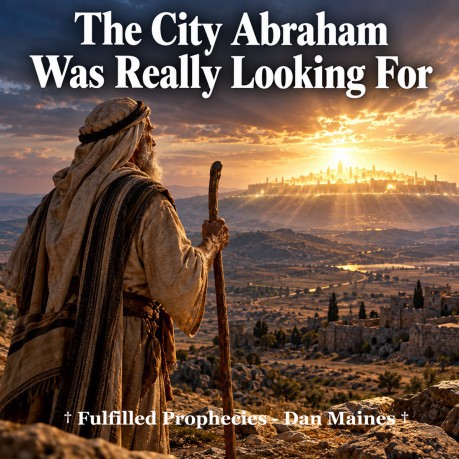
The City Abraham Was Really
Looking For Introduction God Called Abraham Out Of His Homeland Genesis 12:1-3 Abraham Lived In The Promised Land As A Stranger Hebrews 11:8-10 The Patriarchs Desired A Better Country Hebrews 11:13-16 God Fulfilled The Earthly Land Promise Joshua 21:43-45 The Promise Was Fulfilled Through Christ Galatians 3:16 The Jerusalem Above Is Our Mother Galatians 4:26 Believers Had Already Come To The Heavenly Jerusalem Hebrews 12:22-24 The First-Century Believers Were Seeking The Coming City Hebrews 13:14 The City Abraham Awaited Is The New Jerusalem Revelation 21:2-3 The City Has No Earthly Temple Revelation 21:22-23 The Gates Of The City Remain Open Revelation 22:14-17 Historical References How It Applies To Us Today Q & A Appendix Q: Did God fulfill His promise to give Israel the land of
Canaan? Q: If Abraham died before receiving the promises, does
that mean their fulfillment is still future? Q: What city was Abraham looking for? Q: Why did Hebrews say believers had already come to the
heavenly Jerusalem? Q: Why does Hebrews 13:14 say believers were still seeking
the city? Q: Does the New Jerusalem represent a literal city
descending from the sky? Q: Does this mean God rejected His promises to Israel? Q: Are Christians living in the New Jerusalem today? Q: What is the greatest lesson from Abraham's search for
the city? † This is the fulfilled perspective we proclaim at
Fulfilled Prophecies † Source Index
By Dan Maines
† Abraham
left his homeland because God promised him an inheritance, but was
that inheritance ultimately a piece of land, an earthly city, or
something far greater?
† Many Christians
believe God's promises to Abraham still require a future restoration
of national Israel and an earthly Jerusalem. However, the New
Testament identifies the city Abraham was seeking, and it wasn't the
earthly Jerusalem.
† Abraham lived in the
promised land as a stranger because he understood that God's ultimate
promise extended beyond the land beneath his feet. He was looking for
a city whose architect and builder is God (Hebrews 11:9-10).
†
The writer of Hebrews didn't leave that city's identity unanswered.
He told first-century believers that they had already come to Mount
Zion, the heavenly Jerusalem, the city of the living God (Hebrews
12:22-24).
† The question isn't whether
Abraham received a genuine promise concerning the land of Canaan. He
did. The question is whether that land was the final destination of
God's redemptive promise or a temporary inheritance pointing toward
something greater (Genesis 17:8; Galatians 3:16).
†
From Abraham's departure from Ur to the arrival of the New Jerusalem,
Scripture reveals one continuous story of promise, fulfillment, and
God's dwelling with His people (Revelation 21:2-3).
Now the LORD said to Abram,
Go forth from your country, And from your relatives And from your
father's house, To the land which I will show you; And I will make
you a great nation, And I will bless you, And make your name great;
And so you shall be a blessing; And I will bless those who bless you,
And the one who curses you I will curse. And in you all the families
of the earth will be blessed.
† God's promise
began with a command to leave everything familiar and trust Him for
an inheritance Abraham couldn't yet see (Hebrews 11:8).
†
The promise included land, descendants, and blessing, but its
ultimate purpose was never limited to one geographical territory. God
intended to bless all the families of the earth through Abraham
(Galatians 3:8).
† Paul identifies Christ as
the promised descendant through whom God's covenant blessing reaches
the nations. This means the Abrahamic promise finds its fulfillment
in Christ rather than in a future political kingdom (Galatians 3:16,
29).
By faith Abraham, when he
was called, obeyed by going out to a place which he was to receive
for an inheritance; and he went out, not knowing where he was going.
By faith he lived as an alien in the land of promise, as in a foreign
land, dwelling in tents with Isaac and Jacob, fellow heirs of the
same promise; for he was looking for the city which has foundations,
whose architect and builder is God.
† Abraham
entered the very land God had promised him, yet Hebrews says he
continued living there as a stranger. His presence in Canaan didn't
exhaust the meaning of God's promise (Acts 7:5).
†
Abraham, Isaac, and Jacob lived in tents because their ultimate hope
wasn't an earthly settlement. They were looking for something
permanent that God Himself would establish (Hebrews 11:13-16).
†
The city Abraham anticipated wasn't described as something
constructed by human rulers, armies, or governments. Its architect
and builder is God, identifying it as a divine inheritance rather
than an earthly political capital (Hebrews 12:22; Revelation 21:2).
†
Abraham's faith looked beyond the temporary arrangement of the land
covenant toward the permanent dwelling place of God's redeemed people
(Hebrews 13:14; Revelation 21:3).
All these died in faith,
without receiving the promises, but having seen them and having
welcomed them from a distance, and having confessed that they were
strangers and exiles on the earth. For those who say such things make
it clear that they are seeking a country of their own. And indeed if
they had been thinking of that country from which they went out, they
would have had opportunity to return. But as it is, they desire a
better country, that is, a heavenly one. Therefore God is not ashamed
to be called their God; for He has prepared a city for them.
†
Hebrews explicitly identifies the country Abraham and the patriarchs
desired as heavenly. That description rules out the idea that their
ultimate hope was merely an earthly homeland (Philippians 3:20).
†
They died in faith without receiving the complete fulfillment of the
promises because the promised inheritance awaited the accomplishment
of Christ's redemptive work (Hebrews 11:39-40).
†
God had prepared a city for them. The emphasis is on God's completed
provision, not a future city that human beings must construct in the
Middle East (Revelation 21:2).
† The better
country and the city prepared by God belong to the same heavenly
inheritance that believers receive through Jesus Christ (Hebrews
12:22-24).
† The contrast is between the
temporary earthly arrangement and the permanent heavenly reality, not
between two competing geographical locations (2 Corinthians 4:18).
So the LORD gave Israel all
the land which He had sworn to give to their fathers, and they
possessed it and lived in it. And the LORD gave them rest on every
side, according to all that He had sworn to their fathers, and no one
of all their enemies stood before them; the LORD gave all their
enemies into their hand. Not one of the good promises which the LORD
had made to the house of Israel failed; all came to pass.
†
Scripture declares that God gave Israel the land He had promised
their fathers. The land promise wasn't left unfulfilled for a
generation thousands of years later (Nehemiah 9:7-8).
†
Joshua states that none of God's good promises to Israel failed. This
directly challenges the claim that the original land promise remains
unfulfilled today (1 Kings 8:56).
† The
historical possession of Canaan was real, but it wasn't the final
spiritual inheritance anticipated by Abraham. The temporary land
arrangement pointed toward the greater rest and inheritance found in
Christ (Hebrews 4:8-10).
† Israel's later
disobedience and exile didn't erase God's earlier fulfillment. The
prophets addressed Israel's covenant failures and restoration within
the history of God's dealings with that nation (Nehemiah 9:26-31).
†
The ultimate inheritance isn't obtained through national boundaries
or political control. It's received through belonging to Christ, the
promised descendant of Abraham (Galatians 3:29).
Now the promises were spoken
to Abraham and to his seed. He does not say, And to seeds, as
referring to many, but rather to one, And to your seed, that is,
Christ.
† Paul identifies Jesus Christ as the
promised descendant of Abraham. The covenant promise reaches its
intended fulfillment through Him (Acts 3:25-26).
†
This means the fulfillment of Abraham's promise isn't dependent upon
rebuilding an earthly temple, establishing another national kingdom,
or restoring the old covenant system (Galatians 3:26-29).
†
The promise wasn't abandoned or transferred to an unrelated people.
It reached its intended destination in Christ, and everyone who
belongs to Him shares in the promised inheritance (Romans 4:13-16).
†
Abraham's family is ultimately identified through faith in Christ
rather than physical descent alone (Galatians 3:7-9).
But the Jerusalem above is
free; she is our mother.
† Paul contrasts the
earthly Jerusalem associated with slavery under the old covenant with
the Jerusalem above, which represents the freedom of God's people in
Christ (Galatians 4:24-25).
† The heavenly
Jerusalem wasn't presented as another earthly capital awaiting
construction. Paul identified it as the mother of those who belonged
to the promise (Galatians 4:28, 31).
† The
distinction is covenantal. The earthly Jerusalem represented the
covenant that was passing away, while the Jerusalem above represented
the freedom and inheritance established through Christ (2 Corinthians
3:6-11).
† This is why returning to an
earthly Jerusalem as the center of God's redemptive program would
reverse the direction of the New Testament's teaching (Hebrews 8:13).
But you have come to Mount
Zion and to the city of the living God, the heavenly Jerusalem, and
to myriads of angels, to the general assembly and church of the
firstborn who are enrolled in heaven, and to God, the Judge of all,
and to the spirits of the righteous made perfect, and to Jesus, the
mediator of a new covenant, and to the sprinkled blood, which speaks
better than the blood of Abel.
† This is one
of the clearest statements in the entire New Testament concerning the
city Abraham was seeking. The writer doesn't say believers will
someday come to the heavenly Jerusalem. He says they had already come
to it.
† The heavenly Jerusalem is identified
as the city of the living God, directly connecting it with the city
Abraham anticipated (Hebrews 11:10, 16).
†
Believers had come to Mount Zion through their relationship with
Jesus Christ, the mediator of the New Covenant. Their access wasn't
dependent upon traveling to the geographical city of Jerusalem
(Ephesians 2:18-22).
† The first-century
believers were experiencing the arrival of the promised heavenly
reality while the old covenant system was approaching its final
removal (Hebrews 8:13; 12:26-28).
† The
heavenly city's fulfillment was being revealed through Christ and His
covenant, not through a future national restoration thousands of
years later (Revelation 21:9-10).
For here we do not have a
lasting city, but we are seeking the city which is to come.
†
The writer of Hebrews addressed believers living during the final
generation of the old covenant age. The earthly Jerusalem wasn't
their permanent city (Hebrews 8:13).
† The
city they were seeking was the same heavenly city described earlier
as the city of the living God (Hebrews 12:22).
†
There's no contradiction between believers having already come to the
heavenly Jerusalem and still seeking its full establishment. They had
entered the New Covenant reality while awaiting the complete removal
of the old covenant order (Hebrews 10:9, 37).
†
Jesus had warned that Jerusalem and its temple would be destroyed
within that generation. The earthly city was approaching judgment,
while the heavenly kingdom couldn't be shaken (Matthew 24:1-2, 34;
Hebrews 12:28).
† The destruction of
Jerusalem in AD 70 publicly confirmed the end of the old covenant
system and the permanent establishment of the New Covenant order
(Luke 21:20-22).
And I saw the holy city,
new Jerusalem, coming down out of heaven from God, made ready as a
bride adorned for her husband. And I heard a loud voice from the
throne, saying, Behold, the tabernacle of God is among men, and He
will dwell among them, and they shall be His people, and God Himself
will be among them,
† John identifies the New
Jerusalem as the holy city coming from God. Its heavenly origin
agrees with the description of the city Abraham anticipated (Hebrews
11:10, 16).
† The city is also described as a
bride, revealing that the vision concerns God's redeemed covenant
people rather than merely physical buildings and streets (Revelation
21:9-10).
† The central promise is God's
dwelling with His people. This is the goal toward which the entire
biblical story of redemption was moving (Leviticus 26:11-12; 2
Corinthians 6:16).
† The New Jerusalem
represents the completed New Covenant relationship established
through Christ, with God's people enjoying direct access to Him
(Ephesians 2:18).
† John was told that the
prophetic events of Revelation were near and that the time was at
hand. The fulfillment belongs to the first-century covenant
transition rather than an event thousands of years beyond John's
audience (Revelation 1:1-3; 22:6, 10).
†
Abraham anticipated the city, the first-century believers had come to
it, and Revelation revealed its completed covenantal establishment
(Hebrews 11:10; 12:22).
I saw no temple in it,
for the Lord God the Almighty and the Lamb are its temple. And the
city has no need of the sun or of the moon to shine on it, for the
glory of God has illumined it, and its lamp is the Lamb.
†
The New Jerusalem doesn't require a physical temple because God and
the Lamb are its temple. The old covenant sanctuary has reached its
fulfillment in Christ (John 2:19-21).
† This
directly contradicts the expectation that God's ultimate purpose
requires another earthly temple and a restored system of sacrifices
(Hebrews 10:11-18).
† The city's light comes
from God's glory and the Lamb. This prophetic imagery describes the
spiritual reality of God's presence rather than the disappearance of
the physical sun and moon (Isaiah 60:19-20).
†
God's people now worship through Jesus Christ, with access to the
Father in one Spirit. The promise of divine fellowship isn't limited
to a sacred geographical location (John 4:21-24; Ephesians 2:18).
†
The city Abraham desired has everything the earthly sanctuary could
only represent, God's permanent presence among His redeemed people
(Revelation 21:3).
Blessed are those who
wash their robes, so that they may have the right to the tree of
life, and may enter by the gates into the city. Outside are the dogs
and the sorcerers and the immoral persons and the murderers and the
idolaters, and everyone who loves and practices lying. I, Jesus, have
sent My angel to testify to you these things for the churches. I am
the root and the descendant of David, the bright morning star. The
Spirit and the bride say, Come. And let the one who hears say, Come.
And let the one who is thirsty come; let the one who wishes take the
water of life without cost.
† The gates of
the New Jerusalem remain open because the invitation to receive life
in Christ continues (Revelation 21:25).
† The
city isn't waiting to descend upon a future rebuilt earthly
Jerusalem. It represents the New Covenant dwelling of God with His
people, into which believers are welcomed through Christ (Hebrews
12:22-24).
† Those outside the city represent
those who remain separated from its covenant blessings. The
invitation to come and receive the water of life demonstrates that
people can still enter through faith in Christ (John 4:14).
†
The promise Abraham anticipated continues to bless people from every
nation because the gospel remains open to everyone who believes
(Galatians 3:8-9).
† We aren't waiting for
God to establish another earthly capital. We're proclaiming the
kingdom Christ has already established and inviting others to enter
its blessings (Colossians 1:13; Revelation 22:17).
†
Josephus, The Jewish War, Books 5-7, describes the Roman siege of
Jerusalem, the destruction of the temple, and the devastation of the
city in AD 70. His historical account confirms the destruction of the
earthly Jerusalem and its sanctuary, the judgment Jesus had foretold
(Luke 21:20-24).
† Tacitus, Histories
5.10-13, records the Roman campaign against Jerusalem and the
conditions surrounding the city's siege. His testimony provides
additional historical evidence for the first-century destruction of
the Jewish capital (Matthew 24:1-2).
†
Eusebius, Ecclesiastical History 3.5, records the tradition that
Christians in Jerusalem departed for Pella before the city's
destruction. This account is consistent with Jesus' warning that His
followers should flee when they recognized the approaching judgment
(Luke 21:20-21).
† These historical writers
confirm the destruction of earthly Jerusalem. Scripture establishes
the theological meaning of that event as the final judgment upon the
old covenant order (Hebrews 8:13; Luke 21:22).
†
We don't need to travel to Jerusalem to enter the presence of God.
Through Jesus Christ, believers have direct access to the Father in
one Spirit (Ephesians 2:18).
† We aren't
waiting for a future earthly temple, a restored Levitical priesthood,
or another national kingdom. Jesus Christ has fulfilled the
priesthood, the sacrifices, and the promises that pointed toward Him
(Hebrews 7:23-28; 10:12-18).
† Our
citizenship is in heaven, even while we continue living on earth.
This describes our covenant relationship with Christ, not an
expectation that the physical earth must disappear (Philippians 3:20;
Ecclesiastes 1:4).
† We belong to the
heavenly Jerusalem because we've been brought into the household of
God through faith in Jesus Christ (Ephesians 2:19-22).
†
Abraham looked forward in faith to what God had promised. We look
back upon Christ's completed redemptive work and live in the
blessings of the kingdom He established (Colossians 1:12-14).
†
The New Jerusalem isn't a distant destination we're waiting to see
appear in the future. It's the covenantal reality of God's dwelling
with His people through Jesus Christ (Revelation 21:2-3).
†
The promise continues to reach the nations as people respond to the
gospel and become children of Abraham through faith (Galatians 3:7-9,
29).
† Our responsibility isn't to wait for
another prophetic fulfillment. It's to live faithfully in the kingdom
we've received and proclaim the salvation already accomplished
through Christ (Hebrews 12:28; Revelation 22:17).
Q: Was Abraham
ultimately waiting for an earthly city?
A:
No. Although God promised Abraham the land of Canaan, Hebrews
identifies his ultimate hope as a heavenly country and a city whose
architect and builder is God (Hebrews 11:10, 16).
A: Yes. Scripture explicitly
states that God gave Israel the land He had promised and that none of
His good promises failed (Joshua 21:43-45; 1 Kings 8:56).
A:
No. Abraham and the other faithful patriarchs died before Christ
accomplished the redemption toward which the promises pointed.
Hebrews explains that their perfection was connected with the
fulfillment God provided through Christ (Hebrews 11:39-40; 12:22-24).
A:
He was looking for the heavenly city prepared by God, identified in
the New Testament as the heavenly Jerusalem and revealed in
Revelation as the New Jerusalem (Hebrews 11:10, 16; 12:22; Revelation
21:2).
A: Because through
Jesus Christ they had entered the New Covenant relationship and
gained access to God's presence. They weren't required to wait for
another earthly kingdom to receive that blessing (Hebrews 12:22-24;
Ephesians 2:18-22).
A: They had already entered
the heavenly reality through Christ, but the old covenant order
hadn't yet been completely removed. The destruction of Jerusalem in
AD 70 marked the final removal of that temporary system (Hebrews
8:13; 12:26-28; 13:14).
A: No.
Revelation describes the city as the bride, the wife of the Lamb,
showing its covenantal identity as God's redeemed people. Its
heavenly origin identifies it as God's work rather than a human
construction (Revelation 21:2, 9-10).
A:
No. God fulfilled His promises through Jesus Christ, Israel's
promised Messiah. Everyone who belongs to Christ shares in Abraham's
inheritance through faith (Romans 15:8; Galatians 3:16, 29).
A:
Yes. Believers belong to the heavenly Jerusalem through their
relationship with Jesus Christ. The New Covenant provides the access
to God and the spiritual blessings anticipated by Abraham (Hebrews
12:22-24; Revelation 21:3; Ephesians 2:18-22).
A: God's promises find their
ultimate fulfillment in Jesus Christ, not in earthly buildings,
political borders, or national governments. Abraham looked forward to
God's permanent dwelling with His people, and believers now share in
that inheritance through Christ (Hebrews 11:10, 16; Galatians 3:29;
Revelation 21:3).
© Fulfilled Prophecies - Dan
Maines.
† Genesis
12:1-3; Hebrews 11:8-10; Hebrews 11:13-16; Joshua 21:43-45; Galatians
3:16; Galatians 4:26; Hebrews 12:22-24; Hebrews 13:14; Revelation
21:2-3; Revelation 21:22-23; Revelation 22:14-17
†
Flavius Josephus, The Jewish War, Books 5-7; Tacitus, Histories
5.10-13; Eusebius, Ecclesiastical History 3.5
Links