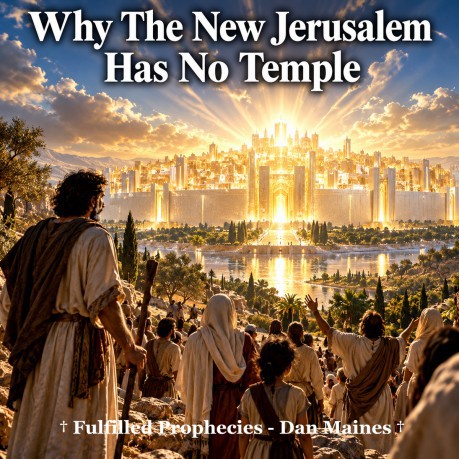
Why The New Jerusalem Has No
Temple Introduction The Lord And The Lamb Are Its Temple Revelation 21:22 Jesus Identified Himself As The True Temple John 2:19-21 Worship Would No Longer Depend On Jerusalem John 4:21-24 God's People Have Become His Dwelling Place Ephesians 2:19-22 The Earthly Sanctuary Was A Copy Of The Heavenly Reality Hebrews 9:8-12 The Veil Was Torn Because Access Was Opened Matthew 27:50-51 The New Jerusalem Was The Heavenly City They Were
Approaching Hebrews 12:22-24 The New Jerusalem Is God's Dwelling Among His People Revelation 21:2-3 The Gates Remain Open Because The Kingdom Is Present Revelation 21:25-27 Historical References How It Applies To Us Today Q & A Appendix † This is the fulfilled perspective we proclaim at
Fulfilled Prophecies † Source Index
By Dan Maines
† For
centuries, the temple in Jerusalem stood at the center of Israel's
worship. It represented God's presence among His covenant people, the
place of sacrifice, priesthood, and access to God.
†
Yet when John described the New Jerusalem, he revealed something
remarkable. There was no temple anywhere in the city because the Lord
God Almighty and the Lamb were its temple (Revelation 21:22).
†
This wasn't an omission or a promise that another temple would
eventually be constructed. It was the fulfillment of everything the
earthly temple had represented.
† Jesus had
already identified Himself as the true temple, promised worship that
wouldn't depend on a sacred location, and established His people as
God's dwelling place (John 2:19-21; John 4:21-24; Ephesians
2:19-22).
† The destruction of Jerusalem and
its temple in AD 70 publicly confirmed the end of the Old Covenant
system. The New Covenant reality had arrived, and God's people no
longer needed a physical sanctuary to approach Him (Hebrews 9:8-12;
Hebrews 10:19-22).
† The New Jerusalem has no
temple because God's presence is no longer represented by a building.
Through Jesus Christ, His people live in direct covenant fellowship
with Him (Hebrews 12:22-24).
I saw no temple in it, for
the Lord God the Almighty and the Lamb are its temple.
†
John didn't describe a city waiting for a temple to be constructed.
He described a city in which the temple's purpose had been completely
fulfilled (Revelation 21:3).
† Under the Old
Covenant, God's presence was represented by the sanctuary, its
priesthood, and its sacrifices. Under the New Covenant, believers
approach God through Jesus Christ Himself (Hebrews 9:11-12; Hebrews
10:19-22).
† The absence of a temple wasn't a
loss. It revealed that the separation represented by the earthly
sanctuary had been overcome through Christ (Ephesians 2:13-18).
†
John identified both the Father and the Lamb as the temple because
access to the Father is established through the Son. No earthly
structure can provide anything beyond what Christ has accomplished
(John 14:6; Hebrews 7:25).
† This is why the
New Jerusalem isn't dependent on a geographical location. Its
defining reality is God's presence among His redeemed people
(Revelation 21:2-3; Hebrews 12:22-23).
Jesus answered them, Destroy
this temple, and in three days I will raise it up. The Jews then
said, It took forty-six years to build this temple, and will You
raise it up in three days? But He was speaking of the temple of His
body.
† Jesus deliberately redirected
attention away from the physical temple toward Himself. The religious
leaders understood His statement as a reference to Herod's temple,
but John explained that Jesus was speaking about His own body
(Matthew 12:6).
† The earthly temple had
served as the appointed place where God met with Israel. Jesus
revealed that God's presence and redemptive purpose were now centered
in Him (Colossians 2:9; John 1:14).
† His
death and resurrection established the foundation of the New
Covenant. The true meeting place between God and humanity wasn't a
building made by human hands but the risen Son of God (Hebrews 8:6; 1
Timothy 2:5).
† This explains why rebuilding
an earthly temple would never restore what the Old Covenant sanctuary
represented. Christ has already fulfilled its purpose through His
completed sacrifice and continuing priesthood (Hebrews 9:24-26;
Hebrews 10:12-14).
† John's vision of a
templeless city was consistent with what Jesus had taught decades
earlier. The true temple had already appeared in the person of Jesus
Christ (Colossians 1:19; John 14:9).
Jesus said to her, Woman,
believe Me, an hour is coming when neither in this mountain nor in
Jerusalem will you worship the Father. You worship what you do not
know; we worship what we know, for salvation is from the Jews. But an
hour is coming, and now is, when the true worshipers will worship the
Father in spirit and truth; for such people the Father seeks to be
His worshipers. God is spirit, and those who worship Him must worship
in spirit and truth.
† Jesus told the
Samaritan woman that the coming order of worship wouldn't be centered
on either Mount Gerizim or Jerusalem. The geographical dispute would
lose its covenant significance (Acts 7:48-50).
†
Notice that Jesus said the hour was coming and had already begun. He
wasn't describing a religious transformation that would wait
thousands of years. The transition was beginning through His earthly
ministry (Luke 16:16; Hebrews 9:10).
†
Worship in spirit and truth means approaching the Father through the
reality revealed in Christ rather than depending on the shadows and
regulations of the former covenant (Colossians 2:16-17; Hebrews
10:1).
† The physical temple remained
standing when Jesus spoke these words, but its approaching end had
already been announced. The destruction in AD 70 would remove the old
center of worship, confirming the transition Jesus proclaimed
(Matthew 24:1-2; Luke 21:20-22).
† The New
Jerusalem has no temple because worship is no longer restricted to a
sacred mountain, city, priesthood, or building. Believers have access
to the Father through Christ in one Spirit (Ephesians 2:18;
Philippians 3:3).
So then you are no longer
strangers and aliens, but you are fellow citizens with the saints,
and are of God's household, having been built on the foundation of
the apostles and prophets, Christ Jesus Himself being the corner
stone, in whom the whole building, being fitted together, is growing
into a holy temple in the Lord, in whom you also are being built
together into a dwelling of God in the Spirit.
†
Paul described believers as members of God's household and citizens
of His kingdom. Their identity wasn't determined by an earthly temple
or national boundary but by their union with Jesus Christ
(Philippians 3:20; Galatians 3:28-29).
† The
foundation was the teaching of the apostles and prophets, with Christ
Himself as the cornerstone. This was a spiritual structure
established by God, not a physical building awaiting construction (1
Peter 2:4-6).
† Jews and Gentiles were being
joined together into one holy dwelling place. The division maintained
under the former covenant was removed through Christ's reconciling
work (Ephesians 2:14-16; Galatians 3:26-28).
†
Paul's language was present and active. God's dwelling place was
already being established among believers in the first century. They
weren't waiting for a future earthly sanctuary to experience His
presence (2 Corinthians 6:16; 1 Corinthians 3:16).
†
The completed New Covenant order is therefore consistent with John's
vision. God dwells among His people, and His people belong to Him
(Revelation 21:3; 1 Peter 2:9-10).
The Holy Spirit is signifying
this, that the way into the holy place has not yet been disclosed
while the outer tabernacle is still standing, which is a symbol for
the present time. Accordingly both gifts and sacrifices are offered
which cannot make the worshiper perfect in conscience, since they
relate only to food and drink and various washings, regulations for
the body imposed until a time of reformation. But when Christ
appeared as a high priest of the good things to come, He entered
through the greater and more perfect tabernacle, not made with hands,
that is to say, not of this creation; and not through the blood of
goats and calves, but through His own blood, He entered the holy
place once for all, having obtained eternal redemption.
†
Hebrews explains that the earthly sanctuary belonged to a temporary
covenant arrangement. Its sacrifices and regulations couldn't provide
the complete access to God that Christ would establish (Hebrews
10:1-4).
† The first tabernacle represented
the limitations of the Old Covenant system. Its continuing service
testified that the former order hadn't yet been completely removed
(Hebrews 8:13).
† Christ entered the greater
and more perfect sanctuary through His own blood. His sacrifice
wasn't repeated annually because His redemptive work accomplished
what animal sacrifices could never accomplish (Hebrews 9:24-26).
†
The time of reformation was the transition from the Old Covenant to
the New Covenant. That transition reached its historical conclusion
with Jerusalem's destruction in AD 70 (Hebrews 10:37; Matthew
24:34).
† John's templeless New Jerusalem
represents the completed reality toward which the earthly sanctuary
had pointed. The shadow gave way to the substance, and the temporary
arrangement gave way to Christ's permanent priesthood (Colossians
2:17; Hebrews 7:23-25).
And Jesus cried out again
with a loud voice, and yielded up His spirit. And behold, the veil of
the temple was torn in two from top to bottom; and the earth shook
and the rocks were split.
† When Jesus died
around AD 30, the temple veil was torn from top to bottom. This
extraordinary event demonstrated that access to God was being opened
through Christ's sacrifice (Hebrews 10:19-20).
†
Under the Old Covenant, the high priest entered the Most Holy Place
only once each year, carrying sacrificial blood. Christ fulfilled
that priestly pattern through His own sacrifice (Hebrews 9:7; Hebrews
9:11-12).
† The tearing of the veil marked
the theological end of the separation represented by the sanctuary.
The temple continued operating during the covenant transition, but
its sacrificial system had already been surpassed by Christ (Hebrews
10:11-14).
† Forty years later, Jerusalem's
destruction removed the physical structure associated with that
former covenant order. The events weren't unrelated judgments but
parts of the same unfolding covenant fulfillment (Luke 21:20-22;
Hebrews 8:13).
† The New Jerusalem doesn't
need a veil because Christ has provided access to the Father. It
doesn't need another sacrificial altar because His sacrifice was
offered once for all (Hebrews 10:18-22).
But you have come to Mount
Zion and to the city of the living God, the heavenly Jerusalem, and
to myriads of angels, to the general assembly and church of the
firstborn who are enrolled in heaven, and to God, the Judge of all,
and to the spirits of the righteous made perfect, and to Jesus, the
mediator of a new covenant, and to the sprinkled blood, which speaks
better than the blood of Abel.
† The writer
didn't tell believers that they would reach the heavenly Jerusalem
thousands of years later. He declared that they had already come to
Mount Zion and the city of the living God (Galatians 4:26).
†
Their access was grounded in Jesus, the mediator of the New Covenant.
The heavenly city was identified with the assembly of God's redeemed
people rather than the geographical boundaries of earthly Jerusalem
(Philippians 3:20; Ephesians 2:19).
† The
contrast throughout Hebrews is between the temporary Old Covenant
order and the permanent kingdom established through Christ (Hebrews
12:18-21; Hebrews 12:28).
† This explains why
the New Jerusalem doesn't contain another physical sanctuary. Its
inhabitants have direct covenant access to the living God through
their eternal High Priest (Hebrews 4:14-16; Hebrews 7:25).
†
What the first-century believers were approaching during the covenant
transition became the fully established New Covenant reality when the
former order passed away in AD 70 (Hebrews 8:13; Hebrews 10:37).
And I saw the holy city,
new Jerusalem, coming down out of heaven from God, made ready as a
bride adorned for her husband. And I heard a loud voice from the
throne, saying, Behold, the tabernacle of God is among men, and He
will dwell among them, and they shall be His people, and God Himself
will be among them,
† John identified the New
Jerusalem as a bride prepared for her husband. This imagery connects
the city with God's covenant people, not merely with buildings,
streets, and physical architecture (Revelation 21:9-10; Ephesians
5:25-27).
† The announcement that God's
dwelling is among His people fulfills the covenant promise that He
would be their God and they would be His people (Leviticus 26:11-12;
Ezekiel 37:26-27).
† The city comes down from
heaven because its origin and authority are from God. The vision
doesn't describe believers abandoning the earth to establish another
earthly temple (Galatians 4:26; Hebrews 11:10).
†
The Old Covenant temple represented God's presence within a
restricted sanctuary. The New Covenant establishes His presence among
all who belong to Christ (2 Corinthians 6:16; Ephesians 2:21-22).
†
The bride, the city, and the dwelling place of God are connected
descriptions of one fulfilled covenant reality. God's redeemed people
live in fellowship with Him through the Lamb (Revelation 22:3-4; John
14:23).
In the daytime (for
there will be no night there) its gates will never be closed; and
they will bring the glory and the honor of the nations into it; and
nothing unclean, and no one who practices abomination and lying,
shall ever come into it, but only those whose names are written in
the Lamb's book of life.
† The open gates
reveal continuing access to the blessings of the New Covenant. The
city isn't described as a temporary refuge that disappears after the
first century (Revelation 22:17).
† The
nations bringing their glory into the city reflects the inclusion of
people from every nation through the gospel of Jesus Christ (Isaiah
60:3; Matthew 28:19).
† The distinction
between those inside and those outside demonstrates that the New
Jerusalem represents covenant fellowship with God. Entrance is
through Christ, not through physical relocation to a reconstructed
Jerusalem (John 10:9; Revelation 22:14-15).
†
The absence of night expresses the permanent light and security of
God's presence. The redeemed no longer depend on the limited access
and repeated rituals of the former sanctuary (John 8:12; 1 John
1:7).
† The gates remain open because the
invitation of the gospel continues. People today can enter the
blessings of the New Covenant through faith in Jesus Christ (Romans
5:1-2; Revelation 22:17).
†
Flavius Josephus, The Jewish War, Book 6, Chapters 4-5, described the
burning and destruction of Jerusalem's temple during the Roman siege
in AD 70. His account establishes the historical removal of the
sanctuary that had served as the center of Israel's sacrificial
worship.
† Josephus, The Jewish War, Book 7,
Chapter 1, described the devastation of Jerusalem after the Roman
victory. The city's destruction confirmed that the former temple
system could no longer continue in its established location.
†
Tacitus, Histories, Book 5, Chapters 10-13, recorded the Roman
campaign against Jerusalem and the circumstances surrounding the
city's siege. His account provides independent Roman historical
testimony concerning the conflict.
†
Eusebius, Ecclesiastical History, Book 3, Chapters 5-7, connected the
destruction of Jerusalem with the warnings Jesus had given concerning
the city. He also preserved the tradition that Christians had
departed from Jerusalem before its destruction.
†
These historical accounts establish the reality of Jerusalem's
destruction. Scripture provides the covenant meaning of those events
through Jesus' predictions and the New Testament teaching concerning
the passing of the former sanctuary (Luke 21:20-22; Hebrews 8:13).
†
We don't need to travel to Jerusalem to experience God's presence.
Through Jesus Christ, believers have access to the Father wherever
they live (John 4:23-24; Ephesians 2:18).
†
We don't need another earthly temple, another sacrificial priesthood,
or another system of animal offerings. Christ's sacrifice is
complete, and His priesthood is permanent (Hebrews 7:24-27; Hebrews
10:12-14).
† We aren't waiting for the New
Jerusalem to descend at some future date. Scripture identifies the
heavenly Jerusalem as the covenant home of God's people, and
believers already belong to that city through Christ (Hebrews
12:22-23; Galatians 4:26).
† We are God's
dwelling place through the Holy Spirit. Our relationship with Him
isn't dependent on a sacred building, religious ceremony, or national
identity (1 Corinthians 3:16; Ephesians 2:19-22).
†
We can approach God with confidence because Jesus has opened the way.
The separation represented by the temple veil has been overcome
through His completed sacrifice (Hebrews 4:16; Hebrews 10:19-22).
†
We should never confuse the modern nation of Israel or a proposed
rebuilding of the temple with the fulfillment of New Covenant
prophecy. God's promises find their fulfillment in Jesus Christ and
His redeemed people (2 Corinthians 1:20; Galatians 3:16, 29).
†
The New Jerusalem has no temple because God hasn't left His people
waiting outside a sanctuary. Through Christ, we've been brought near
and welcomed into His household (Ephesians 2:13, 19; John 14:23).
Q: Why
did John see no temple in the New Jerusalem?
A:
Because the Lord God Almighty and the Lamb are its temple. The
earthly sanctuary's purpose was fulfilled through Jesus Christ, who
provides direct access to the Father (Revelation 21:22; Hebrews
10:19-22).
Q: Did Jesus teach that the physical
temple would be replaced?
A: Yes. Jesus
identified His own body as the true temple and announced that worship
would no longer depend on Jerusalem or Mount Gerizim (John 2:19-21;
John 4:21-24).
Q: Does the New Jerusalem
represent a future physical city?
A: In the
fulfilled perspective, it represents the completed New Covenant
dwelling of God among His people. Hebrews declared that believers had
already come to the heavenly Jerusalem (Hebrews 12:22-24; Revelation
21:2-3).
Q: Why was the temple destroyed in AD
70?
A: Jesus predicted its destruction as part
of the judgment upon first-century Jerusalem. Its removal marked the
historical conclusion of the former covenant order (Matthew 24:1-2,
34; Luke 21:20-22; Hebrews 8:13).
Q: If
believers are God's temple, why does Revelation say there is no
temple?
A: Paul described believers as God's
spiritual dwelling place, while John explained that the New Jerusalem
contains no separate sanctuary because God and the Lamb are its
temple. These teachings describe complementary aspects of the same
New Covenant relationship (Ephesians 2:19-22; Revelation 21:22).
Q:
Does the absence of a temple mean God no longer dwells with
humanity?
A: No. It means the opposite. God's
presence is established among His redeemed people without the
separation represented by the former sanctuary (Revelation 21:3; 2
Corinthians 6:16).
Q: Will another temple be
required to fulfill biblical prophecy?
A: No.
Jesus fulfilled the purpose of the earthly sanctuary, and His
sacrifice accomplished eternal redemption. The New Testament doesn't
require another physical temple to complete His work (Hebrews
9:11-12; Hebrews 10:12-14).
Q: Can people still
enter the New Jerusalem today?
A: Yes. The
gates remain open, and the invitation to receive the water of life
continues. Through faith in Christ, people enter the blessings of His
established kingdom (Revelation 21:25-27; Revelation 22:14, 17; John
10:9).
© Fulfilled Prophecies - Dan
Maines.
† Revelation
21:22; John 2:19-21; John 4:21-24; Ephesians 2:19-22; Hebrews 9:8-12;
Matthew 27:50-51; Hebrews 12:22-24; Revelation 21:2-3; Revelation
21:25-27
† Flavius Josephus, The Jewish War,
Book 6, Chapters 4-5; Book 7, Chapter 1; Tacitus, Histories, Book 5,
Chapters 10-13; Eusebius, Ecclesiastical History, Book 3, Chapters
5-7
Links