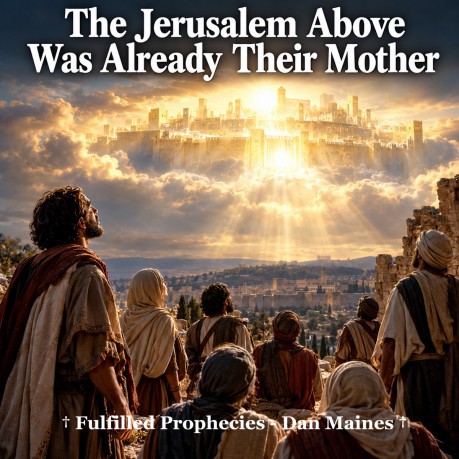
The Jerusalem Above Was
Already Their Mother Introduction Galatians 4:26 Galatians 4:24-25 Galatians 4:28-31 Hebrews 12:22-23 Hebrews 12:18-21 Hebrews 12:26-28 Hebrews 13:14 Revelation 21:1-3 Revelation 21:9-10 Revelation 21:22-23 Revelation 21:25-27 Revelation 22:14-17 Historical References How It Applies To Us Today Q & A Appendix † This is the fulfilled perspective we proclaim at
Fulfilled Prophecies † Source Index
By Dan Maines
† One of the
clearest demonstrations that the New Jerusalem isn't a future
physical city is found in the words of Paul and the writer of
Hebrews. Both described the heavenly Jerusalem as a present reality
for believers living in the first century.
†
Paul declared that the Jerusalem above was already their mother,
while Hebrews declared that believers had already come to Mount Zion,
the heavenly Jerusalem. Neither writer described a city that would
first become available thousands of years later (Galatians 4:26;
Hebrews 12:22).
† Revelation 21 describes
that same heavenly Jerusalem coming down out of heaven from God. The
difference isn't that Paul and Hebrews were describing one city while
John was describing another. They were describing the same New
Covenant reality from different perspectives (Revelation 21:2-3).
†
The question isn't whether the New Jerusalem exists today. Scripture
establishes that it does. The question is how its first-century
existence relates to the completion of the Old Covenant age in AD 70
(Hebrews 8:13; Revelation 21:1-3).
But the Jerusalem above is
free; she is our mother.
† Paul didn't say
the Jerusalem above would become their mother someday. He said she
was already their mother. His present-tense declaration identified
the heavenly Jerusalem as the covenant home of believers in Christ
(Philippians 3:20).
† The Jerusalem above
represented freedom through the New Covenant, not continued bondage
under the Law of Moses. Believers were already children of the
promise through faith in Christ (Galatians 3:26-29).
†
Paul's declaration makes it impossible to argue that the heavenly
Jerusalem didn't exist until some future event. Its identity was
already established, even while the Old Covenant system was
approaching its final removal (Hebrews 8:13).
This is allegorically
speaking, for these women are two covenants: one proceeding from
Mount Sinai bearing children who are to be slaves; she is Hagar. Now
this Hagar is Mount Sinai in Arabia and corresponds to the present
Jerusalem, for she is in slavery with her children.
†
Paul explicitly identified the two women as two covenants. Hagar
represented the covenant established at Mount Sinai, while Sarah
represented the promise fulfilled through Christ (Galatians 4:28,
31).
† The earthly Jerusalem belonged to the
covenant of bondage because its religious system continued under the
Law of Moses. The heavenly Jerusalem represented the freedom already
available through the New Covenant (Galatians 5:1).
†
This comparison wasn't about replacing one geographical city with
another geographical city. It concerned the transition between two
covenant administrations, one passing away and the other established
through Christ (2 Corinthians 3:6-11).
† The
earthly Jerusalem still existed when Paul wrote, but it no longer
defined the people of God. Their identity came through Christ, not
through the physical temple, ancestry, or the Mosaic covenant
(Ephesians 2:14-18).
And you brethren, like
Isaac, are children of promise. But as at that time he who was born
according to the flesh persecuted him who was born according to the
Spirit, so it is now also. But what does the Scripture say? CAST OUT
THE BONDWOMAN AND HER SON, FOR THE SON OF THE BONDWOMAN SHALL NOT BE
AN HEIR WITH THE SON OF THE FREE WOMAN. So then, brethren, we are not
children of a bondwoman, but of the free woman.
†
Paul identified believers as children of promise before Jerusalem's
destruction. Their New Covenant identity wasn't waiting for AD 70 to
begin (Romans 8:15-17).
† The command to cast
out the slave woman and her son pointed toward the removal of the
covenant system that could no longer share the inheritance with the
children of promise (Hebrews 8:13).
† The
destruction of Jerusalem in AD 70 publicly demonstrated the final
removal of the Old Covenant order. The temple, priesthood, and
sacrificial system could no longer function as the center of covenant
worship (Hebrews 10:9-14).
† The inheritance
belonged to those in Christ, whether Jew or Gentile. The heavenly
Jerusalem was their mother because they belonged to the promise
fulfilled in Him (Galatians 3:28-29).
But you have come to Mount
Zion and to the city of the living God, the heavenly Jerusalem, and
to myriads of angels, to the general assembly and church of the
firstborn who are enrolled in heaven, and to God, the Judge of all,
and to the spirits of the righteous made perfect,
†
Hebrews didn't say believers would eventually come to Mount Zion. It
declared that they had already come to the heavenly Jerusalem. This
was their present covenant standing through Jesus Christ (Ephesians
2:6, 19).
† Mount Zion wasn't being presented
as a future earthly destination. It represented access to the living
God through the New Covenant and the heavenly assembly of His people
(Hebrews 10:19-22).
† The heavenly Jerusalem
was already the city of the living God. Believers weren't waiting for
a physical city to descend before they could belong to God's
household (Ephesians 2:19-22).
† This passage
directly connects the heavenly city with the church of the firstborn.
The New Jerusalem is inseparable from the redeemed people who belong
to Christ (Revelation 21:9-10).
For you have not come to a
mountain that can be touched and to a blazing fire, and to darkness
and gloom and whirlwind, and to the blast of a trumpet and the sound
of words which sound was such that those who heard begged that no
further word be spoken to them. For they could not bear the command,
IF EVEN A BEAST TOUCHES THE MOUNTAIN, IT WILL BE STONED. And so
terrible was the sight, that Moses said, I AM FULL OF FEAR and
trembling.
† The writer contrasted Mount
Sinai with Mount Zion. Sinai represented the terrifying establishment
of the Old Covenant, while Zion represented the access believers
possessed through Christ (Hebrews 4:14-16).
†
The contrast wasn't between two future physical mountains. It was
between the covenant of bondage and the covenant of freedom already
established through Jesus (2 Corinthians 3:7-11).
†
Under the Old Covenant, the people couldn't approach God's presence
freely. Through Christ, believers received access to the Father by
one Spirit (Ephesians 2:18).
† The heavenly
Jerusalem was therefore a present spiritual and covenant reality, not
a postponed geographical relocation (John 4:21-24).
And His voice shook the
earth then, but now He has promised, saying, YET ONCE MORE I WILL
SHAKE NOT ONLY THE EARTH, BUT ALSO THE HEAVEN. This expression, Yet
once more, denotes the removing of those things which can be shaken,
as of created things, so that those things which cannot be shaken may
remain. Therefore, since we receive a kingdom which cannot be shaken,
let us show gratitude, by which we may offer to God an acceptable
service with reverence and awe;
† The writer
explained that the things capable of being shaken were being removed
so that the unshakable kingdom would remain. This concerned the
passing covenant order and the permanence of Christ's kingdom
(Hebrews 8:13).
† Notice that believers were
already receiving the kingdom. The New Covenant kingdom wasn't
waiting for a future earthly millennium or the destruction of the
physical universe (Colossians 1:13).
† The
removal of the Old Covenant order reached its historical conclusion
with Jerusalem's destruction in AD 70. The kingdom established
through Christ remained because it wasn't dependent upon an earthly
temple (Daniel 7:13-14).
† The heavenly
Jerusalem belonged to that unshakable kingdom. Its permanence rested
upon Christ's completed work, not the survival of the earthly city
(Luke 1:32-33).
For here we do not have a
lasting city, but we are seeking the city which is to come.
†
This verse doesn't contradict the earlier declaration that believers
had already come to the heavenly Jerusalem. They already possessed
access to the heavenly city while awaiting the complete removal of
the Old Covenant order (Hebrews 12:22-28).
†
The earthly Jerusalem wasn't their permanent covenant home. Its
temple and religious institutions were approaching judgment, just as
Jesus had announced (Matthew 24:1-2).
† The
city they sought was the heavenly Jerusalem already identified as
their covenant destination. Its anticipated coming concerned the
completed manifestation of the New Covenant order, not the
construction of another physical city (Revelation 21:2-3).
†
Present participation and anticipated consummation weren't
contradictions. Believers already belonged to Christ's kingdom while
the former covenant administration was passing away (Hebrews 8:13).
Then I saw a new heaven
and a new earth; for the first heaven and the first earth passed
away, and there is no longer any sea. And I saw the holy city, new
Jerusalem, coming down out of heaven from God, made ready as a bride
adorned for her husband. And I heard a loud voice from the throne,
saying, Behold, the tabernacle of God is among men, and He will dwell
among them, and they shall be His people, and God Himself will be
among them,
† John saw the New Jerusalem
coming down from heaven, but Paul had already identified the
Jerusalem above as the mother of believers. These passages describe
the same heavenly covenant reality (Galatians 4:26).
†
Hebrews had already declared that believers had come to the heavenly
Jerusalem. Revelation therefore wasn't introducing an entirely
different city that wouldn't exist until thousands of years later
(Hebrews 12:22-23).
† The new heaven and new
earth represented the completed New Covenant order replacing the
former covenant world. Isaiah had already connected the creation of
new heavens and a new earth with Jerusalem's restoration and
rejoicing (Isaiah 65:17-19).
† The city
descending from heaven represented God's dwelling being established
among His redeemed people. The emphasis was covenant fellowship, not
a literal city traveling through the atmosphere (2 Corinthians
6:16).
† The fulfillment reached its covenant
completion in AD 70 when the Old Covenant system was finally removed.
What believers had already entered through Christ stood revealed as
the permanent order of God's kingdom (Hebrews 12:26-28).
Then one of the seven
angels who had the seven bowls full of the seven last plagues came
and spoke with me, saying, Come here, I will show you the bride, the
wife of the Lamb. And he carried me away in the Spirit to a great and
high mountain, and showed me the holy city, Jerusalem, coming down
out of heaven from God,
† The angel promised
to show John the bride, the wife of the Lamb, and then showed him the
holy city. Scripture itself connects the city's identity with
Christ's redeemed people (Ephesians 5:25-27).
†
The bride wasn't a collection of physical buildings. She represented
the people united to Christ through the New Covenant (2 Corinthians
11:2).
† This explains why the Jerusalem
above could already be called their mother. The imagery identifies
the covenant community and its heavenly identity rather than a
physical location (Galatians 4:26).
† The
marriage imagery also explains the relationship between what
believers already possessed and what Revelation anticipated. The
church already belonged to Christ while awaiting the full covenant
consummation portrayed in John's vision (Revelation 19:7-9).
I saw no temple in it,
for the Lord God the Almighty and the Lamb are its temple. And the
city has no need of the sun or of the moon to shine on it, for the
glory of God has illumined it, and its lamp is the Lamb.
†
The absence of a temple is essential to understanding the New
Jerusalem. God's presence is no longer represented by a separate
sanctuary because believers have direct access through Christ
(Hebrews 10:19-22).
† The sun and moon
imagery communicates the sufficiency of God's glory and the Lamb's
light. It doesn't require the disappearance of the physical sun or
moon (Isaiah 60:19-20).
† The earthly
temple's destruction in AD 70 demonstrated that the former sanctuary
was no longer necessary. Christ Himself is the fulfillment of what
the temple represented (John 2:19-21).
† The
heavenly Jerusalem doesn't depend upon earthly geography, a restored
temple, or another sacrificial system. God's people are His dwelling
place through the Spirit (Ephesians 2:21-22).
In the daytime (for
there will be no night there) its gates will never be closed; and
they will bring the glory and the honor of the nations into it; and
nothing unclean, and no one who practices abomination and lying,
shall ever come into it, but only those whose names are written in
the Lamb's book of life.
† The open gates
reveal the continuing accessibility of the New Jerusalem. The nations
are invited into the blessings of God's kingdom through Christ
(Isaiah 60:11).
† The distinction between
those inside and outside demonstrates that the vision isn't
describing the disappearance of humanity or the destruction of the
physical earth (Revelation 22:14-15).
†
Entrance into the city belongs to those whose names are written in
the Lamb's book of life. Citizenship is determined by belonging to
Christ, not by national ancestry or earthly residence (Philippians
3:20).
† The gates remain open because the
completed New Covenant continues to welcome those who come to Christ
in faith (Revelation 22:17).
Blessed are those who
wash their robes, so that they may have the right to the tree of
life, and may enter by the gates into the city. Outside are the dogs
and the sorcerers and the immoral persons and the murderers and the
idolaters, and everyone who loves and practices lying. I, Jesus, have
sent My angel to testify to you these things for the churches. I am
the root and the descendant of David, the bright morning star. The
Spirit and the bride say, Come. And let the one who hears say, Come.
And let the one who is thirsty come; let the one who wishes take the
water of life without cost.
† The final
invitation of Revelation confirms that the New Jerusalem is the place
of covenant life available through Jesus Christ. The Spirit and the
bride continue to invite the thirsty to come (John 7:37-39).
†
The tree of life represents the restored access to life that was lost
through Adam and fulfilled through Christ (Genesis 3:22-24; 1
Corinthians 15:22).
† The invitation doesn't
require believers to wait for another prophetic fulfillment. The New
Covenant is established, Christ reigns, and the water of life is
freely available (John 4:13-14).
† The
Jerusalem above remains the mother of God's people because everyone
who belongs to Christ shares in the inheritance of the promise
(Galatians 3:29).
†
Josephus, The Jewish War, Books 5-7, recorded the Roman siege of
Jerusalem, the destruction of the temple, and the devastation that
accompanied the collapse of the Jewish nation's religious center in
AD 70.
† Josephus described the burning of
the temple and the destruction of Jerusalem's sacred buildings. His
account provides historical evidence for the removal of the earthly
sanctuary that had defined Old Covenant worship (Matthew 24:1-2).
†
Tacitus, Histories 5.10-13, described the Roman campaign against
Jerusalem and the conditions surrounding the city's siege. His
account independently confirms the historical setting of Jerusalem's
destruction.
† Eusebius, Ecclesiastical
History 3.5-7, connected the destruction of Jerusalem with the
judgment announced by Jesus and preserved the tradition that
Christians departed Jerusalem before its destruction (Luke
21:20-22).
† These historical writers don't
establish the theological identity of the New Jerusalem. Scripture
establishes that identity. Their accounts confirm the historical
destruction of the earthly city and temple during the first century.
†
We aren't waiting for the heavenly Jerusalem to become our mother.
Everyone who belongs to Christ is already a child of the promise and
a citizen of the heavenly kingdom (Galatians 3:26-29; Philippians
3:20).
† We don't need a rebuilt temple,
another priesthood, or a restored Mosaic covenant. Jesus is our High
Priest, and through Him we've received direct access to the Father
(Hebrews 4:14-16; Ephesians 2:18).
† We
aren't traveling toward a future geographical Jerusalem to find God's
presence. We've already come to Mount Zion through Christ, and God
dwells among His people through the Spirit (Hebrews 12:22; Ephesians
2:21-22).
† We don't have to wait for another
destruction of heaven and earth before experiencing the blessings of
the New Covenant. The former covenant order has passed away, and the
kingdom of Christ remains (Hebrews 8:13; 12:28).
†
Our responsibility isn't to watch for another prophetic Jerusalem.
It's to proclaim the completed work of Christ and invite others to
receive the water of life freely (Revelation 22:17).
†
The heavenly Jerusalem isn't merely our future hope. It's our present
covenant home, and its gates remain open to those who come to Christ
(Galatians 4:26; Revelation 21:25).
Q: Was
the heavenly Jerusalem already in existence when Paul wrote
Galatians?
A: Yes. Paul explicitly declared
that the Jerusalem above was already their mother. He identified a
present covenant relationship, not a city that would first exist
thousands of years later (Galatians 4:26).
Q:
Did the writer of Hebrews say believers would someday come to Mount
Zion?
A: No. He declared that they had already
come to Mount Zion and the heavenly Jerusalem. Their access to God
through Christ was already established (Hebrews 12:22-23).
Q:
If believers had already come to the heavenly Jerusalem, why did
Revelation describe it coming down from heaven?
A:
Revelation portrayed the covenant consummation of what Christ had
already established. The city already existed as the heavenly home of
God's people, while its descent symbolized the completed
establishment of God's dwelling with His redeemed people (Galatians
4:26; Hebrews 12:22; Revelation 21:2-3).
Q:
Does Revelation 21 describe a literal city descending from the
sky?
A: No. The angel identified the city as
the bride, the wife of the Lamb. The imagery describes God's redeemed
covenant people and His dwelling among them (Revelation 21:9-10;
Ephesians 5:25-27).
Q: Why did Hebrews say
believers were still seeking the city to come?
A:
They already had access to the heavenly Jerusalem, but the Old
Covenant order hadn't yet reached its final historical removal. The
city to come represented the permanent New Covenant reality whose
consummation they anticipated (Hebrews 12:22-28; 13:14).
Q:
Did AD 70 create the New Jerusalem?
A: No.
Christ had already established the New Covenant, and believers
already belonged to the heavenly Jerusalem. AD 70 marked the final
removal of the former covenant system, not the beginning of the
heavenly city's existence (Galatians 4:26; Hebrews 8:13; 12:22).
Q:
Is the New Jerusalem available to believers today?
A:
Yes. Through Christ, believers belong to God's household and have
access to the Father. The gates remain open, and the invitation to
receive the water of life continues (Ephesians 2:18-22; Revelation
21:25; 22:17).
Q: Does this mean the physical
earth must eventually be destroyed?
A: No. The
New Jerusalem imagery concerns God's covenant dwelling among His
people. Scripture also declares that the earth remains, while the
prophetic new creation language describes the restoration
accomplished through Christ (Ecclesiastes 1:4; Isaiah 65:17-19;
Revelation 21:1-3).
© Fulfilled Prophecies - Dan
Maines.
† Galatians
4:26; Galatians 4:24-25; Galatians 4:28-31; Hebrews 12:22-23; Hebrews
12:18-21; Hebrews 12:26-28; Hebrews 13:14; Revelation 21:1-3;
Revelation 21:9-10; Revelation 21:22-23; Revelation 21:25-27;
Revelation 22:14-17
† Josephus, The Jewish
War, Books 5-7; Tacitus, Histories 5.10-13; Eusebius, Ecclesiastical
History 3.5-7
Links