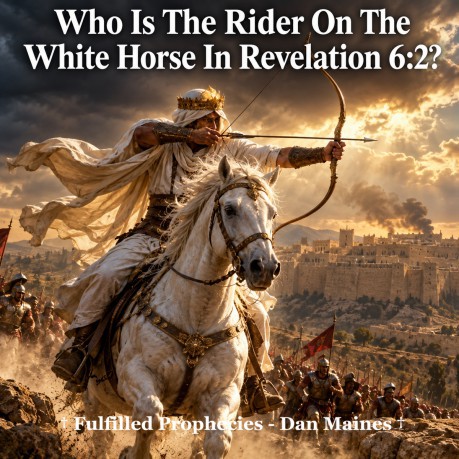
Who Is The Rider On The White
Horse In Revelation 6:2? Introduction † The rider on the white horse in Revelation
6:2 has been debated for centuries. Some believe the rider represents
Jesus Christ, while others identify him as a conquering power, a
false messiah, or the beginning of military judgment. The First Seal And The White Horse Revelation 6:1-2 The Four Horsemen Must Be Studied Together Revelation 6:3-4 Revelation 6:5-6 Revelation 6:7-8 The Old Testament Explains The Horsemen Zechariah 6:1-5 God's Four Severe Judgments Ezekiel 14:21 Is The Rider Jesus Christ? Revelation 19:11-16 The Bow And The Crown Habakkuk 3:8-9 Jesus Predicted The Same Events Matthew 24:6-8, 34 Jerusalem Was The Focus Of The Judgment Luke 21:20-22, 32 Revelation's Own Time Statements Revelation 1:1, 3 Revelation 22:6, 10 Historical References † Flavius Josephus, a first-century Jewish
historian, described the Jewish revolt, Roman military campaigns,
internal violence, famine, and Jerusalem's destruction in Jewish War,
Books 2-7. How It Applies To Us Today † Understanding the first rider reminds us that
Jesus Christ has authority over kingdoms, rulers, and historical
events. Nothing takes place outside His sovereign authority (Matthew
28:18; Colossians 1:16-17). Q & A Appendix Q: Is the white horse rider in Revelation 6:2
Jesus Christ? Q: Why is the horse white if the rider represents
conquest? Q: What does the bow represent? Q: What does the crown represent? Q: Why isn't the first rider necessarily the same
as the rider in Revelation 19? Q: Did the first rider represent the Roman
army? Q: When were the four horsemen fulfilled? Q: Are the four horsemen still riding today? Q: What is the most important lesson from the
first seal? † This is the fulfilled perspective we proclaim at
Fulfilled Prophecies † Source Index
By Dan Maines
†
But we can't identify this rider simply because his horse is white.
We must examine the bow, the crown, the conquest, the other three
horsemen, and the historical setting of Revelation.
†
The central question isn't whether Jesus is victorious. Scripture
clearly establishes that He is. The question is whether the first
rider represents Christ Himself or a conquering power operating under
God's authority.
† From the fulfilled
perspective, the four horsemen describe judgments associated with the
final days of Old Covenant Israel, culminating in Jerusalem's
destruction in AD 70 (Matthew 24:6-8; Luke 21:20-22).
†
Let's examine the evidence and allow Scripture to explain its own
symbols.
Then I saw when the Lamb
broke one of the seven seals, and I heard one of the four living
creatures saying as with a voice of thunder, Come. I looked, and
behold, a white horse, and he who sat on it had a bow; and a crown
was given to him, and he went out conquering and to conquer.
†
Notice that Jesus, represented by the Lamb, opens the seal before the
rider appears. The rider is part of the vision released by the Lamb's
authority (Revelation 5:5-9).
† The rider
carries a bow, receives a crown, and goes out conquering. These are
symbols of military victory and authority, but the passage never
directly identifies him as Jesus (Daniel 7:6; Zechariah 6:1-5).
†
The crown was given to him. His authority is received, not described
as inherently his. This fits the pattern of earthly rulers receiving
temporary authority under God's sovereign judgment (Daniel 4:17; John
19:11).
† The white horse can symbolize
victory, but a shared symbol doesn't prove that two riders are the
same person. Their descriptions and surrounding events must determine
their identities (Revelation 19:11-16).
† The
most convincing interpretation is that this rider represents military
conquest, the first in a connected series of judgments leading toward
Jerusalem's destruction (Matthew 24:6-8; Luke 21:20-22).
When He broke the second
seal, I heard the second living creature saying, Come. And another, a
red horse, went out; and to him who sat on it, it was granted to take
peace from the earth, and that men would slay one another; and a
great sword was given to him.
† The second
horse represents warfare, bloodshed, and the removal of peace. It
follows the first rider's conquest, showing the destructive
consequences of military conflict (Matthew 24:6-7).
†
The first two horses aren't presented as unrelated events. They
belong to one prophetic sequence released as the Lamb opens the seals
(Revelation 5:5; Zechariah 6:1-5).
† Jesus
warned His disciples about wars, rumors of wars, and nations rising
against nations. These events belonged to the beginning of the birth
pains that would precede Jerusalem's judgment (Matthew 24:6-8, 34).
When He broke the third
seal, I heard the third living creature saying, Come. I looked, and
behold, a black horse; and he who sat on it had a pair of scales in
his hand. And I heard something like a voice in the center of the
four living creatures saying, A quart of wheat for a denarius, and
three quarts of barley for a denarius; and do not damage the oil and
the wine.
† The black horse introduces
scarcity and expensive food. The scales represent carefully measured
provisions during severe economic distress (Leviticus 26:26; Ezekiel
4:16).
† This follows naturally after
conquest and warfare. Armies disrupt agriculture, trade, and food
supplies, producing famine among the population (Matthew 24:7).
†
During Jerusalem's Roman siege, famine became one of the city's
greatest disasters. Josephus described desperate hunger and the
breakdown of normal life within Jerusalem (Josephus, Jewish War, Book
5).
When the Lamb broke the
fourth seal, I heard the voice of the fourth living creature saying,
Come. I looked, and behold, an ashen horse; and he who sat on it had
the name Death; and Hades was following with him. Authority was given
to them over a fourth of the earth, to kill with sword and with
famine and with pestilence and by the wild beasts of the earth.
†
The fourth horse completes the sequence with death through warfare,
famine, disease, and other instruments of judgment (Ezekiel 14:21).
†
Conquest, warfare, famine, and death form a connected pattern. This
strongly supports understanding the first rider as military conquest
rather than separating him from the other three horsemen (Leviticus
26:25-26; Ezekiel 14:21).
† These judgments
fit the conditions surrounding the Jewish revolt and Jerusalem's
destruction in AD 70. The vision concerns a historical covenant
judgment, not an endless series of future world catastrophes (Luke
21:20-22, 32).
Now I lifted up my eyes
again and looked, and behold, four chariots were coming forth from
between the two mountains; and the mountains were bronze mountains.
With the first chariot were red horses, with the second chariot black
horses, with the third chariot white horses, and with the fourth
chariot strong dappled horses. Then I spoke and said to the angel who
was speaking with me, What are these, my lord? The angel replied to
me, These are the four spirits of heaven, going forth after standing
before the Lord of all the earth,
† Zechariah
also describes four groups of colored horses. They operate under
heavenly authority rather than independently determining their own
mission (Zechariah 1:8-11).
† John's vision
uses similar prophetic imagery. The four horsemen represent forces
released within God's judgment, not necessarily four individual human
beings (Ezekiel 14:21).
† The white horses in
Zechariah aren't identified as Jesus. Their color alone doesn't
establish the identity of the white horse rider in Revelation
(Zechariah 1:8-11).
† This Old Testament
background strengthens the interpretation that the first rider
belongs to a unified series of divine judgments (Leviticus 26:14-33;
Deuteronomy 28:49-57).
For thus says the Lord GOD,
How much more when I send My four severe judgments against Jerusalem:
sword, famine, wild beasts and plague to cut off man and beast from
it!
† Ezekiel explicitly identifies four
severe judgments against Jerusalem. These correspond closely to the
sword, famine, wild beasts, and pestilence described under
Revelation's fourth seal (Leviticus 26:22-26).
†
This connection is especially important because Ezekiel's prophecy
concerns Jerusalem. John uses the same covenant judgment language
when describing the destruction associated with the seals
(Deuteronomy 28:49-57).
† The four horsemen
aren't evidence that the physical earth must eventually be destroyed.
They reflect established biblical language for God's judgment upon a
disobedient covenant people (Leviticus 26:14-33).
†
The first rider introduces conquest, and the following riders show
the warfare, famine, and death that accompany judgment (Matthew
24:6-8).
And I saw heaven opened,
and behold, a white horse, and He who sat on it is called Faithful
and True, and in righteousness He judges and wages war. His eyes are
a flame of fire, and on His head are many diadems; and He has a name
written on Him which no one knows except Himself. He is clothed with
a robe dipped in blood, and His name is called The Word of God. And
the armies which are in heaven, clothed in fine linen, white and
clean, were following Him on white horses. From His mouth comes a
sharp sword, so that with it He may strike down the nations, and He
will rule them with a rod of iron; and He treads the wine press of
the fierce wrath of God, the Almighty. And on His robe and on His
thigh He has a name written, KING OF KINGS, AND LORD OF LORDS.
†
Revelation 19 explicitly identifies its rider as Faithful and True,
the Word of God, and King of Kings and Lord of Lords. There is no
question that this rider is Jesus Christ (John 1:1, 14).
†
But Revelation 6 gives no such identification. Its rider carries a
bow and receives a single crown, while the rider in Revelation 19 has
many diadems and a sharp sword proceeding from His mouth (Hebrews
4:12).
† The two riders share a white horse
and the imagery of victory, but their descriptions and roles aren't
identical (Psalm 45:3-5).
† Jesus is the Lamb
opening the seals, while the first rider is one of the figures
appearing when those seals are opened. This distinction favors
identifying the first rider as an instrument of judgment rather than
Christ Himself (Revelation 5:5-9).
† We
shouldn't claim the white horse alone settles the question. The
stronger evidence comes from the four-horse sequence, its Old
Testament background, and its first-century setting (Zechariah 6:1-5;
Ezekiel 14:21).
Did the LORD rage against the
rivers, Or was Your anger against the rivers, Or was Your wrath
against the sea, That You rode on Your horses, On Your chariots of
salvation? Your bow was made bare, The rods of chastisement were
sworn. Selah. You cleaved the earth with rivers.
†
A bow can appear in descriptions of divine warfare and judgment. But
that doesn't mean everyone carrying a bow must be God Himself (Psalm
7:12-13).
† The bow in Revelation 6 is
consistent with military conquest. The rider's crown also represents
victorious authority, but the text doesn't identify a particular
Roman emperor or military commander (Daniel 7:6).
†
Rome's military power provides a historical setting for the symbol,
especially because Roman forces eventually surrounded and destroyed
Jerusalem (Luke 21:20-24).
† The rider can
therefore represent conquest carried out through earthly powers under
God's sovereignty without requiring that the rider be Jesus
personally (Isaiah 10:5-7; Jeremiah 25:8-9).
You will be hearing of
wars and rumors of wars. See that you are not frightened, for those
things must take place, but that is not yet the end. For nation will
rise against nation, and kingdom against kingdom, and in various
places there will be famines and earthquakes. But all these things
are merely the beginning of birth pains. Truly I say to you, this
generation will not pass away until all these things take place.
†
Jesus identified wars, international conflicts, famines, and
disturbances as signs preceding the judgment He was describing (Luke
21:9-11).
† These conditions correspond with
the conquest, warfare, famine, and death pictured by the four
horsemen (Ezekiel 14:21).
† Most importantly,
Jesus placed these events within the lifetime of His own generation.
We can't move their fulfillment thousands of years into the future
without addressing His stated time limitation (Luke 21:32).
†
The first rider belongs to that same first-century prophetic setting.
His conquest begins a sequence of judgments that reached their
historical climax in AD 70 (Luke 21:20-22).
But when you see Jerusalem
surrounded by armies, then recognize that her desolation is near.
Then those who are in Judea must flee to the mountains, and those who
are in the midst of the city must leave, and those who are in the
country must not enter the city; because these are days of vengeance,
so that all things which are written will be fulfilled. Truly I say
to you, this generation will not pass away until all things take
place.
† Jesus identified Jerusalem
surrounded by armies as the visible warning of approaching
destruction. His disciples weren't told to watch for a modern world
empire thousands of years later (Matthew 24:15-16).
†
The Jewish revolt began in AD 66, and Roman forces destroyed
Jerusalem and its temple in AD 70. These historical events provide
the setting for understanding Revelation's judgment imagery (Daniel
9:26; Luke 19:41-44).
† The Roman military
campaign brought conquest, bloodshed, famine, and widespread death,
precisely the kinds of disasters pictured by the four horsemen
(Deuteronomy 28:49-57).
† The fulfillment was
the judgment and removal of the Old Covenant temple system, not the
destruction of the physical planet (Hebrews 8:13; Hebrews
12:26-28).
† The white horse rider represents
the opening movement of conquest within that judgment. Christ
remained sovereign over the events because He was the Lamb who opened
the seals (Matthew 28:18; Colossians 1:16-17).
The Revelation of Jesus
Christ, which God gave Him to show to His bond-servants, the things
which must soon take place; and He sent and communicated it by His
angel to His bond-servant John, Blessed is he who reads and those
who hear the words of the prophecy, and heed the things which are
written in it; for the time is near.
†
Revelation begins by declaring that its events must soon take place
and that the time is near. These statements established an
expectation for John's original first-century readers (James
5:8-9).
† The first seal must be interpreted
within that announced time frame. We shouldn't separate Revelation 6
from the timing established at the beginning of the book (Matthew
24:34).
† From the fulfilled perspective, the
conquest pictured by the first rider belonged to the approaching
judgment upon Old Covenant Jerusalem, not a future tribulation
awaiting the modern world (Luke 21:20-22).
And he said to me, These
words are faithful and true; and the Lord, the God of the spirits of
the prophets, sent His angel to show to His bond-servants the things
which must soon take place. And he said to me, Do not seal up the
words of the prophecy of this book, for the time is near.
†
Revelation closes with the same urgency found in its opening chapter.
The things revealed were soon to take place, and John was
specifically instructed not to seal the prophecy (Daniel 12:4).
†
This strengthens the first-century interpretation of the seals. Their
fulfillment wasn't postponed into an unknown distant generation
(Matthew 24:34; Luke 21:32).
† The
destruction of Jerusalem in AD 70 marked the historical fulfillment
of the covenant judgment described throughout this prophecy (Hebrews
8:13; Hebrews 10:37).
† Josephus described the famine
during Jerusalem's siege in Jewish War, Book 5, and the city's
destruction in Book 6. His account provides historical parallels to
the warfare, scarcity, and death pictured by the seals.
†
Tacitus, the Roman historian, described the Jewish revolt and
Jerusalem's siege in Histories, Book 5. His account independently
confirms the historical conflict, although the surviving text doesn't
provide a complete account of Jerusalem's fall.
†
Eusebius, in Ecclesiastical History, Book 3, Chapter 5, recorded the
tradition that Christians departed Jerusalem and settled in Pella
before its destruction. This is consistent with Jesus' instruction to
flee when the city faced approaching judgment (Luke 21:20-21).
†
These historians don't identify the rider of Revelation 6:2. Their
writings provide historical context for the first-century
interpretation rather than direct proof of the rider's identity.
† We don't need
to live in fear that the four horsemen are waiting to begin a
worldwide tribulation. From the fulfilled perspective, their
prophetic purpose was accomplished in the first-century judgment
(Luke 21:20-22, 32).
† We should distinguish
the historical fulfillment of prophecy from the ordinary wars,
famines, and suffering that still occur in our world. Similar events
today don't automatically become new fulfillments of Revelation
(Ecclesiastes 1:9).
† Jesus' victory wasn't
postponed. He established His kingdom, fulfilled His covenant
promises, and brought His people into the New Covenant relationship
with God (Hebrews 12:22-28).
† Our calling
today is to trust Christ, live faithfully, love one another, and
proclaim the kingdom that has already been established (John
13:34-35; Colossians 1:13).
A: The passage doesn't directly
identify him as Jesus. The four-horse sequence and Old Testament
judgment imagery favor understanding him as military conquest
operating under God's authority (Zechariah 6:1-5; Ezekiel 14:21).
A: White can symbolize victory. The
color alone doesn't establish the rider's moral character or
identity. His role must be understood from the entire vision
(Revelation 6:1-8; Revelation 19:11-16).
A:
The bow fits the imagery of military strength and conquest. Scripture
uses bows in descriptions of warfare and judgment (Habakkuk 3:8-9;
Psalm 7:12-13).
A:
It represents authority and victory granted to the rider. The passage
doesn't identify the individual who receives it (Daniel 4:17; John
19:11).
A: Revelation 19
explicitly names its rider Faithful and True, the Word of God, and
King of Kings. Revelation 6 doesn't give those titles and places its
rider within a sequence of four judgments (Revelation 6:1-8;
Revelation 19:11-16).
A: The rider can reasonably represent
military conquest associated with Rome's campaign against Jerusalem,
but the passage doesn't specifically name Rome or a Roman commander
(Luke 21:20-24).
A:
From the fulfilled perspective, their judgment imagery belongs to the
first-century events culminating in Jerusalem's destruction in AD 70
(Matthew 24:6-8, 34; Luke 21:20-22, 32).
A:
Wars, famines, and death still occur, but that doesn't mean
Revelation's first-century prophecy remains unfulfilled. Its
announced time frame was near to John's original readers (Revelation
1:1-3; Revelation 22:6-10).
A: Jesus Christ controlled the
opening of the seals. The judgments weren't outside His authority,
and His kingdom remains established today (Matthew 28:18; Hebrews
12:28).
© Fulfilled Prophecies - Dan
Maines.
† Revelation
6:1-2; Revelation 6:3-4; Revelation 6:5-6; Revelation 6:7-8;
Zechariah 6:1-5; Ezekiel 14:21; Revelation 19:11-16; Habakkuk 3:8-9;
Matthew 24:6-8, 34; Luke 21:20-22, 32; Revelation 1:1, 3; Revelation
22:6, 10
† Flavius Josephus, Jewish War,
Books 2-7; Tacitus, Histories, Book 5; Eusebius, Ecclesiastical
History, Book 3, Chapter 5
Links