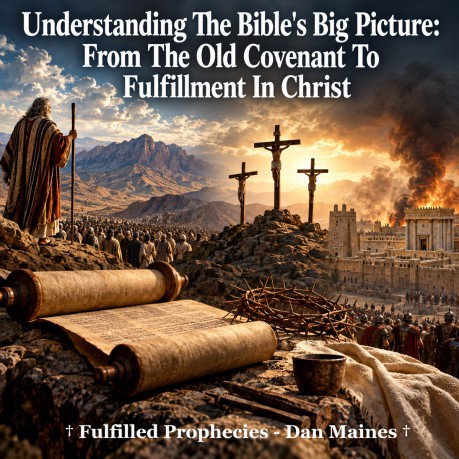
Understanding The Bible's Big
Picture: From The Old Covenant To Fulfillment In Christ Introduction The Beginning: Sin, Separation, And God's Promise Genesis 3:15 God's Promise To Abraham: Blessing For All Nations Genesis 12:3 The Old Covenant: God's Agreement With Israel Exodus 19:5-6 The Prophets: Israel's Failure And God's Promise Jeremiah 31:31 Jesus Christ: The Fulfillment Of The Law And Prophets Matthew 5:17 The Last Days: Whose Last Days Were They? Hebrews 1:1-2 Jesus' Prophecy: Jerusalem And That Generation Matthew 24:34 The Destruction Of Jerusalem: The End Of An Age Luke 21:20 The New Covenant: What Replaced The Old Covenant? Hebrews 8:13 The Kingdom Of God: Are We Still Waiting? Colossians 1:13 The New Jerusalem: Where Do Believers Belong? Hebrews 12:22-23 The Book Of Revelation: Fulfillment, Not Endless Delay Revelation 1:1 Historical References How It Applies To Us Today Q & A Appendix Q: What is the main difference between the Old
Covenant and the New Covenant? Q: Does fulfilled prophecy mean everything in the
Bible has ended? Q: Why is AD 70 important? Q: Are Christians supposed to follow the Law of
Moses today? Q: Is Jesus coming back to establish an earthly
kingdom? Q: What happened to the promises made to
Abraham? Q: Are we living in the New Jerusalem today? Q: What should someone new to the fulfilled
perspective study first? † This is the fulfilled perspective we proclaim at
Fulfilled Prophecies † Source Index
By Dan Maines
† Many
Christians have read portions of the Bible but have never been shown
how the entire biblical story fits together. They know about Adam,
Abraham, Moses, David, Jesus, and Revelation, but they don't always
understand how these people and events are connected.
†
The Bible isn't a collection of unrelated stories. It's the unfolding
account of God's plan of redemption, beginning with the fall of
mankind, continuing through His covenant promises to Israel, and
reaching fulfillment in Jesus Christ (Luke 24:27; Ephesians
1:9-10).
† To understand the fulfilled
perspective, we must first understand the Old Covenant, why God
established it, whom it was given to, and why Jesus came to fulfill
it (Exodus 19:5-6; Hebrews 8:6-13).
† The
central question isn't what God might do thousands of years from now.
It's what God promised, when He promised to accomplish it, and
whether Jesus and His apostles told the truth about the time of
fulfillment (Matthew 24:34; Revelation 1:1-3).
†
This study presents the big picture in simple language so that even
someone unfamiliar with Scripture can understand the difference
between the Old Covenant and the New Covenant.
And I will put enmity Between
you and the woman, And between your seed and her seed; He shall
bruise you on the head, And you shall bruise him on the heel.
†
The biblical story begins with creation, mankind's disobedience, and
the consequences of sin. Adam and Eve lost their place in Eden, but
God didn't abandon His purpose for mankind (Genesis 3:6-24).
†
God's promise concerning the woman's offspring points forward to
Jesus Christ, who came to defeat the power of sin and death (Hebrews
2:14-15; 1 John 3:8).
† From Genesis forward,
Scripture develops the story of redemption. The answer to mankind's
separation from God would come through Christ, not through an earthly
government or a rebuilt temple (Romans 5:18-19; Ephesians 2:13-18).
And I will bless those who
bless you, And the one who curses you I will curse. And in you all
the families of the earth will be blessed.
†
God called Abraham and promised that through him all the families of
the earth would be blessed. This promise was greater than one nation
or one geographical territory (Galatians 3:8).
†
Abraham's descendants became the nation of Israel, but the ultimate
fulfillment of God's promise was Jesus Christ, the promised offspring
through whom the nations receive blessing (Galatians 3:16).
†
This is important because the Bible's destination isn't the permanent
separation of Jews and Gentiles. God's purpose was to bring believers
from all nations together in Christ (Ephesians 2:14-16; Galatians
3:26-29).
'Now then, if you will indeed
obey My voice and keep My covenant, then you shall be My own
possession among all the peoples, for all the earth is Mine; and you
shall be to Me a kingdom of priests and a holy nation.'
†
After bringing Israel out of Egypt, God established a covenant with
them at Mount Sinai. A covenant is a binding agreement that
establishes a relationship with promises and responsibilities (Exodus
24:3-8).
† The Old Covenant included the Law
of Moses, the priesthood, animal sacrifices, the tabernacle, and
later the temple in Jerusalem (Leviticus 16:1-34; Hebrews 9:1-10).
†
These institutions belonged to Israel's covenant relationship with
God. They weren't originally given to every nation on earth as a
permanent religious system (Deuteronomy 5:2-3; Psalm 147:19-20).
†
The Law revealed sin and demonstrated mankind's need for redemption,
but animal sacrifices couldn't permanently remove sin or provide the
completed salvation that Christ would accomplish (Romans 3:20;
Hebrews 10:1-4).
† Understanding this
distinction is essential. The Old Covenant was real, holy, and
purposeful, but it was never intended to replace the greater covenant
that God would establish through His Son (Galatians 3:19-25; Hebrews
8:6-7).
"Behold, days are
coming," declares the LORD, when I will make a new covenant with
the house of Israel and with the house of Judah,
†
Israel repeatedly broke God's covenant. The prophets warned of
judgment, called the people to repentance, and announced that God
would establish a New Covenant (Jeremiah 11:10; Ezekiel 36:25-27).
†
Jeremiah didn't announce that God would repair the Old Covenant and
continue it forever. He announced a new one, showing that the Mosaic
covenant wasn't God's final arrangement (Jeremiah 31:32-34).
†
The prophets also promised a coming Messiah, a righteous King, and a
kingdom that would endure. These promises directed Israel's hope
toward Jesus Christ (Isaiah 9:6-7; Daniel 7:13-14).
†
The prophets must be read within Israel's covenant history. Their
warnings about judgment and restoration weren't disconnected
predictions about modern political events (Deuteronomy 28:15-68;
Daniel 9:24-27).
† God's plan was moving
toward a new relationship with His people, established through Christ
rather than through the continuing sacrifices of the temple (Hebrews
9:11-15).
Do not think that I came to
abolish the Law or the Prophets; I did not come to abolish but to
fulfill.
† Jesus didn't come to begin an
unrelated religion. He came as Israel's promised Messiah to
accomplish what the Law and Prophets had anticipated (Luke 24:44).
†
His birth, ministry, death, and resurrection fulfilled the promises
concerning the Messiah and established the foundation of the New
Covenant (Acts 13:32-33; Hebrews 9:15).
†
Jesus was the true sacrifice for sin, the greater High Priest, and
the mediator of the better covenant. What the Old Covenant pictured
through ceremonies and sacrifices became reality in Him (Hebrews
7:23-28; Hebrews 10:11-14).
† His sacrifice
was completed at the cross. The removal of the Old Covenant temple
system in AD 70 didn't add anything to His sacrifice, but publicly
demonstrated that the former covenant order had reached its end
(Colossians 2:14; Hebrews 10:18).
† The
fulfilled perspective recognizes Jesus as the fulfillment of Israel's
promises, not as someone who postponed those promises for another
generation thousands of years later (2 Corinthians 1:20; Luke 21:22).
God, after He spoke long ago
to the fathers in the prophets in many portions and in many ways,
in
these last days has spoken to us in His Son, whom He appointed heir
of all things, through whom also He made the world.
†
Many Christians have been taught that the last days refer exclusively
to events in our modern world. But the writer of Hebrews said that he
and his original readers were already living in the last days (Acts
2:16-17).
† The New Testament identifies the
first-century period as the closing age of the Old Covenant. Jesus
appeared at the consummation of the ages to accomplish redemption
(Hebrews 9:26).
† Peter applied Joel's
prophecy concerning the last days to the events taking place at
Pentecost, not to a generation thousands of years later (Acts
2:14-21).
† The apostles were living during
the transition from the Old Covenant order to the fully established
New Covenant order. Their time statements must be understood in that
historical setting (1 Corinthians 10:11; Hebrews 8:13).
†
When we read the words last days, we must ask whose age was ending.
The fulfilled perspective understands these passages as referring to
the final days of Israel's Old Covenant age, not the destruction of
planet Earth (Matthew 24:3; Hebrews 8:13).
Truly I say to you, this
generation will not pass away until all these things take place.
†
Jesus warned His disciples that Jerusalem and its temple would face
judgment. His prophecy began with the announcement that the
magnificent temple buildings would be destroyed (Matthew 24:1-2).
†
When the disciples asked when these things would happen, Jesus
described events leading to that judgment and identified the
generation in which they would occur (Matthew 24:3; Luke 21:32).
†
The words this generation referred to the people living when Jesus
spoke. He didn't tell His disciples to expect these events thousands
of years after their deaths (Matthew 23:36; Matthew 24:34).
†
The destruction of Jerusalem in AD 70 was the historical judgment
that ended the temple-centered Old Covenant system. The fulfilled
perspective understands Jesus' coming in judgment as a covenantal
coming, consistent with Old Testament descriptions of divine judgment
(Isaiah 19:1; Matthew 26:64).
† This doesn't
mean Jesus physically returned to stand on the earth. Biblical
cloud-coming language describes divine authority, presence, and
judgment (Daniel 7:13-14; Matthew 24:30).
But when you see Jerusalem
surrounded by armies, then recognize that her desolation is near.
†
Jesus gave His disciples a recognizable warning. When they saw
Jerusalem surrounded by armies, they were to understand that its
destruction was approaching (Luke 21:21-22).
†
In AD 70, Roman armies under Titus destroyed Jerusalem and its
temple. The sacrificial system associated with that temple came to an
end, just as Jesus had warned concerning its destruction (Matthew
24:1-2).
† Jesus described those events as
days of vengeance in which what had been written would be fulfilled.
This connects the judgment directly to Israel's covenant history
(Luke 21:22).
† The destruction wasn't the
end of the physical universe. It was the end of the Old Covenant
religious order centered on Jerusalem, its temple, and its priesthood
(Hebrews 8:13; Hebrews 10:9).
† The physical
earth continued, the nations continued, and God's kingdom continued.
What ended was the former covenant arrangement that had pointed
forward to Christ (Daniel 7:14; Hebrews 12:28).
When He said, "A new
covenant," He has made the first obsolete. But whatever is
becoming obsolete and growing old is ready to disappear.
†
The writer of Hebrews clearly identified the first covenant as
obsolete. The New Covenant wasn't an addition to the Mosaic system,
but a better covenant established through Jesus Christ (Hebrews
8:6).
† The Old Covenant had an earthly
priesthood, repeated sacrifices, and an earthly sanctuary. The New
Covenant has Jesus as the permanent High Priest and His completed
sacrifice as the basis of redemption (Hebrews 7:24-27; Hebrews
9:11-12).
† Under the New Covenant, God's
people aren't defined by physical descent from Abraham, circumcision,
or membership in national Israel. They belong to Christ through faith
(Galatians 3:26-29; Romans 2:28-29).
† The
tearing of the temple veil at Jesus' death revealed the significance
of His sacrifice, while the destruction of the temple in AD 70 marked
the historical disappearance of the former system (Matthew 27:50-51;
Hebrews 10:19-22).
† We don't need another
temple, another animal sacrifice, or another Levitical priesthood.
Jesus accomplished what those earlier institutions could only
anticipate (Hebrews 10:10-18).
For He rescued us from the
domain of darkness, and transferred us to the kingdom of His beloved
Son,
† Paul didn't tell believers that they
would someday be transferred into Christ's kingdom. He said they had
already been transferred into it (Colossians 1:12-14).
†
Jesus announced that the kingdom of God had come near, and His
ministry demonstrated its arrival. His resurrection and exaltation
confirmed His authority as the reigning Messiah (Mark 1:15; Acts
2:32-36).
† The kingdom isn't dependent on a
future political government in Jerusalem. Jesus declared that His
kingdom wasn't of this world, and His reign is everlasting (John
18:36; Daniel 7:14).
† The New Covenant
kingdom includes believers from every nation. Our citizenship and
access to God are found in Christ rather than through an earthly
temple or national boundary (Philippians 3:20; Ephesians 2:18-19).
†
We aren't waiting for Jesus to begin reigning. We're called to live
faithfully under His present authority (1 Corinthians 15:25; Hebrews
12:28).
But you have come to Mount
Zion and to the city of the living God, the heavenly Jerusalem, and
to myriads of angels,
to the general assembly and church of the
firstborn who are enrolled in heaven, and to God, the Judge of all,
and to the spirits of the righteous made perfect,
†
Notice that the writer didn't say believers would someday come to the
heavenly Jerusalem. He said they had come to it (Galatians 4:26).
†
The New Jerusalem represents God's New Covenant dwelling with His
redeemed people. It's contrasted with the earthly Jerusalem
associated with the former covenant (Galatians 4:24-26; Revelation
21:2-3).
† The New Covenant provides direct
access to the Father through Jesus Christ. Believers don't need to
travel to an earthly city to enter God's presence (Ephesians
2:18-22).
† The new heavens and new earth are
understood in the fulfilled perspective as the new covenantal order
established in Christ, not the physical destruction and replacement
of the planet (Isaiah 65:17; Revelation 21:1-5).
†
God's people now live under the completed work of Christ, with the
privilege of approaching Him through faith (Hebrews 4:14-16; Hebrews
10:19-22).
The Revelation of Jesus
Christ, which God gave Him to show to His bond-servants, the things
which must soon take place; and He sent and communicated it by His
angel to His bond-servant John,
† Revelation
begins by identifying its events as things that must soon take place.
Its opening also declares that the time is near (Revelation 1:3).
†
The book uses symbolic language drawn from the Old Testament
prophets. Its beasts, judgments, Babylon, and heavenly imagery must
be understood through Scripture rather than modern newspaper
headlines (Daniel 7:1-14; Ezekiel 16:1-63).
†
The fulfilled perspective understands Revelation as addressing the
first-century covenant crisis and the judgment that culminated in AD
70. This interpretation places its composition before Jerusalem's
destruction (Revelation 11:1-2; Revelation 22:10).
†
Revelation concludes by again declaring that its events were near. We
shouldn't remove those time statements or redefine them to mean
thousands of years (Revelation 22:6-10).
†
The central message is the victory of Jesus Christ, the judgment of
the old covenantal order, and the enduring reality of God's kingdom
(Revelation 11:15; Revelation 21:1-4).
†
Flavius Josephus, a first-century Jewish historian, described the
Roman siege of Jerusalem, the destruction of the temple, the
suffering of its inhabitants, and the collapse of the city in The
Jewish War, Books 5-7.
† Tacitus, the Roman
historian, also recorded the siege of Jerusalem during the reign of
Vespasian and the involvement of Titus in Histories, Book 5. His
surviving account is incomplete, but it provides independent Roman
historical context.
† Eusebius, writing in
the fourth century, preserved traditions concerning Christians
leaving Jerusalem and settling in Pella before the city's destruction
in Ecclesiastical History, Book 3, Chapter 5.
†
These historical writers help establish the setting and reality of
Jerusalem's destruction. They don't establish every detail of the
fulfilled perspective, which must be examined through Scripture.
†
We don't have to live in fear that every war, earthquake, or
political event signals the approaching end of the world. Jesus gave
His first-century disciples specific warnings concerning the judgment
of their generation (Matthew 24:34; Luke 21:20-22).
†
We don't need to return to the Law of Moses, rebuild a temple, or
restore animal sacrifices. Jesus is our High Priest, and His
sacrifice is sufficient (Hebrews 7:25-27; Hebrews 10:12-18).
†
We can understand the Bible more clearly when we recognize who was
speaking, who was being addressed, which covenant was in effect, and
when the promised events were expected to happen (1 Corinthians
10:11; Hebrews 1:1-2).
† We aren't waiting to
become citizens of Christ's kingdom. Through faith in Him, believers
already belong to His kingdom and have access to the Father
(Colossians 1:13; Ephesians 2:18-19).
†
Fulfilled prophecy doesn't mean that our relationship with Jesus is
finished. It means His promises are trustworthy, His sacrifice is
complete, and His kingdom remains forever (Hebrews 13:8; Hebrews
12:28).
† Our responsibility today is to love
God, love one another, grow in understanding, and share the good news
of Jesus Christ (Matthew 22:37-40; Colossians 3:12-17).
†
The entire biblical story points us to Christ. From God's promise in
Eden to the New Jerusalem, the message is redemption, reconciliation,
and life through Him (Luke 24:44; 2 Corinthians 5:18-19).
A: The Old
Covenant was established with Israel through Moses and included the
Law, priesthood, and sacrifices. The New Covenant was established
through Jesus Christ and His completed sacrifice (Exodus 19:5-6;
Hebrews 8:6-13).
A: No. It means God's
prophetic promises concerning the completion of the Old Covenant age
were fulfilled. Christ's kingdom, His salvation, and our relationship
with Him continue (Daniel 7:14; Hebrews 12:28).
A:
AD 70 marks the Roman destruction of Jerusalem and the temple,
fulfilling Jesus' warning concerning that generation and marking the
historical end of the temple-centered covenant order (Matthew 24:1-2,
34; Luke 21:20-22).
A: Christians live under the New
Covenant through Christ, not under the Mosaic covenant. We're called
to live by faith and love through the Spirit (Romans 7:4-6; Galatians
5:13-18).
A: The fulfilled perspective
understands His promised coming in judgment as fulfilled in the first
century. Scripture teaches that Christ already reigns and that His
kingdom will never end (Matthew 24:34; Acts 2:32-36; Daniel 7:14).
A: Those promises reached their
fulfillment in Jesus Christ. Everyone who belongs to Christ is
Abraham's offspring and an heir according to the promise (Galatians
3:16, 26-29).
A:
Believers have come to the heavenly Jerusalem through Christ. It
isn't an earthly city awaiting construction, but the heavenly city
associated with God's redeemed people (Hebrews 12:22-23; Galatians
4:26).
A: Begin with Genesis
12, Exodus 19, Jeremiah 31, Matthew 24, Luke 21, Acts 2, Galatians 3,
and Hebrews 8-12. These passages explain the covenant promises, the
Messiah, the first-century judgment, and the New Covenant.
© Fulfilled Prophecies - Dan
Maines.
† Genesis
3:15; Genesis 12:3; Exodus 19:5-6; Jeremiah 31:31; Matthew 5:17;
Matthew 24:34; Luke 21:20; Hebrews 1:1-2; Hebrews 8:13; Hebrews
12:22-23; Colossians 1:13; Revelation 1:1.
†
Flavius Josephus, The Jewish War, Books 5-7; Tacitus, Histories, Book
5; Eusebius, Ecclesiastical History, Book 3, Chapter 5.
Links