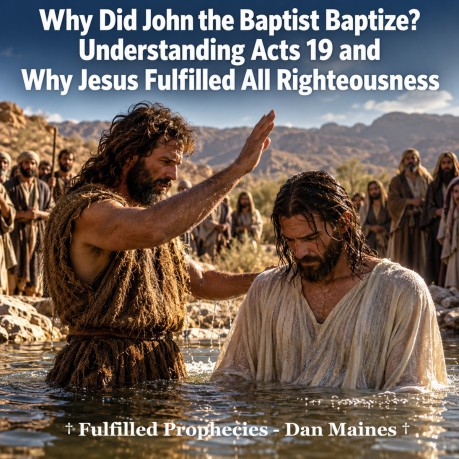
Why Did John the Baptist
Baptize? Understanding Acts 19 and Why Jesus Fulfilled All
Righteousness Introduction John Was Sent To Prepare Israel For Christ Matthew 3:1-3 John's Baptism Was A Baptism Of Repentance Mark 1:4-5 John's Baptism Was Different From Christ's Baptism Matthew 3:11-12 Why Did Jesus Need To Be Baptized? Matthew 3:13-15 The Father Confirmed Jesus As His Son Matthew 3:16-17 Jesus Came To Fulfill The Law And The Prophets Matthew 5:17-18 John Himself Pointed Beyond His Own Ministry John 3:28-30 Acts 19 Explains The Difference Between The Two Baptisms Acts 19:1-5 Why Did The Holy Spirit Come Upon Them? Acts 19:6-7 Apollos Also Needed A Clearer Understanding Acts 18:24-26 Christ's Completed Work Is Greater Than John's Preparation Hebrews 10:12-14 Historical References How It Applies To Us Today Q & A Appendix † This is the fulfilled perspective we proclaim at
Fulfilled Prophecies † Source Index
By Dan Maines
† Why did
John the Baptist baptize people before Jesus began His ministry? Why
did Jesus Himself submit to baptism when He had no sin? And why did
Paul baptize twelve men in Acts 19 who had already received John's
baptism?
† These questions are important
because many Christians read these passages without considering when
they happened, who was being addressed, and what God was
accomplishing through Jesus Christ.
† John's
baptism wasn't an independent religious ceremony intended to continue
forever. It was a God-given ministry of repentance that prepared
Israel for the arrival of her promised Messiah (Luke 3:3-6; Acts
13:24-25).
† Jesus didn't receive John's
baptism because He needed forgiveness. He received it because He was
obedient to His Father and was fulfilling everything required of Him
as Israel's promised Messiah (Matthew 5:17; Hebrews 4:15).
†
Acts 19 reveals the difference between preparing for the Messiah and
believing in the Messiah who had already come. Understanding that
difference helps explain the transition from the Old Covenant to the
New Covenant (Hebrews 8:6-13).
Now in those days John the
Baptist came, preaching in the wilderness of Judea, saying, "Repent,
for the kingdom of heaven is at hand." For this is the one
referred to by Isaiah the prophet when he said, "THE VOICE OF
ONE CRYING IN THE WILDERNESS, 'MAKE READY THE WAY OF THE LORD, MAKE
HIS PATHS STRAIGHT!'"
† John wasn't
preaching about a kingdom thousands of years in the future. He
announced that the kingdom of heaven was at hand because the promised
Messiah was about to appear (Mark 1:14-15).
†
John's ministry fulfilled Isaiah's prophecy concerning the messenger
who would prepare the way of the Lord. His responsibility was to call
Israel to repentance and direct the people toward Christ (Isaiah
40:3; John 1:23).
† The people of Israel had
been living under the Law of Moses, but the promised New Covenant was
approaching. John stood at the beginning of that great covenant
transition (Luke 16:16; Hebrews 8:13).
† His
baptism wasn't the fulfillment itself. It prepared the people to
recognize and receive the One who would accomplish that fulfillment
(Acts 13:24-25).
John the Baptist appeared in the
wilderness preaching a baptism of repentance for the forgiveness of
sins. And all the country of Judea was going out to him, and all the
people of Jerusalem; and they were being baptized by him in the
Jordan River, confessing their sins.
† John's
baptism called Israel to acknowledge her sins and prepare for the
coming Messiah. Repentance was essential because the people needed to
turn from disobedience and recognize God's promised salvation (Luke
3:7-14).
† John's baptism involved water,
confession, and repentance, but John never claimed that his baptism
was the completed work of redemption. He continually directed
attention away from himself and toward Jesus (John 1:26-29).
†
This was a first-century ministry directed to Israel while the Old
Covenant remained in effect. It announced the approaching fulfillment
of God's promises rather than establishing another permanent covenant
system (Acts 13:24; Galatians 4:4-5).
†
John's message also contained a warning. Judgment was approaching the
unrepentant nation, and merely being descended from Abraham wouldn't
protect anyone from that judgment (Matthew 3:7-10).
"As for me, I baptize
you with water for repentance, but He who is coming after me is
mightier than I, and I am not fit to remove His sandals; He will
baptize you with the Holy Spirit and fire. His winnowing fork is in
His hand, and He will thoroughly clear His threshing floor; and He
will gather His wheat into the barn, but He will burn up the chaff
with unquenchable fire."
† John clearly
distinguished his ministry from the ministry of Jesus. John baptized
with water, but Jesus would baptize with the Holy Spirit and fire
(Acts 1:5).
† The Holy Spirit was promised to
Christ's disciples, while the imagery of fire also warned of
judgment. The wheat and chaff represented separation between those
who responded to God and those who rejected Him (Matthew 13:30,
40-43).
† This judgment belonged to the
approaching covenant crisis facing first-century Israel. Jesus later
identified Jerusalem as the city upon which the accumulated judgment
for the blood of the righteous would come (Matthew 23:35-38).
†
John's baptism prepared the people for these approaching realities.
Jesus was the One who would accomplish salvation, establish the New
Covenant, and execute the judgment He had announced (Luke 22:20;
Matthew 24:34).
Then Jesus arrived from
Galilee at the Jordan coming to John, to be baptized by him. But John
tried to prevent Him, saying, "I have need to be baptized by
You, and do You come to me?" But Jesus answering said to him,
"Permit it at this time; for in this way it is fitting for us to
fulfill all righteousness." Then he permitted Him.
†
John understood that Jesus was greater than he was. That's why John
questioned the baptism. Jesus didn't need to repent of sin because He
was without sin (Hebrews 4:15; 1 Peter 2:22).
†
Jesus answered by explaining that His baptism was necessary to
fulfill all righteousness. He wasn't confessing personal wrongdoing.
He was submitting Himself to the Father's purpose and carrying out
everything required in His mission (John 4:34; John 6:38).
†
The words "Permit it at this time" are important. Jesus was
speaking about something appropriate for that particular moment in
God's redemptive plan. His baptism marked His identification with the
people He came to redeem (Galatians 4:4-5; Hebrews 2:17).
†
Jesus entered the waters where repentant Israelites were being
baptized, not because He shared their guilt, but because He came to
fulfill the righteous requirements they couldn't accomplish for
themselves (Romans 8:3-4; 2 Corinthians 5:21).
†
Fulfilling all righteousness included perfect obedience to the
Father's will. His baptism was one act of that obedience, but His
entire ministry, death, and resurrection accomplished the greater
work of redemption (Philippians 2:8; Romans 5:18-19).
†
Jesus didn't say everyone throughout history must receive John's
baptism. He explained why John should baptize Him at that particular
time, as part of His unique mission as the Messiah (Matthew 5:17;
John 19:30).
After being baptized, Jesus
came up immediately from the water; and behold, the heavens were
opened, and he saw the Spirit of God descending as a dove and
lighting on Him, and behold, a voice out of the heavens said, "This
is My beloved Son, in whom I am well-pleased."
†
Jesus' baptism was accompanied by a divine declaration. The Father
identified Jesus as His beloved Son, and the Spirit descended upon
Him (John 1:32-34).
† This wasn't a
declaration that Jesus had just become righteous. He was already
righteous. The event publicly confirmed His identity and mission as
the promised Messiah (John 1:29-34; Hebrews 7:26).
†
The Father, Son, and Holy Spirit are distinguished in this account.
Jesus stood in the water, the Spirit descended, and the Father spoke
from heaven (John 14:16-17).
† The baptism
therefore served a purpose far greater than an ordinary washing. It
revealed the Messiah who had come to accomplish God's promised
salvation (Luke 4:18-21).
"Do not think that I
came to abolish the Law or the Prophets; I did not come to abolish
but to fulfill. For truly I say to you, until heaven and earth pass
away, not the smallest letter or stroke shall pass from the Law until
all is accomplished."
† Jesus didn't
come to leave the Law and the Prophets partially fulfilled. He came
to accomplish what they anticipated (Luke 24:44).
†
His baptism belonged to that mission of obedience and fulfillment. It
wasn't an isolated religious act disconnected from the promises made
to Israel (Galatians 4:4-5).
† The Old
Covenant was still operating during Jesus' earthly ministry. His
death established the New Covenant, and the first-century transition
reached its covenantal conclusion with the removal of Jerusalem's
temple system in AD 70 (Hebrews 9:15; Hebrews 8:13; Matthew
24:1-3).
† Jesus fulfilled righteousness
through His complete obedience, not merely through entering the
Jordan River. His work provided what the Law couldn't accomplish
through sinful humanity (Romans 8:3-4; Romans 10:4).
†
The fulfilled perspective recognizes that Christ accomplished His
covenant mission. We aren't waiting for Him to return to finish the
righteousness He came to establish (Hebrews 10:12-14).
"You yourselves are my
witnesses that I said, 'I am not the Christ,' but, 'I have been sent
ahead of Him.' He who has the bride is the bridegroom; but the friend
of the bridegroom, who stands and hears him, rejoices greatly because
of the bridegroom's voice. So this joy of mine has been made full. He
must increase, but I must decrease."
†
John understood that his ministry wasn't permanent. He was the
messenger preparing the way, not the Messiah who would fulfill the
promises (John 1:19-23).
† His statement that
Christ must increase while he decreased reveals the temporary and
preparatory nature of his work (Acts 13:24-25).
†
The bridegroom had arrived. John rejoiced because the promised Christ
was present, and his responsibility was to direct people to Him (John
1:29).
† Once the Messiah had come and
accomplished redemption, John's preparatory ministry couldn't remain
the center of God's covenant relationship with His people (Hebrews
9:15; Hebrews 10:19-22).
It happened that while Apollos
was at Corinth, Paul passed through the upper country and came to
Ephesus, and found some disciples. He said to them, "Did you
receive the Holy Spirit when you believed?" And they said to
him, "No, we have not even heard whether there is a Holy
Spirit." And he said, "Into what then were you baptized?"
And they said, "Into John's baptism." Paul said, "John
baptized with the baptism of repentance, telling the people to
believe in Him who was coming after him, that is, in Jesus."
When they heard this, they were baptized in the name of the Lord
Jesus.
† This passage answers one of the most
important questions concerning John's baptism. Paul encountered
disciples who knew John's baptism but hadn't received the fuller
message concerning Jesus and the Holy Spirit (Acts 18:24-26).
†
Paul didn't tell them that John's baptism had been sinful or
meaningless. He explained its original purpose. John had baptized
people in repentance while directing them toward the Messiah who was
coming (Acts 13:24-25).
† But Jesus had
already come, died, and risen from the dead. These men needed to
understand that the One John had announced was Jesus Christ (Acts
2:22-24; Acts 13:28-30).
† When they heard
Paul's explanation, they were baptized in the name of the Lord Jesus.
This demonstrates that John's preparatory baptism and baptism
acknowledging the accomplished work of Jesus weren't identical
(Romans 6:3-4).
† Notice that Paul didn't
command them to repeat John's baptism. He directed them to Christ.
Their earlier baptism had pointed forward, while their new confession
recognized the Messiah who had already come (Acts 4:12).
†
Acts 19 describes a particular first-century situation during the
apostolic period. It doesn't establish that every believer must
undergo two separate water baptisms (Ephesians 4:4-6).
†
The essential distinction is between anticipation and fulfillment.
John announced the coming Messiah. Paul proclaimed the Messiah who
had already accomplished redemption (Acts 13:32-39).
And when Paul had laid his hands
upon them, the Holy Spirit came on them, and they began speaking with
tongues and prophesying. There were in all about twelve men.
†
The Holy Spirit came upon these men during the apostolic period, when
God was confirming the message of Jesus Christ through His appointed
witnesses (Hebrews 2:3-4).
† Speaking in
tongues and prophesying were among the spiritual manifestations
recorded during the establishment of the first-century church (1
Corinthians 12:7-11).
† These gifts served
the developing church while God's revelation and covenant purposes
were being brought to completion (1 Corinthians 13:8-12).
†
From the fulfilled perspective, those temporary revelatory gifts
belonged to the foundational apostolic period, not to an endless
continuation of new prophecy after AD 70 (Ephesians 2:20; Jude 3).
†
Acts 19 doesn't teach that every Christian must speak in tongues to
prove salvation. Paul himself explained that not everyone possessed
the same spiritual gifts (1 Corinthians 12:29-30).
Now a Jew named Apollos, an
Alexandrian by birth, an eloquent man, came to Ephesus; and he was
mighty in the Scriptures. This man had been instructed in the way of
the Lord; and being fervent in spirit, he was speaking and teaching
accurately the things concerning Jesus, being acquainted only with
the baptism of John; and he began to speak out boldly in the
synagogue. But when Priscilla and Aquila heard him, they took him
aside and explained to him the way of God more accurately.
†
Apollos knew the Scriptures and taught concerning Jesus, but his
understanding was incomplete because he was acquainted only with
John's baptism (Acts 19:3-4).
† Priscilla and
Aquila didn't reject him. They explained God's way more accurately so
his understanding could grow (Acts 18:27-28).
†
Notice that Scripture doesn't say Apollos was baptized again. We
shouldn't add that claim to the account. The passage emphasizes
instruction and a more complete understanding (2 Timothy 2:15).
†
Both Apollos and the disciples in Acts 19 demonstrate why the
first-century transition must be understood. Some people still knew
the preparatory ministry of John without fully understanding what
Jesus had accomplished (Acts 13:24-30).
but He, having offered one
sacrifice for sins for all time, SAT DOWN AT THE RIGHT HAND OF GOD,
waiting from that time onward UNTIL HIS ENEMIES BE MADE A FOOTSTOOL
FOR HIS FEET. For by one offering He has perfected for all time those
who are sanctified.
† John's baptism called
people to repentance, but Christ accomplished redemption through His
own sacrifice (Hebrews 9:11-14).
† Jesus
didn't merely prepare people for righteousness. Through His obedience
and sacrifice, He established the basis for their acceptance before
God (Romans 5:18-19).
† The New Covenant
rests upon Christ's completed work, not upon a continuing system of
preparatory ceremonies (Hebrews 8:6-13).
†
This is why we must distinguish between what John announced and what
Jesus accomplished. Preparation wasn't the destination. Christ
Himself was the fulfillment (Colossians 2:16-17).
†
Josephus, in Antiquities of the Jews, Book 18, Chapter 5, Section 2,
described John the Baptist as a man who called the Jews to virtue,
righteousness, and baptism. His account independently confirms that
John's ministry was associated with moral repentance and washing.
†
Josephus also recorded that Herod Antipas feared John's influence
over the people and had him executed. This places John's ministry
within the actual political and religious circumstances of
first-century Judea.
† Eusebius, in
Ecclesiastical History, Book 1, Chapter 11, preserved Josephus'
account of John the Baptist and connected his ministry with the
historical setting of Jesus' appearance.
†
These historical writers help establish the first-century setting,
but Scripture provides the explanation of John's prophetic mission,
Jesus' fulfillment of righteousness, and Paul's teaching in Acts 19
(Matthew 3:13-15; Acts 19:1-7).
†
We need to read Scripture according to its original audience and
historical setting. John's baptism was given to prepare Israel for
Christ, not to establish a separate path of salvation that would
continue after the Messiah's arrival (Acts 13:24-25).
†
Jesus' baptism reminds us that He obeyed the Father perfectly. He
didn't need forgiveness, but He willingly fulfilled the mission
entrusted to Him (John 6:38; Hebrews 4:15).
†
Acts 19 teaches us to distinguish between preparing for Christ and
trusting in Christ's accomplished work. Our faith rests in Jesus, not
in remaining within the preparatory ministry of John (Acts 4:12;
Hebrews 10:12-14).
† Water baptism doesn't
replace faith in Christ or become an independent source of
righteousness. Salvation rests upon God's grace through faith, not
human achievement (Ephesians 2:8-9).
† We
also shouldn't use Acts 19 to demand that every Christian experience
tongues or prophecy. Those events occurred within the foundational
apostolic period (Hebrews 2:3-4; Ephesians 2:20).
†
Today, we live in the established New Covenant. We don't need to
return to the Old Covenant or wait for the Messiah John announced.
Jesus has come, accomplished redemption, and reigns as King (Hebrews
12:22-24; Colossians 1:13).
† The message
remains repentance, faith, love, and obedience to Jesus Christ. The
difference is that we now proclaim the completed work of the Messiah
rather than announcing His first coming as something still
approaching (John 3:36; 1 John 2:3-6).
Q: Why
did John the Baptist baptize people?
A: John
preached repentance and prepared Israel for the coming Messiah. His
ministry fulfilled the prophecy concerning the messenger who would
prepare the Lord's way (Matthew 3:1-6; Acts 13:24-25).
Q:
Was John's baptism the same as baptism in Jesus' name?
A:
No. John's baptism anticipated the Messiah. In Acts 19, Paul
explained that the Messiah was Jesus, and the disciples were then
baptized in His name (Acts 19:3-5).
Q: Why was
Jesus baptized if He never sinned?
A: Jesus
wasn't baptized to receive forgiveness. He submitted to baptism in
obedience to the Father's purpose and to fulfill all righteousness
(Matthew 3:13-15; Hebrews 4:15).
Q: What did
Jesus mean by fulfilling all righteousness?
A:
His baptism was one part of His complete obedience to the Father's
will. Jesus came to fulfill the Law and the Prophets and accomplish
redemption through His righteous life and sacrifice (Matthew 5:17;
Romans 5:18-19).
Q: Did Jesus become righteous
when John baptized Him?
A: No. Jesus was
already without sin. His baptism publicly identified Him as the
beloved Son and confirmed His mission (Matthew 3:16-17; Hebrews
7:26).
Q: Why were the twelve men in Acts 19
baptized again?
A: They knew John's baptism but
needed to understand that Jesus was the Messiah John had announced.
After Paul's explanation, they were baptized in Jesus' name (Acts
19:1-7).
Q: Was Apollos also baptized again?
A:
Scripture doesn't say that. It tells us Priscilla and Aquila
explained God's way to him more accurately (Acts 18:24-26).
Q:
Does Acts 19 prove every Christian must speak in tongues?
A:
No. Paul explained that spiritual gifts weren't distributed
identically to every believer (1 Corinthians 12:29-30).
Q:
Does John's baptism still prepare people for a future coming of
Christ?
A: No. John's ministry prepared Israel
for the Messiah's arrival in the first century. Jesus came and
accomplished the redemption John had announced (Acts 13:24-30;
Hebrews 10:12-14).
Q: What should Christians
understand about baptism today?
A: Baptism must
be understood in relation to Jesus Christ and His completed work. Our
salvation depends upon God's grace through faith, and our new life is
found in Christ (Romans 6:3-4; Ephesians 2:8-9).
© Fulfilled Prophecies - Dan
Maines.
† Matthew
3:1-3; Mark 1:4-5; Matthew 3:11-12; Matthew 3:13-15; Matthew 3:16-17;
Matthew 5:17-18; John 3:28-30; Acts 19:1-5; Acts 19:6-7; Acts
18:24-26; Hebrews 10:12-14.
† Flavius
Josephus, Antiquities of the Jews, Book 18, Chapter 5, Section 2;
Eusebius of Caesarea, Ecclesiastical History, Book 1, Chapter 11.
Links