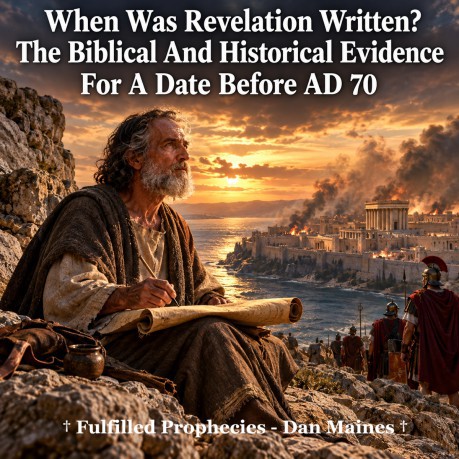
When Was Revelation Written?
The Biblical And Historical Evidence For A Date Before AD 70 Introduction Revelation 1:1 Revelation 1:3 Revelation 1:7 Revelation 2:9 Revelation 3:10 Revelation 11:1-2 Revelation 13:18 Revelation 17:9-10 Revelation 18:24 Matthew 24:34 Revelation 22:6 Revelation 22:10 Revelation 22:20 Historical References Why The Early Date Matters How It Applies To Us Today Q & A Appendix Q: Does the Bible explicitly say Revelation was
written in AD 65? Q: Why do many scholars date Revelation around AD
95-96? Q: Was the temple still standing when John wrote
Revelation? Q: Was Nero the beast whose number was 666? Q: Why does Revelation repeatedly say the time
was near? Q: Does an early date prove every interpretation
of Revelation? Q: What happened to the Old Covenant in AD 70? Q: What should Christians believe about
Revelation today? † This is the fulfilled perspective we proclaim at
Fulfilled Prophecies † Source Index
By Dan Maines
† The date
of the Book of Revelation is one of the most important questions in
understanding biblical prophecy. Was Revelation written before
Jerusalem's destruction in AD 70, or was it written around AD 95-96,
during the reign of Emperor Domitian?
† Many
traditional churches teach the later date and interpret Revelation as
describing events still awaiting fulfillment. But when we examine the
book's own statements, its historical setting, and the words of
Jesus, we find strong evidence supporting an earlier date during the
reign of Emperor Nero, approximately AD 64-68.
†
The question isn't simply when John wrote Revelation. The question is
whether the judgments he described were approaching his original
readers or whether those readers were being told about events
thousands of years beyond their lifetimes (Revelation 1:1-3;
22:6-10).
† Revelation identifies its
original audience as seven churches in Asia. These were real
congregations facing real circumstances in the first century. John
wrote to encourage them, warn them, and reveal what Christ was
bringing to completion (Revelation 1:4, 11; 2:1-3:22).
†
We must also distinguish between biblical evidence and historical
testimony. The Bible doesn't give an exact calendar year for
Revelation's composition. However, its language and historical
circumstances provide substantial evidence for examining the
early-date position.
† Let's examine the
Scriptures first, then consider what the historical writers actually
reported.
The Revelation of Jesus
Christ, which God gave Him to show to His bond-servants, the things
which must soon take place; and He sent and communicated it by His
angel to His bond-servant John,
† Revelation
begins by identifying the events as things that must soon take place.
John wasn't presenting an unrestricted timetable extending thousands
of years into the future (Revelation 1:3; 22:6).
†
The Greek expression translated soon communicates nearness or speed.
Its placement at the beginning of Revelation establishes the urgency
of the prophecy for its original audience (Revelation 22:7, 10).
†
If John wrote before AD 70, this opening statement fits the
approaching destruction of Jerusalem and the completion of the Old
Covenant age (Matthew 24:2, 34; Hebrews 8:13).
†
The early-date understanding takes the original audience seriously.
The seven churches weren't receiving a meaningless warning about
events entirely disconnected from their own generation (Revelation
1:4, 11; 3:10).
Blessed is he who reads and
those who hear the words of the prophecy, and heed the things which
are written in it; for the time is near.
†
John plainly stated that the time was near. This wasn't a statement
made by a modern interpreter. It was part of the original inspired
message (Revelation 22:10).
† The blessing
applied to those who read, heard, and obeyed the prophecy. These were
first-century believers who needed to understand the approaching
circumstances (Revelation 2:10; 3:10).
† The
same language appears near the conclusion of Revelation, forming a
consistent message of nearness from beginning to end (Revelation
22:6-7, 10).
† The early-date interpretation
understands this nearness in its ordinary historical sense,
connecting Revelation's central judgments with the events surrounding
AD 70 (Luke 21:20-22; Matthew 24:34).
BEHOLD, HE IS COMING WITH THE
CLOUDS, and every eye will see Him, even those who pierced Him; and
all the tribes of the earth will mourn over Him. So it is to be.
Amen.
† John identifies those who pierced
Jesus as participants in the judgment being announced. This naturally
directs our attention toward the first-century generation responsible
for His crucifixion (Acts 2:22-23, 36).
†
Jesus used similar language when addressing the high priest and the
Jewish council. He told them they would see the Son of Man sitting at
God's right hand and coming with the clouds of heaven (Matthew
26:63-64).
† Cloud-coming language was
already used by the Old Testament prophets to describe divine
judgment against nations. It didn't require God to appear physically
on the earth (Isaiah 19:1; Daniel 7:13-14).
†
Jesus connected His coming in judgment with the generation then
living. The early-date interpretation places Revelation's
cloud-coming language within that same first-century setting (Matthew
24:30, 34).
'I know your tribulation and
your poverty (but you are rich), and the blasphemy by those who say
they are Jews and are not, but are a synagogue of Satan.
†
The church in Smyrna was experiencing actual persecution. Revelation
addresses identifiable religious opposition, not merely symbolic
opponents in an unknown future century (Acts 13:44-50; 14:19).
†
The conflict between believers in Christ and those rejecting Him was
already taking place throughout the apostolic period (Acts 17:5-8; 1
Thessalonians 2:14-16).
† This historical
setting fits the years before Jerusalem's destruction, when the
separation between the Old Covenant system and the people of the New
Covenant was becoming increasingly evident (Galatians 4:25-31;
Hebrews 8:13).
† This passage alone doesn't
establish Revelation's date, but it contributes to the larger picture
of first-century persecution and covenant conflict (Revelation 3:9;
Matthew 23:34-36).
'Because you have kept the
word of My perseverance, I also will keep you from the hour of
testing, that hour which is about to come upon the whole world, to
test those who dwell on the earth.
† Jesus
addressed the congregation in Philadelphia directly. He promised
protection during an approaching period of testing, giving
encouragement to believers who were already faithfully enduring
persecution (Revelation 3:8-11).
† The
language of an approaching hour fits the warnings Jesus gave His
disciples concerning the tribulation associated with Jerusalem's
destruction (Matthew 24:15-22; Luke 21:20-24).
†
The Greek word translated world can refer to the inhabited world, and
its exact geographical scope must be determined by context. It
doesn't automatically require a modern worldwide event (Luke 2:1;
Acts 11:28).
† An early date allows this
warning to be understood within the lifetime of the original
congregation, rather than moving its primary fulfillment thousands of
years beyond them (Revelation 1:3; 22:10).
Then there was given me a
measuring rod like a staff; and someone said, Get up and measure the
temple of God and the altar, and those who worship in it.
"Leave
out the court which is outside the temple and do not measure it, for
it has been given to the nations; and they will tread under foot the
holy city for forty-two months."
† This
is one of the strongest internal arguments for an early date. John
describes a temple, an altar, worshipers, and a holy city facing
judgment (Luke 21:20-24).
† The Jerusalem
temple was destroyed by the Romans in AD 70. If John was describing
the actual standing temple, Revelation must have been written before
that destruction (Matthew 24:1-2).
† The
forty-two months correspond to the prophetic period of three and
one-half years, closely associated with the time of tribulation and
judgment (Daniel 7:25; Revelation 12:6, 14; 13:5).
†
Jesus had already warned that Jerusalem would be surrounded by armies
and trampled by the Gentiles. John's description closely resembles
that earlier warning (Luke 21:20-24).
†
Later-date interpreters often understand this temple symbolically or
as a future temple. Therefore, this passage is substantial evidence
for the early date, but it isn't an uncontested proof of the writing
date (1 Corinthians 3:16; Ephesians 2:21-22).
†
The early-date interpretation doesn't require another temple to be
constructed thousands of years later. It understands the judgment
within the historical setting of first-century Jerusalem (Matthew
24:2, 34).
Here is wisdom. Let him who
has understanding calculate the number of the beast, for the number
is that of a man; and his number is six hundred and sixty-six.
†
John expected readers with understanding to calculate the number.
This suggests that the identification was meaningful within the
historical circumstances known to his original audience (Revelation
13:17).
† The name Nero Caesar, when
represented by a commonly discussed Hebrew spelling, produces the
numerical value 666. A shorter Latinized form represented in Hebrew
produces 616, a number preserved in some ancient manuscripts.
†
This connection is important because Nero ruled Rome from AD 54 to AD
68, and Christians suffered persecution during his reign (Acts
25:10-12; Revelation 2:10).
† Nero's
persecution following the fire of Rome in AD 64 provides a historical
setting consistent with the suffering described in Revelation
(Revelation 6:9-11; 13:7).
† The numerical
connection supports the early-date interpretation, although
identifying Nero as the beast doesn't independently prove when the
book was written (Revelation 17:10-11).
"Here is the mind
which has wisdom. The seven heads are seven mountains on which the
woman sits,
and they are seven kings; five have fallen, one is,
the other has not yet come; and when he comes, he must remain a
little while."
† Rome was famously
associated with seven hills. This geographical detail provides an
important historical connection between Revelation's imagery and the
Roman Empire (Revelation 13:1; 17:18).
† John
also describes a sequence of rulers, stating that five had fallen,
one was reigning, and another had not yet come (Revelation 17:11).
†
When the emperors are counted beginning with Julius Caesar, the sixth
ruler is Nero. This interpretation places the reigning king during
the period AD 54-68.
† The identification
depends on where the imperial count begins and whether every ruler is
included. Some interpreters begin with Augustus or understand the
kings differently, so the passage requires careful historical
examination.
† Nevertheless, the Nero
identification fits the early-date interpretation and the persecution
experienced by the first-century churches (Revelation 2:10; 13:7).
"And in her was found
the blood of prophets and of saints and of all who have been slain on
the earth."
† Revelation describes
Babylon as guilty of shedding the blood of God's prophets and saints.
This language strongly resembles Jesus' accusation against Jerusalem
(Matthew 23:34-37).
† Jesus declared that
Jerusalem was the city that killed the prophets and stoned those sent
to her. He also announced that the accumulated judgment would come
upon that generation (Matthew 23:35-38).
†
Revelation identifies the great city spiritually with the place where
the Lord was crucified, establishing an important connection with
Jerusalem (Revelation 11:8).
† Rome is
another major historical interpretation of Babylon, particularly
because of the seven mountains and imperial power. But the bloodguilt
language provides strong grounds for examining Jerusalem as the
covenantal object of judgment (Revelation 17:9, 18; Luke 13:33-35).
†
Within the fulfilled perspective, Babylon represents apostate
Jerusalem under judgment, and her fall belongs to the conclusion of
the Old Covenant age in AD 70 (Matthew 23:36; 24:34).
"Truly I say to you, this
generation will not pass away until all these things take place."
†
Jesus gave a definite generational time frame for the events He had
described, including the destruction of the temple and the coming
judgment upon Jerusalem (Matthew 24:1-3, 29-33).
†
His disciples were asking about the temple they could see, not a
building that would be constructed thousands of years later (Mark
13:1-4).
† Luke identifies Jerusalem
surrounded by armies as the sign that its desolation was near,
connecting the prophecy to a recognizable historical event (Luke
21:20-22).
† If Revelation describes the same
covenantal judgment, its repeated statements of nearness agree with
the time frame Jesus had already established (Revelation 1:1, 3;
22:6, 10).
† The destruction of Jerusalem in
AD 70 occurred within the first-century generation Jesus addressed.
This provides the central historical framework for understanding
Revelation from the fulfilled perspective (Luke 21:32; Hebrews 8:13).
And he said to me, "These
words are faithful and true"; and the Lord, the God of the
spirits of the prophets, sent His angel to show to His bond-servants
the things which must soon take place.
† Near
the end of Revelation, John repeats the same time statement found at
the beginning. The prophecy concerns things that must soon take place
(Revelation 1:1).
† This repetition matters
because the opening and conclusion establish the time frame
surrounding the visions throughout the book (Revelation 1:3;
22:10).
† An early date places the prophecy
before the destruction of Jerusalem, allowing its announced judgments
to occur within the approaching first-century crisis (Matthew 24:34;
Luke 21:22).
† The consistency of this
language is one of the strongest reasons for taking the early-date
position seriously (Revelation 22:7, 12, 20).
And he said to me, Do not
seal up the words of the prophecy of this book, for the time is
near.
† John was specifically instructed not
to seal the prophecy because the time was near. This contrasts with
Daniel, who was instructed to seal his vision because its fulfillment
concerned a more distant period (Daniel 8:26; 12:4).
†
The contrast is significant. Daniel's prophecy was sealed because its
fulfillment was distant from his lifetime, while John's prophecy was
left open because its fulfillment was approaching (Daniel 12:9;
Revelation 1:3).
† If Revelation primarily
concerned events thousands of years beyond John's audience, the
command not to seal it would be difficult to reconcile with the
stated reason for leaving it open (Revelation 22:6-7).
†
The fulfilled interpretation recognizes the urgency of this
instruction and places Revelation's central judgments within the
first-century covenant transition (Hebrews 8:13; 10:37).
He who testifies to these
things says, "Yes, I am coming quickly." Amen. Come, Lord
Jesus.
† Jesus concludes Revelation by
affirming the nearness of His coming. This repeats the message of
urgency established throughout the prophecy (Revelation 1:1, 3; 22:7,
12).
† His coming in judgment doesn't require
Him to descend physically onto the earth. Biblical cloud-coming
language describes divine authority, vindication, and judgment
(Daniel 7:13-14; Matthew 26:64).
† Jesus had
already connected His coming with the destruction of Jerusalem within
the generation then living (Matthew 24:30, 34).
†
The early-date interpretation understands this promise as fulfilled
in Christ's covenantal judgment upon Jerusalem in AD 70, rather than
postponing its primary fulfillment into our future (Luke 21:20-22,
32).
†
Josephus, writing in The Jewish War, Books 5-6, documented
Jerusalem's siege, the destruction of the temple, widespread
suffering, and the collapse of the city's religious and political
institutions in AD 70.
† Josephus didn't
write a commentary identifying Revelation's date, but his
eyewitness-era history supplies the background against which an
early-date interpretation can be tested.
†
Tacitus, writing in Annals 15.44, described Nero's persecution of
Christians following the fire of Rome in AD 64. This establishes that
severe persecution occurred during the period proposed by early-date
advocates.
† Irenaeus, writing in Against
Heresies 5.30.3 around AD 180, made a statement commonly translated
as placing the apocalyptic vision near the end of Domitian's reign.
This is a principal historical argument for the later date.
†
Some early-date advocates argue that Irenaeus' wording could refer to
John himself being seen rather than to the vision being seen.
However, the conventional interpretation favors a Domitianic setting,
and the passage must not be presented as unambiguous evidence for an
early date.
† Clement of Alexandria, writing
in Who Is the Rich Man That Shall Be Saved? 42, described John's
return from Patmos after the death of the tyrant. Clement didn't
identify the emperor in that passage, so it cannot independently
establish whether Nero or Domitian was intended.
†
Eusebius, writing in Ecclesiastical History 3.18 and 3.20, associated
John's exile and return with Domitian's reign. His account
demonstrates that the later-date tradition had significant influence
in early church history.
† Epiphanius,
writing in Panarion 51, included chronological statements associating
John's Patmos experience with Claudius. These statements have been
debated because of their historical difficulties and don't securely
establish a pre-AD 70 composition.
† The
Syriac tradition associated with the title of Revelation in certain
manuscripts connects John's exile with Nero. These titles are later
manuscript evidence, not direct first-century testimony, but they
demonstrate that an early-date tradition existed.
†
John A. T. Robinson, in Redating the New Testament, argued for
placing the New Testament writings before AD 70, including
Revelation. His work is an important modern scholarly defense of the
early date.
† Kenneth L. Gentry Jr., in
Before Jerusalem Fell, presented a detailed defense of Revelation's
composition before AD 70, examining internal evidence, historical
testimony, the temple, Nero, and the time statements.
†
R. C. Sproul, in The Last Days According to Jesus, discussed the
importance of Revelation's dating for interpreting fulfilled prophecy
and treated the early-date argument seriously.
†
The historical evidence isn't unanimous. The traditional later date
retains substantial scholarly support, particularly through the
testimony associated with Irenaeus. The early-date case is strongest
when its biblical and historical arguments are considered together.
†
If Revelation was written before AD 70, the standing temple, the
persecution of believers, the Roman imperial setting, and the
approaching judgment upon Jerusalem form a coherent historical
picture (Revelation 11:1-2; 13:18; 17:10).
†
The time statements then retain their ordinary urgency for the
original churches rather than being transferred to an undefined
generation thousands of years later (Revelation 1:1, 3; 22:6, 10).
†
Jesus had already announced the destruction of Jerusalem and
connected that judgment to His own generation (Matthew 23:36-38;
24:34).
† Revelation can therefore be
understood as announcing the approaching completion of the Old
Covenant age and the public vindication of Christ's New Covenant
kingdom (Hebrews 8:13; 12:22-28).
† The date
is important, but it must not replace careful interpretation. Even if
a pre-AD 70 date is accepted, individual symbols and visions still
require examination in their biblical context (Revelation 1:19;
17:7-18).
†
We don't need to live in fear that every modern war, earthquake,
political leader, or technological development is another fulfillment
of Revelation (Matthew 24:34; Revelation 1:3).
†
We should begin with the people who originally received the prophecy
and the circumstances they were facing. Scripture wasn't written
without an audience or historical setting (Revelation 1:4, 11).
†
Christ's kingdom isn't waiting for a future earthly inauguration.
Believers have already been transferred into the kingdom of God's
beloved Son (Colossians 1:13; Hebrews 12:28).
†
We don't need another Jerusalem temple, another animal sacrifice, or
a restored Old Covenant priesthood. Christ's sacrifice is sufficient,
and His priesthood continues forever (Hebrews 7:23-28; 10:11-18).
†
The New Jerusalem represents the heavenly covenant reality to which
believers have come through Christ, not a political city that must
descend physically from the sky (Hebrews 12:22-24; Galatians 4:26).
†
The early-date interpretation helps us appreciate the faithfulness of
Jesus. He warned His generation, identified the approaching judgment,
and accomplished what He promised within the time frame He announced
(Matthew 24:34; Luke 21:20-22).
† Our
responsibility today isn't to keep moving biblical deadlines into the
future. It's to live faithfully in Christ's established kingdom and
proclaim the completed work of our Lord (Colossians 1:13-14; Hebrews
12:28).
A: No. Revelation doesn't
provide an exact calendar year. The early-date position is an
interpretation based on the book's internal evidence, the historical
circumstances, and its time statements (Revelation 1:1-3; 11:1-2;
17:10).
A: Primarily because of the traditional
interpretation of Irenaeus' testimony and its connection with
Domitian's reign. Eusebius also supported that tradition. The
historical testimony must be weighed alongside Revelation's internal
evidence.
A: Revelation describes a temple,
altar, and worshipers, which strongly supports a pre-AD 70 setting if
the temple is understood literally. However, interpreters disagree
about whether John's description is literal or symbolic (Revelation
11:1-2; Matthew 24:1-2).
A:
The Nero Caesar calculation is a substantial historical argument,
especially because Nero's name can be represented by the numerical
values 666 and 616 in different Hebrew spellings. However, this
identification remains an interpretation rather than an explicit
statement naming Nero (Revelation 13:18; 17:10-11).
A: The fulfilled interpretation
understands these statements as genuine first-century time
indicators. The prophecy was relevant to its original churches
because the announced judgments were approaching (Revelation 1:1, 3;
22:6, 10).
A: No. Dating the book before AD
70 provides an important historical framework, but the symbols must
still be interpreted through Scripture. The fulfilled perspective
understands Revelation's central prophetic judgments as completed by
AD 70 (Matthew 24:34; Revelation 22:10).
A:
Christ established the New Covenant through His death, and the
destruction of Jerusalem and its temple brought the Old Covenant
sacrificial system to its historical end. The New Covenant remains
established through Christ's completed sacrifice (Hebrews 8:6-13;
9:15; 10:11-18).
A: We should recognize its
original audience, examine its historical setting, respect its time
statements, and trust Christ's faithfulness. We now live under His
established kingdom and have access to God through Him (Revelation
1:3; Colossians 1:13; Hebrews 12:22-28).
© Fulfilled Prophecies - Dan
Maines.
† Revelation
1:1; 1:3; 1:7; 2:9; 3:10; 11:1-2; 13:18; 17:9-10; 18:24; 22:6; 22:10;
22:20; Matthew 24:34
† Flavius Josephus, The
Jewish War, Books 5-6; Tacitus, Annals 15.44; Irenaeus, Against
Heresies 5.30.3; Clement of Alexandria, Who Is the Rich Man That
Shall Be Saved? 42; Eusebius, Ecclesiastical History 3.18, 3.20;
Epiphanius, Panarion 51; Syriac manuscript title tradition of
Revelation; John A. T. Robinson, Redating the New Testament; Kenneth
L. Gentry Jr., Before Jerusalem Fell; R. C. Sproul, The Last Days
According to Jesus
Links