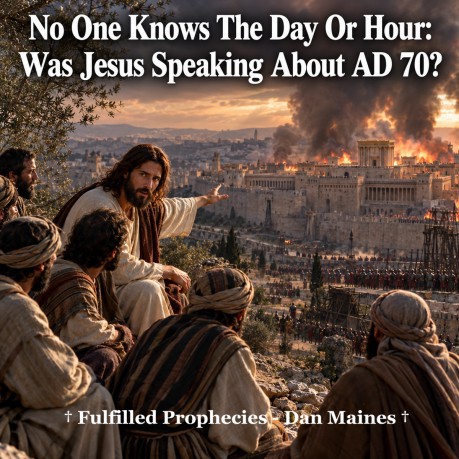
No One Knows The Day Or Hour:
Was Jesus Speaking About AD 70? Introduction The Disciples Asked About The Temple And The End Of The
Age Matthew 24:2-3 Jesus Identified The Generation That Would Witness
Everything Matthew 24:33-34 No One Knew The Exact Day Or Hour Matthew 24:36 The Days Of Noah Explain The Unexpected Judgment Matthew 24:37-39 Jesus Told His Disciples To Remain Alert Matthew 24:42-44 Mark Confirms The Same Generation And Unknown Hour Mark 13:30, 32-33 Luke Identifies Jerusalem As The Place Of Judgment Luke 21:20-22 Luke Repeats The Same Generation Promise Luke 21:32 Jesus Had Already Announced Judgment On Jerusalem Matthew 23:36-38 The First-Century Church Expected The Coming Judgment James 5:8-9 Revelation Confirms The Nearness Of Fulfillment Revelation 1:1, 3 Historical References † Flavius Josephus, a first-century Jewish
historian, described the Roman siege of Jerusalem, the famine,
internal violence, destruction of the temple, and terrible suffering
during the Jewish-Roman War. His account provides important
historical evidence for the catastrophe Jesus predicted (Josephus,
The Jewish War, Books 5-6; Luke 21:20-24). How It Applies To Us Today † We don't need to live in fear of another
predicted destruction of Jerusalem or a future end of the Old
Covenant age. Christ completed His redemptive work, and the former
covenant has given way to the New Covenant established through Him
(Hebrews 8:6-13; Hebrews 10:12-18). Q & A Appendix Q: If no one knew the day or hour, how could
Jesus say everything would happen within that generation? Q: Doesn't Matthew 24:36 begin a new prophecy
about a future Second Coming? Q: Didn't Jesus say heaven and earth would pass
away? Q: Why didn't Jesus tell His disciples the exact
date? Q: Was the coming of the Son of Man a physical
appearance in the sky? Q: Did the Roman destruction of Jerusalem fulfill
Jesus' prophecy? Q: Does this mean Jesus will never come again to
fulfill Matthew 24? Q: Should Christians today still watch for the
end times? Q: Is there another Day of the Lord still waiting
to happen? Q: What is the most important point in
understanding no one knows the day or hour? † This is the fulfilled perspective we proclaim at
Fulfilled Prophecies † Source Index
By Dan Maines
† One of the
most misunderstood statements in the New Testament is Jesus'
declaration that no one knows the day or hour of His coming. For
generations, Christians have used this statement to argue that the
Second Coming must still be in our future. But is that what Jesus
actually taught? (Matthew 24:36; Mark 13:32)
†
The problem begins when we remove one verse from its original setting
and ignore everything Jesus said before and after it. Jesus wasn't
speaking to Christians living thousands of years later. He was
answering questions from His disciples about the coming destruction
of Jerusalem, the temple, and the end of the Old Covenant age
(Matthew 24:1-3; Luke 21:20-22).
† Jesus gave
His disciples signs they could recognize, warnings they could obey,
and a generation in which His words would be fulfilled. Not knowing
the exact day or hour didn't mean the event was thousands of years
away. It meant the precise moment remained unknown within the period
He had already identified (Matthew 24:33-36).
†
The question isn't whether Jesus knew what He was talking about. The
question is whether we're willing to accept His own explanation of
when these things would happen (Matthew 24:34; Luke 21:32).
And He said to them, Do you
not see all these things? Truly I say to you, not one stone here will
be left upon another, which will not be torn down.
As He was
sitting on the Mount of Olives, the disciples came to Him privately,
saying, Tell us, when will these things happen, and what will be the
sign of Your coming, and of the end of the age?
†
The entire discussion began with Jesus predicting the destruction of
the temple. The disciples weren't asking about the destruction of
planet Earth. They wanted to know when the magnificent temple
standing before them would be destroyed (Matthew 24:1-3).
†
The end of the age referred to the approaching conclusion of the Old
Covenant age, not the end of human history. The temple represented
the religious system that was about to lose its covenantal standing
through Christ's completed work (Hebrews 8:13; Hebrews 9:8-10).
†
Jesus connected the temple's destruction, His coming in judgment, and
the end of the age within one prophetic discussion. We can't separate
His answer from the questions His disciples actually asked (Matthew
24:2-3; Luke 21:5-7).
so, you too, when you see
all these things, recognize that He is near, right at the door.
Truly
I say to you, this generation will not pass away until all these
things take place.
† Jesus didn't say a
generation living thousands of years later would witness these
events. He said this generation, identifying the people living when
He spoke those words (Matthew 23:36; Matthew 24:34).
†
The expression all these things includes the events He had just
described, including the tribulation, the coming of the Son of Man,
and the judgment associated with Jerusalem's destruction (Matthew
24:21, 29-34).
† The generation statement
establishes the time boundary. Jesus wasn't providing an exact
calendar date, but He was identifying the generation in which His
prophecy would be fulfilled (Matthew 24:33-34).
†
If we move His coming thousands of years beyond that generation,
we're no longer allowing Jesus' own time statement to govern our
interpretation (Matthew 24:34; Luke 21:32).
But of that day and hour no
one knows, not even the angels of heaven, nor the Son, but the Father
alone.
† Notice what Jesus didn't say. He
didn't say the event couldn't happen within that generation. He said
the exact day and hour were unknown. Those are two completely
different statements (Matthew 24:34-36).
†
Knowing the general period of an event doesn't require knowing its
precise date. Jesus had already identified the generation, but the
Father retained authority over the exact timing (Matthew 24:33-36;
Acts 1:7).
† The words but of that day and
hour don't automatically introduce an entirely different event. The
immediate context continues discussing the coming of the Son of Man
and the need for watchfulness (Matthew 24:36-44).
†
Jesus' statement about His own knowledge must be respected as He gave
it. The text says the Son didn't know the day or hour at that time.
It doesn't say His prophecy lacked a definite first-century
fulfillment (Matthew 24:34-36).
† The mistake
is turning an unknown hour into an unlimited number of generations.
Jesus never made that argument. He identified the generation while
withholding the precise moment (Matthew 24:33-36).
For the coming of the Son
of Man will be just like the days of Noah.
For as in those days
before the flood they were eating and drinking, marrying and giving
in marriage, until the day that Noah entered the ark,
and they
did not understand until the flood came and took them all away; so
will the coming of the Son of Man be.
† Jesus
compared His coming to the days of Noah because judgment arrived
unexpectedly upon people who continued their ordinary activities
without recognizing the danger (Genesis 7:6-10; Matthew 24:37-39).
†
Noah knew judgment was approaching because God had warned him. Yet
the people outside the ark continued living as though nothing would
happen. Their failure wasn't the absence of a warning, but their
refusal to respond (Genesis 6:13-22; Hebrews 11:7).
†
In the same way, Jesus warned His disciples about Jerusalem's
approaching judgment. Those who believed His words could recognize
the signs and escape, while those who rejected His warning faced
destruction (Matthew 24:15-16; Luke 21:20-22).
†
The comparison concerns the sudden arrival of judgment upon the
unprepared. It doesn't require the destruction of the physical
universe or place the fulfillment thousands of years beyond Jesus'
generation (Matthew 24:34, 37-39).
Therefore be on the alert,
for you do not know which day your Lord is coming.
But be sure
of this, that if the head of the house had known at what time of the
night the thief was coming, he would have been on the alert and would
not have allowed his house to be broken into.
For this reason
you also must be ready; for the Son of Man is coming at an hour when
you do not think He will.
† Jesus addressed
His disciples directly. They were the ones instructed to remain alert
because the approaching judgment concerned their own generation
(Matthew 24:33-44).
† The thief illustration
emphasizes unexpected timing, not an event postponed for thousands of
years. A thief arrives without announcing the exact hour, even when
the possibility of his arrival is understood (Matthew 24:43-44).
†
Jesus wasn't commanding every future generation to calculate another
possible date. He was warning His original audience to remain
faithful and prepared during the approaching crisis (Matthew
24:42-44; Luke 21:34-36).
† The command to
watch makes sense because the disciples were living within the period
Jesus had identified. His warning had immediate relevance to their
lives (Matthew 24:34, 42).
Truly I say to you, this
generation will not pass away until all these things take place.
But
of that day or hour no one knows, not even the angels in heaven, nor
the Son, but the Father alone.
Take heed, keep on the alert; for
you do not know when the appointed time will come.
†
Mark places the generation statement and the unknown day or hour
within the same prophetic discussion. The timing of the event and the
uncertainty of its precise moment aren't contradictions (Mark
13:30-33).
† Jesus didn't say this generation
would pass away and another generation thousands of years later would
witness the fulfillment. His warning remained directed toward those
who heard Him (Mark 13:30-33).
† The
appointed time belonged to the Father's authority. The disciples
needed to remain alert, not because fulfillment was indefinitely
distant, but because its exact arrival couldn't be calculated (Mark
13:32-33; Acts 1:7).
But when you see Jerusalem
surrounded by armies, then recognize that her desolation is
near.
Then those who are in Judea must flee to the mountains,
and those who are in the midst of the city must leave, and those who
are in the country must not enter the city;
because these are
days of vengeance, so that all things which are written will be
fulfilled.
† Luke removes any uncertainty
about the geographical setting. Jesus specifically identified
Jerusalem surrounded by armies as the warning that her desolation was
approaching (Luke 21:20).
† The command to
flee was practical and urgent. People living in Judea could obey it
when they recognized the approaching military danger. This wasn't a
warning about the end of planet Earth (Luke 21:20-21).
†
Jesus called these the days of vengeance, connecting Jerusalem's
destruction with the fulfillment of the prophetic judgments written
against covenant unfaithfulness (Luke 21:22; Deuteronomy 28:49-52).
†
The Roman destruction of Jerusalem and its temple in AD 70 fits the
historical setting of Jesus' warning. The fulfillment concerned the
removal of the Old Covenant order, not the destruction of the
physical creation (Luke 21:20-24; Hebrews 8:13).
Truly I say to you, this
generation will not pass away until all things take place.
†
Luke confirms the same generation limitation recorded by Matthew and
Mark. All three accounts connect the predicted events with the people
living in Jesus' day (Matthew 24:34; Mark 13:30; Luke 21:32).
†
Jesus didn't leave His audience without a time boundary. He gave them
a clear assurance that the events He described would happen before
their generation passed away (Luke 21:32).
†
The unknown day and hour cannot overturn this promise. An
interpretation that makes the fulfillment indefinitely future
contradicts the natural meaning of Jesus' generation statement
(Matthew 24:34-36; Luke 21:32).
Truly I say to you, all
these things will come upon this generation.
Jerusalem,
Jerusalem, who kills the prophets and stones those who are sent to
her! How often I wanted to gather your children together, the way a
hen gathers her chicks under her wings, and you were
unwilling.
Behold, your house is being left to you desolate!
†
Before Jesus delivered the Olivet Discourse, He had already announced
judgment upon Jerusalem and identified the generation that would
experience it (Matthew 23:34-38).
†
Jerusalem's responsibility for rejecting God's messengers and
ultimately rejecting Christ formed the covenantal basis for the
coming judgment (Matthew 23:29-38; Luke 19:41-44).
†
The desolate house points to Jerusalem and its temple establishment.
Jesus' prophecy in the following chapter explains how that desolation
would become a historical reality (Matthew 23:38; Matthew 24:1-2).
†
The generation in Matthew 23 and the generation in Matthew 24 belong
to the same historical setting. Nothing in the text requires moving
the judgment into our future (Matthew 23:36; Matthew 24:34).
You too be patient; strengthen
your hearts, for the coming of the Lord is near.
Do not
complain, brethren, against one another, so that you yourselves may
not be judged; behold, the Judge is standing right at the door.
†
James told first-century believers that the coming of the Lord was
near. He didn't describe an event that would remain unfulfilled for
thousands of years (James 5:8).
† The Judge
standing at the door agrees with Jesus' statement that His coming was
near when the disciples recognized the appointed signs (Matthew
24:33; James 5:9).
† The original recipients
were instructed to strengthen their hearts because they were living
during the approaching covenantal transition and judgment (James
5:7-9; Hebrews 8:13).
† The language of
nearness must be understood from the standpoint of the people who
originally received these words, not redefined according to our
modern expectations (James 5:8-9).
The Revelation of Jesus
Christ, which God gave Him to show to His bond-servants, the things
which must soon take place; and He sent and communicated it by His
angel to His bond-servant John,
Blessed is he who reads and
those who hear the words of the prophecy, and heed the things which
are written in it; for the time is near.
†
Revelation begins by declaring that its prophetic events must soon
take place. The time was near for its original recipients, not
thousands of years away (Revelation 1:1-3).
†
The language of nearness agrees with Jesus' generation statement and
the apostolic expectation of approaching judgment (Matthew 24:34;
James 5:8).
† The fulfilled perspective
understands Revelation's judgment prophecies in connection with the
first-century covenantal crisis that culminated in AD 70 (Revelation
1:1-3; Revelation 22:6-10).
† The fact that
the precise day and hour were unknown doesn't cancel the repeated
declarations that fulfillment was near. Both statements can be true
without contradiction (Matthew 24:36; Revelation 1:3).
†
Josephus recorded the burning of the temple and the devastation of
Jerusalem in AD 70. His history confirms that the temple Jesus
identified was destroyed within the lifetime of His original audience
(Josephus, The Jewish War, Book 6; Matthew 24:2, 34).
†
Eusebius of Caesarea, writing in the fourth century, reported a
tradition that Jerusalem's Christian community departed for Pella
before the city's destruction. This account is often connected with
Jesus' warning to flee, although the historical details remain
debated (Eusebius, Ecclesiastical History, 3.5; Luke 21:20-21).
†
Tacitus, a Roman historian, also recorded the destruction of
Jerusalem during Titus' military campaign. His account supplies
non-Christian testimony concerning the historical catastrophe
(Tacitus, Histories, Book 5; Matthew 24:2).
†
These historical writers document the destruction of Jerusalem and
its temple. The identification of that catastrophe with the
fulfillment of Jesus' coming in judgment is the fulfilled
perspective's interpretation of the biblical evidence (Matthew
24:30-34; Luke 21:20-22).
† We
don't need to calculate prophetic dates, identify modern nations as
end-time signs, or search today's headlines for another fulfillment
of Matthew 24. Jesus placed those events within His own generation
(Matthew 24:33-36).
† We can live with
confidence in Christ's established kingdom. Believers have already
come to Mount Zion and the heavenly Jerusalem through their
relationship with Jesus Christ (Hebrews 12:22-24).
†
We should still remain spiritually faithful, but our faithfulness
isn't motivated by fear of an approaching AD 70 judgment. It's the
response of people who belong to Christ and live under His
everlasting reign (Colossians 1:13-14; Hebrews 12:28).
†
The unknown day and hour shouldn't become an excuse to ignore Jesus'
clear time statements. His words were fulfilled, and His faithfulness
gives us confidence in every promise He has made (Matthew 24:34-35; 2
Corinthians 1:20).
† The kingdom isn't
waiting to arrive. Christ reigns now, and His people enjoy the
blessings of the New Covenant through faith in Him (Ephesians
1:20-23; Hebrews 12:28).
A:
Because knowing the generation isn't the same as knowing the exact
date. Jesus identified the period while explaining that the Father
alone knew the precise day and hour (Matthew 24:34-36).
A: The text
doesn't explicitly announce a new event. Jesus continues discussing
the coming of the Son of Man, using Noah and the thief illustration
to explain why His disciples needed to remain alert (Matthew
24:36-44).
A: Yes, but the fulfilled perspective
understands the language in its covenantal and prophetic setting.
Scripture uses heaven-and-earth imagery for the removal of
established orders, while Hebrews describes the Old Covenant as
becoming obsolete (Matthew 24:35; Isaiah 51:15-16; Hebrews 8:13).
A: Jesus stated that the Father alone
knew the day and hour. The disciples were given signs to recognize
and instructions to obey, but they weren't authorized to calculate
the precise moment (Matthew 24:33-36; Acts 1:7).
A: The fulfilled
perspective understands this as Christ's covenantal coming in
judgment. Biblical cloud imagery often represents divine authority
and judgment, and Daniel describes the Son of Man receiving dominion
and a kingdom (Daniel 7:13-14; Isaiah 19:1; Matthew 24:30).
A: Yes, according to the
fulfilled perspective. Jesus identified Jerusalem's surrounding
armies, its desolation, and the generation that would witness these
things. The events of AD 70 correspond to that historical setting
(Luke 21:20-24, 32; Matthew 24:34).
A: Yes, in the fulfilled
perspective, the coming described in Matthew 24 was fulfilled within
the generation Jesus identified. Scripture doesn't require repeating
that covenantal judgment thousands of years later (Matthew 24:30-36;
Luke 21:32).
A: We should remain faithful to
Christ, but the first-century last-days judgment isn't still awaiting
fulfillment. The apostles described those last days as their own
time, and Jesus placed the predicted judgment within their generation
(Acts 2:16-17; Hebrews 1:1-2; Matthew 24:34).
A: The fulfilled perspective
understands the promised covenantal Day of the Lord associated with
Jerusalem's judgment as completed. There is no additional prophetic
Day of the Lord required to finish the Old Covenant age (Luke
21:20-22; Matthew 24:34; Revelation 1:1-3).
A:
We must read Matthew 24:36 together with Matthew 24:34. Jesus
identified the generation that would witness the fulfillment while
withholding the exact day and hour. One statement doesn't cancel the
other (Matthew 24:34-36).
© Fulfilled Prophecies - Dan
Maines.
† Matthew
24:2-3; Matthew 24:33-34; Matthew 24:36; Matthew 24:37-39; Matthew
24:42-44; Mark 13:30, 32-33; Luke 21:20-22; Luke 21:32; Matthew
23:36-38; James 5:8-9; Revelation 1:1, 3
†
Flavius Josephus, The Jewish War, Books 5-6; Eusebius of Caesarea,
Ecclesiastical History, Book 3, Chapter 5; Tacitus, Histories, Book 5
Links