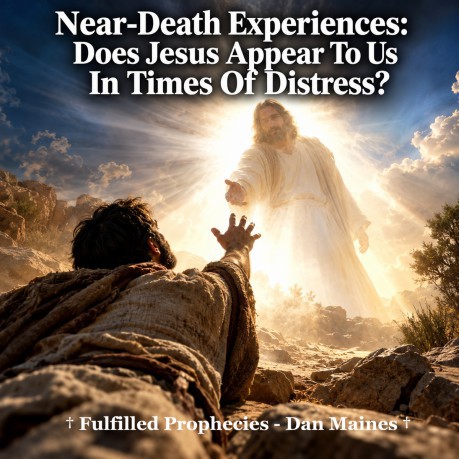
Near-Death Experiences: Does
Jesus Appear To Us In Times Of Distress? Introduction Stephen Saw Jesus As Death Approached Acts 7:55-56 Paul Experienced Something Beyond His Physical
Understanding 2 Corinthians 12:2-4 Jesus Appeared To Paul In A Brilliant Light Acts 9:3-6 Jesus Comforted Paul During A Time Of Fear Acts 18:9-10 God's Presence In The Valley Of Death Psalm 23:4 Jesus Promised Life Beyond Physical Death John 11:25-26 Believers Are With Christ Beyond Physical Death 2 Corinthians 5:6-8 The Bible Describes Heavenly Light Revelation 21:23 God Determines The Days Of Our Lives Psalm 139:16 We Must Test Spiritual Experiences Against Scripture 1 John 4:1 Historical References † Josephus, the first-century Jewish historian,
recorded Jewish beliefs concerning the soul, death, and the existence
of life beyond the grave. His writings demonstrate that questions
about consciousness and death were important in the ancient world
(Josephus, Jewish War 2.8.14). My Near-Death Experience † Yes, I saw and talked with Jesus as
well. This wasn't something I read about or heard from someone else.
It was something I personally experienced on December 7, 1979,
following a terrible automobile accident. How It Applies To Us Today † When someone tells us they saw a brilliant
light while approaching death, we should listen respectfully. Their
experience may have been deeply meaningful, even when we can't
determine its source (Romans 12:15). Q & A Appendix Q: Can Jesus appear to someone who is approaching
death? Q: Is the brilliant light people describe during
near-death experiences actually Jesus? Q: What about people who hear a voice saying it
isn't their time to die? Q: Can a person's spirit leave the body during
surgery and watch everything from above? Q: Why do some people remember these experiences
so clearly? Q: Are people who report these experiences
lying? Q: Does Jesus still comfort believers during
serious illness? Q: Does someone who has a near-death experience
actually enter heaven and then return? Q: Does the fulfilled resurrection mean
Christians no longer physically die? Q: What should we believe when someone we love
says they saw Jesus or heard His voice near death? Q: What is the greatest assurance for someone
approaching death? † This is the fulfilled perspective we proclaim at
Fulfilled Prophecies † Source Index
By Dan Maines
† Throughout
history, people who have come close to death have reported
extraordinary experiences. Some describe seeing a brilliant light,
others remember hearing a voice telling them that it isn't their time
to die, and some describe looking down upon their own bodies while
doctors worked to save their lives.
† These
experiences have occurred during serious illnesses, surgeries,
accidents, and moments when people were unconscious or near death.
†
Some people have described seeing Jesus, while others have
experienced an overwhelming sense of peace, love, and comfort that
they couldn't explain.
† Many have recovered
with clear memories of what they experienced, and some have carried
those memories throughout their lives.
† But
what does Scripture actually tell us about these experiences? Can
Jesus reveal Himself to someone approaching death? Can a person
experience something beyond ordinary physical awareness? And how
should Christians understand these testimonies?
†
The Bible doesn't describe every medical situation or explain every
near-death experience. However, it does provide several remarkable
accounts of people seeing heavenly glory, receiving comfort from
Christ, and experiencing visions beyond their ordinary
surroundings.
† We must distinguish between
what Scripture clearly reveals and what remains unknown. Personal
experiences can be meaningful, but Scripture remains our authority
for understanding spiritual truth (2 Timothy 3:16-17).
But he, being full of the Holy
Spirit, looked intently into heaven and saw the glory of God, and
Jesus standing at the right hand of God; and he said, "Behold, I
see the heavens opened and the Son of Man standing at the right hand
of God."
† Stephen was facing death when
he experienced an extraordinary vision of heaven. Instead of being
overcome by fear, he saw God's glory and Jesus standing at God's
right hand (Acts 7:54-60).
† This wasn't a
vision of judgment against Stephen. It was a revelation of Christ's
presence and heavenly glory during a moment of terrible suffering
(Acts 7:55-56).
† Stephen's experience
establishes that Jesus can reveal Himself to someone approaching
death. Scripture doesn't limit Christ's ability to make His presence
known during moments of extreme distress (Acts 7:55-60).
†
However, Stephen's experience was specifically recorded as a
revelation given through the Holy Spirit. We shouldn't automatically
assume that every modern report of seeing light or Jesus is the same
kind of revelation (1 John 4:1).
† Stephen's
vision also reminds us that death doesn't separate believers from
Christ. His final prayer expressed complete confidence that Jesus
would receive him (Acts 7:59).
But he, being full of
the Holy Spirit, looked intently into heaven and saw the glory of
God, and Jesus standing at the right hand of God; and he said,
"Behold, I see the heavens opened and the Son of Man standing at
the right hand of God."
† Paul described
an extraordinary experience involving heaven and Paradise, but he
couldn't determine whether the experience occurred physically or
apart from his body (2 Corinthians 12:2-4).
†
This is particularly important when considering people who report
floating above their bodies during surgery or unconsciousness. Paul
acknowledged that an experience could be so extraordinary that its
physical nature couldn't be determined (2 Corinthians 12:2-3).
†
However, Paul's account doesn't prove that modern out-of-body
experiences are genuine departures of the spirit from the body. His
own words demonstrate the importance of admitting what we don't know
(2 Corinthians 12:3).
† The experience was
real to Paul, but he didn't attempt to explain every detail. He left
what he couldn't understand in God's hands (2 Corinthians 12:2-4).
†
Paul's example teaches us that we shouldn't dismiss every unusual
experience, but neither should we build doctrines upon experiences
that Scripture hasn't explained (2 Corinthians 12:6; 1 Corinthians
4:6).
Now as he was traveling, it
happened that he was approaching Damascus, and suddenly a light from
heaven flashed around him; and he fell to the ground and heard a
voice saying to him, "Saul, Saul, why are you persecuting Me?"
And he said, "Who are You, Lord?" And He said, "I am
Jesus whom you are persecuting, but get up and enter the city, and it
will be told to you what you must do."
†
Paul experienced a brilliant heavenly light and heard the voice of
Jesus speaking directly to him. This demonstrates that Christ can
make His presence known through an extraordinary experience involving
both light and a voice (Acts 9:3-6).
† Paul
wasn't dying when this happened. Jesus appeared to him for a specific
purpose, to confront him and redirect his life (Acts 9:6, 15-16).
†
This distinction matters because people who report hearing a voice
saying that it isn't their time to die sometimes associate that voice
with Jesus. Scripture shows that Jesus can speak through
extraordinary experiences, but it doesn't establish that every such
voice belongs to Him (Acts 9:4-6; 1 John 4:1).
†
The light Paul saw wasn't simply an unexplained brightness. Scripture
identifies its source through the words of Jesus Himself (Acts
9:5).
† We should therefore be careful about
identifying every brilliant light in a near-death experience as
Jesus. Scripture provides examples of heavenly light, but it doesn't
tell us that every reported light has a supernatural origin (Acts
9:3-6).
And the Lord said to Paul by a
vision at night, "Do not be afraid any longer, but go on
speaking and do not be silent; for I am with you, and no one will
attack you to harm you, for I have many people in this city."
†
Jesus appeared to Paul in a vision during a difficult period of his
ministry. His message was one of encouragement, reassurance, and
continued purpose (Acts 18:9-10).
† The Lord
didn't tell Paul that every difficulty would disappear. He assured
him of His presence and gave him courage to continue the work before
him (Acts 18:9-11).
† This helps us
understand why some believers associate extraordinary experiences
during illness or distress with God's comfort. Scripture confirms
that Christ knows the fears and struggles of His people (Hebrews
4:14-16).
† Yet we must remember that Paul's
vision was an identifiable revelation recorded in Scripture. It
doesn't establish that every comforting dream, voice, or vision today
is a direct appearance of Jesus (2 Timothy 3:16-17).
†
What remains certain is that Christ's care for His people doesn't
depend upon their receiving an extraordinary vision (Romans 8:38-39).
Even though I walk through the
valley of the shadow of death, I fear no evil, for You are with me;
Your rod and Your staff, they comfort me.
†
David described God's presence during life's darkest moments. His
confidence wasn't based upon seeing a brilliant light or hearing an
audible voice, but upon trusting the Lord's continuing care (Psalm
23:1-4).
† This passage doesn't promise that
every dying believer will receive a vision. It promises something
greater, that God's faithfulness remains sufficient even when death
approaches (Psalm 23:4).
† Some believers
approach death with extraordinary experiences, while others pass away
quietly without reporting anything unusual. Neither experience
determines the strength of their faith or their standing before God
(Romans 8:38-39).
† The presence of Christ
isn't measured by what our physical eyes can see. Believers walk by
faith, not by sight (2 Corinthians 5:7).
†
Whether someone sees a light, hears a comforting voice, or
experiences nothing unusual, the promise of God's faithfulness
remains unchanged (Hebrews 13:5).
Jesus said to her, "I am
the resurrection and the life; the one who believes in Me will live,
even if he dies, and everyone who lives and believes in Me will never
die. Do you believe this?"
† Jesus
didn't teach that physical death would cease to occur. He promised
that those who belong to Him possess life that death cannot destroy
(John 11:25-26).
† This promise is central to
understanding death from the fulfilled perspective. Christ
accomplished the promised victory over death through His redemptive
work and the fulfillment of the resurrection hope (1 Corinthians
15:54-57).
† Under the Old Covenant, death
and Hades were associated with humanity's separation from the
completed resurrection promise. Christ brought that covenantal order
to its appointed end (Revelation 20:14; Hebrews 9:8-10).
†
We understand the resurrection fulfillment in connection with the
passing of the Old Covenant age in AD 70. Believers now live under
the completed New Covenant, with direct access to the Father through
Christ (Hebrews 12:22-24; Ephesians 2:18).
†
Therefore, the Christian's hope doesn't depend upon returning from a
near-death experience with a remarkable story. Our hope rests upon
Jesus Christ and His accomplished redemption (John 11:25-26; Hebrews
10:19-22).
Therefore, being always
of good courage, and knowing that while we are at home in the body we
are absent from the Lord-for we walk by faith, not by sight-but we
are of good courage and prefer rather to be absent from the body and
to be at home with the Lord.
† Paul expressed
confidence that being absent from the physical body didn't mean being
separated from Christ. His hope was to be at home with the Lord (2
Corinthians 5:6-8).
† This passage supports
the believer's hope beyond physical death, but it doesn't describe
the medical experiences of people who temporarily lose consciousness
and later recover (2 Corinthians 5:6-8).
†
Someone who survives cardiac arrest or a serious medical emergency
hasn't necessarily experienced irreversible death. We shouldn't
confuse a near-death experience with the completed transition Paul
was discussing (Philippians 1:21-23).
† From
the fulfilled perspective, Christ has completed His victory over
covenantal death. Physical death remains a reality, but it doesn't
separate those who belong to Him from His presence (Romans
8:38-39).
† This is why believers can face
death with confidence even when they don't know exactly what the
final moments of physical life will feel like (Philippians 1:21-23).
And the city has no need of
the sun or of the moon to shine on it, for the glory of God has
illuminated it, and its lamp is the Lamb.
†
John described the New Jerusalem as illuminated by God's glory, with
the Lamb as its light. This is covenantal imagery revealing the
completed presence of God among His redeemed people (Revelation
21:22-23).
† The New Jerusalem isn't a future
physical city waiting to descend upon the earth. It represents the
fulfilled New Covenant dwelling of God with His people (Hebrews
12:22-24; Galatians 4:26).
† Some people who
have nearly died describe a beautiful light that brings peace and
removes fear. Their descriptions may remind Christians of biblical
imagery, but similarity doesn't establish that they actually saw the
New Jerusalem (Revelation 21:23).
† Scripture
identifies Jesus as the true light, but it doesn't teach that every
unexplained light encountered during unconsciousness is a personal
appearance of Christ (John 8:12).
† Our
understanding of heavenly glory must come from what Scripture
reveals, rather than from attempting to interpret every reported
vision as a description of heaven (Revelation 21:22-23).
Your eyes have seen my formless
substance; And in Your book were written All the days that were
ordained for me, When as yet there was not one of them.
†
David acknowledged God's complete knowledge of human life, even
before birth. Our existence isn't hidden from the One who created us
(Psalm 139:13-16).
† This passage helps
explain why believers find comfort in testimonies from people who
heard a voice saying that their time hadn't yet come. God's knowledge
extends beyond what human beings can understand (Psalm 139:16).
†
However, Scripture doesn't teach that everyone who survives a medical
emergency was literally sent back from heaven after receiving a
divine command (Ecclesiastes 3:1-2).
†
Medical treatment, the body's response to injury, and the
circumstances of recovery can all contribute to survival. Recognizing
those realities doesn't deny God's providence (James 1:17).
†
We can thank God for someone's recovery without claiming to know
exactly what caused a vision or who spoke during an unusual
experience (Psalm 107:19-21).
Beloved, do not believe every
spirit, but test the spirits to see whether they are from God,
because many false prophets have gone out into the world.
†
John instructed believers not to accept every spiritual claim without
examination. This principle is important when considering visions,
voices, and unusual experiences (1 John 4:1).
†
A person may sincerely describe what they remember without
understanding exactly what produced the experience. Sincerity and
accuracy about the cause aren't necessarily the same thing (Proverbs
14:15).
† Medical research has identified
several possible contributors to near-death experiences, including
changes in brain activity, oxygen availability, medications, and
altered states of consciousness. These explanations don't account for
every testimony, but they remind us to avoid premature conclusions.
†
We shouldn't accuse someone of dishonesty simply because their
experience is difficult to explain. Neither should we declare an
experience supernatural merely because it was vivid or emotionally
powerful (1 Thessalonians 5:21).
† Most
importantly, no personal vision should be treated as new divine
revelation that adds to or changes the completed testimony of
Scripture (2 Timothy 3:16-17; Jude 3).
† Tertullian,
writing around the beginning of the third century, discussed dreams,
visions, and the soul's relationship to the body. His writings show
that early Christians considered extraordinary experiences while
attempting to understand them through their beliefs about human
nature (Tertullian, On the Soul, chapters 43-49).
†
Augustine, writing in the early fifth century, examined unusual
visions and experiences that appeared to involve perception beyond
ordinary physical senses. He recognized that such reports raised
difficult questions about how human beings experience visions
(Augustine, The Literal Meaning of Genesis, Book 12).
†
Gregory the Great, writing near the end of the sixth century,
preserved accounts of people who reportedly approached death,
experienced visions, and returned to life. These accounts demonstrate
that near-death testimonies aren't limited to modern times (Gregory
the Great, Dialogues, Book 4).
† These
historical writers provide evidence that unusual experiences
surrounding death have been discussed for centuries. However, their
reports don't establish that every experience was supernatural or
that every interpretation was correct (1 John 4:1).
†
Historical testimony can help us understand what people believed and
reported, but it cannot replace Scripture as our authority for
Christian doctrine (2 Timothy 3:16-17).
† I
was told that I had died for more than seven minutes. What happened
during that time changed the direction of my life forever.
†
I remember meeting Jesus inside what appeared to be some kind of cave
or enclosed building. The surroundings reminded me of what I later
came to understand about Hades. I can't explain exactly where I was,
and I won't claim that Scripture identifies the place I saw.
†
The first thing I remember was Jesus walking right through me. He
knew exactly who I was, how I had been living, and what needed to
change.
† He told me that He knew I didn't
reject Him, but I needed to make some serious changes because I had
been living for myself. He told me to go back, study, and find Him.
†
At that time, I believed in God, but I didn't have a personal
relationship with Jesus. I was a partier, living the way I wanted
without giving much thought to what God expected of me.
†
Jesus wasn't pleased with the way I had been living. I remember that
very clearly. This wasn't simply a comforting experience filled with
beautiful light and peaceful feelings. It was a serious encounter
that confronted me with the direction of my life.
†
During our conversation, Jesus told me that I wouldn't remember
everything we had discussed. I remember asking Him to allow me to
remember so that I could study, search for Him, and come to know
Him.
† He told me to search for Him, knock,
and get to know Him. He also made it clear that it wasn't my time to
stay there. I needed to return and make changes in my life.
†
I remember waking up on the operating table and exclaiming that I had
just seen and talked with Jesus!
† When I
fully regained consciousness about four weeks later, I told my
parents, doctors, and nurses that I had met Jesus. To my surprise,
they believed me. I had expected them to question my story or think I
was imagining things.
† I can't explain
everything that happened to me through Scripture, and I'm not asking
anyone to accept my experience as biblical revelation. I'm simply
telling you what I experienced and what I remember.
†
Jesus told His listeners to seek, and they would find, and to knock,
and the door would be opened (Matthew 7:7-8). Those words have
special meaning to me because they remind me of what I remember Jesus
telling me during that encounter.
† I also
think about His words concerning repentance and turning away from a
life centered upon ourselves (Luke 13:3; Matthew 16:24-26).
†
Looking back, I understand that believing God exists isn't the same
as living in fellowship with Him. My experience confronted me with
that difference and gave me a desire to search the Scriptures and
understand Jesus more deeply (John 5:39; John 17:3).
†
I don't claim to understand how I could have experienced these things
while my body was undergoing a medical emergency. I can only tell you
that the memories remain with me.
† I
remember Jesus. I remember our conversation. I remember that He
wasn't happy with the way I had been living. And I remember being
told to go back, study, search for Him, and change my life.
†
That happened on December 7, 1979, and I've never forgotten it. I
share this testimony not to establish a new doctrine, but to explain
why my relationship with Jesus and my commitment to studying
Scripture became so important to me.
† My
experience is my personal testimony. Scripture remains the authority
for what I believe and teach (2 Timothy 3:16-17).
† When
someone remembers hearing a voice telling them that their time hadn't
yet come, we can acknowledge their testimony without claiming
certainty that Jesus personally spoke those words (1 John 4:1).
†
When someone describes floating above an operating table and seeing
doctors working below, we should distinguish their remembered
experience from the conclusion that their spirit literally left their
body (2 Corinthians 12:2-3).
† Scripture
demonstrates that God has revealed Himself through visions, heavenly
light, and extraordinary experiences. But it doesn't promise that
these experiences will accompany death or severe illness (Acts
7:55-56; Acts 9:3-6).
† Jesus can comfort His
people during suffering, whether through prayer, Scripture, the care
of others, or an awareness of His presence. We don't need a
supernatural vision to know that He cares for us (Hebrews 4:15-16).
†
For those facing serious illness, the greatest comfort isn't a
promise that they'll recover or receive a heavenly vision. It's the
assurance that nothing, including death, can separate believers from
God's love in Christ (Romans 8:38-39).
† We
should never tell someone that a lack of extraordinary experiences
means they lack faith. Our relationship with Christ is grounded in
His completed work, not in visions or sensations (Ephesians 2:8-9).
†
We can rejoice when someone survives a life-threatening illness,
thank God for the doctors and treatments that helped them, and
continue trusting Him without claiming knowledge He hasn't revealed
(James 1:17).
† From the fulfilled
perspective, Christ's promised victory has already been accomplished.
We aren't waiting for another resurrection event, another final
judgment, or another coming of Christ to complete redemption (Hebrews
9:26-28; 1 Corinthians 15:54-57).
† Physical
death remains part of human experience, but it doesn't have the final
word over those who belong to Jesus. The completed New Covenant
provides our confidence in life and in death (John 11:25-26;
Philippians 1:21-23).
A: Scripture records Jesus revealing
Himself to Stephen as he faced death. This establishes that Christ
can make His presence known in extraordinary ways, but it doesn't
prove that every modern vision is an appearance of Jesus (Acts
7:55-60).
A: We
can't know that from the description alone. Paul saw heavenly light
when Jesus appeared to him, but Scripture doesn't identify every
unusual light as Christ (Acts 9:3-6; John 8:12).
A: Scripture teaches
that God knows our days, but it doesn't explain every voice heard
during a medical emergency. We can respect the person's experience
without claiming certainty about the speaker (Psalm 139:16; 1 John
4:1).
A:
Paul described an extraordinary experience without knowing whether it
occurred in or apart from his body. His account doesn't establish
what happens during modern surgical experiences, so we should avoid
claiming more than Scripture reveals (2 Corinthians 12:2-4).
A: Vivid memories can occur during
unusual states of consciousness. Scripture doesn't explain the
medical processes involved in near-death experiences, and a clear
memory alone doesn't establish that the experience was supernatural
(1 Thessalonians 5:21).
A: Not necessarily. Someone can
sincerely remember an experience without knowing its cause.
Christians should respond with compassion while carefully examining
any spiritual interpretation (Romans 12:15; 1 John 4:1).
A: Yes. Christ understands
human suffering, and believers can approach God confidently for mercy
and help. His comfort doesn't require an audible voice or visible
appearance (Hebrews 4:15-16; Romans 8:38-39).
A:
Scripture doesn't provide enough information to establish that
conclusion. Paul's experience involved Paradise, but he didn't
explain its physical nature, and his account shouldn't be applied
automatically to every modern testimony (2 Corinthians 12:2-4).
A: No.
Physical death continues, but Christ has fulfilled the promised
victory over covenantal death. Believers have the assurance of life
with Christ beyond physical death (John 11:25-26; 2 Corinthians
5:6-8).
A:
We should listen with love, respect the importance of their
testimony, and recognize that we may not be able to verify its
source. Our confidence rests upon what Christ has revealed in
Scripture, not upon our ability to explain every extraordinary
experience (Acts 7:55-56; 2 Timothy 3:16-17).
A: The greatest assurance is
that Jesus Christ has accomplished redemption and that physical death
cannot separate those who belong to Him from His love and presence
(Romans 8:38-39; Philippians 1:21-23).
© Fulfilled Prophecies - Dan
Maines.
† Acts
7:55-56; 2 Corinthians 12:2-4; Acts 9:3-6; Acts 18:9-10; Psalm 23:4;
John 11:25-26; 2 Corinthians 5:6-8; Revelation 21:23; Psalm 139:16; 1
John 4:1.
† Josephus, Jewish War, Book 2,
Chapter 8, Section 14; Tertullian, On the Soul, Chapters 43-49;
Augustine, The Literal Meaning of Genesis, Book 12; Gregory the
Great, Dialogues, Book 4.
Links