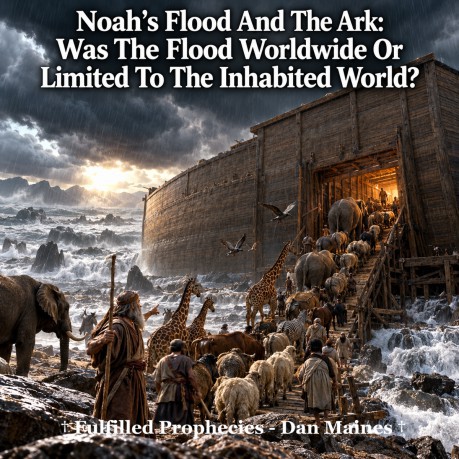
Noah's Flood And The Ark: Was
The Flood Worldwide Or Limited To The Inhabited World? Introduction Genesis 6:5-7 Genesis 6:13-16 Genesis 6:19-21 Genesis 7:2-3 Genesis 7:11-12 Genesis 7:19-23 Genesis 8:3-5 Genesis 9:8-11 Genesis 11:1-2 Genesis 41:56-57 Luke 2:1-3 Matthew 24:37-39 Hebrews 11:7 2 Peter 2:5 2 Peter 3:5-7 Historical References How It Applies To Us Today Q & A Appendix Q: Does Genesis explicitly say the flood covered
the entire modern planet? Q: Could the flood have covered only the
inhabited world of Noah's day? Q: Does the Bible say every modern animal species
entered the ark? Q: How could Noah fit all those animals inside
the ark? Q: If the flood was regional, why did Noah need
an ark instead of moving somewhere else? Q: Doesn't God's promise never to send another
flood prove the original flood was global? Q: Did Jesus teach that Noah's flood covered the
entire planet? Q: Does believing in a regional flood require
accepting Covenant Creation? Q: What conclusion can we reach from Scripture
alone? † This is the fulfilled perspective we proclaim at
Fulfilled Prophecies † Source Index
By Dan Maines
† Was Noah's
flood a worldwide catastrophe covering every continent, or was it a
devastating judgment upon the inhabited world of Noah's day?
†
This question deserves careful examination because Genesis describes
the waters covering the mountains, the destruction of all flesh, and
the preservation of Noah's family and the animals aboard the ark
(Genesis 7:19-23).
† Some believe the flood
covered the entire planet, while others believe it covered the
populated world known to Noah.
† The question
becomes even more challenging when we consider how pairs of land
animals could've entered a single wooden vessel and survived for more
than a year (Genesis 7:2-3; 8:13-19).
† We
must distinguish what Scripture explicitly states from conclusions
based on geography, science, or theological systems (2 Timothy
2:15).
† Our purpose isn't to defend Covenant
Creation or any other system, but to examine the biblical evidence
and determine what we can responsibly conclude (Acts 17:11).
Then the Lord saw that the
wickedness of mankind was great on the earth, and that every intent
of the thoughts of their hearts was only evil continually. So the
Lord was sorry that He had made mankind on the earth, and He was
grieved in His heart. Then the Lord said, "I will wipe out
mankind whom I have created from the face of the land; mankind, and
animals as well, and crawling things, and the birds of the sky. For I
am sorry that I have made them."
† The
stated reason for the flood was humanity's wickedness, not a divine
intention to destroy the physical planet (Genesis 6:11-13).
†
God's judgment was directed against corrupt humanity and the living
creatures associated with the earth under judgment (Genesis
6:12-13).
† The passage doesn't identify
continents, oceans, or the geographical boundaries of the flood
(Genesis 7:17-24).
† Therefore, the extent of
the flood must be examined through the additional descriptions
provided in Scripture (Genesis 7:19-23).
Then God said to Noah, "The
end of humanity has come before Me; for the earth is filled with
violence because of people; and behold, I am about to destroy them
with the earth. Make for yourself an ark of gopher wood; you shall
make the ark with compartments, and cover it inside and out with
pitch. This is how you shall make it: the length of the ark shall be
three hundred cubits, its width fifty cubits, and its height thirty
cubits. You shall make a window for the ark, and finish it to a cubit
from the top; and put the door of the ark on the side; you shall make
it with lower, second, and third decks.
† God
gave Noah specific construction instructions, demonstrating that the
ark was intended to preserve life through an actual historical
judgment (Hebrews 11:7).
† Using an
approximate eighteen-inch cubit, the ark would've measured about 450
feet long, 75 feet wide, and 45 feet high (Genesis 6:15).
†
Its three decks would've provided approximately 101,250 square feet
of total floor area before accounting for walls, storage, and
internal structures (Genesis 6:16).
† The ark
was enormous by ancient standards, but its dimensions alone don't
establish whether the flood was global or regional (Genesis
7:17-20).
† Scripture gives the dimensions of
the vessel but doesn't provide the number of animal species, their
individual sizes, or the arrangement of their enclosures (Genesis
6:19-21).
And of every living thing of
all flesh, you shall bring two of every kind into the ark, to keep
them alive with you; they shall be male and female. Of the birds
according to their kind, and of the animals according to their kind,
of every crawling thing of the ground according to its kind, two of
every kind will come to you to keep them alive. As for you, take for
yourself some of every food that is edible, and gather it to
yourself; and it shall be food for you and them.
†
God commanded Noah to preserve representative pairs of living
creatures according to their kinds, not according to modern
biological classifications (Genesis 7:14-16).
†
Scripture doesn't say Noah collected every modern species, breed, or
variety of animal existing throughout the planet (Genesis 6:20).
†
The biblical word kind cannot automatically be equated with the
modern scientific category of species (Genesis 1:24-25).
†
The passage specifically identifies birds, livestock, and creatures
moving along the ground, rather than fish or every form of marine
life (Genesis 7:14).
† The Bible doesn't
describe Noah traveling to distant continents to capture animals
(Genesis 7:9).
† Instead, Scripture says the
animals came to Noah, demonstrating God's direction over their
preservation (Genesis 7:15-16).
† A regional
interpretation would limit the animals requiring preservation to
those within the affected world, while a global interpretation would
require a broader representation of land-animal kinds (Genesis
7:21-23).
† Neither interpretation can
establish an exact animal count from the biblical text alone (Genesis
6:19-21).
You shall take with you seven
pairs of every clean animal, a male and his female; and two of the
animals that are not clean, a male and his female; also of the birds
of the sky, seven pairs, male and female, to keep their offspring
alive on the face of all the earth.
† Noah
was instructed to preserve additional clean animals and birds, making
the familiar statement about only two of every animal incomplete
(Genesis 8:20).
† The additional clean
animals also provided for sacrifices after the flood without
eliminating the preserved animal populations (Genesis 8:20).
†
The purpose was the continuation of life after judgment, not the
preservation of every individual animal (Genesis 9:1-3).
†
The text doesn't tell us how many animals entered, how much food was
stored, or how Noah organized the living quarters (Genesis 6:21).
In the six hundredth year of
Noah's life, in the second month, on the seventeenth day of the
month, on that day all the fountains of the great deep burst open,
and the floodgates of the sky were opened. The rain fell upon the
earth for forty days and forty nights.
†
Genesis identifies two sources of floodwater, the fountains of the
great deep and rain from the heavens (Genesis 7:11).
†
The description presents an extraordinary catastrophe rather than an
ordinary seasonal flood (Genesis 7:17-20).
†
However, the passage doesn't identify the precise physical mechanism
of the fountains or the geographical extent of their activity
(Genesis 8:2).
† The forty days of rainfall
must also be distinguished from the much longer period during which
the floodwaters remained upon the earth (Genesis 7:24; 8:3).
And the water prevailed more
and more upon the earth, so that all the high mountains everywhere
under the heavens were covered. The water prevailed fifteen cubits
higher, and the mountains were covered. So all creatures that moved
on the earth perished: birds, livestock, animals, and every swarming
thing that swarms upon the earth, and all mankind; of all that was on
the dry land, all in whose nostrils was the breath of the spirit of
life, died. So He wiped out every living thing that was upon the face
of the land, from mankind to animals, to crawling things, and the
birds of the sky, and they were wiped out from the earth; and only
Noah was left, together with those that were with him in the ark.
†
This is the strongest passage supporting the traditional worldwide
interpretation because it describes all the high mountains under the
whole heaven being covered (Genesis 7:19-20).
†
A global interpretation understands this language as describing every
mountain on the planet.
† A regional
interpretation understands the language as describing every mountain
within the geographical world being discussed.
†
Both interpretations must account for the statement that all
land-dwelling creatures outside the ark died (Genesis 7:21-23).
†
The phrase fifteen cubits doesn't independently establish the total
depth of the flood because the passage doesn't specify a modern
sea-level reference point (Genesis 7:20).
†
We must also recognize that the expression whole heaven can describe
an extensive geographical region without necessarily identifying
every location on the planet (Deuteronomy 2:25).
†
Nevertheless, the language of Genesis is sweeping, and a regional
interpretation must explain why such comprehensive descriptions were
used (Genesis 7:19-23).
† We shouldn't weaken
the passage merely because the logistics of the ark seem difficult to
understand (Hebrews 11:7).
and the water receded steadily
from the earth, and at the end of 150 days the water decreased. Then
in the seventh month, on the seventeenth day of the month, the ark
rested upon the mountains of Ararat. And the water decreased steadily
until the tenth month; in the tenth month, on the first day of the
month, the tops of the mountains became visible.
†
The flood lasted far longer than forty days, and Noah remained aboard
until the ground was suitable for life again (Genesis 8:13-19).
†
The ark came to rest upon the mountains of Ararat, identifying a
geographical region associated with the ancient Near East (2 Kings
19:37).
† Scripture doesn't identify the
specific modern mountain upon which the ark rested (Genesis 8:4).
†
The reference to Ararat establishes the ark's final resting region
but doesn't by itself determine the boundaries of the flood (Genesis
8:4-5).
† The gradual recession of the waters
emphasizes the completeness of the judgment and the restoration of
habitable ground (Genesis 8:13-14).
Then God spoke to Noah and to
his sons with him, saying, "Now behold, I Myself am establishing
My covenant with you, and with your descendants after you; and with
every living creature that is with you: the birds, the livestock, and
every animal of the earth with you; of all that comes out of the ark,
every animal of the earth. I establish My covenant with you; and all
flesh shall never again be eliminated by the waters of a flood, nor
shall there again be a flood to destroy the earth."
†
God's covenant with Noah included his descendants and living
creatures, demonstrating the continuing importance of life upon the
earth (Genesis 9:12-17).
† God promised that
another flood wouldn't destroy all flesh in the manner of Noah's
judgment (Genesis 9:11).
† Regional floods
have occurred repeatedly throughout history, so the promise cannot
reasonably mean that no local flooding would ever happen again.
†
Supporters of a global flood argue that this covenant strongly favors
a worldwide event because regional floods continue.
†
Supporters of a regional flood respond that the promise concerns
another destruction of humanity comparable to Noah's flood, not the
absence of ordinary regional disasters.
† The
covenant therefore provides important evidence, but its
interpretation must remain connected to the particular judgment
Genesis describes (Genesis 9:15).
Now all the earth used the
same language and the same words. And it came about, as they
journeyed east, that they found a plain in the land of Shinar and
settled there.
† This passage demonstrates
how the expression whole earth can be used in a narrative describing
the human population under consideration (Genesis 11:1-9).
†
The account centers upon people gathering in Shinar, not a
geographical survey of every continent (Genesis 11:2).
†
This doesn't prove that Noah's flood was regional, but it
demonstrates why biblical expressions must be interpreted within
their literary context (Genesis 7:19; 11:1).
†
The same Hebrew word translated earth can also refer to land or
ground, depending upon the context (Genesis 1:10; 12:1).
†
Therefore, the Hebrew word alone cannot settle whether Genesis
describes the entire planet or a particular inhabited region (Genesis
6:17; 7:17).
When the famine was spread
over the entire face of the earth, then Joseph opened all the
storehouses and sold grain to the Egyptians; and the famine was
severe in the land of Egypt. Then the people of all the earth came to
Egypt to buy grain from Joseph, because the famine was severe in all
the earth.
† Genesis uses the expression all
the earth when describing the widespread famine during Joseph's
lifetime.
† The narrative concerns Egypt and
the surrounding nations that came to purchase grain, not a documented
famine across every continent (Genesis 42:1-5).
†
This demonstrates that comprehensive geographical language can
describe the known world within the context of a particular
historical account (Genesis 41:57).
†
However, the use of such language elsewhere doesn't automatically
establish that the flood account has the same limited meaning
(Genesis 7:19-23).
† Context must determine
the intended scope rather than assuming every occurrence of earth has
precisely the same meaning (Genesis 12:1; 41:57).
Now in those days a decree went
out from Caesar Augustus, that a census be taken of all the inhabited
earth. This was the first census taken while Quirinius was governor
of Syria. And all the people were on their way to register for the
census, each to his own city.
† Luke
describes a registration involving all the world, yet the context
concerns the territory under Roman administration (Luke 2:1-3).
†
The decree didn't require people living on continents outside Roman
authority to register.
† This provides
another biblical example of world language being used within a
specific historical and political setting (Acts 11:28).
†
The Greek terminology in Luke isn't identical to the Hebrew
terminology in Genesis, so the comparison illustrates a principle of
language rather than proving the flood's geographical extent (Genesis
7:19).
† We must allow the biblical writers
to communicate within the geographical understanding and
circumstances of their original audiences (Romans 1:8).
For the coming of the Son
of Man will be just like the days of Noah. For as in those days
before the flood they were eating and drinking, marrying and giving
in marriage, until the day that Noah entered the ark, and they did
not understand until the flood came and took them all away; so will
the coming of the Son of Man be.
† Jesus used
Noah's flood as a historical example of sudden judgment upon an
unprepared generation (Luke 17:26-27).
† His
emphasis wasn't upon the number of continents flooded but upon the
certainty and unexpected arrival of judgment (Matthew 24:38-39).
†
Jesus applied this warning to the generation that would experience
the destruction of Jerusalem and the end of the Old Covenant age
(Matthew 24:2, 34).
† Just as Noah's family
escaped the flood, believers who recognized Jesus' warning could
escape Jerusalem's coming destruction (Luke 21:20-22).
†
The comparison demonstrates a pattern of judgment and deliverance
without requiring both events to have identical geographical
boundaries (Matthew 24:37-39).
By faith Noah, being warned by
God about things not yet seen, in reverence prepared an ark for the
salvation of his household, by which he condemned the world, and
became an heir of the righteousness which is according to faith.
†
Hebrews confirms Noah's obedience, the construction of the ark, and
the salvation of his household.
† Noah acted
upon God's warning before the judgment became visible (Genesis
6:22).
† The emphasis is upon faith and
obedience rather than a scientific explanation of the flood's
physical boundaries (Hebrews 11:7).
† Noah's
example demonstrates that salvation comes through trusting God's
provision rather than relying upon human understanding (1 Peter
3:20).
and did not spare the ancient
world, but protected Noah, a preacher of righteousness, with seven
others, when He brought a flood upon the world of the ungodly;
†
Peter identifies the object of judgment as the ancient world and
specifically calls it the world of the ungodly.
†
The Greek word kosmos can refer to the world, humanity, or an ordered
system, depending upon its context (John 3:16; 1 John 2:15).
†
Peter's emphasis is upon the destruction of the ungodly and the
preservation of Noah's family (2 Peter 2:5).
†
This language is consistent with judgment upon the human world, but
it doesn't independently establish whether every geographical region
was submerged (Genesis 7:19-23).
† Peter also
compares Noah's judgment with the destruction of Sodom and Gomorrah,
demonstrating God's ability to judge the wicked while rescuing the
righteous (2 Peter 2:6-9).
For when they maintain this,
it escapes their notice that by the word of God the heavens existed
long ago and the earth was formed out of water and by water, through
which the world at that time was destroyed by being flooded with
water. But by His word the present heavens and earth are being
reserved for fire, kept for the day of judgment and destruction of
ungodly people.
† Peter describes the world
that existed before the flood as having perished through water.
†
Yet the physical planet continued after the flood, demonstrating that
the destruction of a world doesn't necessarily mean the annihilation
of the earth itself (Genesis 8:21-22).
† The
same principle applies to prophetic descriptions of the heavens and
earth undergoing judgment and transformation (Isaiah 65:17; Hebrews
12:26-28).
† Peter's warning concerned the
approaching judgment upon the ungodly within the covenantal
transition of the first century (2 Peter 3:7, 10-13).
†
The destruction of the Old Covenant order in AD 70 fulfilled that
prophetic judgment without requiring the physical planet to disappear
(Matthew 24:34-35).
† However, recognizing
covenantal judgment in Peter's prophecy doesn't establish that Noah's
historical flood was geographically regional (Genesis 7:19-23).
†
These are related biblical themes, but each account must be examined
according to its own historical and literary context (2 Peter 2:5;
3:5-7).
†
Flavius Josephus, Antiquities of the Jews, Book 1, Chapters 3-4,
records the Jewish tradition of Noah's flood, the ark's resting place
in Armenia, and accounts of remains associated with the vessel.
†
Josephus wrote during the first century AD, making his account
valuable evidence of how ancient Jewish readers understood the flood
narrative.
† Josephus generally presented the
flood as an extensive destruction of humanity, but his account
doesn't independently establish the precise geographical boundaries
of the event.
† Berossus, a Babylonian priest
of the third century BC whose account survives through later writers,
described a great flood and a vessel associated with the mountains of
Armenia.
† The Epic of Gilgamesh, Tablet XI,
preserves an ancient Mesopotamian flood tradition involving a vessel,
preserved living creatures, birds released to test the waters, and a
mountain landing.
† These ancient accounts
demonstrate that flood traditions existed outside the biblical
record, particularly within Mesopotamia.
†
Similarities between these accounts and Genesis are historically
significant, but they don't establish whether the flood covered the
entire planet or a particular geographical region.
†
Ancient historical testimony can provide background, but Scripture
remains the foundation for our theological conclusions (2 Timothy
3:16-17).
†
Noah's account teaches that God takes human wickedness seriously and
that His judgments aren't empty warnings (Genesis 6:5-7).
†
It also demonstrates that God provides a means of deliverance for
those who trust and obey Him (Hebrews 11:7).
†
We shouldn't reject Scripture simply because we don't understand
every detail of the ark's construction, animal preservation, or
floodwaters (Genesis 6:19-22).
† Neither
should we claim certainty about geographical details that Scripture
doesn't explicitly define (Genesis 7:19-23).
†
The Bible's descriptions of all the earth and the whole world must be
examined in their historical contexts rather than automatically
assigned modern geographical definitions (Genesis 41:57; Luke 2:1).
†
At the same time, the strong universal language of the flood account
deserves serious consideration and must never be dismissed merely
because a regional interpretation appears easier to explain (Genesis
7:19-23).
† Our confidence rests upon God's
revealed Word, not upon Covenant Creation, modern geological
theories, or inherited religious traditions (2 Timothy 3:16-17).
†
The essential message remains that God judged wickedness, preserved
Noah's household, and demonstrated His faithfulness to those who
trusted Him (Genesis 9:8-17).
† Today, our
salvation rests in Jesus Christ, who has established the everlasting
New Covenant and brought His people into His kingdom (Hebrews
12:22-24, 28).
A: Genesis says the
waters covered all the high mountains under the whole heaven. That
strongly supports a worldwide reading, but the text doesn't identify
modern continents or define its geographical boundaries using modern
terminology (Genesis 7:19-20).
A: It's a
possible interpretation because Scripture sometimes uses expressions
such as all the earth for a geographically limited world. However,
that possibility doesn't prove the flood was regional, and it must
account for the comprehensive language of Genesis (Genesis 7:19-23;
41:57).
A: No. Scripture describes
animals entering according to their kinds. It doesn't provide a
modern species list or a total animal count (Genesis 6:19-21;
7:14-16).
A: The ark was a very large vessel
with three levels, and Scripture doesn't identify the exact number or
sizes of the animals. We therefore can't calculate its required
capacity with certainty from the biblical text alone (Genesis
6:15-21).
A: God
commanded Noah to build the ark as His appointed means of
preservation. Scripture doesn't say relocation was offered as an
alternative, so the question doesn't independently prove either
interpretation (Genesis 6:13-22; Hebrews 11:7).
A:
The covenant is a strong argument for the global interpretation
because regional floods continue. A regional interpretation must
understand the promise as referring to another judgment destroying
humanity in the manner of Noah's flood (Genesis 9:8-17).
A: Jesus affirmed the flood and
the destruction of those outside the ark, but His teaching focused
upon unexpected judgment rather than identifying the geographical
extent of the waters (Matthew 24:37-39; Luke 17:26-27).
A: No. The
geographical extent of Noah's flood and the Covenant Creation
interpretation of Genesis are separate questions. The flood must be
examined through its own biblical account (Genesis 6-9).
A: Scripture unquestionably presents a
catastrophic historical flood that destroyed the ungodly human world
and preserved Noah's family and the animals aboard the ark. The
worldwide interpretation has strong support from Genesis 7:19-23 and
God's covenant in Genesis 9:11. A regional interpretation is
linguistically possible, but Scripture doesn't explicitly state that
the flood was limited to the populated world. We should distinguish
these conclusions from what the text directly establishes.
© Fulfilled Prophecies - Dan
Maines.
† Genesis
6:5-7; Genesis 6:13-16; Genesis 6:19-21; Genesis 7:2-3; Genesis
7:11-12; Genesis 7:19-23; Genesis 8:3-5; Genesis 9:8-11; Genesis
11:1-2; Genesis 41:56-57; Luke 2:1-3; Matthew 24:37-39; Hebrews 11:7;
2 Peter 2:5; 2 Peter 3:5-7
† Flavius
Josephus, Antiquities of the Jews, Book 1, Chapters 3-4; Berossus,
Babyloniaca, surviving fragments; Epic of Gilgamesh, Tablet XI
Links