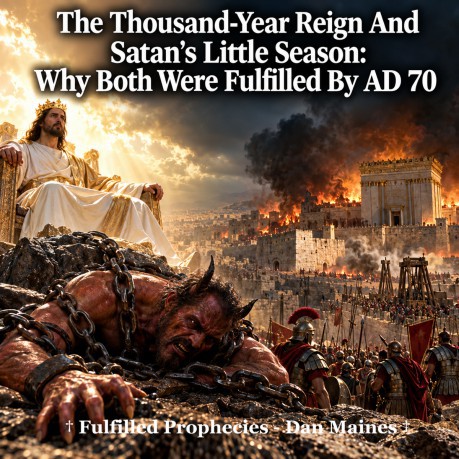
The Thousand-Year Reign And
Satan's Little Season: Why Both Were Fulfilled By AD 70 Introduction Revelation 20:1-3 Why The Thousand Years Are Symbolic Psalm 50:10-12 Matthew 12:28-29 Luke 10:17-18 John 12:31-32 When Did Christ Begin To Reign? Acts 2:32-36 Revelation 20:4-6 Satan's Little Season Was Not Another Millennium Revelation 20:7-10 Revelation 12:12 Matthew 24:21-22 Romans 16:20 Why AD 70 Matters Revelation 1:1-3 Revelation 22:10-12 Historical References How It Applies To Us Today Q & A Appendix Q: Were the thousand years a literal 1,000
years? Q: When was Satan bound? Q: Did Christ begin reigning in AD 70? Q: What was Satan's little season? Q: Was Satan's little season fulfilled before AD
70? Q: Are Gog and Magog modern nations preparing for
another prophetic war? Q: Is Satan's little season happening today? Q: If Satan has been defeated, why is there still
evil? Q: Will Satan be released again in the future? Q: Will there be another Day of the Lord to
complete these prophecies? Q: Does Christ's kingdom still exist today? † This is the fulfilled perspective we proclaim at
Fulfilled Prophecies † Source Index
By Dan Maines
† Revelation
20 is one of the most misunderstood chapters in the Bible, especially
concerning the thousand-year reign of Christ, the binding of Satan,
and Satan's little season.
† Many Christians
have been taught that the thousand years must be a literal period of
1,000 calendar years and that Satan's little season is either
happening today or will happen sometime in the future.
†
However, Revelation was written to first-century believers concerning
events that were soon to take place, not events thousands of years
beyond their lifetime (Revelation 1:1-3; 22:6-10).
†
The thousand years symbolize the complete period of Satan's restraint
and the victorious reign of Christ, beginning with Christ's
first-century ministry and reaching its covenantal fulfillment in AD
70 (Matthew 12:28-29; Revelation 20:1-6).
†
Satan's little season wasn't a second millennium, a modern worldwide
conspiracy, or a period beginning thousands of years after
Jerusalem's destruction.
† It was the brief
period of intensified opposition against Christ's people before the
final judgment of the Old Covenant world (Matthew 24:9-14; Revelation
20:7-10).
† To understand Revelation 20
correctly, we must allow Scripture to interpret Scripture, recognize
prophetic symbolism, and respect the time statements given to the
original audience (Daniel 12:1-7; Revelation 1:1-3).
Then I saw an angel coming
down from heaven, holding the key of the abyss and a great chain in
his hand. And he took hold of the dragon, the serpent of old, who is
the devil and Satan, and bound him for a thousand years; and he threw
him into the abyss and shut it and sealed it over him, so that he
would not deceive the nations any longer, until the thousand years
were completed; after these things he must be released for a short
time.
† The thousand years aren't presented
as an ordinary historical calendar but as part of an apocalyptic
vision filled with symbolic imagery (Revelation 1:1; 12:1-9).
†
The key, chain, abyss, and seal describe spiritual restraint, not
physical objects capable of imprisoning a spiritual being (Luke
10:18-19; John 12:31).
† Satan's binding had
a specific purpose, to prevent him from deceiving the nations in the
manner described by the vision, not to eliminate every temptation or
act of evil immediately (Matthew 12:29; Luke 10:17-20).
†
This explains why Satan could still oppose the apostles during the
first century while his ultimate defeat was already underway (1
Thessalonians 2:18; Romans 16:20).
† The
expression a little time establishes a contrast between the symbolic
thousand years and the brief release that followed, not a prediction
of another extended age (Revelation 12:12; 22:10).
†
Revelation uses numbers symbolically throughout its visions,
including seven churches, seven seals, seven trumpets, twelve tribes,
and 144,000 sealed servants (Revelation 1:4; 5:1; 7:4; 8:2).
†
The number ten frequently expresses completeness, and one thousand is
ten multiplied by ten multiplied by ten, making it a fitting
representation of fullness rather than a required literal duration
(Psalm 50:10; Deuteronomy 7:9).
† A symbolic
number doesn't mean an imaginary event. It means a real spiritual or
historical reality is being communicated through prophetic imagery
(Daniel 7:17-18; Revelation 17:9-10).
†
Nothing in the passage requires a literal thousand-year calendar to
begin after AD 70, and imposing that requirement ignores the
first-century fulfillment framework of Revelation (Revelation 1:1-3;
22:6-10).
For every animal of the
forest is Mine, The cattle on a thousand hills. I know every bird of
the mountains, And everything that moves in the field is Mine. If I
were hungry I would not tell you, For the world is Mine, and
everything it contains.
† God doesn't own
cattle on only 1,000 hills while the cattle on the remaining hills
belong to someone else (Psalm 24:1; 89:11).
†
The thousand hills communicate completeness and unlimited ownership,
demonstrating that Scripture can use one thousand symbolically
(Deuteronomy 10:14; Psalm 115:16).
† This
doesn't prove every occurrence of one thousand is symbolic, but it
establishes that the number doesn't automatically demand a literal
mathematical interpretation (2 Peter 3:8; Revelation 20:2).
But if I cast out the
demons by the Spirit of God, then the kingdom of God has come upon
you. Or, how can anyone enter the strong man's house and carry off
his property, unless he first ties up the strong man? And then he
will plunder his house.
† Jesus connected the
arrival of God's kingdom directly with His authority over Satan and
the demonic realm (Luke 11:20-22; Colossians 2:15).
†
The strong man represents Satan, and the binding represents Christ's
victory over his authority (Mark 3:27; Hebrews 2:14-15).
†
Jesus didn't announce that the strong man would first be bound
thousands of years later. He described the binding as necessary for
the kingdom work already taking place (Luke 10:17-20; Matthew
4:17).
† Therefore, the binding in Revelation
20 belongs within the victorious work of Christ that began during His
earthly ministry, not a future millennium waiting to begin (John
12:31; 1 John 3:8).
Now the seventy-two returned
with joy, saying, "Lord, even the demons are subject to us in
Your name!" And He said to them, I watched Satan fall from
heaven like lightning.
† Jesus described
Satan's fall in connection with the successful ministry of His
disciples, showing that Satan's authority was already being
overthrown (Luke 10:19-20; John 16:11).
† The
disciples weren't waiting for a distant generation to experience
Christ's authority over the enemy (Mark 16:17; Colossians 1:13).
†
This provides an important first-century foundation for understanding
the symbolic binding and eventual destruction of Satan's power
(Hebrews 2:14; Romans 16:20).
Now judgment is upon this
world; now the ruler of this world will be cast out. And I, if I am
lifted up from the earth, will draw all people to Myself.
†
Jesus used the word now, placing the judgment of the ruler of that
world within His own redemptive mission (John 16:11; Colossians
2:15).
† His death and resurrection
decisively defeated Satan's claim over those whom Christ redeemed
(Hebrews 2:14-15; Revelation 12:10-11).
† The
casting out of Satan wasn't postponed until a future earthly kingdom.
It was inseparably connected to Christ's first-century victory (Luke
10:18; 1 John 3:8).
† Revelation 20 presents
that same victory through the symbolic picture of Satan being
restrained and finally judged (Revelation 12:9-12; 20:1-10).
†
Christ didn't have to wait for Jerusalem's destruction to receive His
kingdom. His royal authority was established through His
resurrection, ascension, and exaltation (Acts 2:30-36; Ephesians
1:20-22).
† The thousand-year reign wasn't a
future political government headquartered in earthly Jerusalem (John
18:36; Luke 17:20-21).
† It represented
Christ's victorious reign and the participation of His faithful
people in that victory during the period leading to the completed
covenant transition (1 Corinthians 15:24-26; Revelation 20:4-6).
It is this Jesus whom God
raised up, a fact to which we are all witnesses. Therefore, since He
has been exalted at the right hand of God, and has received the
promise of the Holy Spirit from the Father, He has poured out this
which you both see and hear. For it was not David who ascended into
heaven, but he himself says: The Lord said to my Lord, "Sit at
My right hand, Until I make Your enemies a footstool for Your feet."
Therefore let all the house of Israel know for certain that God has
made Him both Lord and Christ-this Jesus whom you crucified.
†
Peter declared that Jesus had already been exalted to God's right
hand and made both Lord and Christ (Ephesians 1:20-23; Philippians
2:9-11).
† Christ's reign wasn't awaiting a
future earthly throne, because His heavenly enthronement was already
accomplished (Hebrews 1:3; 10:12-13).
† His
enemies were being subjected to His authority during the apostolic
generation, culminating in the judgment of the covenant system that
rejected Him (Psalm 110:1; Matthew 22:41-45).
†
AD 70 didn't begin Christ's reign. It marked the public covenantal
vindication of the King who was already reigning (Matthew 26:64; Luke
21:20-22).
Then I saw thrones, and
they sat on them, and judgment was given to them. And I saw the souls
of those who had been beheaded because of their testimony of Jesus
and because of the word of God, and those who had not worshiped the
beast or his image, and had not received the mark on their foreheads
and on their hands; and they came to life and reigned with Christ for
a thousand years. The rest of the dead did not come to life until the
thousand years were completed. This is the first resurrection.
Blessed and holy is the one who has a part in the first resurrection;
over these the second death has no power, but they will be priests of
God and of Christ, and will reign with Him for a thousand years.
†
John saw souls reigning with Christ, not resurrected physical bodies
governing a restored political nation on earth (2 Corinthians 5:6-8;
Philippians 1:23).
† The vision particularly
honors believers who remained faithful despite persecution and death
under the beast's authority (Revelation 6:9-11; 13:7-10).
†
The first resurrection belongs to the spiritual and covenantal
victory of God's redeemed people, while the second death represents
final judgment rather than ordinary physical death (John 5:24-25;
Revelation 2:11; 20:14).
† The priestly reign
of believers reflects their participation in Christ's kingdom, not a
promise that the Roman world would experience 1,000 literal years
without sin or persecution (1 Peter 2:5-9; Revelation 1:5-6).
†
The resurrection hope of the first-century saints reached its
covenantal fulfillment with the passing of the Old Covenant age,
while Christ's kingdom continues without end (Daniel 12:1-3; 1
Corinthians 15:54-57; Luke 1:33).
†
One of the greatest mistakes in interpreting Revelation 20 is
treating Satan's little season as though it describes a separate age
lasting thousands of years (Revelation 12:12; 20:3).
†
The passage says Satan would be released for a little time, and
Revelation repeatedly emphasizes the nearness of its prophetic events
(Revelation 1:3; 22:10).
† Satan's release
doesn't mean Christ lost His authority or that Satan regained
permanent control of the world (Matthew 28:18; Colossians 2:15).
†
It represents a final, limited period of deception and opposition
before Satan's judgment was completed (Matthew 24:21-22; Revelation
20:7-10).
† The little season wasn't a
prophecy about modern technology, contemporary governments, or an
alleged worldwide deception beginning after AD 70 (Revelation 1:1;
22:6).
† Its fulfillment must be understood
within the first-century crisis that Revelation itself describes
(Matthew 24:34; Revelation 22:7).
When the thousand years
are completed, Satan will be released from his prison, and will come
out to deceive the nations which are at the four corners of the
earth, Gog and Magog, to gather them together for the war; the number
of them is like the sand of the seashore. And they came up on the
broad plain of the earth and surrounded the camp of the saints and
the beloved city, and fire came down from heaven and devoured them.
And the devil who deceived them was thrown into the lake of fire and
brimstone, where the beast and the false prophet are also; and they
will be tormented day and night forever and ever.
†
The release of Satan is followed by deception, the gathering of
hostile nations, an assault against God's people, and final divine
judgment (Ezekiel 38:1-9; Revelation 19:19-21).
†
Gog and Magog are drawn from Ezekiel's prophetic imagery and
represent the collective enemies of God's covenant people rather than
two modern nations identified by contemporary political maps (Ezekiel
38:14-23; 39:1-6).
† The camp of the saints
represents God's covenant community, while the beloved city is
understood in this fulfilled interpretation through the heavenly
Jerusalem belonging to Christ's people (Galatians 4:26; Hebrews
12:22-24).
† The surrounding of the camp
portrays the final concentration of hostility against the faithful,
corresponding to the intense persecution and conflict preceding
Jerusalem's destruction (Matthew 24:9-22; Revelation 12:17).
†
Fire coming down from heaven signifies decisive divine judgment,
using imagery familiar from earlier prophetic accounts (Genesis
19:24; Ezekiel 38:22).
† The devil's
destruction in the lake of fire completes the judgment already
announced through Christ's victory and the apostles' expectation of
Satan's imminent defeat (John 16:11; Romans 16:20).
†
There is no statement here that Satan would escape the lake of fire,
begin another little season, or return to deceive the nations after
his final judgment (Hebrews 2:14-15; Revelation 21:4).
For this reason, rejoice,
you heavens and you who dwell in them. Woe to the earth and the sea,
because the devil has come down to you with great wrath, knowing that
he has only a short time.
† Revelation
explicitly describes the devil as knowing that his remaining time was
short, not that he had thousands of years left to continue his
activity (Revelation 1:3; 22:10).
† His great
wrath explains the intensified opposition against the first-century
believers during the final covenant crisis (Revelation 12:17;
13:7).
† The short time in this vision
provides an important parallel to the little season of Revelation 20,
although the two visions use different imagery (Revelation 20:3;
Daniel 7:21-22).
† These passages support the
understanding that Satan's final period of opposition belonged to the
generation experiencing the approaching judgment (Matthew 24:21-34;
James 5:8-9).
For then there will be a
great tribulation, such as has not occurred since the beginning of
the world until now, nor ever will again. And if those days had not
been cut short, no life would have been saved; but for the sake of
the elect those days will be cut short.
†
Jesus described an unparalleled period of tribulation connected with
Jerusalem's approaching destruction (Luke 21:20-24; Matthew
24:15-16).
† The days would be shortened for
the sake of the elect, demonstrating that the crisis had a divinely
established limit (Daniel 12:1; Mark 13:19-20).
†
This period of intensified suffering provides the historical setting
in which the symbolic little season can be understood (Revelation
12:12; 20:7-9).
† Jesus placed these events
within the generation He was addressing, not within a generation
thousands of years later (Matthew 24:34; Luke 21:32).
The God of peace will soon
crush Satan under your feet. The grace of our Lord Jesus be with
you.
† Paul told the Roman Christians that
God would soon crush Satan under their feet, making the promise
directly relevant to his original readers (Romans 13:11-12; 1
Corinthians 7:29-31).
† The word shortly
communicates an approaching victory, not an event postponed for
thousands of years (James 5:8-9; Revelation 22:6).
†
This expectation fits the completed defeat of Satan portrayed in
Revelation 20 rather than a theory that Satan would remain active
throughout an indefinite future age (Hebrews 2:14; 1 John 3:8).
†
Christ had already secured the decisive victory, and the
first-century believers anticipated its approaching covenantal
completion (Colossians 2:15; Hebrews 10:12-13).
†
Jerusalem's destruction in AD 70 marked the final removal of the Old
Covenant temple system and the public vindication of Jesus' prophetic
warnings (Matthew 23:36-38; Luke 21:20-22).
†
The persecution of the saints, the beast's opposition, the judgment
of Babylon, and Satan's final defeat belong together within
Revelation's covenantal judgment imagery (Revelation 17:5-6;
18:20-24; 20:7-10).
† Revelation doesn't
provide a second prophetic timetable extending Satan's activity
thousands of years beyond the first-century fulfillment (Revelation
1:1-3; 22:6-10).
† The thousand years and
little season are symbolic periods within the same prophetic
framework, with the final judgment reaching its fulfillment by AD 70
(Daniel 12:7; Matthew 24:34).
The Revelation of Jesus
Christ, which God gave Him to show to His bond-servants, the things
which must soon take place; and He sent and communicated it by His
angel to His bond-servant John, who testified to the word of God and
to the testimony of Jesus Christ, everything that he saw. Blessed is
the one who reads, and those who hear the words of the prophecy and
keep the things which are written in it; for the time is near.
†
Revelation begins by identifying its events as things that must soon
take place, and it declares that the time was near (Revelation
22:6-7).
† These statements establish the
prophetic timeframe before the reader ever reaches the symbolic
thousand years (Revelation 20:1-6).
† We
can't take the book's symbolic numbers literally while dismissing its
explicit statements of nearness (Revelation 22:10; Matthew 24:34).
†
The original churches were expected to hear, understand, and respond
to this prophecy because its fulfillment concerned their own
historical circumstances (Revelation 1:4; 2:10; 3:10).
And he said to me, "Do
not seal up the words of the prophecy of this book, for the time is
near. Let the one who does wrong still do wrong, and the one who is
filthy still be filthy; and let the one who is righteous still
practice righteousness, and the one who is holy still keep himself
holy." Behold, I am coming quickly, and My reward is with Me,
to reward each one as his work deserves.
†
John was commanded not to seal the prophecy because its fulfillment
was near, contrasting with Daniel's instruction to seal his vision
until the time of the end (Daniel 12:4, 9).
†
Jesus declared that He was coming quickly, reinforcing the
first-century timeframe established at the beginning of Revelation
(Revelation 1:1-3; 22:20).
† Interpreting
Satan's little season as an event still waiting to happen thousands
of years later conflicts with the book's repeated emphasis on
nearness (Revelation 3:11; 22:7).
† The
fulfilled interpretation recognizes that Revelation's judgment
visions reached their intended covenantal conclusion in the first
century (Matthew 16:27-28; 24:34).
†
Flavius Josephus, The Jewish War, Books 4-6, described the violent
factions, internal warfare, famine, bloodshed, and Roman siege that
devastated Jerusalem before its destruction in AD 70.
†
Josephus, The Jewish War 6.4-6, recorded the burning of the temple
and the terrible suffering associated with Jerusalem's fall,
providing historical context for Jesus' warnings (Luke 19:41-44;
21:20-24).
† Tacitus, Histories 5.10-13,
described the Roman campaign against Jerusalem and the city's
desperate conditions, confirming the historical setting of the
first-century catastrophe.
† Eusebius,
Ecclesiastical History 3.5-7, connected the destruction of Jerusalem
with the judgment that followed the rejection of Christ and recorded
the tradition that believers fled to Pella.
†
These historians document the first-century crisis, although they
don't independently establish the symbolic interpretation of the
thousand years or identify Satan's little season by name.
†
Their testimony supports the historical setting, while the
theological interpretation must be established from Scripture
(Matthew 24:34; Revelation 1:1-3).
†
We aren't waiting for Satan to be released from a future prison
because the fulfilled interpretation places his little season and
final judgment within the completed first-century prophetic framework
(Romans 16:20; Revelation 20:7-10).
† We
don't need to identify modern nations as Gog and Magog or interpret
every war as evidence that Revelation 20 is happening again (Ezekiel
38:1-9; Revelation 22:10).
† The continued
existence of evil doesn't prove Satan remains alive or active,
because Scripture also identifies human desires, sinful choices, and
the fallen condition of humanity as sources of wrongdoing (James
1:14-15; Mark 7:20-23).
† Christ's victory
doesn't mean that every human being automatically becomes righteous
or that sin disappears from human experience (Romans 6:12-13; 1 John
1:8-10).
† Believers now live under the
authority of the risen Christ, who possesses all authority in heaven
and on earth (Matthew 28:18; Colossians 1:13).
†
We're citizens of the heavenly Jerusalem, members of God's kingdom,
and participants in the New Covenant established through Jesus Christ
(Hebrews 12:22-24; Philippians 3:20).
† Our
hope isn't another prophetic battle against Satan, but the continuing
life, righteousness, and fellowship available through Christ (Romans
14:17; John 17:3).
† The kingdom doesn't need
to be established again because Christ's reign is everlasting and His
victory is complete (Luke 1:32-33; Hebrews 12:28).
A: No. In this fulfilled interpretation,
the thousand years symbolically represent the complete period of
Satan's restraint and Christ's victorious reign leading to the
first-century covenantal judgment. Scripture frequently uses symbolic
numbers in prophetic visions (Psalm 50:10; Revelation 1:1; 20:1-6).
A:
Satan's binding began through Christ's earthly ministry and His
authority over the demonic realm. Jesus described the binding of the
strong man as part of His kingdom work (Matthew 12:28-29; Luke
10:17-18).
A:
No. Christ began reigning through His resurrection, ascension, and
exaltation. AD 70 marked the covenantal vindication of His already
established authority (Acts 2:32-36; Ephesians 1:20-22).
A:
It was the brief period of intensified deception, persecution, and
opposition against God's people before the final judgment of the Old
Covenant world (Revelation 12:12; 20:7-10; Matthew 24:21-22).
A: Yes, according to the fulfilled
interpretation. Revelation's time statements and the first-century
tribulation place this final period of opposition within the
generation addressed by Jesus and the apostles (Matthew 24:34; Romans
16:20; Revelation 22:10).
A: No. They are symbolic
enemies drawn from Ezekiel's prophetic imagery and represent the
final collective opposition against God's covenant people (Ezekiel
38:1-9; Revelation 20:8-9).
A:
No. The fulfilled perspective doesn't place Satan's little season in
modern history. Revelation declares that its prophetic events were
near to its original audience (Revelation 1:3; 22:6-10).
A: Human beings remain capable of sin
through their own desires and decisions. Satan's defeat doesn't
eliminate human responsibility or the need for repentance and
righteousness (James 1:14-15; Mark 7:20-23; Romans 6:12-13).
A:
No. Revelation describes one little season followed by Satan's final
judgment. It never teaches another release after the lake of fire
(Revelation 20:7-10; Hebrews 2:14-15).
A: No. The fulfilled
perspective recognizes the first-century Day of the Lord against Old
Covenant Jerusalem as the completion of the prophetic judgment
announced by Jesus. There is no additional future Day of the Lord
required to fulfill Revelation 20 (Matthew 24:34; Luke 21:20-22;
Revelation 22:10).
A:
Absolutely. Christ's reign is everlasting, His kingdom cannot be
shaken, and believers already belong to the heavenly Jerusalem (Luke
1:33; Hebrews 12:22-28; Daniel 7:14).
© Fulfilled Prophecies - Dan
Maines.
† Revelation
20:1-3; Psalm 50:10-12; Matthew 12:28-29; Luke 10:17-18; John
12:31-32; Acts 2:32-36; Revelation 20:4-6; Revelation 20:7-10;
Revelation 12:12; Matthew 24:21-22; Romans 16:20; Revelation 1:1-3;
Revelation 22:10-12
† Flavius Josephus, The
Jewish War, Books 4-6; Tacitus, Histories 5.10-13; Eusebius,
Ecclesiastical History 3.5-7
Links