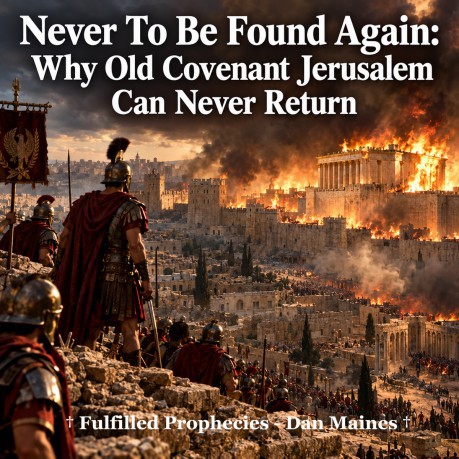
Never To Be Found Again: Why
Old Covenant Jerusalem Can Never Return Introduction Revelation 18:21-23 Revelation 11:8 Revelation 18:24 Matthew 23:37-38 Luke 21:20-22 Jeremiah 51:63-64 Ezekiel 26:13-14 Hebrews 8:13 Hebrews 10:9 Galatians 4:25-26 Hebrews 12:22-24 Revelation 21:1-3 Revelation 21:22-23 Revelation 22:14-17 Historical References How It Applies To Us Today Q & A Appendix Q: If Revelation says Babylon will never be found
again, why does Jerusalem still exist today? Q: Doesn't the continued existence of Jerusalem
prove that Revelation 18 hasn't been fulfilled? Q: How do we know Babylon represents
Jerusalem? Q: Could a future temple restore old covenant
Jerusalem? Q: Was the New Jerusalem physically rebuilt from
the ruins of the old city? Q: Does the New Jerusalem exist today? Q: Will there be another future destruction of
Jerusalem to fulfill Revelation 18? Q: What does never to be found again ultimately
mean? † This is the fulfilled perspective we proclaim at
Fulfilled Prophecies † Source Index
By Dan Maines
† Many
futurists argue that Jerusalem couldn't have been the Babylon of
Revelation 18 because the city still exists today. They point to
modern Jerusalem and claim that Revelation 18:21 says Babylon would
never be found again. Since Jerusalem can still be found on a map,
they conclude that the prophecy must refer to another city awaiting
destruction.
† But this argument overlooks
the covenantal meaning of the prophecy. The issue wasn't whether
people would ever live in Jerusalem again. The issue was whether the
old covenant city, with its temple, priesthood, sacrifices, and
religious authority, would ever exist again before God (Hebrews 8:13;
Hebrews 10:9).
† Revelation wasn't predicting
that Jerusalem's geographical location would disappear from the
earth. It was announcing the permanent destruction of the covenantal
system that had rejected and crucified its Messiah (Matthew 23:37-38;
Luke 19:41-44).
† The physical location could
remain, buildings could be reconstructed, and people could continue
living there. But the Jerusalem that represented the old covenant
could never return to its former standing before God (Galatians
4:25-26; Hebrews 12:22-24).
† This
distinction is essential. The destruction of old covenant Jerusalem
in AD 70 wasn't the disappearance of a geographical location. It was
the permanent removal of an obsolete covenantal order and the full
establishment of the New Jerusalem in Christ (Hebrews 8:13;
Revelation 21:2-3).
Then a strong angel
picked up a stone like a great millstone and threw it into the sea,
saying, So will Babylon, the great city, be thrown down with
violence, and will never be found again. And the sound of harpists,
musicians, flute players, and trumpeters will never be heard in you
again; and no craftsman of any craft will ever be found in you again;
and the sound of a mill will never be heard in you again; and the
light of a lamp will never shine in you again; and the voice of the
groom and bride will never be heard in you again; for your merchants
were the powerful people of the earth, because all the nations were
deceived by your witchcraft.
† The angel's
millstone represented an irreversible judgment. Once the stone
disappeared beneath the water, it couldn't be recovered. This was
prophetic language announcing the permanent overthrow of Babylon's
former position and authority (Jeremiah 51:63-64).
†
The expression found no more at all doesn't require the geographical
location to disappear. It describes the final removal of the city in
the identity and role for which it was being judged (Hebrews 8:13;
Revelation 21:1-2).
† The silence of
musicians, craftsmen, mills, and wedding celebrations portrayed the
complete termination of Babylon's former life. Similar judgment
language was used against ancient cities without requiring their
geographical locations to vanish forever (Isaiah 13:19-22; Ezekiel
26:13-14).
† Old covenant Jerusalem could
never again become God's covenantal dwelling place through the
temple, Levitical priesthood, and animal sacrifices. Those things had
reached their fulfillment in Jesus Christ (Hebrews 7:11-12; Hebrews
10:11-14).
† The prophecy was fulfilled in AD
70 when Jerusalem and its temple were destroyed by the Roman armies.
The old covenant religious order was permanently removed, even though
the geographical location continued to exist (Luke 21:20-22; Hebrews
8:13).
And their dead bodies will
lie on the street of the great city which spiritually is called Sodom
and Egypt, where also their Lord was crucified.
†
Revelation identifies the great city through a specific historical
event. It was the city where the Lord was crucified. That points
directly to Jerusalem, not a future city in another part of the world
(Luke 13:33; Hebrews 13:12).
† Jerusalem was
spiritually called Sodom and Egypt because of its rebellion,
corruption, and rejection of God's Son. These names described its
covenantal condition rather than its geographical location (Isaiah
1:10; Matthew 23:37).
† Revelation's
identification of the great city provides an important connection
with Babylon in chapter 18. The language of judgment, corruption, and
opposition to God's people points to Jerusalem under the old covenant
(Revelation 17:6; Matthew 23:34-36).
† The
city that rejected its Messiah was facing the covenant judgment Jesus
had announced to His own generation (Matthew 23:36; Matthew 24:34).
And in her was found the
blood of prophets and of saints, and of all who have been slaughtered
on the earth.
† Babylon was held responsible
for the blood of God's prophets and saints. Jesus placed that same
responsibility upon Jerusalem and the generation that rejected Him
(Matthew 23:34-36).
† This connection is
significant because Jesus specifically identified Jerusalem as the
city that killed the prophets and stoned those sent to her (Luke
13:33-34).
† The judgment of Babylon wasn't
disconnected from Israel's covenant history. It was the culmination
of the covenant curses that had been announced through Moses and the
prophets (Deuteronomy 28:49-52; Luke 21:22).
†
The expression all that have been slain upon the earth reflects the
comprehensive responsibility assigned to the guilty city. Jesus had
already declared that the righteous blood shed upon the earth would
come upon that generation (Matthew 23:35-36).
Jerusalem, Jerusalem, who
kills the prophets and stones those who have been sent to her! How
often I wanted to gather your children together, the way a hen
gathers her chicks under her wings, and you were unwilling. Behold,
your house is being left to you desolate!
†
Jesus didn't pronounce this judgment against Rome, New York, or some
unidentified future Babylon. He addressed Jerusalem directly and
announced that its house would be left desolate (Luke 19:41-44).
†
The house represented the temple and the religious order centered
upon it. Its desolation meant that the old covenant system had
reached its appointed end (Matthew 24:1-2; Hebrews 8:13).
†
Jesus had already declared that the kingdom would be taken from the
unfaithful leaders and given to a people producing its fruit. The old
covenant leadership couldn't retain its former authority after
rejecting the Son (Matthew 21:42-43).
† When
the temple was destroyed in AD 70, the judgment Jesus had announced
was visibly demonstrated. The old covenant house wasn't awaiting
restoration because Christ had established the greater and permanent
dwelling place of God (Ephesians 2:19-22; Hebrews 12:22-24).
But when you see Jerusalem
surrounded by armies, then recognize that her desolation is near.
Then those who are in Judea must flee to the mountains, and those who
are inside the city must leave, and those who are in the country must
not enter the city; because these are days of punishment, so that all
things which have been written will be fulfilled.
†
Jesus identified the approaching destruction of Jerusalem by
describing armies surrounding the city. This was a recognizable
historical event, not an unspecified catastrophe thousands of years
later (Matthew 24:15-16).
† The disciples
were instructed to flee because the judgment would occur within their
historical circumstances. They weren't told to watch for a future
worldwide destruction of the planet (Luke 21:32).
†
Jesus described those events as days of vengeance when the written
judgments would be fulfilled. Jerusalem's destruction was the
culmination of the covenant warnings against Israel's unfaithfulness
(Deuteronomy 28:49-52; Daniel 9:26-27).
† The
Roman destruction in AD 70 brought an end to the functioning temple
and its sacrifices. That historical event demonstrated the permanent
passing away of the old covenant order (Hebrews 9:8-10; Hebrews
10:9).
And as soon as you finish
reading this scroll, you shall tie a stone to it and throw it into
the middle of the Euphrates, and say, 'Just so shall Babylon sink
down and not rise again, because of the disaster that I am going to
bring upon her; and they will become exhausted.'" To this point
are the words of Jeremiah.
† Revelation's
millstone imagery comes from Jeremiah's judgment against ancient
Babylon. The stone being thrown into the water represented the
permanent overthrow of Babylon's power and dominion (Revelation
18:21).
† Ancient Babylon's geographical
location didn't need to disappear for the prophecy to be fulfilled.
What ended was Babylon's position as a ruling imperial power (Isaiah
13:19; Jeremiah 50:39-40).
† Revelation
applies this established prophetic pattern to the great city facing
judgment in the first century. The imagery describes irreversible
destruction, not the removal of a location from every future map
(Revelation 17:18; Revelation 18:21).
† If
futurists insist that Jerusalem must physically disappear to fulfill
Revelation, they must explain why the same prophetic language was
used against ancient Babylon without requiring the land itself to
cease existing (Jeremiah 51:26; Jeremiah 51:63-64).
So I will put an end to the
sound of your songs, and the sound of your harps will no longer be
heard. I will turn you into a bare rock; you will become a dry place
for the spreading of nets. You will not be rebuilt, for I the Lord
have spoken," declares the Lord God.
†
Ezekiel used language remarkably similar to Revelation when
announcing judgment against Tyre. Music would cease, and the city
would no longer exist in its former glory (Revelation 18:22).
†
Yet the geographical location of Tyre remains identifiable today. The
prophecy's language concerned the overthrow of the condemned city and
its former status, not the disappearance of the coastline itself
(Ezekiel 26:3-5).
† This establishes an
important principle of prophetic interpretation. The continued
existence of a geographical location doesn't automatically invalidate
a prophecy announcing that a city would never rise again in its
former identity (Jeremiah 51:64; Revelation 18:21).
†
The same principle applies to Jerusalem. The old covenant city was
judged and removed from its covenantal position, even though people
continued living in the same geographical area (Galatians 4:25-26;
Hebrews 8:13).
When He said, "A new
covenant," He has made the first obsolete. But whatever is
becoming obsolete and growing old is about to disappear.
†
Hebrews explains exactly why old covenant Jerusalem could never
return. God had established a new covenant through Jesus Christ,
making the first covenant obsolete (Hebrews 8:6-12).
†
The old covenant was approaching its final disappearance when Hebrews
was written. The destruction of Jerusalem and the temple in AD 70
brought that transitional period to its historical conclusion
(Hebrews 9:8-10; Matthew 24:2).
† The old
covenant wasn't temporarily suspended so that God could restore it
thousands of years later. It had been fulfilled and replaced by the
better covenant established through Christ (Hebrews 7:22; Hebrews
10:9).
† Rebuilding a physical temple
couldn't restore the covenant that God had declared obsolete.
Christ's sacrifice accomplished what the repeated animal sacrifices
could never accomplish (Hebrews 10:11-14).
then He said, "Behold, I
have come to do Your will." He takes away the first in order to
establish the second.
† The first covenant
was removed so that the second could be established. Scripture
doesn't describe two competing covenant systems that would alternate
throughout history (Hebrews 8:6-7).
† Jesus
fulfilled the Law and accomplished the redemption toward which its
sacrifices and ceremonies had pointed. Returning to the old system
would deny the finality of His completed work (Matthew 5:17;
Colossians 2:16-17).
† The old covenant
temple, priesthood, and sacrifices weren't intended to remain
permanent institutions. They were shadows pointing to the reality
found in Christ (Hebrews 9:11-12; Hebrews 10:1).
†
This is why old covenant Jerusalem can never be found again. Its
covenantal purpose has been completed, and its former religious
authority cannot be restored by human construction (Hebrews 7:12;
Hebrews 10:18).
Now this Hagar is Mount
Sinai in Arabia and corresponds to the present Jerusalem, for she is
enslaved with her children. But the Jerusalem above is free; she is
our mother.
† Paul distinguished between two
Jerusalems. One represented the old covenant and its bondage, while
the other represented the freedom of the new covenant in Christ
(Galatians 4:21-24).
† The Jerusalem that
existed in Paul's day was associated with Mount Sinai and the
covenant that was passing away. Its geographical existence didn't
guarantee its continuing covenantal standing before God (2
Corinthians 3:7-11).
† The Jerusalem above
wasn't another physical city awaiting construction. It represented
the heavenly covenantal reality established through Christ (Hebrews
12:22-24).
† The New Jerusalem didn't need to
replace the old city's geographical location. It replaced the old
covenant relationship with a greater and permanent relationship
between God and His people (Ephesians 2:18-22; Revelation 21:3).
But you have come to Mount
Zion and to the city of the living God, the heavenly Jerusalem, and
to myriads of angels, to the general assembly and church of the
firstborn who are enrolled in heaven, and to God, the Judge of all,
and to the spirits of the righteous made perfect, and to Jesus, the
mediator of a new covenant, and to the sprinkled blood, which speaks
better than the blood of Abel.
† The writer
of Hebrews told believers that they had already come to the heavenly
Jerusalem. He didn't tell them to wait thousands of years for a
physical city to descend onto the earth (Galatians 4:26).
†
Their access to the heavenly city was through Jesus, the mediator of
the new covenant. This was a spiritual and covenantal reality, not a
promise of renewed Levitical sacrifices (Hebrews 9:15; Hebrews
10:19-22).
† The heavenly Jerusalem is the
city of the living God, where His people have fellowship with Him
through Christ (Ephesians 2:18-22).
† The old
Jerusalem could be destroyed, but the heavenly Jerusalem belonged to
the kingdom that couldn't be shaken (Hebrews 12:27-28).
Then I saw a new heaven
and a new earth; for the first heaven and the first earth passed
away, and there is no longer any sea. And I saw the holy city, new
Jerusalem, coming down out of heaven from God, prepared as a bride
adorned for her husband. And I heard a loud voice from the throne,
saying, Behold, the tabernacle of God is among the people, and He
will dwell among them, and they shall be His people, and God Himself
will be among them,
† Revelation presents the
New Jerusalem after the judgment of Babylon. This contrast is
deliberate. The unfaithful city was judged, while the faithful bride
was revealed in her new covenant glory (Revelation 19:7-9).
†
The New Jerusalem is described as a bride, demonstrating that the
vision concerns God's redeemed people and their covenant relationship
with Christ, not merely buildings and streets (Revelation 21:9-10;
Ephesians 5:25-27).
† The new heaven and new
earth represent the completed covenantal order in which God's
dwelling place is with His people. The old order of separation,
condemnation, and temple restrictions had passed away (Isaiah 65:17;
Hebrews 9:8; Ephesians 2:18).
† The New
Jerusalem didn't emerge from the physical rubble of Jerusalem as a
reconstructed earthly capital. It came from God as the fulfilled
spiritual reality that the old city and temple had foreshadowed
(Galatians 4:26; Hebrews 12:22).
† This is
the permanent answer to the destruction of Babylon. The old covenant
city could never return because God's people now belong to the New
Jerusalem established through Jesus Christ (Revelation 22:14; Hebrews
12:28).
I saw no temple in it,
for the Lord God the Almighty and the Lamb are its temple. And the
city has no need of the sun or of the moon to shine on it, for the
glory of God has illuminated it, and its lamp is the Lamb.
†
The New Jerusalem has no physical temple because God and the Lamb are
its temple. This directly contradicts the expectation that another
earthly temple must become the center of God's covenantal presence
(John 4:21-24).
† The old temple was a
temporary structure that pointed forward to the greater reality
accomplished in Christ. Once the reality arrived, the shadow no
longer held covenantal authority (Colossians 2:17; Hebrews
9:11-12).
† The light of the New Jerusalem
comes from God's glory and the Lamb. God's people no longer depend
upon the old covenant sanctuary for access to His presence (Ephesians
2:18; Hebrews 10:19-22).
† A modern building
in Jerusalem, regardless of its size or religious significance, can't
restore the old covenant. God's dwelling place is now with His
redeemed people through Christ (1 Corinthians 3:16; Ephesians
2:21-22).
Blessed are those who
wash their robes, so that they will have the right to the tree of
life, and may enter the city by the gates. Outside are the dogs, the
sorcerers, the sexually immoral persons, the murderers, the
idolaters, and everyone who loves and practices lying. "I,
Jesus, have sent My angel to testify to you of these things for the
churches. I am the root and the descendant of David, the bright
morning star." The Spirit and the bride say, "Come."
And let the one who hears say, "Come." And let the one who
is thirsty come; let the one who desires, take the water of life
without cost.
† The New Jerusalem is
presented with open access to the tree of life for those who belong
to Christ. Its blessings are available through the gospel, not
through returning to the old covenant (John 4:13-14; Revelation
21:25).
† The invitation to come demonstrates
the continuing availability of salvation through Jesus Christ. The
New Jerusalem isn't an abandoned city waiting for a future generation
to discover it (John 7:37-39).
† The old
Jerusalem excluded people through covenantal boundaries and temple
restrictions. In Christ, believing Jews and Gentiles have access to
the Father through the same Spirit (Ephesians 2:14-18).
†
The old covenant city was judged and removed from its former
standing. The New Jerusalem remains the permanent home of God's
redeemed people (Hebrews 12:22-28).
†
Flavius Josephus, The Jewish War, Book 6, Chapters 4-5, described the
burning of Jerusalem's temple in AD 70 and the devastation
accompanying the Roman conquest.
† Flavius
Josephus, The Jewish War, Book 7, Chapter 1, recorded the destruction
of Jerusalem's buildings and walls, demonstrating the severity of the
city's historical judgment.
† Tacitus,
Histories, Book 5, Chapters 10-13, described the Roman campaign
against Jerusalem and the circumstances surrounding the siege. His
account provides additional historical context for the catastrophe.
†
Eusebius, Ecclesiastical History, Book 3, Chapters 5-7, connected
Jerusalem's destruction with the judgment announced by Jesus and
described the suffering that came upon the city.
†
These historical writers establish that Jerusalem and its temple
suffered catastrophic destruction in the first century. The
covenantal significance of that destruction is explained by Scripture
itself (Luke 21:20-22; Hebrews 8:13).
†
We don't need to look for another Babylon, another temple, or another
destruction of Jerusalem to complete the prophecies Jesus gave to His
first-century disciples (Matthew 24:34; Revelation 22:6).
†
Modern Jerusalem's existence doesn't overturn Revelation 18. The old
covenant city was judged in its former covenantal identity, not
erased from geographical existence (Galatians 4:25-26; Hebrews
8:13).
† We don't approach God through a
physical temple, a Levitical priesthood, or animal sacrifices. We
approach Him through Jesus Christ, our permanent High Priest (Hebrews
4:14-16; Hebrews 10:19-22).
† We belong to
the kingdom that cannot be shaken. Our hope isn't the restoration of
old covenant Jerusalem but the permanent reality of the heavenly
Jerusalem (Hebrews 12:22-28).
† The New
Jerusalem is the dwelling place of God with His people. Its gates
remain open, and the invitation of the gospel continues to call
people to Christ (Revelation 21:25; Revelation 22:17).
†
The old covenant system can never be found again because its purpose
was fulfilled in Jesus Christ. What God has completed doesn't need to
be repeated (Hebrews 10:9-14).
A:
Because the prophecy concerns the permanent destruction of Jerusalem
in its old covenant identity and authority, not the disappearance of
its geographical location. The old covenant became obsolete, and
Christ established the new covenant (Hebrews 8:13; Hebrews 10:9).
A:
No. Biblical prophets used similar judgment language against ancient
Babylon and Tyre. Their geographical locations remained identifiable
even after their former power and status were destroyed (Jeremiah
51:63-64; Ezekiel 26:13-14).
A: Revelation identifies the great
city as the place where the Lord was crucified. It also attributes
the blood of the prophets to Babylon, just as Jesus attributed that
responsibility to Jerusalem and His generation (Revelation 11:8;
Revelation 18:24; Matthew 23:35-37).
A: No. Jesus fulfilled the old
covenant sacrificial system, and His sacrifice was offered once for
all. A new physical building couldn't restore a covenant God had made
obsolete (Hebrews 7:12; Hebrews 8:13; Hebrews 10:11-18).
A: No. Although the
geographical city was later rebuilt, Revelation describes the New
Jerusalem as coming down from heaven from God. It represents the new
covenant people of God, not merely reconstructed buildings (Galatians
4:26; Hebrews 12:22; Revelation 21:2).
A:
Yes. Believers have come to the heavenly Jerusalem through Jesus
Christ, and God's dwelling place is with His people under the new
covenant (Hebrews 12:22-24; Ephesians 2:19-22; Revelation 21:3).
A: No. The
covenantal judgment announced by Jesus was fulfilled in His
generation. Revelation's judgment of Babylon belongs to that
completed first-century fulfillment, not another future covenantal
judgment (Matthew 23:36; Matthew 24:34; Luke 21:20-22).
A: It means that old covenant Jerusalem,
as the center of God's covenantal administration through the Law,
temple, priesthood, and sacrifices, has permanently passed away.
God's people now belong to the New Jerusalem through Jesus Christ
(Hebrews 8:13; Hebrews 10:9; Hebrews 12:22-24).
© Fulfilled Prophecies - Dan
Maines.
† Revelation
18:21-23; Revelation 11:8; Revelation 18:24; Matthew 23:37-38; Luke
21:20-22; Jeremiah 51:63-64; Ezekiel 26:13-14; Hebrews 8:13; Hebrews
10:9; Galatians 4:25-26; Hebrews 12:22-24; Revelation 21:1-3;
Revelation 21:22-23; Revelation 22:14-17
†
Flavius Josephus, The Jewish War, Book 6, Chapters 4-5; The Jewish
War, Book 7, Chapter 1; Tacitus, Histories, Book 5, Chapters 10-13;
Eusebius, Ecclesiastical History, Book 3, Chapters 5-7
Links