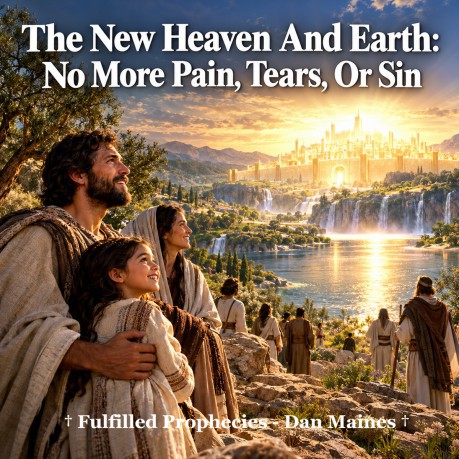
The New Heaven And Earth: No
More Pain, Tears, Or Sin Introduction The First Heaven And Earth Passed Away Revelation 21:1 God's Dwelling Is Now With His People Revelation 21:2-3 What Does No More Pain Or Tears Mean? Revelation 21:4 Why Futurists Expect All Physical Suffering To End 2 Peter 3:13 Isaiah Explained The Tears Before John Did Isaiah 25:8 The New Creation Was Promised Through Isaiah Isaiah 65:17-19 Jesus Promised To Turn Their Sorrow Into Joy John 16:20-22 What Death Was Destroyed? 1 Corinthians 15:55-57 Why Sin Still Exists Outside The New Jerusalem Revelation 22:14-15 The New Jerusalem Was Already A Present Reality Hebrews 12:22-24 Revelation Said These Things Were Near Revelation 22:6-7 Historical References How It Applies To Us Today Q & A Appendix Q: If Revelation says there will be no more pain,
why do Christians still get sick? Q: Why do futurists believe all physical pain and
tears must disappear? Q: Does no more tears mean Christians will never
cry again? Q: If death has been destroyed, why do people
still die? Q: Does the New Heaven and New Earth mean there
is no more sin anywhere? Q: What exactly passed away in AD 70? Q: Are we living in the New Heaven and New Earth
today? Q: What is the greatest promise of Revelation
21? † This is the fulfilled perspective we proclaim at
Fulfilled Prophecies † Source Index
By Dan Maines
† One of the
most misunderstood promises in the Bible is God's declaration that
there will be no more death, mourning, crying, or pain in the New
Heaven and New Earth (Revelation 21:4).
†
Futurists believe this promise describes a future world where nobody
gets sick, nobody suffers, nobody dies, and every physical tear is
permanently removed after Christ returns.
†
But is that what John was describing, or was he announcing the end of
the Old Covenant world and the establishment of God's eternal
dwelling with His people?
† The answer
depends on understanding what was passing away, what was being made
new, and what kind of death and sorrow the prophets were addressing
(Isaiah 65:17-19; 2 Corinthians 5:17).
† The
New Heaven and New Earth aren't promises that human bodies will never
experience physical pain. They're the promise that the separation,
condemnation, and covenantal death associated with Adam and the Old
Covenant have been overcome through Jesus Christ (Romans 5:18-21;
Romans 8:1-2).
† The question isn't whether
Christians still cry. We know they do. The question is what God
promised to remove and when He promised to accomplish it (Revelation
21:1-4; Revelation 22:6-10).
Then I saw a new heaven and
a new earth; for the first heaven and the first earth passed away,
and there is no longer any sea.
† John wasn't
describing the destruction of the physical universe. He was
describing the passing of the Old Covenant order and the
establishment of the New Covenant creation in Christ (Hebrews 8:13; 2
Corinthians 5:17).
† The first heaven and
earth represented the former covenantal arrangement, with its earthly
sanctuary, priesthood, sacrifices, and separation from God's presence
(Hebrews 9:6-10; Hebrews 12:26-28).
† The
removal of the sea symbolized the removal of separation and disorder,
not the disappearance of every physical ocean from the planet (Isaiah
57:20; Revelation 21:3).
† The physical earth
continues, but the covenantal world governed by the Law of Moses has
passed away (Ecclesiastes 1:4; Hebrews 8:13).
†
This distinction is essential because futurism assumes John was
predicting a completely different physical planet rather than a
completely transformed covenantal relationship with God (Galatians
4:24-26; Hebrews 12:22-24).
And I saw the holy city,
new Jerusalem, coming down out of heaven from God, prepared as a
bride adorned for her husband. And I heard a loud voice from the
throne, saying, Behold, the tabernacle of God is among the people,
and He will dwell among them, and they shall be His people, and God
Himself will be among them,
† Notice that the
New Jerusalem comes down from heaven. John wasn't describing
believers leaving the earth to occupy a distant heavenly city
(Galatians 4:26; Hebrews 12:22).
† The
central promise is God's presence with His people, not the removal of
His people from the physical world (Ephesians 2:19-22; 2 Corinthians
6:16).
† Under the Old Covenant, God's
presence was represented by the Most Holy Place, where access was
restricted by the veil and the priesthood (Hebrews 9:7-8).
†
Through Christ, believers now have direct access to the Father by the
Holy Spirit, without an earthly temple or sacrificial priesthood
(Ephesians 2:18; Hebrews 10:19-22).
† The New
Jerusalem is the covenantal dwelling of God with His redeemed people.
Its fulfillment isn't postponed until the end of human history
(Hebrews 12:22-23; Revelation 22:14).
and He will wipe away every
tear from their eyes; and there will no longer be any death; there
will no longer be any mourning, or crying, or pain; the first things
have passed away.
† This is the verse
futurists most frequently use to argue that the New Heaven and New
Earth cannot exist today because people still experience sickness,
grief, suffering, and physical death.
† Their
argument assumes that every expression in the passage must describe a
physical condition rather than the covenantal transformation John was
revealing (Isaiah 25:8; Revelation 21:1-3).
†
But John connects the removal of tears, death, mourning, and pain
directly to the passing away of the former things. The context is the
removal of the former covenantal order (Hebrews 8:13; Hebrews
12:27-28).
† The tears represent the sorrow
associated with sin, condemnation, exile, and separation from God's
presence under the former order (Isaiah 25:8; Isaiah 35:10).
†
The mourning includes the grief of a people living under covenantal
judgment, awaiting the promised redemption and restoration through
their Messiah (Isaiah 61:1-3; Luke 21:28).
†
The pain represents the suffering and anguish connected with that
former covenantal condition, including the judgment and distress
surrounding the end of the age (Matthew 24:8; Luke 21:22-23).
†
John wasn't promising that Christians would never again experience a
headache, lose a loved one, or shed a physical tear. He was
announcing the end of the covenantal condition that separated
humanity from God (Romans 8:1-2; Ephesians 2:13-18).
†
Physical suffering remains part of mortal human existence, but it no
longer represents condemnation or separation from God's love for
those who belong to Christ (Romans 8:35-39; 2 Corinthians 4:16-18).
†
The promise is that the former covenantal sorrow has been removed
because God's redeemed people now live in His presence through Jesus
Christ (Hebrews 12:22-24; Revelation 21:3).
But according to His promise we
are looking for new heavens and a new earth, in which righteousness
dwells.
† Futurists combine Peter's promise
with Revelation 21 and conclude that Christ must return in the future
to destroy or recreate the physical universe.
†
They reason that because disease, war, disasters, and physical death
still exist, the promised New Heaven and New Earth cannot have
arrived.
† However, Peter was writing about
the coming Day of the Lord, the dissolution of the former order, and
the establishment of the promised dwelling place of righteousness (2
Peter 3:10-12; Hebrews 12:26-28).
† The
righteousness that characterizes the new creation is the
righteousness established through Christ, not a claim that every
person on earth has become morally perfect (Romans 3:21-26; Romans
5:17).
† Futurism treats the continuing
existence of physical suffering as proof that prophecy remains
unfulfilled, but that conclusion depends on assuming the prophecy
concerns the elimination of all biological suffering.
†
Peter's first-century audience was awaiting the fulfillment of God's
covenant promises, not a prediction that human beings would never
again experience physical discomfort (1 Peter 1:10-12; Hebrews
10:36-37).
He will swallow up death for all
time, And the Lord God will wipe tears away from all faces, And He
will remove the disgrace of His people from all the earth; For the
Lord has spoken.
† John's language wasn't
new. Isaiah had already connected the removal of tears with the
defeat of death and the removal of God's people's disgrace (1
Corinthians 15:54-57; Revelation 21:4).
† The
promise concerned redemption from the condition brought by sin and
the restoration of fellowship with God (Romans 5:12-21; Hebrews
9:15).
† Paul applied Isaiah's prophecy to
the victory over death accomplished through Jesus Christ, identifying
sin as death's sting and the Law as sin's power (1 Corinthians
15:54-57).
† This connection is critical
because the defeat of death wasn't merely about preventing human
bodies from dying. It involved overcoming the power of sin and the
condemnation associated with the Law (Romans 7:6; Romans 8:1-2).
†
Isaiah's removal of tears describes the triumph of redemption, not a
guarantee that redeemed people will never experience ordinary human
grief (Psalm 30:5; Romans 8:35-39).
For behold, I create new
heavens and a new earth; And the former things will not be remembered
or come to mind. But be glad and rejoice forever in what I create;
For behold, I create Jerusalem for rejoicing And her people for
gladness. I will also rejoice in Jerusalem and be glad in My people;
And there will no longer be heard in her The voice of weeping and the
sound of crying.
† Isaiah directly connects
the New Heaven and New Earth with a new Jerusalem, rejoicing, and the
removal of weeping.
† John uses this same
prophetic framework because Revelation announces the fulfillment of
promises already given to Israel (Isaiah 65:17-19; Revelation
21:1-4).
† Isaiah's vision also continues
with references to birth, aging, and death, demonstrating that the
prophetic description cannot simply be reduced to a future physical
world without mortality (Isaiah 65:20-23).
†
The removal of weeping describes the reversal of covenantal judgment
and the joy of God's restored people (Isaiah 35:10; Isaiah 61:3).
†
The former things were the conditions of the old order, while the new
creation brought the promised righteousness, fellowship, and joy
found in Christ (2 Corinthians 5:17; Galatians 6:15).
†
This is why the New Heaven and New Earth must be understood through
the prophets rather than through modern expectations about a
physically perfect planet.
Truly, truly I say to you that
you will weep and mourn, but the world will rejoice; you will grieve,
but your grief will be turned into joy! Whenever a woman is in labor
she has pain, because her hour has come; but when she gives birth to
the child, she no longer remembers the anguish because of the joy
that a child has been born into the world. Therefore you too have
grief now; but I will see you again, and your heart will rejoice, and
no one is going to take your joy away from you.
†
Jesus promised His disciples that their sorrow would be transformed
into joy, not that they would never experience physical hardship
again.
† His immediate promise concerned the
grief of His approaching death and the joy of seeing Him again,
beginning with His resurrection (John 16:16-22; John 20:19-20).
†
That joy continued as the disciples experienced the blessings of
redemption even while facing persecution and suffering (Acts 5:40-42;
1 Peter 1:6-8).
† Jesus used the pain of
childbirth to illustrate sorrow giving way to joy. The suffering was
real, but it wasn't permanent (John 16:21; Romans 8:22-23).
†
The first-century covenantal transition also involved birth pains as
the former age approached its conclusion and the promised kingdom
reached its full establishment (Matthew 24:8; Hebrews 12:26-28).
†
The joy of redemption doesn't require the elimination of every
physical tear. It rests upon the accomplished work of Christ and the
certainty of God's presence (Romans 5:1-2; Philippians 4:4-7).
Where, O Death, is
your victory? Where, O Death, is your sting? The sting of death is
sin, and the power of sin is the Law; but thanks be to God, who gives
us the victory through our Lord Jesus Christ.
†
Paul explains the kind of victory Christ accomplished. Death's sting
is sin, and sin's power is the Law.
† If the
destruction of death meant that human bodies could no longer
physically die, then Paul's explanation of sin and the Law would be
disconnected from his conclusion (Romans 7:7-11; Romans 8:2).
†
The victory concerns deliverance from sin's condemnation and the
death associated with separation from God (Romans 5:17-21; Ephesians
2:1-6).
† Christ defeated death through His
resurrection and brought His people into the life of the New Covenant
(2 Timothy 1:10; Romans 6:4-11).
† The
corporate resurrection of God's covenant people reached its promised
fulfillment at the end of the Old Covenant age, when the former order
passed away (Daniel 12:1-3; Matthew 24:34).
†
Christians still experience physical death, but physical death no
longer separates those in Christ from the life and presence of God
(Romans 8:38-39; Philippians 1:21-23).
† This
is the difference between the biblical victory over death and the
futurist expectation that no human body will ever die again.
Blessed are those who
wash their robes, so that they will have the right to the tree of
life, and may enter the city by the gates. Outside are the dogs, the
sorcerers, the sexually immoral persons, the murderers, the
idolaters, and everyone who loves and practices lying.
†
This passage creates a serious problem for the futurist
interpretation of a completely sinless physical planet.
†
After John describes the New Jerusalem, he still identifies people
outside the city who practice wickedness (Revelation 21:8; Revelation
21:27).
† The distinction is covenantal.
Those washed by Christ have access to the city, while those remaining
in unbelief and rebellion have no share in its blessings (Hebrews
10:19-22; Ephesians 2:12-13).
† The New
Jerusalem is holy because everyone belonging to it has been cleansed
through Christ, not because every human being on the planet has
stopped committing sin (1 Corinthians 6:9-11; 1 John 1:7-9).
†
Sin still exists in the world, but sin doesn't reign over those who
belong to Christ as it did under the former condition of bondage
(Romans 6:12-14; Romans 8:1-2).
† The open
gates and invitation to enter show that the blessings of the city
remain available through Christ (Revelation 21:25; Revelation
22:17).
† If John were describing a future
earth where every sinner had already disappeared, the continuing
invitation to come and receive the water of life would be difficult
to explain (Revelation 22:17).
But you have come to Mount
Zion and to the city of the living God, the heavenly Jerusalem, and
to myriads of angels, to the general assembly and church of the
firstborn who are enrolled in heaven, and to God, the Judge of all,
and to the spirits of the righteous made perfect, and to Jesus, the
mediator of a new covenant, and to the sprinkled blood, which speaks
better than the blood of Abel.
† The writer
didn't tell believers that they would someday come to the heavenly
Jerusalem. He declared that they had already come to it.
†
The New Jerusalem was already a covenantal reality for believers
through Jesus Christ, even while the Old Covenant system was
approaching its final removal (Galatians 4:26; Hebrews 8:13).
†
The destruction of Jerusalem and its temple in AD 70 publicly
demonstrated the removal of the former covenantal order (Matthew
24:1-3; Luke 21:20-22).
† The heavenly
Jerusalem wasn't built from physical stones. It was established
through Christ, who brought His people into direct fellowship with
God (Ephesians 2:19-22; 1 Peter 2:4-5).
† If
believers had already come to the heavenly Jerusalem in the first
century, its existence cannot be postponed for thousands of years
into our future.
† The completed transition
from the Old Covenant to the New Covenant explains why John's vision
describes the former things passing away (Hebrews 12:26-28;
Revelation 21:4).
And he said to me, "These
words are faithful and true"; and the Lord, the God of the
spirits of the prophets, sent His angel to show His bond-servants the
things which must soon take place. "And behold, I am coming
quickly. Blessed is the one who keeps the words of the prophecy of
this book."
† John wasn't announcing
events that would remain unfulfilled for thousands of years. He was
told that the things revealed must soon take place.
†
The time statements establish the original audience's expectation and
cannot be separated from the promises of the New Jerusalem and the
removal of the former things (Revelation 1:1-3; Revelation 22:10).
†
Jesus had already identified the generation that would witness the
judgment upon Jerusalem and the fulfillment of the things He foretold
(Matthew 23:36; Matthew 24:34).
† The New
Heaven and New Earth belong to that same first-century covenantal
fulfillment, not to an indefinitely postponed destruction of the
physical universe (Hebrews 10:37; Hebrews 12:26-28).
†
The passing of the Old Covenant order in AD 70 marked the completion
of that transition and the full establishment of the New Covenant age
(Hebrews 8:13; Luke 21:20-22).
†
Flavius Josephus, writing in The Jewish War, Books 5-6, described the
famine, suffering, violence, and destruction that overtook Jerusalem
during the Roman siege of AD 70.
† His
account provides historical evidence of the terrible distress that
accompanied the judgment Jesus had warned would come upon that
generation (Luke 21:20-24; Matthew 24:21).
†
Josephus recorded the destruction of the temple, demonstrating the
historical removal of the earthly sanctuary that had stood at the
center of Israel's Old Covenant worship (Hebrews 9:1-10; Matthew
24:2).
† Tacitus, in Histories, Book 5, also
described the Roman campaign against Jerusalem and the destruction
associated with that conflict.
† Eusebius, in
Ecclesiastical History, Book 3, chapters 5-7, connected the
destruction of Jerusalem with the judgment foretold by Jesus and
preserved the tradition that Christians had departed Jerusalem before
its destruction.
† These writers don't
establish the spiritual meaning of Revelation by themselves, but they
confirm the first-century historical setting in which the Old
Covenant order came to its end.
†
We don't have to wait for a future physical universe to experience
the blessings of the New Heaven and New Earth. In Christ, we're
already part of the new creation (2 Corinthians 5:17; Galatians
6:15).
† When we experience sickness, pain,
or grief, it doesn't mean God's promises have failed. It means we're
still mortal human beings living in a physical world (2 Corinthians
4:16-18; Romans 8:35-39).
† When a Christian
cries over the loss of someone they love, those tears don't mean the
New Jerusalem is absent. God's presence remains with His people even
during their suffering (Psalm 34:18; Romans 8:38-39).
†
When we face physical death, we don't face the covenantal
condemnation that Christ removed. We belong to Him in life and in
death (Romans 8:1; Romans 14:8).
† The
promise of no more tears means the former sorrow of separation from
God has been overcome through Christ. We now have peace with God and
direct access to His presence (Romans 5:1-2; Ephesians 2:18).
†
The promise of no more pain doesn't mean every disease has
disappeared. It means the former covenantal anguish and condemnation
don't define our relationship with God (Romans 8:1-2; Hebrews
10:19-22).
† The promise of no more death
means that death has lost its covenantal power over those who have
eternal life in Christ (John 11:25-26; 2 Timothy 1:10).
†
The promise of a holy city doesn't mean sin has vanished from the
physical earth. It means those who belong to Christ have been
cleansed, reconciled, and brought into God's dwelling (1 Corinthians
6:11; Hebrews 12:22-24).
† We aren't waiting
for God to begin dwelling with His people. Through the Holy Spirit,
He already dwells among us (1 Corinthians 3:16; Ephesians 2:21-22).
†
The New Heaven and New Earth are the fulfilled reality of God's
covenant promises, and their greatest blessing isn't the absence of
physical discomfort. It's the permanent presence of God with His
redeemed people (Revelation 21:3; Revelation 22:3-5).
A: Because
the promise concerns the removal of the former covenantal sorrow and
condemnation, not the elimination of every physical illness.
Christians still experience bodily weakness, but nothing can separate
them from God's love (2 Corinthians 4:16-18; Romans 8:35-39).
A: They interpret
Revelation 21:4 as a literal description of a future physical world
after Christ returns. They assume the absence of pain and death
requires the end of all sickness, mourning, and biological mortality.
The Fulfilled View understands these expressions through Isaiah's
covenantal promises and the removal of the former order (Isaiah 25:8;
Isaiah 65:17-19; Hebrews 8:13).
A: No. Christians can still grieve
and experience emotional pain. The promise describes the removal of
the former sorrow associated with condemnation and separation from
God. Our joy in Christ remains even when we experience trials (John
16:20-22; 1 Peter 1:6-8).
A: Christ destroyed death's
covenantal power over His people. Physical death continues, but those
in Christ aren't separated from Him by death (1 Corinthians 15:55-57;
Romans 8:38-39; Philippians 1:21-23).
A: No. Revelation
still describes sinners outside the New Jerusalem. The city
represents those cleansed and reconciled through Christ, while sin
continues among those outside His covenant blessings (Revelation
21:27; Revelation 22:14-15).
A:
The Old Covenant order, including its temple-centered worship,
priesthood, sacrifices, and national covenantal administration,
reached its final historical removal with Jerusalem's destruction
(Hebrews 8:13; Hebrews 9:8-10; Luke 21:20-22).
A: Yes. From the Fulfilled View, the New
Heaven and New Earth describe the completed New Covenant creation.
Believers have come to the heavenly Jerusalem and now enjoy direct
access to God through Christ (2 Corinthians 5:17; Hebrews 12:22-24;
Ephesians 2:18-22).
A: The greatest promise isn't that human
beings will never again feel physical pain. It's that God dwells with
His redeemed people, and the former covenantal separation has been
removed forever (Revelation 21:3-4; Hebrews 10:19-22).
© Fulfilled Prophecies - Dan
Maines.
† Revelation
21:1; Revelation 21:2-3; Revelation 21:4; 2 Peter 3:13; Isaiah 25:8;
Isaiah 65:17-19; John 16:20-22; 1 Corinthians 15:55-57; Revelation
22:14-15; Hebrews 12:22-24; Revelation 22:6-7
†
Flavius Josephus, The Jewish War, Books 5-6; Tacitus, Histories, Book
5; Eusebius, Ecclesiastical History, Book 3, Chapters 5-7
Links