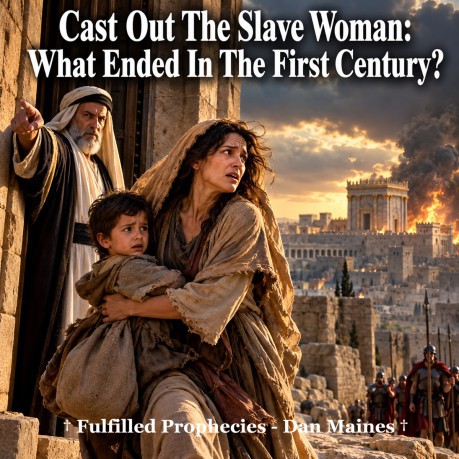
Cast Out The Slave Woman:
What Ended In The First Century? Introduction The Two Women Represented Two Covenants Galatians 4:22-24 Hagar Represented The Jerusalem Of Paul's Day Galatians 4:25 The Jerusalem Above Was Already The Mother Of Believers Galatians 4:26 The Children Of Promise Were The True Heirs Galatians 4:28 The Persecution Revealed The Covenant Conflict Galatians 4:29 Cast Out The Slave Woman And Her Son Galatians 4:30 The Old Covenant Was Already Becoming Obsolete Hebrews 8:13 The Priesthood And The Law Changed Together Hebrews 7:12 Jesus Announced The Judgment Of That Generation Matthew 23:36 The Days Of Vengeance Were Fulfilled In Jerusalem Luke 21:20-22 We Are Children Of The Free Woman Galatians 4:31 Historical References Flavius Josephus, The Jewish War, Book 6, Chapters 4-5 Flavius Josephus, The Jewish War, Book 7, Chapter 1 Tacitus, Histories, Book 5, Chapters 10-13 Eusebius, Ecclesiastical History, Book 3, Chapters 5-7 How It Applies To Us Today Q & A Appendix Q: Who was the slave woman in Paul's allegory? Q: Who was the free woman? Q: What did Paul mean by casting out the slave woman? Q: Did the Old Covenant end at the Cross or in AD 70? Q: Did casting out the slave woman mean God rejected all
Jewish people? Q: Was the destruction of Jerusalem the end of the
physical world? Q: Why couldn't the two covenants continue together? Q: What happened to the priesthood when the Old Covenant
ended? Q: Does the heavenly Jerusalem exist now? Q: Are believers still waiting to receive the inheritance
promised to Abraham? Q: What is the central message of Galatians 4:30? † This is the fulfilled perspective we proclaim at
Fulfilled Prophecies † Source Index
By Dan Maines
† When Paul
commanded the Galatian believers to cast out the slave woman and her
son, he wasn't describing a future destruction of the physical world.
He was explaining the removal of the Old Covenant system and the end
of its claim to the inheritance promised through Christ (Galatians
4:21-31).
† The slave woman represented the
covenant established at Mount Sinai, while the free woman represented
the Jerusalem above, the mother of those who belong to Christ
(Galatians 4:24-26).
† This wasn't merely a
comparison between two women in Abraham's household. Paul was
explaining two covenants, two Jerusalems, two kinds of children, and
two completely different relationships to God (Galatians 4:22-29).
†
The command to cast out the slave woman revealed that the Old
Covenant couldn't remain alongside the New Covenant as an equal
authority or a second means of inheritance (Galatians 4:30; Hebrews
8:13).
† The first-century destruction of
Jerusalem and its temple demonstrated publicly what Christ had
already accomplished through His death, resurrection, and
establishment of the New Covenant (Hebrews 9:15; Matthew 24:1-3,
34).
† To understand what ended in the first
century, we must allow Paul to explain his own illustration rather
than impose a future fulfillment upon it (Galatians 4:21-31).
For it is written that
Abraham had two sons, one by the slave woman and one by the free
woman. But the son by the slave woman was born according to the
flesh, and the son by the free woman through the promise. This is
speaking allegorically, for these women are two covenants: one coming
from Mount Sinai giving birth to children who are to be slaves; she
is Hagar.
† Paul explicitly identified the
two women as two covenants. He wasn't asking his readers to speculate
about their meaning because he supplied the interpretation himself
(Galatians 4:21-31).
† Hagar represented the
covenant established at Mount Sinai, which placed Israel under the
Law and its obligations (Exodus 19:5-8; Galatians 3:23-25).
†
Sarah represented the promise fulfilled through Christ, where
inheritance comes through God's grace rather than the works of the
Law (Galatians 3:16-18; Romans 4:13-16).
†
The contrast wasn't between physical and spiritual human beings. It
was between an inheritance pursued through the Law and an inheritance
received through God's promise (Galatians 3:18, 29).
†
The Law served its appointed purpose until the promised Seed arrived.
Once Christ came, the temporary guardian no longer governed God's
covenant people (Galatians 3:19, 24-25).
Now this Hagar is Mount Sinai
in Arabia and corresponds to the present Jerusalem, for she is
enslaved with her children.
† Paul's
identification of Hagar with the Jerusalem of his own day is one of
the strongest historical indicators in the passage. He wasn't
describing a Jerusalem thousands of years in the future (Galatians
4:25).
† The Jerusalem that existed when Paul
wrote remained associated with the temple, Levitical priesthood,
sacrifices, and Mosaic covenant administration (Acts 21:20-26;
Hebrews 9:6-10).
† Those institutions had
once served God's purpose, but they couldn't provide the permanent
redemption accomplished through Jesus Christ (Hebrews 10:1-4,
11-14).
† Paul's concern wasn't the ethnic
identity of Jewish people. He was identifying the covenant system
that continued to claim authority after the promised Messiah had
arrived (Galatians 3:26-29; Philippians 3:3-9).
†
Jewish believers who trusted Christ belonged to the children of
promise, just as believing Gentiles did. The dividing line was
covenant relationship, not ancestry (Romans 9:6-8; Ephesians
2:14-18).
† Jerusalem's approaching judgment
would expose the finality of the covenant transition already
established through Christ (Luke 21:20-22; Hebrews 8:13).
But the Jerusalem above is
free; she is our mother.
† Paul didn't say
that the Jerusalem above would someday become the mother of
believers. He declared that she already was their mother (Galatians
4:26).
† The heavenly Jerusalem represented
the freedom, righteousness, and inheritance established through Jesus
Christ (Hebrews 12:22-24; Romans 8:1-4).
†
The New Covenant wasn't waiting for the destruction of the physical
universe to become a reality. Christ had already inaugurated it
through His blood (Luke 22:20; Hebrews 9:15).
†
The first-century believers were experiencing the transition from the
old covenant administration to the completed establishment of the new
covenant order (2 Corinthians 3:6-11; Hebrews 8:13).
†
The heavenly city wasn't another earthly capital waiting to replace
Jerusalem geographically. It represented God's dwelling with His
redeemed people through Christ (Ephesians 2:19-22; Revelation
21:2-3).
† The distinction between the two
Jerusalems explains why the destruction of the earthly city didn't
mean the destruction of God's kingdom (Hebrews 12:26-28).
And you, brothers and
sisters, like Isaac, are children of promise.
†
Paul included himself and the Galatian believers among the children
of promise. Their inheritance rested upon Christ, not their ability
to maintain the Mosaic Law (Galatians 3:26-29).
†
Abraham's promised blessing extended to the nations through faith in
Jesus Christ, fulfilling the purpose announced long before Sinai
(Genesis 12:3; Galatians 3:8-9).
† The
children of promise weren't identified by physical descent alone.
They were identified by belonging to the promised Seed, Jesus Christ
(Romans 9:6-8; Galatians 3:16).
† This
doesn't mean God rejected every Israelite. The apostles themselves
were Israelites who received the promise through faith in Christ
(Romans 11:1-5).
† The inheritance wasn't
transferred from one ethnic people to another unrelated people. God's
promises to Israel reached their intended fulfillment in Christ, who
brought believing Jews and Gentiles together in one body (Ephesians
2:14-16; Romans 15:8-12).
† The children of
promise inherited what the Law anticipated but couldn't accomplish
through its sacrifices and regulations (Hebrews 10:1, 14; Galatians
3:18).
But as at that time the son
who was born according to the flesh persecuted the one who was born
according to the Spirit, so it is even now.e.
†
Paul's words so also it is now placed the conflict directly within
his own generation. The persecution wasn't something reserved for a
distant age (Galatians 4:29).
† Just as
Ishmael's treatment of Isaac illustrated hostility toward the
promised heir, opposition from those defending the old covenant order
confronted believers in Christ (Genesis 21:9; Acts 13:45, 50).
†
Paul himself had persecuted the church before recognizing Jesus as
the Messiah (Galatians 1:13; Acts 9:1-5).
†
The apostles experienced opposition because they proclaimed that
forgiveness and righteousness came through Christ rather than through
the Law of Moses (Acts 13:38-39; Acts 15:1-11).
†
This conflict didn't establish guilt upon every Jewish person. It
described opposition to the gospel, including opposition Paul had
personally participated in before his conversion (1 Timothy
1:12-16).
† The persecution belonged to the
period in which the old covenant administration was passing away and
the New Covenant was being openly established (Hebrews 8:13; Hebrews
10:32-37).
But what does the Scripture
say? "Drive out the slave woman and her son For the son of the
slave woman shall not be an heir with the son of the free woman."
†
This is the central declaration of Paul's argument. The slave woman
and her son couldn't share the inheritance belonging to the free
woman's son (Genesis 21:10; Galatians 4:30).
†
Because Paul identified the women as covenants, the command
illustrated the exclusion of the Sinai covenant from the inheritance
established through Christ (Galatians 4:24; Galatians 3:18).
†
The command wasn't a call to expel or harm Jewish people. It was a
declaration that the Mosaic covenant couldn't remain an alternative
means of righteousness and inheritance (Romans 10:4; Galatians
5:4-6).
† The Old Covenant couldn't be
repaired, renewed as a competing system, or placed beside the New
Covenant as an equal authority. Christ had established a better
covenant through His completed sacrifice (Hebrews 8:6; Hebrews
10:11-18).
† The inheritance belonged to the
children of promise because Jesus Christ, Abraham's promised Seed,
had fulfilled the covenant promises (Galatians 3:16, 29).
†
Jerusalem's destruction in AD 70 wasn't the moment Christ first
became victorious. It was the historical judgment that removed the
temple system associated with the covenant that had already become
obsolete (Hebrews 8:13; Luke 21:20-22).
† The
slave woman's removal therefore represented the end of the Old
Covenant's governing authority, not the end of the earth or the
disappearance of the Jewish people (Hebrews 7:12; Hebrews 8:13).
When He said, "A new
covenant," He has made the first obsolete. But whatever is
becoming obsolete and growing old is about to disappear.
†
Hebrews identifies the first covenant as obsolete and approaching
disappearance. The writer was describing a process already underway
in the first century (Hebrews 8:13).
†
Christ's death established the New Covenant, making the former
covenant administration no longer necessary for access to God
(Hebrews 9:15; Hebrews 10:19-22).
† The
temple continued operating during the transition, but its sacrifices
couldn't add anything to Christ's completed offering (Hebrews
10:11-14).
† The destruction of Jerusalem and
its temple brought the functioning sacrificial administration to an
end, publicly demonstrating the passing of the old order (Matthew
24:1-2; Luke 21:20-22).
† This explains why
the covenant could already be obsolete while its visible institutions
still existed. Its authority had ended through Christ, while its
historical removal was approaching (Colossians 2:14-17; Hebrews
8:13).
† The events of AD 70 confirmed that
the old covenant administration wouldn't continue as a parallel
system alongside Christ's completed redemption (Hebrews 9:8-12;
Hebrews 10:18).
For when the priesthood is
changed, of necessity there takes place a change of law also.
†
The Mosaic priesthood and its covenant legislation were inseparably
connected. A change in priesthood necessarily involved a change in
the governing covenant arrangement (Hebrews 7:11-12).
†
Jesus didn't become another Levitical priest offering repeated animal
sacrifices. He became the permanent High Priest according to the
order of Melchizedek (Hebrews 7:15-17, 23-28).
†
The Levitical system couldn't bring the worshiper to complete
perfection, but Christ accomplished what its repeated sacrifices
anticipated (Hebrews 7:18-19; Hebrews 10:14).
†
The removal of the temple in AD 70 eliminated the physical center of
the former priestly administration, but Christ's priesthood remains
permanent (Hebrews 7:24-25).
† Believers
don't need another earthly temple, another animal sacrifice, or
another Levitical priest to approach God (Hebrews 10:19-22; Ephesians
2:18).
† Casting out the slave woman
therefore included the removal of the covenant system that governed
worship through the former priesthood (Galatians 4:24, 30; Hebrews
7:12).
Truly I say to you, all these
things will come upon this generation.
†
Jesus identified His own generation as the one that would experience
the accumulated judgment upon Jerusalem (Matthew 23:34-39).
†
The judgment concerned the city that rejected the prophets and would
reject the Messiah sent to her (Luke 19:41-44; Matthew 23:37-38).
†
Jesus wasn't predicting the destruction of the entire planet. He was
announcing covenant judgment upon Jerusalem and its religious
establishment (Matthew 24:1-2; Luke 21:20-22).
†
The destruction of the temple in AD 70 fulfilled His warning that its
stones would be thrown down (Matthew 24:1-2, 34).
†
This judgment corresponds historically with Paul's explanation that
the covenant represented by Hagar couldn't remain an heir alongside
the covenant of promise (Galatians 4:24-30).
†
The judgment fell upon the old covenant center, while the kingdom
established through Christ continued without interruption (Daniel
7:13-14; Hebrews 12:28).
But when you see Jerusalem
surrounded by armies, then recognize that her desolation is near.
Then those who are in Judea must flee to the mountains, and those who
are inside the city must leave, and those who are in the country must
not enter the city; because these are days of punishment, so that all
things which have been written will be fulfilled.
†
Jesus provided a recognizable historical sign. Jerusalem surrounded
by armies would signal that its desolation was approaching (Luke
21:20).
† The warning was directed to people
living in Judea who could flee when the danger appeared. It wasn't an
instruction to generations living thousands of years later (Luke
21:21).
† Jesus called these the days of
vengeance, connecting Jerusalem's approaching destruction with the
covenant judgments announced in Scripture (Deuteronomy 28:49-52;
Daniel 9:26-27).
† The Roman destruction of
Jerusalem in AD 70 brought the temple sacrifices and priestly
administration to an end (Matthew 24:1-2; Hebrews 10:11-18).
†
This was the historical setting in which the old covenant order
represented by Hagar disappeared from its former institutional
position (Galatians 4:25, 30; Hebrews 8:13).
†
The New Covenant didn't collapse when Jerusalem fell because its
foundation was the risen Christ, not the earthly temple (1
Corinthians 3:11; Ephesians 2:20-22).
So then, brothers and
sisters, we are not children of a slave woman, but of the free
woman.
† Paul concluded by identifying
believers as children of the free woman. Their covenant identity was
already established through Christ (Galatians 4:26-28).
†
They weren't waiting to become heirs through the restoration of the
Mosaic system. They were already Abraham's descendants and heirs
according to promise (Galatians 3:29).
†
Freedom in Christ didn't mean freedom to practice sin. It meant
release from the Law as the governing covenant and freedom to serve
God through love (Galatians 5:1, 13-14).
†
The children of the free woman belong to the heavenly Jerusalem,
where access to the Father comes through Jesus Christ (Hebrews
12:22-24; Ephesians 2:18).
† The inheritance
is secure because it rests upon Christ's completed work rather than
upon the continued existence of an earthly temple (Hebrews 9:12, 15;
Romans 8:16-17).
†
Josephus described the burning of the Jerusalem temple during the
Roman siege in AD 70. His account provides historical evidence that
the center of the former sacrificial system was destroyed.
†
Josephus recorded the devastation of the city and the collapse of its
religious institutions. These events correspond to the historical
setting of Jesus' warning about Jerusalem's approaching desolation
(Luke 21:20-24).
† Josephus didn't interpret
Paul's allegory for us. Scripture supplies that interpretation, while
his historical account confirms the destruction of the temple
associated with the former covenant administration (Galatians
4:24-30).
†
Josephus described the aftermath of Jerusalem's destruction,
including the demolition of much of the city and the Roman
occupation.
† His account demonstrates that
the judgment involved an identifiable first-century city, not the
destruction of the physical universe (Matthew 24:1-2; Luke 21:20-22).
†
Tacitus described the Roman campaign against Jerusalem and the
conditions surrounding the siege.
† His
testimony provides an additional Roman historical witness to the
conflict that culminated in Jerusalem's destruction in AD 70.
†
The historical evidence supports the occurrence of Jerusalem's
judgment, while the covenant significance must be established from
the teachings of Christ and His apostles (Matthew 23:36; Galatians
4:25-30).
†
Eusebius recorded the early Christian tradition that believers in
Jerusalem departed to Pella before the city's destruction.
†
Writing centuries afterward, he understood Jerusalem's judgment in
connection with Jesus' warnings. His account is a later historical
witness rather than independent first-century proof of the evacuation
(Luke 21:20-22).
† His writings show that
early Christian historical interpretation connected Jerusalem's
destruction with the warnings Jesus gave to His own generation
(Matthew 23:36; Matthew 24:34).
†
We aren't children of the slave woman. Through faith in Jesus Christ,
we belong to the covenant of promise and share in Abraham's
inheritance (Galatians 3:26-29; Galatians 4:31).
†
We don't need the Mosaic priesthood, temple sacrifices, or ceremonial
regulations to obtain acceptance before God. Jesus Christ has
provided permanent access to the Father (Hebrews 7:24-25; Hebrews
10:19-22).
† Our citizenship isn't dependent
upon an earthly Jerusalem because believers belong to the heavenly
Jerusalem and the kingdom that cannot be shaken (Philippians 3:20;
Hebrews 12:22-28).
† We shouldn't confuse the
modern nation of Israel with the covenant system Paul identified as
Hagar. His argument concerned the first-century covenant conflict,
not a command to reject any ethnic people today (Galatians 4:24-31;
Romans 10:12).
† We must never use this
passage to justify hostility toward Jewish people. Salvation in
Christ is offered to Jews and Gentiles alike, and both are reconciled
to God through the same Lord (Romans 10:12-13; Ephesians 2:14-18).
†
The kingdom isn't waiting for a future destruction of the earth to
begin. Christ already reigns, and His people already belong to His
kingdom (Colossians 1:13; Hebrews 12:28).
†
We live in the freedom Christ accomplished, serving one another
through love rather than returning to the covenant obligations from
which He has released His people (Galatians 5:1, 13-14).
†
The slave woman has been cast out in the covenant sense Paul
explained. The inheritance belongs to the children of promise, and
nothing needs to be added to Christ's completed redemption (Galatians
4:30-31; Hebrews 10:14-18).
A:
Hagar represented the covenant established at Mount Sinai, which Paul
connected with the Jerusalem of his own day and its condition of
bondage (Galatians 4:24-25).
A:
Sarah represented the covenant of promise fulfilled through Christ.
Paul identified the Jerusalem above as the mother of believers
(Galatians 4:26-28).
A:
He meant that the Old Covenant couldn't share governing authority or
provide a competing claim to the inheritance established through
Christ. The children of promise alone inherit through Him (Galatians
4:24, 30; Galatians 3:16-18).
A:
Christ established the New Covenant through His death, making the
former covenant obsolete. AD 70 brought the historical destruction of
the temple and the end of its functioning sacrificial administration
(Luke 22:20; Hebrews 8:13; Hebrews 9:15; Matthew 24:1-2).
A: No. Paul himself was
Jewish, and Jewish believers were among the first children of
promise. The distinction concerned faith in Christ rather than ethnic
ancestry (Romans 11:1-5; Galatians 3:26-29).
A: No. Jesus described
the judgment of Jerusalem and its temple within His own generation.
God's kingdom continued because it wasn't dependent upon the earthly
city (Matthew 23:36; Matthew 24:1-2, 34; Hebrews 12:28).
A:
The Law served as a temporary guardian until Christ came. Once the
promised Seed fulfilled God's purpose, the former covenant couldn't
remain an equal means of inheritance (Galatians 3:19, 24-25; Hebrews
8:6-13).
A: The Levitical priesthood
lost its covenant authority because Jesus became the permanent High
Priest. The destruction of the temple ended its functioning
sacrificial system (Hebrews 7:12, 23-28; Hebrews 10:11-18).
A:
Yes. Paul declared that the Jerusalem above was already the mother of
believers, and Hebrews stated that Christians had already come to
Mount Zion and the heavenly Jerusalem (Galatians 4:26; Hebrews
12:22-24).
A: Believers
already belong to Christ and are heirs according to promise. Their
covenant standing is established through Him, not through a future
restoration of the Mosaic system (Galatians 3:26-29; Romans 8:16-17).
A:
The covenant represented by Hagar couldn't inherit alongside the
covenant of promise. Christ fulfilled what the Law anticipated, and
the inheritance belongs to those who are His (Galatians 4:24-31;
Galatians 3:16, 29).
© Fulfilled Prophecies - Dan
Maines.
† Galatians
4:22-24; Galatians 4:25; Galatians 4:26; Galatians 4:28; Galatians
4:29; Galatians 4:30; Hebrews 8:13; Hebrews 7:12; Matthew 23:36; Luke
21:20-22; Galatians 4:31
† Flavius Josephus,
The Jewish War, Book 6, Chapters 4-5; Flavius Josephus, The Jewish
War, Book 7, Chapter 1; Tacitus, Histories, Book 5, Chapters 10-13;
Eusebius, Ecclesiastical History, Book 3, Chapters 5-7
Links