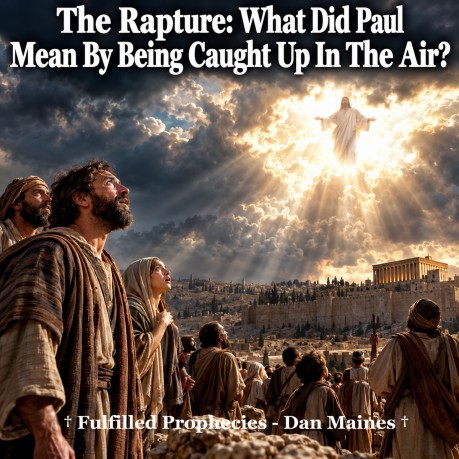
The Rapture: What Did Paul
Mean By Being Caught Up In The Air? Introduction The Concern Of The Thessalonian Believers 1 Thessalonians 4:13-14 Who Were Those Who Were Alive And Remained? 1 Thessalonians 4:15 What Does Caught Up Mean? 1 Thessalonians 4:16-17 What Do The Clouds Represent? Daniel 7:13-14 Did God Literally Ride A Cloud Into Egypt? Isaiah 19:1 What Does Meeting The Lord In The Air Mean? Matthew 25:6 What Did Jesus Say About The Timing Of His Coming? Matthew 24:30-34 What Did Paul Mean By The Last Trumpet? 1 Corinthians 15:51-53 Was The Coming Of The Lord Near In Paul's Day? 1 Thessalonians 5:1-4 Had Believers Already Come To Heavenly Jerusalem? Hebrews 12:22-24 What About The Promise Of Being With Christ? John 14:2-3 Historical References How It Applies To Us Today Q & A Appendix Q: Does the word "rapture" appear in
the Bible? Q: Was Paul predicting that Christians would
physically fly into the sky? Q: Why did Paul say "we who are alive"? Q: What happened to the dead in Christ? Q: What happened to believers who remained
alive? Q: Does meeting the Lord in the air mean Jesus
returned physically to earth? Q: Did the rapture happen in AD 70? Q: Are Christians still waiting for Jesus to
establish His kingdom? Q: What happens when a Christian dies today? Q: What was Paul's main purpose in writing about
being caught up? † This is the fulfilled perspective we proclaim at
Fulfilled Prophecies † Source Index
By Dan Maines
† For
generations, Christians have been taught that Jesus will return to
earth, resurrect dead believers, and physically lift living
Christians into the sky. This teaching is commonly called the
rapture.
† But is that what the apostle Paul
was teaching? Was he describing a future disappearance of Christians
from the earth, or was he explaining the fulfillment of God's
covenant promises to believers living in the first century?
†
The answer must come from Scripture, not modern prophecy charts,
popular books, or religious traditions (2 Timothy 3:16-17).
†
Paul wasn't writing to Christians living thousands of years in his
future. He was writing to the Thessalonian believers about their
deceased brothers and sisters, their hope in Christ, and the coming
of the Lord they were expecting (1 Thessalonians 1:9-10; 2:19).
†
The central question is simple. What did Paul mean when he said that
those who were alive and remained would be caught up together with
the resurrected saints to meet the Lord in the air?
†
To answer that question, we must examine Paul's audience, his time
statements, his resurrection teaching, and the prophetic language he
used.
But we do not want
you to be uninformed, brothers and sisters, about those who are
asleep, so that you will not grieve as indeed the rest of mankind do,
who have no hope. For if we believe that Jesus died and rose from the
dead, so also God will bring with Him those who have fallen asleep
through Jesus.
† Paul's subject wasn't
Christians escaping a future worldwide catastrophe. His concern was
believers who had died before the anticipated coming of Christ (1
Corinthians 15:18-20).
† The Thessalonians
were grieving because they feared their deceased brothers and sisters
might miss the promised resurrection and participation in Christ's
kingdom (1 Corinthians 15:22-23).
† Paul
assured them that physical death hadn't separated these believers
from the promises of God. Their hope rested on the death and
resurrection of Jesus Christ (Romans 8:38-39).
†
The resurrection of Christ guaranteed the fulfillment of the
resurrection promises given to God's covenant people (Acts 26:6-8; 1
Corinthians 15:20-23).
For we say this to you
by the word of the Lord, that we who are alive and remain until the
coming of the Lord will not precede those who have fallen asleep.
†
Notice Paul's words, "we that are alive." He included
himself and his contemporary believers in the group anticipating the
coming of the Lord (1 Corinthians 15:51-52).
†
Paul didn't say that Christians living thousands of years later would
be the intended generation. He spoke from the perspective of
believers living during the first-century covenant transition
(Hebrews 8:13).
† This doesn't prove Paul
knew he would personally survive until the coming. It shows that the
event belonged to the expectation of his own generation (Philippians
4:5; James 5:8-9).
† The phrase "are
left" identifies believers who remained alive, in contrast to
those who had already died. It doesn't identify people surviving a
future seven-year tribulation (Matthew 24:34).
†
Paul was assuring the living that they wouldn't have an advantage
over those who had died in Christ (1 Corinthians 15:51-52).
For the Lord Himself
will descend from heaven with a shout, with the voice of the
archangel and with the trumpet of God, and the dead in Christ will
rise first. Then we who are alive, who remain, will be caught up
together with them in the clouds to meet the Lord in the air, and so
we will always be with the Lord.
† The Greek
word translated "caught up" is harpazo, meaning to seize,
take, or snatch away. The word itself doesn't determine whether an
event is physical or spiritual (Acts 8:39; 2 Corinthians 12:2-4).
†
Paul used harpazo when describing someone caught up into paradise,
yet he explicitly said he didn't know whether that experience
occurred in the body or apart from the body (2 Corinthians 12:2-4).
†
Therefore, the Greek word alone can't establish that Paul predicted
the physical removal of millions of Christians into the atmosphere.
†
The passage also doesn't describe believers disappearing for seven
years, returning to earth afterward, or escaping a future Antichrist.
Those details must be imported from other interpretations (Matthew
24:34; 1 John 2:18).
† Paul's emphasis was
that deceased and living believers would share the same completed
relationship with Christ. Neither group would be excluded from the
promised resurrection (1 Corinthians 15:51-54).
†
The words "and so shall we ever be with the Lord" identify
the permanent result. The passage centers on union with Christ, not a
temporary journey through the atmosphere (John 14:3; Romans 8:38-39).
I kept looking in the night
visions, And behold, with the clouds of heaven One like a son of man
was coming, And He came up to the Ancient of Days And was presented
before Him. And to Him was given dominion, Honor, and a kingdom, So
that all the peoples, nations, and populations of all languages Might
serve Him. His dominion is an everlasting dominion Which will not
pass away; And His kingdom is one Which will not be destroyed.
†
Daniel's vision provides an essential background for understanding
the language of Christ's coming in the clouds (Matthew 26:64).
†
Notice the direction of movement. The Son of Man comes to the Ancient
of Days to receive dominion, glory, and an everlasting kingdom.
Daniel wasn't describing Jesus descending physically to earth (Psalm
110:1).
† Clouds frequently symbolize divine
presence, authority, and judgment in biblical prophecy (Psalm 104:3;
Isaiah 19:1).
† When Jesus applied Daniel's
prophecy to Himself before the high priest, He connected His
vindication and heavenly authority with events that His opponents
would witness (Matthew 26:64).
† Therefore,
the cloud language in Paul's description must be considered within
the Bible's established prophetic imagery. It doesn't automatically
require a physical appearance in the atmosphere (Matthew 24:30).
The pronouncement concerning
Egypt: Behold, the Lord is riding on a swift cloud and is about to
come to Egypt; The idols of Egypt will tremble at His presence, And
the heart of the Egyptians will melt within them.
†
Isaiah described God coming upon a cloud in judgment against Egypt.
The prophecy concerned historical judgment, not God's visible bodily
descent from heaven (Isaiah 19:2-4).
† The
language communicated divine authority and intervention in human
history. God didn't need to become physically visible in the
atmosphere to fulfill His prophetic announcement (Psalm 18:9-12).
†
This provides a biblical precedent for understanding the coming of
Christ in judgment upon Jerusalem in the first century (Matthew
23:36-38).
† The clouds in Paul's passage
shouldn't be isolated from this prophetic background and turned into
a modern transportation system (Daniel 7:13-14; Matthew 24:30).
But at midnight there finally
was a shout: 'Behold, the groom! Come out to meet him.'
†
The Greek word translated "meet" is apantesis, the same
word Paul used when describing believers meeting the Lord (1
Thessalonians 4:17).
† In the ancient world,
this word could describe people going out to welcome an arriving
dignitary. It also appears when believers went out to meet Paul as he
approached Rome (Acts 28:15).
† However, the
word doesn't automatically prove either a physical return to earth or
a journey into heaven. Its meaning must be determined by the
context.
† Paul's description emphasizes the
gathering of God's people to Christ and their permanent fellowship
with Him (2 Thessalonians 2:1; John 14:3).
†
The air was also understood in the ancient world as the realm
associated with spiritual powers. Paul elsewhere described the ruler
of the authority of the air, making spiritual imagery relevant to the
discussion (Ephesians 2:2).
† This connection
doesn't prove that the word "air" must be symbolic, but it
challenges the assumption that Paul was necessarily giving a literal
description of atmospheric travel.
† From the
fulfilled perspective, meeting Christ in the air describes the
completion of the promised gathering and union with the victorious
Lord, rather than Christians being physically transported above the
earth (Hebrews 12:22-24; John 14:3).
And then the sign of the
Son of Man will appear in the sky, and then all the tribes of the
earth will mourn, and they will see the Son of Man coming on the
clouds of the sky with power and great glory. And He will send forth
His angels with a great trumpet blast, and they will gather together
His elect from the four winds, from one end of the sky to the other.
Now learn the parable from the fig tree: as soon as its branch has
become tender and sprouts its leaves, you know that summer is near;
so you too, when you see all these things, recognize that He is near,
right at the door. Truly I say to you, this generation will not pass
away until all these things take place.
†
Jesus connected His coming in the clouds, the sounding of the
trumpet, and the gathering of His elect with the generation listening
to Him (Matthew 23:36).
† These are the same
major prophetic elements Paul used when describing the coming of the
Lord to the Thessalonians (1 Thessalonians 4:16-17).
†
Jesus didn't place these events thousands of years into the future.
He declared that His generation wouldn't pass away before all these
things were accomplished (Luke 21:20-22, 32).
†
The destruction of Jerusalem and its temple in AD 70 publicly
demonstrated the end of the Old Covenant order and the vindication of
Christ's authority (Hebrews 8:13; Matthew 26:64).
†
The fulfilled perspective understands Paul's resurrection and
gathering language within that same first-century covenant
fulfillment, not as a separate coming still awaiting fulfillment (1
Corinthians 15:51-54).
Behold, I am telling
you a mystery; we will not all sleep, but we will all be changed, in
a moment, in the twinkling of an eye, at the last trumpet; for the
trumpet will sound, and the dead will be raised imperishable, and we
will be changed. For this perishable must put on the imperishable,
and this mortal must put on immortality.
†
Paul again distinguished between believers who had died and those who
would remain alive at the resurrection's fulfillment (1 Thessalonians
4:15-17).
† The last trumpet corresponds to
the gathering announced by Jesus and the trumpet associated with the
coming of the Lord (Matthew 24:31; 1 Thessalonians 4:16).
†
Trumpets in Scripture frequently announced God's intervention,
covenant assemblies, and divine judgment (Numbers 10:2-10; Joel
2:1).
† Paul wasn't describing an event in
which Christians would abandon their bodies while the world continued
through a secret tribulation. He was describing the victory of Christ
over death (1 Corinthians 15:54-57).
† From
the corporate resurrection perspective, the change concerns the
completed transition from the Adamic order of death into the
incorruptible life established through Christ (1 Corinthians 15:22,
45-49).
† The promise reached its covenant
fulfillment when the Old Covenant order passed away, and Christ's
people entered the completed New Covenant reality (Hebrews 8:13;
Revelation 21:1-4).
Now as to the periods
and times, brothers and sisters, you have no need of anything to be
written to you. For you yourselves know full well that the day of the
Lord is coming just like a thief in the night. While they are saying,
"Peace and safety!" then sudden destruction will come upon
them like labor pains upon a pregnant woman, and they will not
escape. But you, brothers and sisters, are not in darkness, so that
the day would overtake you like a thief;
†
Paul didn't introduce a completely different coming when he continued
into chapter five. He explained the timing and suddenness of the day
associated with the preceding resurrection promise (1 Thessalonians
4:13-18).
† The chapter division was added
centuries later. Paul's original letter presented a continuous
discussion.
† He distinguished between those
facing sudden judgment and believers who had been instructed to
remain spiritually alert (1 Thessalonians 5:5-9).
†
Jesus likewise warned His first-century disciples to remain watchful
because judgment would arrive unexpectedly upon those who rejected
His warnings (Matthew 24:42-44; Luke 21:34-36).
†
This connection supports understanding Paul's teaching within the
approaching first-century judgment rather than separating it into an
entirely different prophetic program (James 5:8-9).
But you have come to Mount
Zion and to the city of the living God, the heavenly Jerusalem, and
to myriads of angels, to the general assembly and church of the
firstborn who are enrolled in heaven, and to God, the Judge of all,
and to the spirits of the righteous made perfect, and to Jesus, the
mediator of a new covenant, and to the sprinkled blood, which speaks
better than the blood of Abel.
† Notice that
the writer didn't say believers must wait thousands of years to
approach heavenly Jerusalem. He declared that they had already come
to Mount Zion and the heavenly city (Galatians 4:26).
†
Their participation in the heavenly assembly was a covenant reality
established through Jesus Christ, not the result of physically
traveling into the sky (Ephesians 2:6, 18-22).
†
The promised gathering and resurrection brought God's people into the
completed New Covenant order, where access to the Father was
established through Christ (Hebrews 10:19-22).
†
We don't need a future rapture to enter God's kingdom. Believers
already belong to the kingdom of His beloved Son (Colossians 1:13).
In My Father's house are many
rooms; if that were not so, I would have told you, because I am going
there to prepare a place for you. And if I go and prepare a place for
you, I am coming again and will take you to Myself, so that where I
am, there you also will be.
† Jesus promised
His disciples that He would receive them to Himself. The emphasis was
fellowship with Christ, not the physical location of believers in the
atmosphere (John 14:18-23).
† Jesus also
explained that the Father and Son would make Their dwelling with
those who loved Him and kept His word (John 14:23).
†
This promise agrees with the New Covenant reality of God dwelling
among His people (2 Corinthians 6:16; Revelation 21:3).
†
Being forever with the Lord is the enduring blessing Paul announced.
It isn't dependent upon a future worldwide disappearance of
Christians (Romans 8:38-39).
†
Flavius Josephus, The Jewish War, Books 5-7, recorded the Roman
siege, the destruction of Jerusalem, the burning of the temple, and
the terrible suffering associated with the war of AD 66-70.
†
Tacitus, Histories, Book 5, described the Jewish revolt and the Roman
campaign against Jerusalem, providing independent Roman historical
testimony concerning the conflict.
†
Eusebius, Ecclesiastical History, Book 3, Chapters 5-7, preserved
early Christian traditions concerning believers leaving Jerusalem and
interpreted the city's destruction as judgment connected with the
rejection of Christ.
† These historical
writers document the first-century setting of Jerusalem's
destruction. They don't independently establish that a spiritual
resurrection or gathering occurred in AD 70. That conclusion comes
from the fulfilled interpretation of Scripture.
†
No historical record describes millions of first-century Christians
physically disappearing into the sky. The fulfilled perspective
doesn't require such an event because it understands Paul's
description as covenantal and prophetic (Matthew 24:30-34; Hebrews
12:22-24).
†
We don't need to wait for a secret rapture to experience the
blessings of the New Covenant. Christ has already established His
kingdom, and believers belong to Him now (Colossians 1:13).
†
We don't need to fear that we'll be left behind during a future
seven-year tribulation. Jesus' warnings about the approaching
destruction of Jerusalem belonged to His first-century generation
(Luke 21:20-22).
† We don't need to look
toward the clouds for the fulfillment of promises that Christ has
already accomplished. We're called to live by faith in the reigning
Lord (2 Corinthians 5:7; Hebrews 12:28).
†
Physical death doesn't separate believers from Christ. Those who
belong to Him have the assurance of continuing fellowship with Him
(Romans 8:38-39; Philippians 1:23).
† The
resurrection victory means death doesn't have the final word. Our
hope rests in Christ's completed work, not in an unfinished prophetic
timetable (1 Corinthians 15:54-57).
† The
kingdom isn't waiting to begin. The heavenly Jerusalem isn't waiting
to open. Christ reigns, His people belong to Him, and His New
Covenant remains forever (Hebrews 12:22-28; Revelation 22:14, 17).
A: The English word doesn't appear
in most Bible translations. It comes through the Latin translation of
the Greek word harpazo, meaning to seize or catch up. The word is
biblical, but the modern doctrine of a secret, future removal of
Christians isn't established by the word itself (1 Thessalonians
4:17; Acts 8:39).
A: The passage
uses language of clouds, a trumpet, resurrection, and meeting the
Lord. The fulfilled perspective interprets these through biblical
prophetic imagery and the first-century expectation of Christ's
coming (Daniel 7:13-14; Matthew 24:30-34).
A:
Paul was addressing the living believers of his own time and
contrasting them with believers who had died. His language reflects
the first-century expectation of the Lord's coming, although it
doesn't prove Paul knew he would personally survive until that event
(1 Corinthians 15:51-52; James 5:8-9).
A:
From the corporate resurrection perspective, they participated in the
promised resurrection victory when the covenant order of death was
brought to its appointed end through Christ (1 Corinthians 15:22-26,
54-57; Revelation 20:12-14).
A: They participated in the completed
New Covenant reality without needing to experience physical death
first. Their relationship with Christ was secured through the
fulfillment of His promises (1 Corinthians 15:51-53; Hebrews
12:22-24).
A: The Greek word
for meeting doesn't determine the physical direction of travel. The
fulfilled interpretation understands the meeting as the completed
gathering of believers to Christ, consistent with the prophetic
language of His coming (Matthew 24:30-31; 2 Thessalonians 2:1).
A:
The fulfilled perspective teaches that the resurrection, gathering,
and coming of Christ described by Paul reached their covenant
fulfillment in the first century. It doesn't teach that Christians
physically vanished into the atmosphere in AD 70 (Matthew 24:34; 1
Corinthians 15:51-54).
A: No. Jesus received
His kingdom, and believers have been transferred into His kingdom.
We're citizens of the heavenly Jerusalem now (Daniel 7:13-14;
Colossians 1:13; Hebrews 12:22-28).
A:
A believer's physical death doesn't interrupt fellowship with Christ.
Because the resurrection promise has been fulfilled, believers have
the assurance of being with the Lord rather than waiting in an
unfulfilled covenant order (Philippians 1:23; 2 Corinthians 5:6-8).
A: Paul wanted grieving
Christians to understand that their deceased brothers and sisters
wouldn't miss the promises of Christ. Both the living and the dead
belonged to the Lord, and their hope was secure in Him (1
Thessalonians 4:13-18; Romans 8:38-39).
© Fulfilled Prophecies - Dan
Maines.
† 1
Thessalonians 4:13-14; 1 Thessalonians 4:15; 1 Thessalonians 4:16-17;
Daniel 7:13-14; Isaiah 19:1; Matthew 25:6; Matthew 24:30-34; 1
Corinthians 15:51-53; 1 Thessalonians 5:1-4; Hebrews 12:22-24; John
14:2-3
† Flavius Josephus, The Jewish War,
Books 5-7; Tacitus, Histories, Book 5; Eusebius, Ecclesiastical
History, Book 3, Chapters 5-7
Links