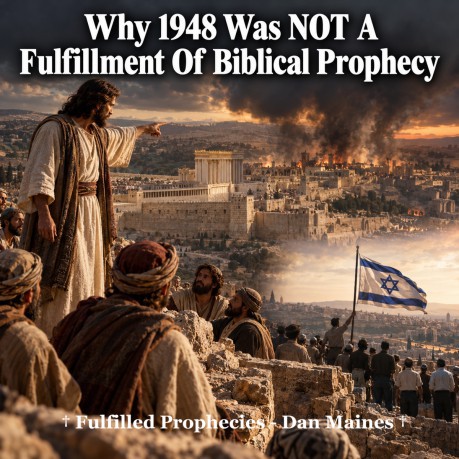
Why 1948 Was NOT A
Fulfillment Of Biblical Prophecy Introduction Matthew 24:32-34 Luke 21:20-22 But when you see Jerusalem
surrounded by armies, then recognize that her desolation is near.
Then those who are in Judea must flee to the mountains, and those who
are inside the city must leave, and those who are in the country must
not enter the city; because these are days of punishment, so that all
things which have been written will be fulfilled. Ezekiel 37:11-14 Ezekiel 37:24-26 Isaiah 11:10-12 Amos 9:11-12 Galatians 3:16 Galatians 3:28-29 Romans 9:6-8 Romans 11:5-7 2 Corinthians 1:20 Hebrews 8:13 Historical References How It Applies To Us Today Q & A Appendix Q: Doesn't the fig tree in Matthew 24 represent
Israel becoming a nation again? Q: Doesn't Isaiah 11 predict Jews returning to
Israel from every nation? Q: Didn't God promise Abraham the land
forever? Q: Doesn't Romans 11 promise that all Israel will
be saved? Q: Does rejecting 1948 as prophecy mean God has
rejected Jewish people? Q: Did the church replace Israel? Q: Why do so many evangelical teachers connect
1948 with prophecy? Q: If 1948 wasn't prophetic fulfillment, what
should Christians be watching for today? Q: What is the greatest mistake in making 1948
the center of biblical prophecy? † This is the fulfilled perspective we proclaim at
Fulfilled Prophecies † Source Index
By Dan Maines
† On May 14,
1948, the modern State of Israel was established. Since that day,
many evangelical teachers have claimed that this political event
fulfilled biblical prophecy and began the countdown to Christ's
return.
† But there's a serious problem with
that interpretation. The New Testament never identifies a modern
Jewish nation as the fulfillment of God's promises, and Jesus never
told His disciples to watch for a political event nearly two thousand
years in their future (Matthew 24:34; Luke 21:20-22).
†
Much of modern dispensational eschatology depends on the assumption
that the establishment of Israel in 1948 fulfilled Ezekiel 37, Isaiah
11, and other restoration prophecies. Once that assumption is
accepted, teachers begin constructing prophetic timelines involving a
rebuilt temple, a future tribulation, an Antichrist, and a future
earthly kingdom.
† But an interpretation
can't become biblical truth simply because it's popular. We must
examine what the prophets actually promised, how the apostles
interpreted those promises, and when Jesus said the fulfillment would
occur (Luke 24:44; Acts 3:24).
† The biblical
restoration of Israel wasn't about establishing another political
nation. It was about bringing God's covenant promises to their
fulfillment in Jesus Christ, gathering His people into one body, and
establishing the everlasting kingdom (Luke 1:32-33; Ephesians
2:14-16).
† The question isn't whether Israel
became a modern nation in 1948. That's an established historical
fact. The question is whether Scripture identifies that event as the
fulfillment of prophecy. It doesn't.
Now learn the parable from
the fig tree: as soon as its branch has become tender and sprouts its
leaves, you know that summer is near; so you too, when you see all
these things, recognize that He is near, right at the door. Truly I
say to you, this generation will not pass away until all these things
take place.
† The fig tree illustration is
frequently used to claim that Israel became a nation in 1948 and that
the generation witnessing that event would see Christ's return. But
Jesus never identified the fig tree as the modern State of Israel
(Luke 21:29-31).
† Luke's parallel account
mentions the fig tree and all the trees. That makes the illustration
about recognizing the nearness of an event from visible signs, not
identifying a particular modern nation (Luke 21:29-31).
†
Jesus told His disciples that the generation hearing His words
wouldn't pass away before all those things occurred. He didn't say a
generation beginning in 1948 would witness their fulfillment (Matthew
23:36; Luke 21:32).
† The destruction of
Jerusalem and its temple in AD 70 provides the historical setting for
His warning. Turning the fig tree into a prediction of 1948 ignores
the audience, context, and time limitation Jesus established (Matthew
24:1-3; Luke 21:20-24).
†
Jesus identified the approaching destruction of Jerusalem by
surrounding armies as the sign of its coming desolation. He
instructed people living in Judea to flee, not future generations to
watch for the establishment of a modern nation (Matthew 24:15-16).
†
His warning concerned a specific city, a specific people, and a
judgment that would come upon the generation rejecting Him (Luke
19:41-44; Matthew 23:35-38).
† Jesus called
those events days of vengeance in which the things written concerning
that judgment would be fulfilled. The Roman destruction of Jerusalem
in AD 70 fits the historical setting of His warning (Daniel 9:26;
Luke 21:32).
† The prophecy concerned the end
of Jerusalem's Old Covenant order, not the beginning of a modern
political state nearly nineteen centuries later (Hebrews 8:13;
Hebrews 10:9).
Then He said to me, "Son
of man, these bones are the entire house of Israel; behold, they say,
'Our bones are dried up and our hope has perished. We are completely
cut off.' Therefore prophesy and say to them, 'This is what the Lord
God says: "Behold, I am going to open your graves and cause you
to come up out of your graves, My people; and I will bring you into
the land of Israel. Then you will know that I am the Lord, when I
have opened your graves and caused you to come up out of your graves,
My people. And I will put My Spirit within you and you will come to
life, and I will place you on your own land. Then you will know that
I, the Lord, have spoken and done it," declares the Lord.'"
†
Ezekiel spoke to a people experiencing exile and covenant judgment.
The valley of dry bones portrayed Israel's hopeless condition and
God's promise to restore His people (Ezekiel 37:1-10).
†
The prophecy included restoration to the land, but it also promised
spiritual life through God's Spirit. We can't isolate the
geographical language and ignore the spiritual transformation at the
center of the vision (Ezekiel 36:26-27).
†
Israel's historical return from Babylonian exile began centuries
before Christ. The deeper promise of spiritual restoration reached
its fulfillment through the Messiah and the New Covenant (Ezra 1:1-4;
Acts 2:32-33).
† The apostles identified the
giving of the Holy Spirit as an accomplished reality in their
generation. The modern State of Israel wasn't established through the
apostolic proclamation of Christ or the New Covenant gift of the
Spirit (Acts 2:16-18; Acts 2:38-39).
†
Ezekiel's vision can't simply be transferred to 1948 while separating
it from God's promised spiritual restoration.
And My servant David will
be king over them, and they will all have one shepherd; and they will
walk in My ordinances, and keep My statutes and follow them. And they
will live on the land that I gave to My servant Jacob, in which your
fathers lived; and they will live on it, they, and their sons and
their sons' sons, forever; and My servant David will be their leader
forever. And I will make a covenant of peace with them; it will be an
everlasting covenant with them. And I will place them and multiply
them, and set My sanctuary in their midst forever.
†
Ezekiel didn't merely predict national restoration. He promised one
shepherd, one king, an everlasting covenant, and God's permanent
dwelling among His people (John 10:14-16; Hebrews 13:20).
†
Jesus is the promised Son of David who reigns over His people. Peter
proclaimed that God raised Jesus and exalted Him to fulfill His
promise concerning David's throne (Acts 2:29-36).
†
The everlasting covenant is established through Christ's blood, not
through a modern government's declaration of independence (Luke
22:20; Hebrews 9:15).
† God's sanctuary is
now His people, built together as a dwelling of God in the Spirit.
This is the New Covenant fulfillment of the promise that God would
dwell among them (Ephesians 2:19-22; 2 Corinthians 6:16).
†
A political nation without universal recognition of Jesus as its king
can't be identified as the complete fulfillment of Ezekiel's promised
kingdom.
Then on that day The nations
will resort to the root of Jesse, Who will stand as a signal flag for
the peoples; And His resting place will be glorious. Then it will
happen on that day that the Lord Will again recover with His hand the
second time The remnant of His people who will remain, From Assyria,
Egypt, Pathros, Cush, Elam, Shinar, Hamath, And from the islands of
the sea. And He will lift up a flag for the nations And assemble the
banished ones of Israel, And will gather the dispersed of Judah From
the four corners of the earth.
† Isaiah's
prophecy is often presented as a prediction of Jewish immigration and
the establishment of Israel in 1948. But the prophecy begins with the
root of Jesse, the Messiah who becomes the gathering point for the
nations (Romans 15:12).
† Paul directly
quoted Isaiah 11:10 and applied it to Jesus Christ and the inclusion
of the Gentiles in God's people. He didn't postpone its meaning to a
modern national restoration (Romans 15:8-12).
†
The gathering of God's people takes place under the authority of the
Messiah, who brings Jews and Gentiles together through faith
(Ephesians 2:11-18).
† The apostles preached
this gathering as an unfolding reality in their own ministry.
Isaiah's promise wasn't waiting for a political declaration in 1948
(John 11:51-52; Acts 15:14-17).
"On that day I will raise
up the fallen shelter of David, And wall up its gaps; I will also
raise up its ruins And rebuild it as in the days of old; So that they
may possess the remnant of Edom And all the nations who are called by
My name," Declares the Lord who does this.
†
Amos promised the restoration of David's fallen dwelling, but the New
Testament explains how that promise was being fulfilled (Acts
15:13-18).
† At the Jerusalem council, James
appealed to Amos when explaining why Gentiles were being received
into God's people without becoming Jews under the Law of Moses (Acts
15:14-19).
† The restoration of David's house
was taking place through the reign of Christ and the gathering of
believers from the nations, not through the reestablishment of an
independent Jewish government (Acts 2:30-36).
†
James didn't instruct the church to wait for a national event
thousands of years later. He recognized the prophetic restoration in
what God was already accomplishing through the gospel (Acts
15:15-18).
Now the promises were spoken
to Abraham and to his seed. He does not say, "And to seeds,"
as one would in referring to many, but rather as in referring to one,
"And to your seed," that is, Christ.
†
Paul identified Jesus Christ as the promised offspring of Abraham.
This is foundational because God's covenant promises find their
fulfillment in Christ, not in national identity apart from Him (2
Corinthians 1:20).
† The promise to Abraham
always included blessing for the nations. Through Christ, Gentiles
receive the promised blessing and become heirs through faith
(Galatians 3:8-9, 14).
† Making the modern
State of Israel the center of prophetic fulfillment reverses Paul's
explanation. Christ is the promised heir, and belonging to Him
determines participation in the inheritance (Galatians 3:26-29).
There is neither Jew nor
Greek, there is neither slave nor free, there is neither male nor
female; for you are all one in Christ Jesus. And if you belong to
Christ, then you are Abraham's descendants, heirs according to
promise.
† Paul didn't establish two separate
covenant peoples with two separate prophetic destinations. He taught
that believers are united in Christ and share the inheritance
promised to Abraham (Ephesians 3:4-6).
†
Ethnic ancestry doesn't replace faith in Christ as the basis of New
Covenant membership. The promises are received through the Messiah,
whether a believer is Jewish or Gentile (Romans 4:11-16).
†
The church didn't replace Israel. God's promises to Israel reached
their intended fulfillment in Christ, and all who belong to Him share
in that fulfillment (Galatians 3:7-9; Ephesians 2:19).
But it is not as though the
word of God has failed. For they are not all Israel who are descended
from Israel; nor are they all children because they are Abraham's
descendants, but: "through Isaac your descendants shall be
named." That is, it is not the children of the flesh who are
children of God, but the children of the promise are regarded as
descendants.
† Paul distinguished physical
descent from membership among God's covenant people. Not everyone
descended from Israel belonged to the faithful remnant through whom
God's promise was being fulfilled (Romans 9:27).
†
This doesn't deny Jewish ancestry or history. It establishes that
God's saving promises aren't fulfilled merely by possessing a
particular ethnicity or national citizenship (Romans 2:28-29).
†
If physical descent alone never guaranteed participation in the
covenant promise, the creation of a modern nation can't automatically
establish prophetic fulfillment (Romans 4:13-16).
In the same way then, there
has also come to be at the present time a remnant according to God's
gracious choice. But if it is by grace, it is no longer on the basis
of works, since otherwise grace is no longer grace. What then? What
Israel is seeking, it has not obtained, but those who were chosen
obtained it, and the rest were hardened;
†
Paul identified a faithful remnant of Israel in his own day. That
remnant received God's promises through grace and faith in Christ,
not through national political restoration (Romans 11:1-5).
†
The hardening of unbelieving Israel didn't prevent God from
accomplishing His purpose. Through the gospel, the faithful remnant
and believing Gentiles were brought into one covenant people (Romans
11:17-24).
† Paul's olive tree illustration
describes participation through faith. It doesn't establish a future
political nation as a separate means of covenant salvation (Romans
11:20-23).
† His expectation concerning
Israel's salvation must be read within his explanation of the
Deliverer, the removal of sins, and God's covenant mercy (Romans
11:25-27).
For as many as the
promises of God are, in Him they are yes; therefore through Him also
is our Amen to the glory of God through us.
†
Paul declared that God's promises find their confirmation in Jesus
Christ. He didn't direct believers to search for a future political
state as the final proof of God's faithfulness (Luke 24:44).
†
Christ fulfilled the Law and the Prophets, established the New
Covenant, and brought the promised blessing to those who believe
(Matthew 5:17; Hebrews 8:6).
† The foundation
of biblical eschatology must be Christ's accomplished work, not a
modern historical event interpreted through a prophetic system
(Colossians 2:16-17).
When He said, "A new
covenant," He has made the first obsolete. But whatever is
becoming obsolete and growing old is about to disappear.
†
Hebrews explained that the Old Covenant had become obsolete and was
approaching its final disappearance. The temple system was still
standing when this warning was written (Hebrews 9:8-10).
†
The destruction of Jerusalem and the temple in AD 70 visibly
confirmed the end of that covenant order. There was no biblical
requirement for the Old Covenant nation to be politically restored in
1948 (Hebrews 10:9-18).
† Christ established
a better covenant with a permanent priesthood and an effective
sacrifice. Returning prophetic attention to a future temple and
national sacrificial system moves backward from what Christ
accomplished (Hebrews 7:23-28; Hebrews 10:11-14).
†
Flavius Josephus, The Jewish War, Books 5-7, documented the Roman
siege, the destruction of Jerusalem's temple, and the devastating
consequences of the Jewish revolt in AD 70. His account provides
historical confirmation of the setting Jesus described in His warning
about Jerusalem (Luke 21:20-24).
† Tacitus,
Histories, Book 5, described the Jewish revolt and the Roman campaign
against Jerusalem. His surviving account independently confirms the
first-century conflict that brought Jerusalem under Roman judgment
(Matthew 24:1-2).
† Eusebius, Ecclesiastical
History, Book 3, chapters 5-7, preserved early Christian traditions
concerning the flight of believers from Jerusalem and connected the
city's destruction with the warnings of Christ (Luke 21:20-22).
†
The United Nations General Assembly adopted Resolution 181 on
November 29, 1947, proposing the partition of British Mandatory
Palestine into Jewish and Arab states. This was an international
political proposal, not a declaration that biblical prophecy had been
fulfilled.
† On May 14, 1948, David
Ben-Gurion proclaimed the establishment of the State of Israel. The
declaration was a historical act of national independence. It didn't
claim to be a New Testament fulfillment of Ezekiel's spiritual
restoration through Jesus Christ.
† John
Nelson Darby helped develop and popularize dispensational teaching in
the nineteenth century, long before 1948. His prophetic framework
distinguished Israel and the church and anticipated a future national
role for Israel.
† The Scofield Reference
Bible, first published in 1909, further popularized dispensational
interpretations among English-speaking evangelicals. The belief in a
future restoration of national Israel therefore preceded 1948, and
the event was subsequently interpreted by many as confirmation of
that expectation.
† Historical events must be
interpreted by Scripture. We can't take a theological system
developed centuries after the apostles and use it to override the
explanations Jesus and His apostles already provided (Acts 17:11).
†
We must distinguish historical events from biblical prophecy. The
establishment of Israel in 1948 was historically significant, but
historical significance alone doesn't establish prophetic fulfillment
(2 Peter 1:20-21).
† We must stop building
prophetic timelines around dates that Scripture never identifies.
Jesus located the judgment of Jerusalem within His own generation,
and the apostles consistently spoke of the approaching end of their
covenant age (Matthew 24:34; James 5:8-9).
†
We must read Old Testament promises through their fulfillment in
Jesus Christ. The apostles interpreted the promises to Abraham,
David, and Israel through the Messiah and the New Covenant (Acts
13:32-33; Galatians 3:16).
† We must never
confuse the modern State of Israel with the New Covenant people of
God. Jewish people, like Gentiles, are invited to receive salvation
through faith in Jesus Christ (Romans 10:9-13).
†
We must reject the idea that opposing a particular prophetic
interpretation means opposing Jewish people. Biblical interpretation,
human dignity, and contemporary political questions aren't the same
issue (Romans 12:18; Galatians 6:10).
† We
don't need another temple, another priesthood, another sacrifice, or
another national covenant. Jesus Christ has already established the
everlasting covenant through His finished work (Hebrews 9:11-15).
†
We aren't waiting for the kingdom to begin. Believers have already
been transferred into Christ's kingdom and have come to Mount Zion,
the heavenly Jerusalem (Colossians 1:13; Hebrews 12:22-24).
†
The New Jerusalem isn't a future political capital established
through military power. It's the New Covenant dwelling of God with
His redeemed people, and its gates remain open to those who come to
Christ (Revelation 21:2-3; Revelation 21:25; Revelation 22:17).
†
Our hope rests in the risen and reigning Christ, not in predicting
the next Middle Eastern conflict or calculating another prophetic
countdown (Hebrews 1:3; Ephesians 1:20-23).
Q: Was
the establishment of Israel in 1948 a fulfillment of Ezekiel 37?
A:
No. Ezekiel's prophecy included spiritual restoration, one shepherd,
an everlasting covenant, and God's dwelling among His people. Those
promises find their fulfillment in Jesus Christ and the New Covenant,
not merely in political statehood (Ezekiel 37:24-28; John 10:16;
Hebrews 13:20).
A: Jesus never
identified the fig tree as the establishment of modern Israel. Luke's
parallel mentions all the trees, and Jesus explicitly identified His
own generation as the generation witnessing the fulfillment (Matthew
24:32-34; Luke 21:29-32).
A: Isaiah described
the gathering under the root of Jesse. Paul identified that root as
Jesus Christ and applied the prophecy to the inclusion of the
Gentiles through the gospel (Isaiah 11:10-12; Romans 15:8-12).
A: God made land promises to Abraham
and his descendants, and Scripture records their historical
fulfillment in Israel's possession of the land. The New Testament
identifies Christ as Abraham's promised offspring and expands the
inheritance to all who belong to Him (Joshua 21:43-45; Galatians
3:16, 29; Romans 4:13).
A: Paul connected Israel's salvation
with the Deliverer who removes sins and with God's covenant mercy. He
didn't identify the establishment of a modern political state as the
fulfillment of that salvation (Romans 11:25-27).
A: Absolutely not. Paul
affirmed that God hadn't rejected His people and that Jewish
believers were part of the faithful remnant. Salvation remains
available to Jews and Gentiles through the same Lord Jesus Christ
(Romans 11:1-5; Romans 10:12-13).
A:
No. God's promises to Israel reached their fulfillment in Christ.
Jewish and Gentile believers are united in one body and share the
inheritance through Him (Ephesians 2:14-19; Galatians 3:28-29).
A: Many inherited a
dispensational framework that expects a future national restoration
of Israel. They interpret 1948 through that framework, but Scripture
itself never identifies that date or the modern state as the
fulfillment of the restoration prophecies (Acts 15:14-18; Galatians
3:16).
A:
Christians should live faithfully under Christ's present reign,
proclaim the gospel, and demonstrate His love. We're not instructed
to calculate future prophetic dates from modern political events
(Colossians 3:1-4; Matthew 28:18-20).
A: It shifts
the center of God's redemptive promises away from their fulfillment
in Jesus Christ and makes a modern political event the foundation for
interpreting passages the apostles already applied to Christ and His
people (2 Corinthians 1:20; Acts 13:32-33).
© Fulfilled Prophecies - Dan
Maines.
† Matthew
24:32-34; Luke 21:20-22; Ezekiel 37:11-14; Ezekiel 37:24-26; Isaiah
11:10-12; Amos 9:11-12; Galatians 3:16; Galatians 3:28-29; Romans
9:6-8; Romans 11:5-7; 2 Corinthians 1:20; Hebrews 8:13.
†
Flavius Josephus, The Jewish War, Books 5-7; Tacitus, Histories, Book
5; Eusebius, Ecclesiastical History, Book 3, Chapters 5-7; United
Nations General Assembly, Resolution 181 (1947); David Ben-Gurion,
Declaration of the Establishment of the State of Israel (1948); John
Nelson Darby, nineteenth-century dispensational writings; C. I.
Scofield, Scofield Reference Bible (1909).
Links