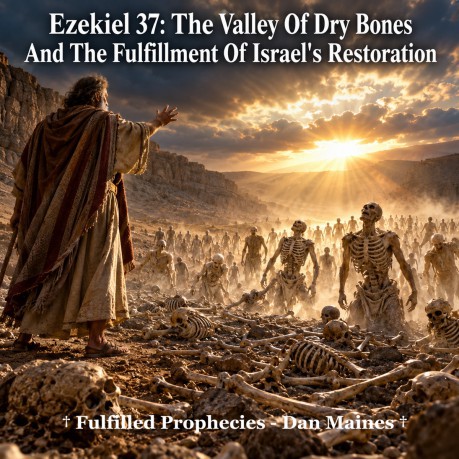
Ezekiel 37: The Valley Of Dry
Bones And The Fulfillment Of Israel's Restoration Introduction The Valley Of Dry Bones Was A Vision Of Israel's
Restoration Ezekiel 37:1-3 Ezekiel Explains What The Bones Represent Ezekiel 37:11 The Opened Graves Represent Restoration From Exile Ezekiel 37:12-14 The Two Sticks Become One Under One King Ezekiel 37:21-22 David Would Be Their King Forever Ezekiel 37:24-25 The Everlasting Covenant Of Peace Ezekiel 37:26 God's Sanctuary Would Be Among His People Ezekiel 37:27-28 Jesus Is The Shepherd Ezekiel Promised John 10:14-16 Peter Declared That David's Throne Was Occupied Acts 2:30-33 The New Covenant Replaced The Old Covenant Hebrews 8:13 The Promise Includes Those Who Belong To Christ Galatians 3:28-29 The Promised Dwelling Is The New Jerusalem Revelation 21:2-3 Historical References Why The Futurist Interpretation Fails How It Applies To Us Today Q & A Appendix † This is the fulfilled perspective we proclaim at
Fulfilled Prophecies † Source Index
By Dan Maines
† Ezekiel 37
is one of the most misunderstood chapters in biblical prophecy.
Futurists frequently claim that the valley of dry bones predicts the
modern nation of Israel, a future national conversion, and an earthly
kingdom that Jesus will establish thousands of years after His first
coming.
† But Ezekiel wasn't describing the
political establishment of a modern nation. He was revealing God's
promise to restore His covenant people, reunite them under one King,
give them His Spirit, and establish an everlasting covenant of peace
(Ezekiel 36:26-27; 37:21-28).
† The New
Testament identifies Jesus Christ as the promised Son of David, the
Good Shepherd, and the mediator of the New Covenant. His kingdom
wasn't postponed, and His reign didn't depend on a future political
restoration (Luke 1:32-33; John 10:16; Hebrews 8:6-13).
†
To understand Ezekiel 37 correctly, we must allow the prophet to
explain his own vision and then examine how Jesus and His apostles
revealed its fulfillment.
The hand of the Lord was upon
me, and He brought me out by the Spirit of the Lord and set me down
in the middle of the valley; and it was full of bones. He had me pass
among them all around, and behold, there were very many on the
surface of the valley; and behold, they were very dry. Then He said
to me, "Son of man, can these bones live?" And I answered,
"Lord God, You Yourself know."
†
Ezekiel saw a prophetic vision, not a prediction that dead bodies
would physically rise from graves in the twenty-first century
(Ezekiel 37:11-14).
† The dry bones
represented Israel's hopeless condition following national judgment,
exile, and the apparent collapse of its covenant promises (Jeremiah
25:11; Lamentations 3:17-20).
† God was
demonstrating that restoration depended entirely on His power. Israel
couldn't restore itself through military strength, political
independence, or human achievement (Zechariah 4:6).
†
The vision begins with a spiritually and nationally devastated
people, not a prediction about the boundaries of a modern political
state (Ezekiel 36:24-27).
Then He said to me, Son of
man, these bones are the entire house of Israel; behold, they say,
'Our bones are dried up and our hope has perished. We are completely
cut off.'
† God explicitly identified the
bones as the whole house of Israel. He didn't identify them as a
modern government or a future army (Ezekiel 37:1-10).
†
Their problem was hopelessness and separation, and God's promised
solution was restoration through His covenant faithfulness (Isaiah
49:14-16; Jeremiah 31:31-34).
† The phrase
whole house of Israel is important because Ezekiel later describes
the reunification of Judah and Joseph under one King (Ezekiel
37:15-22).
† Futurism frequently begins with
modern Israel and reads that assumption backward into the prophecy.
Biblical interpretation must begin with Ezekiel's original audience
and God's explanation of the vision (Ezekiel 33:21; 37:11).
Therefore prophesy and say
to them, 'This is what the Lord God says: "Behold, I am going to
open your graves and cause you to come up out of your graves, My
people; and I will bring you into the land of Israel. Then you will
know that I am the Lord, when I have opened your graves and caused
you to come up out of your graves, My people. And I will put My
Spirit within you and you will come to life, and I will place you on
your own land. Then you will know that I, the Lord, have spoken and
done it," declares the Lord.'"
†
The opened graves picture Israel's recovery from a condition
resembling national death. The language belongs to the vision's
symbolic portrayal of restoration (Hosea 6:1-2; Isaiah 26:19).
†
The promise contains two connected themes, return to the land and the
gift of God's Spirit. We shouldn't ignore either theme or assume both
must occur in a modern political restoration (Ezekiel 36:24-27).
†
The historical return from Babylon began under Cyrus, and the
rebuilding of Jerusalem and the temple followed under Persian rule
(Ezra 1:1-4; Nehemiah 6:15-16).
† Yet the
deeper promise of spiritual renewal reaches its fulfillment through
Christ and the outpouring of the Holy Spirit (Acts 2:16-18, 32-33;
Titus 3:5-6).
† Ezekiel's vision therefore
connects Israel's historical restoration with the greater covenant
renewal accomplished through the Messiah (Jeremiah 31:31-34; Hebrews
8:6-13).
And say to them, This is
what the Lord God says: Behold, I am going to take the sons of Israel
from among the nations where they have gone, and I will gather them
from every side and bring them into their own land; and I will make
them one nation in the land, on the mountains of Israel; and one king
will be king for all of them; and they will no longer be two nations,
and no longer be divided into two kingdoms.
†
The two sticks represented Judah and Joseph, the divided covenant
people who had been separated following the reign of Solomon (Ezekiel
37:15-20; 1 Kings 12:16-20).
† The prophecy
promised reunification under one King, not the permanent restoration
of two competing national kingdoms (Ezekiel 37:24).
†
Jesus came to gather God's scattered children into one people. John
specifically connects His approaching death with gathering those
children together (John 11:51-52).
† Christ
also declared that He had other sheep who would become one flock
under one Shepherd, revealing the unity accomplished through His
ministry (John 10:16).
† Paul explained that
Christ made Jews and Gentiles one, breaking down the dividing wall
and creating one new humanity through the cross (Ephesians
2:14-18).
† The unity promised through the
Messiah is covenantal and spiritual. It isn't dependent on restoring
the territorial divisions of ancient Israel (Galatians 3:26-29;
Ephesians 4:4-6).
And My servant David will
be king over them, and they will all have one shepherd; and they will
walk in My ordinances, and keep My statutes and follow them. And they
will live on the land that I gave to My servant Jacob, in which your
fathers lived; and they will live on it, they, and their sons and
their sons' sons, forever; and My servant David will be their leader
forever.
† David had already died centuries
before Ezekiel delivered this prophecy. The promised Davidic ruler
therefore points beyond David himself to the Messiah from his royal
line (2 Samuel 7:12-16; Isaiah 9:6-7).
†
Gabriel announced that Jesus would receive David's throne and reign
over the house of Jacob forever, with no end to His kingdom (Luke
1:32-33).
† Peter declared that God raised
Jesus from the dead in fulfillment of His oath to David and that
Christ had been exalted to God's right hand (Acts 2:29-36).
†
Jesus didn't fail to receive His throne at His first coming. His
resurrection and exaltation established Him as the reigning Davidic
Messiah (Acts 13:32-34; 1 Corinthians 15:25).
†
The promise of an everlasting reign can't be reduced to a temporary
earthly administration lasting one thousand literal years (Daniel
7:13-14; Hebrews 1:8).
† The land language
belongs to Israel's covenant promises, while the New Testament
reveals the greater inheritance secured in Christ, an enduring
heavenly country and kingdom (Hebrews 11:13-16; 12:22-28).
†
Futurism postpones the reign that the apostles proclaimed as already
established through Christ's resurrection and exaltation (Colossians
1:13; Revelation 1:5-6).
And I will make a covenant of
peace with them; it will be an everlasting covenant with them. And I
will place them and multiply them, and set My sanctuary in their
midst forever.
† Ezekiel didn't promise
another temporary covenant built around animal sacrifices. He
announced an everlasting covenant of peace (Isaiah 54:10; Jeremiah
31:31-34).
† Jesus identified His blood as
the blood of the covenant poured out for forgiveness, establishing
the promised covenant relationship through His sacrifice (Matthew
26:28; Hebrews 9:15).
† The New Covenant
isn't awaiting a future national inauguration. Christ is already its
mediator, and His completed sacrifice provides permanent access to
God (Hebrews 8:6; 10:19-22).
† Paul explained
that Christ Himself is our peace, reconciling those who were
separated and bringing them near to God (Ephesians 2:13-18).
†
The everlasting covenant of peace is fulfilled in Jesus Christ, not
in a future political treaty involving the modern nation of Israel
(Romans 5:1; Colossians 1:19-22).
My dwelling place also will
be among them; and I will be their God, and they will be My people.
And the nations will know that I am the Lord who sanctifies Israel,
when My sanctuary is in their midst forever.
†
God's promise wasn't merely to construct another physical building.
The ultimate purpose was His permanent dwelling among His redeemed
people (Leviticus 26:11-12; 2 Corinthians 6:16).
†
John declared that the Word became flesh and dwelt among us,
revealing God's presence in Jesus Christ (John 1:14).
†
Paul identified believers as God's temple, with the Holy Spirit
dwelling among them (1 Corinthians 3:16; Ephesians 2:19-22).
†
The New Jerusalem contains no physical temple because the Lord God
Almighty and the Lamb are its temple (Revelation 21:22).
†
Revelation uses Ezekiel's covenant dwelling language to describe
God's completed relationship with His people (Revelation 21:2-3).
†
A future temple with renewed animal sacrifices would move backward
toward the shadows after Christ had accomplished the reality to which
they pointed (Hebrews 10:1-18; Colossians 2:16-17).
I am the good shepherd, and I
know My own, and My own know Me, just as the Father knows Me and I
know the Father; and I lay down My life for the sheep. And I have
other sheep that are not of this fold; I must bring them also, and
they will listen to My voice; and they will become one flock, with
one shepherd.
† Jesus directly identified
Himself as the Good Shepherd, fulfilling the promised leadership of
God's people (Ezekiel 34:23-24).
† His death
brought salvation and reconciliation, creating the foundation for one
united flock (John 11:51-52; Ephesians 2:16).
†
The gathering wasn't postponed for thousands of years. Jesus
announced that He was accomplishing it through His own ministry (John
12:32; John 17:20-23).
† The Messiah's sheep
are identified by their relationship with Him, not merely by national
ancestry or geographic residence (John 10:27-29; Romans 9:6-8).
So because he was a prophet and
knew that God had sworn to him with an oath to seat one of his
descendants on his throne, he looked ahead and spoke of the
resurrection of the Christ, that He was neither abandoned to Hades,
nor did His flesh suffer decay. It is this Jesus whom God raised up,
a fact to which we are all witnesses. Therefore, since He has been
exalted at the right hand of God, and has received the promise of the
Holy Spirit from the Father, He has poured out this which you both
see and hear.
† Peter connected God's promise
to David directly with Christ's resurrection and exaltation (Psalm
132:11; Acts 2:34-36).
† Jesus had already
received the promised Spirit and poured Him out upon His people,
demonstrating His messianic authority (John 16:7; Acts 2:16-18).
†
The apostles didn't preach that Jesus had failed to establish His
kingdom and would return thousands of years later to begin His reign
(Acts 17:6-7; Colossians 1:13).
† Christ's
heavenly enthronement is the fulfillment of the Davidic kingship, not
a substitute for a failed earthly kingdom (Daniel 7:13-14; Hebrews
10:12-13).
When He said, "A new
covenant," He has made the first obsolete. But whatever is
becoming obsolete and growing old is about to disappear.
†
Hebrews identifies the Old Covenant as obsolete and approaching its
final disappearance in the first-century covenant transition (Hebrews
8:6-12).
† Jesus established the New Covenant
through His blood, making the former sacrificial system unnecessary
(Luke 22:20; Hebrews 10:9-14).
† The
destruction of Jerusalem and its temple in AD 70 publicly
demonstrated the end of the old covenant order that had already been
rendered obsolete through Christ (Matthew 24:1-3, 34; Hebrews
10:37).
† Restoring the former covenant
system would contradict the finality of Christ's sacrifice and
priesthood (Hebrews 7:11-28; 10:18).
There is neither Jew nor
Greek, there is neither slave nor free, there is neither male nor
female; for you are all one in Christ Jesus. And if you belong to
Christ, then you are Abraham's descendants, heirs according to
promise.
† Paul identified belonging to
Christ as the basis for participation in Abraham's promised
inheritance (Galatians 3:7-9, 16).
† This
doesn't mean the church replaced Israel as though God's promises had
failed. It means those promises reached their intended fulfillment
through Israel's Messiah (Romans 15:8-12).
†
Jews and Gentiles who belong to Christ share one covenant inheritance
rather than separate salvation programs (Ephesians 3:4-6).
†
The promise is fulfilled through faith in Christ, not through the
establishment of a modern political nation (Romans 4:13-16;
Philippians 3:3).
And I saw the holy city,
new Jerusalem, coming down out of heaven from God, prepared as a
bride adorned for her husband. And I heard a loud voice from the
throne, saying, Behold, the tabernacle of God is among the people,
and He will dwell among them, and they shall be His people, and God
Himself will be among them,
† Revelation
repeats Ezekiel's promise that God would dwell among His people,
identifying its ultimate fulfillment with the New Jerusalem (Ezekiel
37:27).
† The New Jerusalem represents the
completed covenant relationship between God and His redeemed people,
not a future political capital (Galatians 4:26; Hebrews 12:22-24).
†
John was told that the prophetic events were near and must soon take
place, locating their fulfillment within the first-century prophetic
horizon (Revelation 1:1-3; 22:6-10).
† The
earthly temple was removed in AD 70, but God's spiritual dwelling
with His people remains forever through Jesus Christ (John 4:21-24;
Ephesians 2:19-22).
†
Josephus, Antiquities of the Jews, Book 11, chapters 1-4, records the
return from Babylonian exile, the rebuilding of the temple, and the
restoration of Jewish worship under Persian rule. This establishes
the historical background for Israel's return from captivity.
†
Josephus, The Jewish War, Book 6, chapters 4-5, records the
destruction of Jerusalem's temple in AD 70. The removal of that
sanctuary provides historical context for the New Testament's
teaching about the passing of the former covenant order.
†
Eusebius, Ecclesiastical History, Book 3, chapter 5, describes the
departure of Jerusalem's Christian community before the Roman
destruction, connecting the first-century crisis with the warnings of
Jesus.
† These historical writers confirm
important events surrounding the return from exile and the
destruction of Jerusalem. The fulfillment of Ezekiel's spiritual
promises, however, must be established from Scripture rather than
historical testimony alone (Luke 24:44-47; Acts 3:18-24).
†
Futurism separates Ezekiel's promised King from the reign Jesus
already received through His resurrection and exaltation (Acts
2:30-36).
† It postpones the promised
Shepherd even though Jesus identified Himself as that Shepherd and
gathered His flock (John 10:14-16).
† It
expects a future covenant restoration even though Christ has already
established the everlasting New Covenant through His blood (Hebrews
8:6; 13:20).
† It looks toward another
physical sanctuary even though believers are God's temple and Christ
is the fulfillment of the sacrificial system (Ephesians 2:19-22;
Hebrews 10:1-18).
† It treats national
identity as the controlling issue even though the apostles identified
Christ as the fulfillment of God's promises and united believers in
Him (2 Corinthians 1:20; Galatians 3:28-29).
†
The modern State of Israel was established in 1948, but Ezekiel 37
doesn't identify that event, provide that date, or teach that a
modern government would inaugurate the everlasting covenant (Ezekiel
37:24-28).
† The return from exile addressed
Israel's historical captivity, while the promised Davidic King,
Spirit, covenant, and divine dwelling find their greater fulfillment
in Jesus Christ (Ezra 1:1-4; Luke 1:32-33; Acts 2:33).
†
Scripture provides no reason to postpone these accomplished realities
into a future earthly millennium (Hebrews 12:22-28; Revelation
1:5-6).
†
We aren't waiting for dry bones to become a future political nation.
We're living in the New Covenant established through Jesus Christ (2
Corinthians 3:5-6; Hebrews 8:6).
† We don't
need a rebuilt temple because God's Spirit dwells among His people,
and we have direct access to the Father through Christ (Ephesians
2:18-22).
† We don't need another Davidic
king because Jesus reigns forever as the promised Messiah (Luke
1:32-33; Hebrews 1:8).
† We aren't divided
into separate covenant peoples. Everyone who belongs to Christ shares
the promised inheritance through faith (Galatians 3:26-29).
†
We don't need to wait for a future New Jerusalem. Believers have
already come to Mount Zion and the heavenly Jerusalem (Hebrews
12:22-24).
† Ezekiel's message remains
powerful today because the God who restored hope to His people has
given us lasting life, peace, and fellowship through His Son (John
10:10; Romans 5:1-2).
† The kingdom isn't
waiting to begin. Christ reigns, His covenant stands, and His people
are His dwelling place (Colossians 1:13; Revelation 21:3).
Q: Does
Ezekiel 37 predict the establishment of modern Israel in 1948?
A:
No date or modern government is identified in the chapter. The
prophecy addresses Israel's restoration, reunification, and
everlasting covenant under the promised Davidic King. The New
Testament identifies Jesus as that King (Ezekiel 37:21-28; Luke
1:32-33).
Q: Doesn't Ezekiel say Israel would
return to its land?
A: Yes. The historical
return from Babylon addressed the land promise in its immediate
setting. The greater covenant promises of the Spirit, Messiah, and
everlasting peace are fulfilled through Christ (Ezra 1:1-4; Acts
2:33; Hebrews 8:6-13).
Q: Are the dry bones a
prophecy of a future bodily resurrection?
A:
The immediate vision identifies the bones as the whole house of
Israel in a condition of hopelessness. Its opened graves symbolize
national restoration, while the New Testament reveals the greater
spiritual life given through Christ (Ezekiel 37:11-14; John
5:24-25).
Q: Is David supposed to return
physically and reign over Israel?
A: No. The
promised Davidic ruler is Jesus Christ, the descendant of David who
was raised and exalted to God's right hand (Luke 1:32-33; Acts
2:29-36).
Q: Does the prophecy require a future
rebuilt temple?
A: No. God's promised dwelling
is fulfilled through Christ and His people. The New Jerusalem has no
physical temple because God and the Lamb are its temple (Ephesians
2:19-22; Revelation 21:22).
Q: Has the
everlasting covenant already been established?
A:
Yes. Jesus established the New Covenant through His sacrifice and is
its mediator. Its blessings aren't awaiting another covenant
inauguration (Luke 22:20; Hebrews 8:6; 13:20).
Q:
Did God's promises to Israel fail?
A: No. God's
promises reached their fulfillment in Jesus Christ, Israel's Messiah.
Jews and Gentiles who belong to Him share the promised inheritance
(Romans 15:8-12; Galatians 3:26-29).
Q: Why
does Ezekiel say forever if the physical temple and ancient nation
came to an end?
A: The everlasting realities
are the Messiah's reign, the covenant of peace, and God's dwelling
with His people. These endure in Christ beyond the temporary
institutions of the Old Covenant (Daniel 7:14; Hebrews 12:27-28;
Revelation 21:3).
Q: What is the central
mistake in the futurist interpretation?
A: It
treats the Messiah's accomplished covenant work as though it remains
unfulfilled. Jesus already reigns, has gathered His people,
established His covenant, and made them God's dwelling place (Acts
2:30-36; John 10:16; Hebrews 8:6; Ephesians 2:19-22).
© Fulfilled Prophecies - Dan
Maines.
† Ezekiel
37:1-3; Ezekiel 37:11; Ezekiel 37:12-14; Ezekiel 37:21-22; Ezekiel
37:24-25; Ezekiel 37:26; Ezekiel 37:27-28; John 10:14-16; Acts
2:30-33; Hebrews 8:13; Galatians 3:28-29; Revelation 21:2-3
†
Josephus, Antiquities of the Jews, Book 11, chapters 1-4; Josephus,
The Jewish War, Book 6, chapters 4-5; Eusebius, Ecclesiastical
History, Book 3, chapter 5
Links