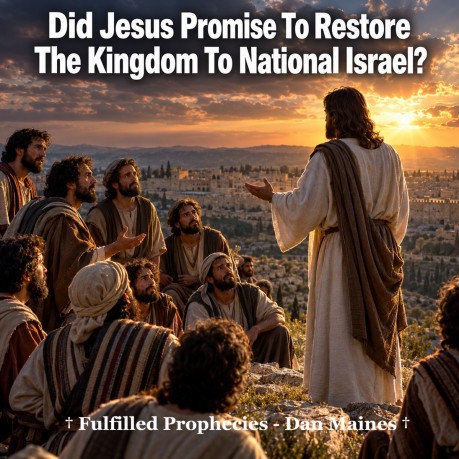
Did Jesus Promise To Restore
The Kingdom To National Israel? Introduction The Disciples Asked About The Restoration Of Israel Acts 1:6-7 Jesus Redirected Their Attention To The Holy Spirit Acts 1:8 Jesus Had Already Announced That The Kingdom Was Near Mark 1:14-15 Jesus Explained That His Kingdom Wasn't Political John 18:36 Jesus Promised The Kingdom Within That Generation Luke 21:31-32 Peter Declared That Jesus Was Already On David's Throne Acts 2:29-36 The Apostles Preached The Restoration Of All Things Acts 3:19-21 The Kingdom Was Already Being Received Colossians 1:12-14 The Promise To Israel Was Fulfilled Through Christ Galatians 3:16, 28-29 The Kingdom Cannot Be Shaken Hebrews 12:26-28 Historical References How It Applies To Us Today Q & A Appendix Q: Doesn't Acts 1:7 prove that the restoration
would happen sometime in the future? Q: Were the disciples wrong to expect the
restoration of Israel? Q: Did Jesus postpone the kingdom because Israel
rejected Him? Q: What about the promise that Jesus would sit on
David's throne? Q: Doesn't Israel still need to become a powerful
nation to fulfill God's promises? Q: Did the church replace Israel? Q: What does the destruction of Jerusalem in AD
70 have to do with the kingdom? Q: If the kingdom has already been established,
what are Christians waiting for today? Q: What is the clearest answer to someone using
Acts 1:6-7 to defend Dispensational Futurism? † This is the fulfilled perspective we proclaim at
Fulfilled Prophecies † Source Index
By Dan Maines
† One of the
passages that causes confusion for Christians leaving Dispensational
Futurism is Acts 1:6-7. The disciples asked Jesus whether He was
restoring the kingdom to Israel at that time, and Jesus didn't answer
with a simple yes or no.
† Futurists often
interpret His response as evidence that the restoration of national
Israel was postponed until a future earthly kingdom. But is that what
Jesus actually taught?
† The answer becomes
clear when we examine what Jesus had already taught about the
kingdom, what the prophets promised, what the apostles preached after
Pentecost, and what happened during the first century.
†
Jesus wasn't postponing the kingdom for thousands of years. He was
correcting the disciples' understanding of how God's kingdom would be
established and directing their attention to the mission they were
about to receive.
† The kingdom wasn't going
to be restored through political independence, military power, or a
rebuilt national government. It was being established through Jesus
Christ, the promised Son of David, and the fulfillment of God's
covenant promises (Luke 1:32-33; John 18:36; Acts 2:29-36).
†
The disciples were asking about Israel's restoration, but Jesus was
preparing them to proclaim the kingdom to Israel and the nations
(Isaiah 49:6; Acts 1:8).
So, when they had come together,
they began asking Him, saying, "Lord, is it at this time that
You are restoring the kingdom to Israel?" But He said to them,
"It is not for you to know periods of time or appointed times
which the Father has set by His own authority;
†
Notice that Jesus didn't promise a future political restoration of
national Israel. He simply told the disciples that the times and
periods were under the Father's authority (Matthew 24:36; 1
Thessalonians 5:1-2).
† Their question
reflected the expectation that Israel's kingdom would be restored,
but it didn't establish what that restoration would look like. Jesus
had already explained that His kingdom wasn't established through the
political systems of this world (John 18:36).
†
Jesus didn't say the kingdom would be postponed for thousands of
years. That conclusion must be imported into the passage because
nothing in His answer identifies a future earthly millennium (Luke
17:20-21; John 18:36).
† The disciples still
needed to understand how the promises to Israel were being fulfilled
through Christ, the Holy Spirit, and the gathering of God's people
(Luke 24:44-49; Ephesians 2:11-22).
† The
immediate context provides the explanation. Instead of describing a
future national government, Jesus directed them to the coming Holy
Spirit and their mission of witnessing to the nations (Luke 24:47-49;
Acts 2:1-4).
but you will receive power when the
Holy Spirit has come upon you; and you shall be My witnesses both in
Jerusalem and in all Judea, and Samaria, and as far as the remotest
part of the earth.
† Jesus answered their
concern about Israel by explaining what would happen next. They would
receive the Holy Spirit and become His witnesses, beginning in
Jerusalem and extending throughout the nations (Luke 24:47-49).
†
This wasn't a political program for restoring Israel's national
independence. It was the fulfillment of God's promise that salvation
would extend beyond Israel to the nations (Isaiah 49:6; Luke
2:30-32).
† Jerusalem was the starting point
because the gospel was proclaimed to Israel first, but the kingdom
wasn't restricted to Israel's national boundaries (Romans 1:16;
Ephesians 2:13-19).
† The disciples would
witness the gathering of Jews and Gentiles into one people under
Christ, fulfilling the promise that Abraham's blessing would reach
all the families of the earth (Genesis 12:3; Galatians 3:8, 28-29).
†
Jesus wasn't telling them to wait for a future Jewish political
kingdom. He was preparing them to participate in the establishment
and proclamation of His kingdom during their own generation (Matthew
24:14; Colossians 1:23).
Now after John was taken into
custody, Jesus came into Galilee, preaching the gospel of God, and
saying, "The time is fulfilled, and the kingdom of God has come
near; repent and believe in the gospel."
†
Jesus began His public ministry by announcing that the appointed time
had arrived and God's kingdom was near. He didn't announce that the
kingdom would be postponed for another two thousand years (Daniel
2:44; Galatians 4:4).
† The kingdom was
connected directly to His arrival and ministry. His miracles,
authority, and victory over evil demonstrated that God's reign was
already breaking into Israel's history (Matthew 12:28; Luke 11:20).
†
The kingdom was near because the promised King had arrived. The final
removal of the Old Covenant order would complete the first-century
transition into the established New Covenant kingdom (Hebrews 8:13;
12:26-28).
† Dispensational Futurism
separates the kingdom from Christ's first-century ministry, but Jesus
connected the kingdom directly to His presence and the fulfillment of
the appointed time (Matthew 4:17; Luke 17:20-21).
Jesus answered, "My kingdom
is not of this world. If My kingdom were of this world, My servants
would be fighting so that I would not be handed over to the Jews; but
as it is, My kingdom is not of this realm."
†
Jesus didn't deny that He was a King. He explained that His kingdom
didn't originate from the political authority and military power of
this world (John 18:37; Luke 17:20-21).
† If
His kingdom depended upon national independence, His followers would
have fought to establish it. Instead, His kingdom was established
through His death, resurrection, exaltation, and the proclamation of
the gospel (Philippians 2:8-11; Colossians 1:13-14).
†
The kingdom wasn't a failed political opportunity that needed to be
postponed. It was God's promised reign through the Messiah, whose
authority extended over heaven and earth (Matthew 28:18; Ephesians
1:20-22).
† This is why interpreting Israel's
restoration as a future political government misses the nature of the
kingdom Jesus Himself described (Romans 14:17; Hebrews 12:28).
So you too, when you see these
things happening, recognize that the kingdom of God is near. Truly I
say to you, this generation will not pass away until all things take
place.
† Jesus connected the fulfillment of
His prophetic warnings with the generation listening to Him. He
didn't identify a generation thousands of years in the future
(Matthew 23:36; 24:34).
† The surrounding
passage identifies Jerusalem's coming destruction as the fulfillment
of what had been written, placing these events within Israel's
first-century judgment (Luke 21:20-24).
† The
kingdom was already present in Christ's ministry, but the removal of
the Old Covenant system would publicly demonstrate the passing of the
former covenant order (Hebrews 8:13; 12:26-28).
†
Jerusalem's destruction in AD 70 didn't create Christ's authority. It
marked the decisive historical judgment upon the covenant system that
had rejected Him (Matthew 21:42-43; 23:37-38).
†
Jesus gave His disciples a generational time frame, not an indefinite
postponement (Matthew 16:27-28; 24:34).
"Brothers, I may
confidently say to you regarding the patriarch David that he both
died and was buried, and his tomb is with us to this day. So because
he was a prophet and knew that God had sworn to him with an oath to
seat one of his descendants on his throne, he looked ahead and spoke
of the resurrection of the Christ, that He was neither abandoned to
Hades, nor did His flesh suffer decay. It is this Jesus whom God
raised up, a fact to which we are all witnesses. Therefore, since He
has been exalted at the right hand of God, and has received the
promise of the Holy Spirit from the Father, He has poured out this
which you both see and hear. For it was not David who ascended into
heaven, but he himself says: 'The Lord said to my Lord, "Sit at
My right hand, Until I make Your enemies a footstool for Your feet."'
Therefore let all the house of Israel know for certain that God has
made Him both Lord and Christ-this Jesus whom you crucified."
†
Peter explained the fulfillment of God's promise to David by
connecting the resurrection and exaltation of Jesus with His promised
royal authority (Psalm 132:11; Luke 1:32-33).
†
Peter didn't announce that Jesus had failed to establish the kingdom
or that David's throne would remain vacant for thousands of years. He
proclaimed that Jesus had been exalted to God's right hand (Psalm
110:1; Ephesians 1:20-22).
† The promised Son
of David was already reigning. His throne wasn't dependent upon a
future political government in Jerusalem (Hebrews 1:3, 8;
10:12-13).
† The outpouring of the Holy
Spirit was evidence of Christ's exaltation, connecting the promise of
the kingdom with what the disciples experienced at Pentecost (Joel
2:28-32; John 7:39).
† Peter's explanation
answers the question raised earlier. Israel's promised King had been
enthroned through His resurrection and ascension, not through the
restoration of a national monarchy (Romans 1:3-4; Philippians
2:9-11).
Therefore repent and return, so
that your sins may be wiped away, in order that times of refreshing
may come from the presence of the Lord; and that He may send Jesus,
the Christ appointed for you, whom heaven must receive until the
period of restoration of all things, about which God spoke by the
mouths of His holy prophets from ancient times.
†
Peter connected the restoration of all things with what God had
promised through the prophets. The passage must be understood within
the prophetic promises concerning Christ and His covenant work (Luke
24:44; Acts 3:24-26).
† The restoration
wasn't merely about rebuilding Israel's political government. It
concerned the fulfillment of God's redemptive promises, including
forgiveness, covenant renewal, and the blessing promised through
Abraham (Genesis 22:18; Galatians 3:14).
†
Peter was addressing the very generation that had rejected and
crucified Jesus, calling them to repentance while the covenant
transition was underway (Acts 2:36-40; Hebrews 8:13).
†
The restoration of all things didn't require the restoration of
animal sacrifices, the Levitical priesthood, or the Old Covenant
temple. Those institutions had reached their fulfillment in Christ
(Hebrews 7:11-12; 9:11-12).
† The promise of
restoration must be interpreted through Christ's completed work
rather than through an expectation that the former covenant system
would return (2 Corinthians 1:20; Hebrews 10:1-14).
giving thanks to the
Father, who has qualified us to share in the inheritance of the
saints in light. For He rescued us from the domain of darkness, and
transferred us to the kingdom of His beloved Son, in whom we have
redemption, the forgiveness of sins.
† Paul
didn't describe the kingdom as something believers would enter only
after a future earthly millennium began. He said they had already
been transferred into the kingdom of God's Son (Romans 14:17; 1
Corinthians 4:20).
† This happened during the
first century, while the apostles were still preaching the gospel and
the Old Covenant system was approaching its end (Hebrews 8:13;
10:37).
† If the kingdom had been postponed,
Paul couldn't have described believers as already belonging to it (1
Thessalonians 2:12; Revelation 1:6).
†
Christ's kingdom was a present spiritual reality, and the approaching
judgment upon Jerusalem would complete the removal of the former
covenant order (Hebrews 12:26-28; Matthew 21:43).
†
The kingdom wasn't waiting for the establishment of another earthly
Jewish government. Its citizens were already being gathered through
faith in Christ (Galatians 3:26-29; Philippians 3:20).
Now the promises were
spoken to Abraham and to his seed. He does not say, "And to
seeds," as one would in referring to many, but rather as in
referring to one, "And to your seed," that is, Christ.
There is neither Jew nor Greek, there is neither slave nor free,
there is neither male nor female; for you are all one in Christ
Jesus. And if you belong to Christ, then you are Abraham's
descendants, heirs according to promise.
†
Paul identified Christ as the promised descendant of Abraham and
explained that everyone belonging to Christ shares in Abraham's
inheritance (Romans 4:13-16; Ephesians 3:6).
†
God's promises weren't abandoned, and Israel wasn't simply replaced
by an unrelated people. The promises reached their intended
fulfillment through Israel's Messiah (Romans 15:8-12; 2 Corinthians
1:20).
† Believing Jews and Gentiles became
one people in Christ, sharing the same inheritance rather than
belonging to separate covenant kingdoms (Ephesians 2:14-19; 3:6).
†
The restoration of Israel wasn't the recreation of the Old Covenant
nation. It was the fulfillment of God's covenant purpose through
Christ and the gathering of His people (Romans 9:6-8; 11:5-7).
†
The kingdom belongs to Christ and everyone united to Him by faith,
not to a future national system based upon physical ancestry (John
1:12-13; Galatians 3:7-9).
And His voice shook the
earth then, but now He has promised, saying, "Yet once more I
will shake not only the earth, but also the heaven." This
expression, "Yet once more," denotes the removing of those
things which can be shaken, as of created things, so that those
things which cannot be shaken may remain. Therefore, since we receive
a kingdom which cannot be shaken, let's show gratitude, by which we
may offer to God an acceptable service with reverence and awe;
†
The writer of Hebrews described believers as receiving an unshakable
kingdom while the former covenant order was approaching its removal
(Hebrews 8:13; 10:9).
† The shaking
represented the removal of what belonged to the temporary covenant
system so that what was permanent in Christ would remain (Haggai
2:6-9; Hebrews 9:8-10).
† The destruction of
Jerusalem and its temple in AD 70 demonstrated that the former system
had reached its end. Christ's kingdom remained because it wasn't
dependent upon that earthly sanctuary (John 4:21-24; Hebrews 9:11).
†
The kingdom Jesus established wasn't temporary, postponed, or
awaiting a replacement. It was the everlasting kingdom promised
through the prophets (Daniel 7:13-14; Luke 1:33).
†
Flavius Josephus, writing in The Jewish War, Books 5-7, described the
Roman siege of Jerusalem, the destruction of the temple, and the
collapse of the Jewish national and religious center in AD 70. These
events provide historical confirmation of the judgment Jesus
predicted upon Jerusalem (Luke 19:41-44; 21:20-24).
†
Tacitus, in Histories 5.10-13, described the conflict surrounding
Jerusalem and the Roman campaign against the city. His account
provides additional historical context for the first-century
destruction of Jerusalem (Matthew 24:1-2; Luke 21:20).
†
Eusebius, in Ecclesiastical History 3.5-7, connected Jerusalem's
destruction with the suffering of the Jewish nation and recorded the
tradition that Christians had departed from Jerusalem before its fall
(Matthew 24:15-16; Luke 21:20-22).
† These
historical accounts don't establish doctrine by themselves. Scripture
establishes the meaning of the events, while the historical writers
help confirm that Jerusalem and its temple were destroyed within the
generation Jesus addressed (Matthew 24:34; Luke 21:32).
†
We don't need to wait for Jesus to become King. He already reigns at
the Father's right hand, possessing all authority in heaven and on
earth (Matthew 28:18; Ephesians 1:20-22).
†
We don't need a rebuilt temple, renewed animal sacrifices, or a
restored Levitical priesthood. Jesus fulfilled what those
institutions represented and established the better covenant (Hebrews
8:6; 9:11-12; 10:12-18).
† We don't need to
divide God's people into separate Jewish and Gentile kingdoms.
Everyone who belongs to Christ shares in the same inheritance and has
access to the Father through the same Spirit (Galatians 3:28-29;
Ephesians 2:18-22).
† We don't need to look
for the kingdom through political events in modern Israel. Jesus
taught that His kingdom wasn't established through the political
power of this world (John 18:36; Romans 14:17).
†
We have already come to Mount Zion, the heavenly Jerusalem, and the
assembly of those who belong to God (Hebrews 12:22-24; Galatians
4:26).
† Our responsibility isn't to wait for
an unfinished prophetic program. It's to live faithfully under
Christ's present reign, proclaim the gospel, love one another, and
serve God with gratitude (Colossians 3:12-17; Hebrews 12:28).
†
The question in Acts 1 wasn't whether Jesus would someday become
King. The apostles soon proclaimed that He had already been exalted
as Lord and Christ (Acts 2:33-36).
† The
restoration promised to Israel was fulfilled through Israel's
Messiah, and everyone who belongs to Him now shares in the blessings
of His everlasting kingdom (Romans 15:8-12; Galatians 3:29).
Q: Why
didn't Jesus simply answer yes or no when the disciples asked about
restoring the kingdom to Israel?
A: Jesus
redirected their attention from the timing of Israel's restoration to
the coming Holy Spirit and their mission as witnesses. His answer
didn't promise a future political kingdom, and His earlier teaching
had already established the spiritual nature of His reign (Acts
1:6-8; John 18:36).
A: It
establishes that the Father controlled the times and periods, but it
doesn't identify a restoration thousands of years later. The
following verse directs the disciples toward the first-century
proclamation of the gospel (Acts 1:7-8; Luke 24:47-49).
A: They weren't wrong to
expect God's promises to Israel to be fulfilled. The misunderstanding
concerned the nature and manner of that fulfillment. Jesus was
establishing His kingdom through His resurrection, exaltation, and
the work of the Holy Spirit rather than through a national political
government (Luke 1:32-33; Acts 2:29-36).
A: No. Jesus announced that the
kingdom was near, and Paul later declared that believers had already
been transferred into Christ's kingdom. Scripture doesn't teach that
the kingdom was postponed because Israel rejected its Messiah (Mark
1:14-15; Colossians 1:13-14).
A: Peter connected God's
promise to David with Jesus' resurrection and exaltation. Christ was
already reigning at God's right hand when Peter preached at Pentecost
(Acts 2:29-36; Psalm 110:1).
A: God's
promises find their fulfillment in Christ. The New Covenant
inheritance isn't based upon national power or physical ancestry, but
upon belonging to Abraham's promised descendant, Jesus Christ
(Galatians 3:16, 28-29; Romans 4:13-16).
A:
No. Israel's covenant promises reached their intended fulfillment in
Jesus, Israel's Messiah. Believing Jews and Gentiles were brought
together into one body through Him. The church didn't replace Israel,
God's promises reached their fulfillment in Christ (Romans 15:8-12;
Ephesians 2:14-19).
A: It marked
the historical removal of the Old Covenant temple system and
fulfilled Jesus' warnings about Jerusalem's coming judgment. Christ's
kingdom continued because it wasn't dependent upon the earthly temple
(Luke 21:20-24, 31-32; Hebrews 8:13; 12:26-28).
A: We're
not waiting for Jesus to receive His kingdom or for Old Covenant
prophecy to be fulfilled. We live under His present reign, enjoy the
blessings of the New Covenant, and continue proclaiming His salvation
to the world (Colossians 1:13-14; Hebrews 12:28; Revelation 22:17).
A:
Read verse 8, then read Peter's sermon in Acts 2. Jesus directed the
disciples toward the Holy Spirit and their mission, and Peter
proclaimed that the promised Son of David had already been raised and
exalted. The passage doesn't teach a postponed kingdom. It points
toward the fulfillment of God's promises through the reigning Christ
(Acts 1:6-8; 2:29-36).
© Fulfilled Prophecies - Dan
Maines.
† Acts
1:6-7; Acts 1:8; Mark 1:14-15; John 18:36; Luke 21:31-32; Acts
2:29-36; Acts 3:19-21; Colossians 1:12-14; Galatians 3:16, 28-29;
Hebrews 12:26-28
† Flavius Josephus, The
Jewish War, Books 5-7; Tacitus, Histories 5.10-13; Eusebius,
Ecclesiastical History 3.5-7
Links