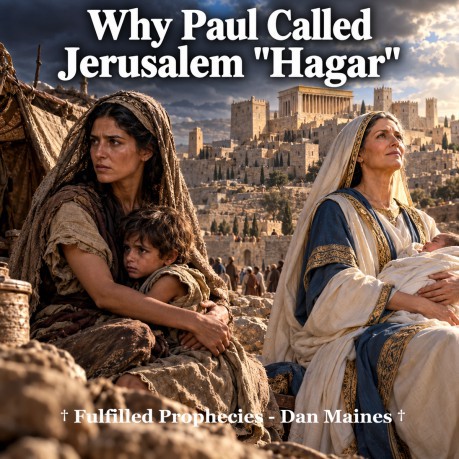
Why Paul Called Jerusalem
"Hagar" Introduction The Two Sons Of Abraham Galatians 4:21-23 The Promise Came Before The Law Galatians 3:16-18 Hagar Represented Mount Sinai Galatians 4:24-25 The Jerusalem Above Is Our Mother Galatians 4:26-27 Children Of Promise, Not Children Of Slavery Galatians 4:28-29 Cast Out The Slave Woman And Her Son Galatians 4:30-31 The Old Covenant Was Becoming Obsolete Hebrews 8:13 The Heavenly Jerusalem Was Already Accessible Hebrews 12:22-24 Jesus Announced Jerusalem's Coming Judgment Matthew 23:37-38 The New Jerusalem Is The Bride Of Christ Revelation 21:2-3 Historical References How It Applies To Us Today Q & A Appendix Q: Was Paul condemning all Jewish people? Q: Why did Hagar represent slavery? Q: Why did Sarah represent freedom? Q: What does it mean that the Jerusalem above is
our mother? Q: Did the New Covenant begin in AD 70? Q: Does Galatians 4 directly predict Jerusalem's
destruction? Q: Does God still require Christians to observe
the Mosaic Law? Q: Is the New Jerusalem a future physical
city? Q: What happened to the inheritance promised to
Abraham? Q: Why is Paul's comparison important to
fulfilled prophecy? † This is the fulfilled perspective we proclaim at
Fulfilled Prophecies † Source Index
By Dan Maines
† When Paul
called Jerusalem "Hagar," he wasn't simply comparing two
women from Genesis. He was explaining the difference between two
covenants, two Jerusalems, two kinds of children, and two completely
different relationships with God (Galatians 4:21-31).
†
Hagar represented the Old Covenant established at Mount Sinai, while
Sarah represented the promise fulfilled through Jesus Christ. Paul's
argument wasn't about the superiority of one ethnic group over
another. It was about slavery under the Law and freedom through faith
in Christ (Galatians 3:26-29; 4:24-26).
† The
remarkable part of Paul's explanation is that he identified the
Jerusalem of his own day with Hagar, the slave woman, rather than
Sarah, the free woman. Jerusalem possessed the temple, priesthood,
sacrifices, and religious traditions, yet Paul declared that the city
and her children were in slavery (Galatians 4:24-25).
†
This distinction is essential to understanding why the Old Covenant
Jerusalem faced judgment in AD 70 and why the heavenly Jerusalem is
the permanent dwelling place of God's redeemed people (Matthew
23:37-38; Hebrews 12:22-24).
† The story
begins with Abraham's two sons, but its fulfillment reaches the
establishment of the New Covenant and the removal of the Old Covenant
system (Genesis 21:9-12; Hebrews 8:13).
Tell me, you who want to
be under law, do you not listen to the Law? For it is written that
Abraham had two sons, one by the slave woman and one by the free
woman. But the son by the slave woman was born according to the
flesh, and the son by the free woman through the promise.
†
Paul addressed people who wanted to place themselves under the Mosaic
Law. His response was to take them back to Abraham, before the Law
was given, and demonstrate that God's inheritance was always
connected to His promise rather than human effort (Genesis 15:4-6;
Galatians 3:17-18).
† Ishmael was born
through Abraham and Hagar's attempt to accomplish God's promise
through human arrangements. Isaac was born because God fulfilled what
He had promised, even when Abraham and Sarah were beyond the normal
age of having children (Genesis 16:1-4; 17:15-19; Romans 4:19-21).
†
Paul's contrast wasn't between physical and nonphysical births. Both
sons were physically born. The distinction concerned the basis of
their birth and inheritance, human effort contrasted with God's
promise (Romans 9:7-9; Galatians 3:18).
†
This established the foundation of Paul's argument. Physical descent
from Abraham couldn't guarantee participation in the promised
inheritance. God's promise determined who belonged to the covenant
family (Romans 9:6-8; Galatians 3:29).
Now the promises were
spoken to Abraham and to his seed. He does not say, "And to
seeds," as one would in referring to many, but rather as in
referring to one, "And to your seed," that is, Christ. What
I am saying is this: the Law, which came 430 years later, does not
invalidate a covenant previously ratified by God, so as to nullify
the promise. For if the inheritance is based on law, it is no longer
based on a promise; but God has granted it to Abraham by means of a
promise.
† Paul identified Christ as the
promised descendant of Abraham. The inheritance wasn't ultimately
secured through the Sinai covenant because God's promise existed
centuries before Moses received the Law (Genesis 12:3; 22:18;
Galatians 3:8).
† The Law served a temporary
purpose within Israel's covenant history. It couldn't cancel the
earlier promise or establish another means of receiving the
inheritance (Galatians 3:19-25; Romans 4:13-16).
†
This is why returning to the Law after Christ had come was such a
serious mistake. It meant returning to a covenant arrangement that
had served its purpose rather than resting in the fulfillment of
God's promise (Galatians 5:1-4; Hebrews 10:1).
†
The promised inheritance belongs to Christ and those united with Him
through faith, not to a nation merely because of its physical
ancestry (Galatians 3:26-29; Ephesians 3:6).
This is speaking
allegorically, for these women are two covenants: one coming from
Mount Sinai giving birth to children who are to be slaves; she is
Hagar. Now this Hagar is Mount Sinai in Arabia and corresponds to the
present Jerusalem, for she is enslaved with her children.
†
Paul explicitly identified the two women as representing two
covenants. This wasn't an interpretation imposed upon the passage. It
was the explanation Paul himself provided (Galatians 4:22-23,
28-31).
† Hagar represented the covenant
established at Mount Sinai, the covenant under which Israel received
the Law, priesthood, sacrifices, and earthly sanctuary (Exodus
19:3-6; Hebrews 9:1-10).
† Paul then made his
most startling statement. Hagar corresponded to the Jerusalem
existing in his own generation. The city that regarded itself as the
center of God's covenant relationship was identified with the slave
woman (Galatians 4:25; Romans 10:2-4).
† The
expression "Jerusalem that now is" identified Paul's
contemporary earthly Jerusalem. It wasn't a reference to a city
thousands of years in the future (Matthew 23:36-38; Luke 21:20-22).
†
Jerusalem remained under the Mosaic covenant while rejecting the
Messiah who fulfilled its promises. Its religious leadership
continued defending the system that Christ had brought to its
intended completion (John 5:39-40; Acts 6:13-14).
†
Paul's statement also revealed that possession of the temple didn't
prove covenant freedom. The people could possess an impressive
religious system and still remain in slavery because they rejected
the freedom found in Christ (John 8:31-36; Galatians 5:1).
†
The distinction wasn't geographical superiority or ethnic
condemnation. It was a covenant distinction between those remaining
under the Law and those receiving the promise through Christ (Romans
9:30-33; Galatians 3:28-29).
But the Jerusalem above is
free; she is our mother. For it is written: "Rejoice, infertile
one, you who do not give birth; Break forth and shout, you who are
not in labor; For the children of the desolate one are more numerous
Than those of the one who has a husband."
†
Paul contrasted the earthly Jerusalem with the Jerusalem above. One
represented slavery under the Old Covenant, while the other
represented freedom through the promise fulfilled in Christ (Hebrews
12:22-24; Revelation 21:2).
† Notice that
Paul said the Jerusalem above "is" free and "is"
our mother. He spoke of a present covenant reality for believers
living in the first century, not merely a distant city awaiting
physical construction (Philippians 3:20; Hebrews 12:22).
†
Paul quoted Isaiah's promise concerning the formerly barren woman.
What appeared unproductive would become fruitful through God's
redemptive work (Isaiah 54:1-3; Romans 9:24-26).
†
Sarah's barrenness illustrated that God's covenant family would come
into existence through His promise rather than through human ability
or physical descent (Genesis 18:10-14; Romans 4:16-21).
†
The Jerusalem above is the heavenly covenant community established
through Jesus Christ. Its identity isn't determined by earthly walls,
national boundaries, or a physical temple (Ephesians 2:19-22; Hebrews
12:22-23).
† God's people don't need to
travel to the modern city of Jerusalem to enter His presence. Through
Christ, believers have access to the Father by the Holy Spirit (John
4:21-24; Ephesians 2:18).
And you, brothers and
sisters, like Isaac, are children of promise. But as at that time the
son who was born according to the flesh persecuted the one who was
born according to the Spirit, so it is even now.
†
Paul identified believers in Christ as children of promise, just as
Isaac was. Their covenant identity came through faith rather than
physical ancestry or obedience to the Mosaic Law (Galatians 3:7-9,
26-29).
† Paul also connected the conflict
between Ishmael and Isaac with the persecution experienced by
Christians in his own generation (Genesis 21:9; 1 Thessalonians
2:14-16).
† The words "so also it is
now" are significant. Paul was describing a conflict taking
place during his lifetime, while the Old Covenant system and the
emerging New Covenant community existed alongside each other (Acts
13:44-50; 14:19).
† The opposition wasn't
merely disagreement about religious customs. It concerned whether
God's promised inheritance came through the Law or through Jesus
Christ (Acts 15:1-11; Galatians 2:15-21).
†
Jewish believers who accepted Christ were children of promise, while
those who insisted upon the Law as the basis of covenant standing
remained under slavery. The distinction was faith in Christ, not
ethnicity (Romans 11:1-5, 17-23).
But what does the
Scripture say? Drive out the slave woman and her son, For the son of
the slave woman shall not be an heir with the son of the free woman."
So then, brothers and sisters, we are not children of a slave woman,
but of the free woman.
† Paul reached the
decisive conclusion of his argument. Hagar's son couldn't share the
inheritance assigned to Isaac, and the Old Covenant couldn't remain a
competing basis of inheritance alongside the New Covenant (Genesis
21:10-12; Hebrews 8:6-13).
† The command to
cast out the slave woman pointed to the exclusion of the
slavery-producing covenant arrangement from the promised inheritance.
It wasn't a command for Christians to mistreat or expel Jewish people
(Galatians 3:28-29; Romans 11:17-24).
† This
distinction is essential. The covenant was passing away, but
individuals from Israel could receive salvation through faith in
Jesus Christ. Paul himself was an Israelite who belonged to the
redeemed people of God (Romans 11:1-5; Acts 21:20).
†
The two covenants weren't intended to continue forever as equally
valid systems. The Old Covenant was temporary, while the New Covenant
established through Christ provided the promised inheritance (2
Corinthians 3:6-11; Hebrews 8:13).
† The
destruction of Jerusalem and its temple in AD 70 publicly
demonstrated the end of the earthly sacrificial and priestly system.
The New Covenant didn't begin in AD 70, but the judgment removed the
Old Covenant's central earthly institutions (Matthew 24:1-2, 34;
Hebrews 10:11-18).
† Paul wasn't predicting
the destruction of Jerusalem directly in this passage. He was
explaining the covenant distinction that makes Jerusalem's coming
judgment understandable within the larger testimony of Scripture
(Matthew 23:37-38; Luke 21:20-22).
When He said, "A new
covenant," He has made the first obsolete. But whatever is
becoming obsolete and growing old is about to disappear.
†
Hebrews confirms the covenant transition that Paul explained through
Hagar and Sarah. The establishment of the New Covenant made the first
covenant obsolete (Jeremiah 31:31-34; Hebrews 8:6-12).
†
The writer described the Old Covenant as becoming obsolete and ready
to disappear. This language fits the first-century period when the
temple system still operated but no longer provided the means of
covenant access to God (Hebrews 9:8-10; 10:1-4).
†
Christ's sacrifice accomplished what repeated animal sacrifices
couldn't accomplish. His completed work provided forgiveness and
direct access to God (Hebrews 9:11-15; 10:19-22).
†
The destruction of the temple in AD 70 ended the functioning earthly
sanctuary, but it didn't end the New Covenant. Christ's priesthood
and kingdom continue because they aren't dependent upon an earthly
temple (Hebrews 7:23-25; 12:28).
† The Old
Covenant's disappearance didn't mean God abandoned His promises. It
meant those promises reached their fulfillment in Jesus Christ (2
Corinthians 1:20; Romans 15:8-9).
But you have come to Mount
Zion and to the city of the living God, the heavenly Jerusalem, and
to myriads of angels, to the general assembly and church of the
firstborn who are enrolled in heaven, and to God, the Judge of all,
and to the spirits of the righteous made perfect, and to Jesus, the
mediator of a new covenant, and to the sprinkled blood, which speaks
better than the blood of Abel.
† The writer
didn't tell believers that they would someday come to heavenly
Jerusalem. He declared that they had already come to Mount Zion and
the city of the living God (Galatians 4:26; Philippians 3:20).
†
This heavenly Jerusalem is the covenant reality Paul identified with
Sarah, the free woman. Believers belonged to that city through their
relationship with Jesus Christ (Ephesians 2:19-22; Galatians 4:28).
†
The contrast between Mount Sinai and Mount Zion is the same covenant
distinction found in Paul's explanation of Hagar and Sarah (Hebrews
12:18-21; Galatians 4:24-26).
† Mount Sinai
represented the covenant established through Moses, while heavenly
Mount Zion represented the New Covenant mediated by Christ (2
Corinthians 3:7-11; Hebrews 8:6).
† The
heavenly Jerusalem wasn't awaiting construction by human hands. Its
foundation was God's redemptive work through Christ, and believers
already possessed citizenship in that heavenly community (Hebrews
11:10, 16; Ephesians 2:6).
† The
first-century completion of the covenant transition removed the
former order, leaving the unshakable kingdom of Christ (Hebrews
12:26-28; Daniel 7:13-14).
Jerusalem, Jerusalem, who
kills the prophets and stones those who have been sent to her! How
often I wanted to gather your children together, the way a hen
gathers her chicks under her wings, and you were unwilling. Behold,
your house is being left to you desolate!
†
Jesus identified Jerusalem's rejection of God's messengers and
announced the coming desolation of its house. The city that possessed
the temple had rejected the Messiah to whom the Scriptures pointed
(Matthew 23:29-36; John 5:39-40).
† His
judgment wasn't directed against every Jewish person. Jesus and His
apostles were Jewish, and thousands of Jewish believers became part
of the New Covenant community (Acts 2:41; 21:20).
†
The judgment concerned the covenant leadership and the city that
rejected Christ and persecuted His messengers (Matthew 21:33-43;
23:34-36).
† The earthly Jerusalem's
destruction in AD 70 was consistent with Paul's description of the
city as Hagar. The former covenant order couldn't retain the
inheritance that belonged to Christ and His redeemed people
(Galatians 4:25-31; Hebrews 8:13).
† Jesus
had already announced that these judgments would fall upon His own
generation. The fulfillment wasn't postponed thousands of years into
the future (Matthew 23:36; 24:34).
And I saw the holy city,
new Jerusalem, coming down out of heaven from God, prepared as a
bride adorned for her husband. And I heard a loud voice from the
throne, saying, Behold, the tabernacle of God is among the people,
and He will dwell among them, and they shall be His people, and God
Himself will be among them,
† John's vision
completes the covenant picture. The New Jerusalem is presented as a
bride, connecting the city with the redeemed covenant people rather
than merely describing buildings and streets (Revelation 21:9-10;
Ephesians 5:25-27).
† Paul identified the
Jerusalem above as the mother of believers, while John portrayed the
New Jerusalem as the bride. These images describe different aspects
of God's redeemed covenant community (Galatians 4:26; Revelation
21:9-10).
† The New Jerusalem comes from
heaven because the New Covenant originates with God. It isn't the
restoration of the former earthly religious system (Hebrews 8:6;
9:11).
† God's dwelling with His people
fulfills the promise of covenant fellowship. Through Christ,
believers have become God's dwelling place in the Spirit (Ezekiel
37:26-27; Ephesians 2:21-22).
† The New
Jerusalem stands in contrast to the earthly city that rejected
Christ. One belonged to the covenant passing away, while the other
expresses the enduring relationship established through the New
Covenant (Galatians 4:25-26; Hebrews 12:22-28).
†
The fulfillment of this covenant transformation in the first century
doesn't mean the physical earth disappeared. It means the former
covenant order gave way to the completed redemptive order established
through Jesus Christ (Isaiah 65:17-19; 2 Peter 3:13).
†
Flavius Josephus, a first-century Jewish historian, described the
destruction of Jerusalem and its temple by the Romans in AD 70. His
account provides historical confirmation of the judgment Jesus
announced upon the city and its religious institutions (Matthew
24:1-2; Luke 21:20-24).
† In The Jewish War,
Book 6, chapters 4-5, Josephus described the burning of the temple
and the devastation surrounding Jerusalem's fall. These events ended
the operation of the temple-centered sacrificial system that had
characterized the Mosaic covenant (Hebrews 8:13; 10:11-18).
†
Tacitus, the Roman historian, discussed the siege and destruction of
Jerusalem in Histories, Book 5. His account provides an additional
Roman historical perspective on the conflict that culminated in the
city's fall (Luke 21:20-22).
† Eusebius, in
Ecclesiastical History, Book 3, chapters 5-7, connected Jerusalem's
destruction with the earlier warnings of Jesus and recorded the
tradition that Christians had departed from Jerusalem before its
destruction (Matthew 24:15-16; Luke 21:20-21).
†
These historical writers don't establish Paul's theological meaning.
Scripture establishes that meaning. Their accounts help confirm the
first-century historical setting in which the earthly Jerusalem and
its temple-centered system came to an end (Galatians 4:25-31; Matthew
24:34).
†
We aren't children of Hagar. Through faith in Jesus Christ, we're
children of promise, belonging to the covenant family represented by
Sarah (Galatians 3:26-29; 4:28, 31).
† We
don't need to return to the Mosaic Law to obtain righteousness.
Christ fulfilled the Law, and our standing before God rests upon His
completed work (Romans 10:4; Galatians 2:16).
†
We don't need a rebuilt temple in Jerusalem. Jesus Christ is our
eternal High Priest, and believers have direct access to the Father
through Him (Hebrews 7:24-25; Ephesians 2:18).
†
We aren't waiting for an earthly Jerusalem to become the center of
God's kingdom. We've come to heavenly Mount Zion, and our citizenship
is in heaven (Hebrews 12:22-24; Philippians 3:20).
†
We don't inherit God's promises through ethnicity, religious
ceremonies, or human achievement. We receive the promised inheritance
through Christ (Romans 4:13-16; Galatians 3:29).
†
The removal of the Old Covenant doesn't mean that God's moral
standards disappeared. The New Covenant calls believers to walk by
the Spirit and demonstrate love, faithfulness, and righteousness
(Galatians 5:13-25; Romans 13:8-10).
† We
don't need another covenant, another sacrifice, or another earthly
priesthood. Christ has already established the better covenant
through His own blood (Hebrews 8:6; 9:12-15).
†
The heavenly Jerusalem isn't merely a future destination. It's our
present covenant home, and our fellowship with God continues beyond
physical death because Christ's kingdom cannot be shaken (Hebrews
12:22-28; 2 Corinthians 5:6-8).
† Paul's
message remains clear. We must never exchange the freedom Christ has
given us for the slavery of a covenant that has already fulfilled its
purpose (Galatians 5:1; Hebrews 8:13).
Q: Why
did Paul call Jerusalem "Hagar"?
A:
Because Hagar represented the covenant established at Mount Sinai,
and Paul identified the earthly Jerusalem of his own day with that
covenant and its slavery (Galatians 4:24-25).
A:
No. Paul was Jewish himself, and he taught that both Jews and
Gentiles receive the promised inheritance through faith in Christ.
His distinction concerned covenant standing, not ethnic identity
(Romans 11:1-5; Galatians 3:28-29).
A:
Hagar was a slave woman, and Paul used her position to illustrate the
bondage of those seeking righteousness and inheritance through the
Mosaic Law rather than through Christ (Galatians 4:22-25; 5:1-4).
A:
Sarah was the free woman whose son was born according to God's
promise. Paul used her to represent the New Covenant community
receiving its inheritance through Christ (Galatians 4:26-31; 3:29).
A: It means believers belong to the
heavenly covenant community established through Jesus Christ. Their
spiritual identity comes through God's promise rather than earthly
ancestry or geographical location (Galatians 4:26-28; Hebrews
12:22-24).
A:
No. Jesus established the New Covenant through His death and
resurrection. AD 70 marked the destruction of Jerusalem and its
temple, bringing the Old Covenant's earthly institutions to their
historical end (Luke 22:20; Hebrews 9:15; Matthew 24:1-2).
A: No. Paul explains the
relationship between the two covenants. Jesus directly announced
Jerusalem's coming destruction, and Hebrews described the Old
Covenant as becoming obsolete and ready to disappear (Matthew
23:36-38; 24:1-2; Hebrews 8:13).
A: No. Believers are no longer
under the Mosaic covenant as their governing covenant. They're called
to live by faith, walk by the Spirit, and fulfill the law of Christ
through love (Galatians 5:13-18; 6:2; Romans 7:4-6).
A: In the fulfilled perspective, the New
Jerusalem represents the heavenly covenant community of God's
redeemed people. Hebrews declares that believers had already come to
heavenly Jerusalem, while Revelation presents the city as the bride
of Christ (Hebrews 12:22-24; Revelation 21:2, 9-10).
A: The promise reached its fulfillment
in Jesus Christ. Everyone who belongs to Christ becomes Abraham's
descendant according to the promise and an heir of the promised
inheritance (Galatians 3:16, 26-29; Romans 4:13-16).
A: It establishes that the
earthly Jerusalem belonged to the covenant passing away, while the
heavenly Jerusalem belonged to the permanent New Covenant. This
explains why the destruction of Jerusalem in AD 70 wasn't the defeat
of God's promises but the historical removal of the former covenant
order (Galatians 4:24-31; Hebrews 8:13; 12:22-28).
© Fulfilled Prophecies - Dan
Maines.
† Galatians
4:21-23; Galatians 3:16-18; Galatians 4:24-25; Galatians 4:26-27;
Galatians 4:28-29; Galatians 4:30-31; Hebrews 8:13; Hebrews 12:22-24;
Matthew 23:37-38; Revelation 21:2-3
† Flavius
Josephus, The Jewish War, Book 6, Chapters 4-5; Tacitus, Histories,
Book 5; Eusebius, Ecclesiastical History, Book 3, Chapters 5-7
Links