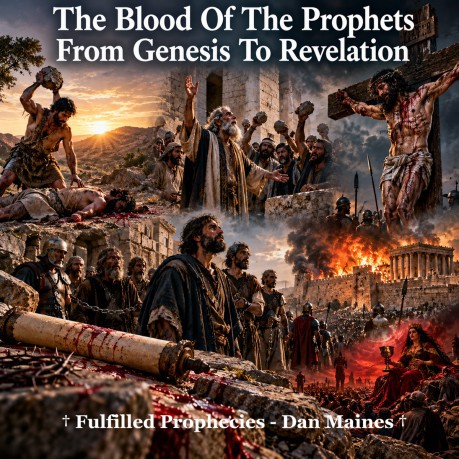
The Blood Of The Prophets
From Genesis To Revelation
By Dan Maines
Introduction
† From
the blood of righteous Abel in Genesis to the blood of the martyrs in
Revelation, Scripture tells one continuous story of persecution,
covenant rebellion, and divine judgment.
†
This wasn't a collection of unrelated tragedies. It was the unfolding
history of God's righteous servants being rejected by those who
claimed to represent Him.
† Abel was murdered
by his brother. The prophets were persecuted by Israel. Jesus was
rejected and crucified. The apostles were threatened, beaten,
imprisoned, and killed. Revelation reveals the final judgment upon
the covenant nation responsible for shedding the blood of God's
servants.
† Jesus identified the generation
that would bear responsibility for this accumulated bloodshed. He
didn't point to a generation thousands of years in the future. He
pointed directly to the generation standing before Him.
†
The blood of the prophets wasn't forgotten. God had promised justice,
and Jesus declared when that justice would come.
†
The central question isn't whether God would avenge His servants. The
question is when that judgment would take place, and Jesus answered
it plainly.
Genesis 4:8-10
Cain talked to
his brother Abel; and it happened that when they were in the field
Cain rose up against his brother Abel and killed him. Then the Lord
said to Cain, "Where is Abel your brother?" And he said, "I
do not know. Am I my brother's keeper?" Then He said, "What
have you done? The voice of your brother's blood is crying out to Me
from the ground.
† The first recorded murder
in Scripture was the murder of a righteous man by his own brother.
Abel's death established a pattern that would continue throughout
Israel's history.
† Abel's blood cried out
for justice. His murderer couldn't hide what he'd done, and God
didn't overlook the innocent blood that had been shed.
†
Jesus later identified Abel as the beginning of the historical record
of righteous bloodshed for which His generation would be held
accountable (Matthew 23:35).
† This
connection is important because Revelation's judgment didn't begin
with the persecution of Christians. Its roots reached back to the
earliest account of a righteous person being murdered.
Hebrews
11:4
By faith Abel offered to God a better sacrifice
than Cain, through which he was attested to be righteous, God
testifying about his gifts, and through faith, though he is dead, he
still speaks.
† Abel's righteousness was
grounded in faith, not merely in the outward act of presenting a
sacrifice.
† His testimony continued after
his death because God hadn't forgotten his faithfulness.
†
The writer of Hebrews places Abel at the beginning of a long history
of faithful witnesses, many of whom suffered persecution and death.
†
Abel's continuing testimony helps us understand why the blood of the
martyrs in Revelation also demanded divine justice (Revelation
6:9-11).
2 Chronicles 24:20-22
Then the
Spirit of God covered Zechariah, the son of Jehoiada the priest like
clothing; and he stood above the people and said to them, "This
is what God has said, 'Why do you break the commandments of the Lord
and do not prosper? Because you have abandoned the Lord, He has also
abandoned you.'" So they conspired against him, and at the
command of the king they stoned him to death in the courtyard of the
house of the Lord. So Joash the king did not remember the kindness
which Zechariah's father Jehoiada had shown him, but he murdered his
son. And as Zechariah died he said, "May the Lord see and
avenge!"
† Zechariah was murdered in the
temple courtyard because he confronted the nation's covenant
rebellion.
† His death exposed the corruption
of a religious system that claimed to honor God while rejecting His
messengers.
† Zechariah's final appeal was
for God to see the injustice and require an accounting for his
blood.
† Jesus later connected the blood of
Abel with the blood of Zechariah, bringing the long history of
righteous persecution into one declaration of judgment (Matthew
23:35-36).
† The location of Zechariah's
murder is significant. The temple, which should've represented
faithfulness to God, became the scene of violence against His
servant.
Nehemiah 9:26
But they became
rebellious and revolted against You, And threw Your Law behind their
backs And killed Your prophets who had admonished them In order to
bring them back to You, And they committed great blasphemies.
†
Israel's persecution of the prophets wasn't an isolated problem. It
was part of a recurring pattern of rejecting God's warnings.
†
The prophets were sent to call the people back to covenant
faithfulness, but their message was often met with hostility.
†
The nation repeatedly rejected the very messengers God sent for its
correction.
† This history explains why Jesus
described Jerusalem as the city that killed the prophets and stoned
those sent to her (Matthew 23:37).
Jeremiah
7:25-26
Since the day that your fathers came out of the
land of Egypt until this day, I have sent you all My servants the
prophets, sending them daily, again and again. Yet they did not
listen to Me or incline their ear, but stiffened their neck; they did
more evil than their fathers.
† God
repeatedly sent His prophets to Israel, but generation after
generation resisted their message.
† The
problem wasn't that God had failed to warn the nation. The problem
was that the nation refused to listen.
†
Jeremiah's warning was connected to the coming destruction of
Jerusalem and the temple in his own day, establishing a historical
pattern of covenant judgment.
† Jesus later
applied the same pattern to the Jerusalem of His generation,
announcing that its rejection of God's messengers would result in
another devastating judgment (Luke 19:41-44).
†
The destruction of Jerusalem in AD 70 was the final judgment upon the
Old Covenant system, not the destruction of the physical
world.
Matthew 23:29-32
Woe to you,
scribes and Pharisees, hypocrites! For you build the tombs for the
prophets and decorate the monuments of the righteous, and you say,
'If we had been living in the days of our fathers, we would not have
been partners with them in shedding the blood of the prophets.' So
you testify against yourselves, that you are sons of those who
murdered the prophets. Fill up, then, the measure of the guilt of
your fathers.
† Jesus exposed the hypocrisy
of the religious leaders who honored dead prophets while rejecting
the Messiah standing before them.
† They
condemned their ancestors for murdering God's messengers, yet they
were preparing to commit an even greater act of rebellion.
†
Their rejection of Jesus demonstrated that they shared the same
hostility toward God's revelation that had characterized their
fathers.
† When Jesus told them to complete
the measure of their fathers, He was announcing that their covenant
rebellion was approaching its final judgment.
†
This wasn't a prediction about religious leaders thousands of years
later. Jesus was addressing the scribes and Pharisees of His own
generation.
Matthew 23:34-36
Therefore,
behold, I am sending you prophets and wise men and scribes; some of
them you will kill and crucify, and some of them you will flog in
your synagogues, and persecute from city to city, so that upon you
will fall the guilt of all the righteous blood shed on earth, from
the blood of righteous Abel to the blood of Zechariah, the son of
Berechiah, whom you murdered between the temple and the altar. Truly
I say to you, all these things will come upon this generation.
†
This passage is one of the clearest declarations of the timing and
purpose of Jerusalem's coming judgment.
†
Jesus identified the historical beginning of righteous bloodshed with
Abel and connected it to the murder of Zechariah.
†
The Zechariah named by Jesus is identified as the son of Barachiah,
while the Zechariah murdered in the temple courtyard in Chronicles is
identified as the son of Jehoiada. The identification is debated, but
the theological point remains unmistakable.
†
Jesus declared that the accumulated guilt of persecuting God's
righteous servants would come upon the generation standing before
Him.
† Notice that Jesus also predicted the
persecution of His own messengers. Some would be killed, others would
be beaten, and others would be pursued from city to city.
†
The persecution of the apostles wasn't a separate prophetic event. It
was the final stage of the same historical pattern.
†
The words "this generation" establish the time frame. Jesus
wasn't describing a judgment reserved for a distant generation.
†
The judgment announced here belongs to the same first-century
generation identified in the Olivet Discourse (Matthew 24:34).
†
The destruction of Jerusalem in AD 70 fulfilled this declaration of
covenant accountability.
Matthew 23:37-38
Jerusalem,
Jerusalem, who kills the prophets and stones those who have been sent
to her! How often I wanted to gather your children together, the way
a hen gathers her chicks under her wings, and you were unwilling.
Behold, your house is being left to you desolate!
†
Jesus identified Jerusalem as the city responsible for killing the
prophets and rejecting God's messengers.
†
His lament revealed both the mercy that had been offered and the
rebellion that had continued.
† Jerusalem's
desolation wasn't an arbitrary punishment. It was the consequence of
persistent covenant unfaithfulness.
† The
declaration that their house would be left desolate pointed toward
the coming removal of the temple system.
†
The temple's destruction in AD 70 demonstrated that the Old Covenant
order had reached its appointed end.
† God's
dwelling place wasn't being transferred to another physical temple.
Through Christ, believers had become God's spiritual household
(Ephesians 2:19-22).
Luke 11:49-51
For
this reason also, the wisdom of God said, 'I will send them prophets
and apostles, and some of them they will kill, and some they will
persecute, so that the blood of all the prophets, shed since the
foundation of the world, may be charged against this generation, from
the blood of Abel to the blood of Zechariah, who was killed between
the altar and the house of God; yes, I tell you, it shall be charged
against this generation.'
† Luke confirms the
same declaration recorded in Matthew, but explicitly includes the
apostles among those who would be persecuted.
†
The blood of the prophets and the blood of the apostles belong to one
continuous history of opposition to God's messengers.
†
Jesus stated that the blood of the prophets would be required of His
generation.
† This provides the foundation
for understanding Revelation's later announcement that judgment had
come upon the city responsible for the blood of the saints.
†
We don't need to invent another generation or another prophetic
timetable. Jesus already identified the people and the period
involved.
Acts 7:51-52
You men who are
stiff-necked and uncircumcised in heart and ears are always resisting
the Holy Spirit; you are doing just as your fathers did. Which one of
the prophets did your fathers not persecute? They killed those who
had previously announced the coming of the Righteous One, and you
have now become betrayers and murderers of Him;
†
Stephen confronted the religious leaders with the same historical
pattern Jesus had identified.
† Their
ancestors persecuted the prophets who announced the coming of Christ,
and Stephen's audience had participated in rejecting Christ
Himself.
† Stephen wasn't introducing a new
accusation. He was confirming the covenant indictment already
pronounced by Jesus.
† The religious
authorities responded by killing Stephen, demonstrating the very
rebellion he had exposed (Acts 7:54-60).
†
Stephen's martyrdom showed that the persecution Jesus predicted was
already taking place within that generation.
†
The murder of Stephen also revealed that the religious establishment
wasn't merely defending tradition. It was resisting the fulfillment
of the promises those traditions were supposed to anticipate.
1
Thessalonians 2:14-16
For you, brothers and sisters,
became imitators of the churches of God in Christ Jesus that are in
Judea, for you also endured the same sufferings at the hands of your
own countrymen, even as they did from the Jews, who both killed the
Lord Jesus and the prophets, and drove us out. They are not pleasing
to God, but hostile to all people, hindering us from speaking to the
Gentiles so that they may be saved; with the result that they always
reach the limit of their sins. But wrath has come upon them fully.
†
Paul connected the killing of Jesus, the persecution of the prophets,
and the opposition to the apostles in one continuous accusation.
†
He also declared that the persecutors were completing the measure of
their sins.
† This directly parallels Jesus'
warning that the religious leaders would complete the measure of
their fathers (Matthew 23:32).
† Paul's words
show that the anticipated judgment wasn't disconnected from the
events of the first century.
† The wrath he
described belonged to the covenant crisis unfolding during the
apostolic generation.
† This passage doesn't
condemn every Jewish person. Paul himself was Jewish, and the
earliest Christians were Jewish. The indictment concerns those who
actively opposed Christ and persecuted His messengers.
†
The judgment was directed against covenant rebellion, not against an
ethnic identity.
Revelation 6:9-11
When
the Lamb broke the fifth seal, I saw underneath the altar the souls
of those who had been killed because of the word of God, and because
of the testimony which they had maintained; and they cried out with a
loud voice, saying, "How long, O Lord, holy and true, will You
refrain from judging and avenging our blood on those who live on the
earth?" And a white robe was given to each of them; and they
were told that they were to rest for a little while longer, until the
number of their fellow servants and their brothers and sisters who
were to be killed even as they had been, was completed also.
†
The martyrs beneath the altar were crying out for justice, just as
Abel's blood had cried out from the ground.
†
Their appeal wasn't for personal revenge. It was a request for God's
righteous judgment against those responsible for persecuting His
servants.
† They were told to rest for a
little time because the persecution hadn't yet reached its appointed
completion.
† The expression "a little
time" is significant. Revelation presents the judgment as
approaching, not as an event separated from its original audience by
thousands of years.
† The altar imagery
connects the martyrs' deaths with sacrificial language, emphasizing
that their faithful testimony hadn't been forgotten.
†
The same covenant accountability announced by Jesus was now being
revealed through the prophetic imagery of Revelation.
†
The martyrs' prayer would receive its answer in the judgment of the
persecuting city.
Revelation 16:4-7
Then
the third angel poured out his bowl into the rivers and the springs
of waters; and they became blood. And I heard the angel of the waters
saying, "Righteous are You, the One who is and who was, O Holy
One, because You judged these things; for they poured out the blood
of saints and prophets, and You have given them blood to drink. They
deserve it." And I heard the altar saying, "Yes, Lord God,
the Almighty, true and righteous are Your judgments."
†
Revelation declares that God's judgments were righteous because the
persecutors had shed the blood of saints and prophets.
†
The imagery of blood given in return for blood represents divine
justice corresponding to the crimes committed.
†
This judgment wasn't directed against the physical universe. It was
covenant judgment against those responsible for persecuting God's
people.
† The altar's affirmation connects
this judgment with the earlier appeal of the martyrs beneath the
altar (Revelation 6:9-11).
† What had been
requested in the fifth seal was being answered through the judgments
revealed in the bowls.
† The connection
between bloodshed and judgment becomes even clearer when Revelation
identifies the guilty city.
Revelation 17:5-6
and
on her forehead a name was written, a mystery: "BABYLON THE
GREAT, THE MOTHER OF PROSTITUTES AND OF THE ABOMINATIONS OF THE
EARTH." And I saw the woman drunk with the blood of the saints,
and with the blood of the witnesses of Jesus. When I saw her, I
wondered greatly.
† The woman called Babylon
was portrayed as intoxicated with the blood of God's people.
†
This wasn't simply a description of general wickedness. It identified
a persecuting city whose guilt included the blood of the saints and
the witnesses of Jesus.
† The name Babylon
was symbolic, drawing upon the Old Testament language of idolatry,
covenant unfaithfulness, and divine judgment.
†
Jerusalem had repeatedly been condemned for spiritual unfaithfulness,
and Jesus had specifically identified her as the city that killed the
prophets.
† Revelation's portrayal of Babylon
fits the covenant indictment Jesus pronounced against Jerusalem.
†
The city that rejected the prophets, crucified the Messiah, and
persecuted the apostles was approaching the judgment Jesus had
announced.
† The symbolic name doesn't
require us to look for a rebuilt Babylon or a future worldwide
religious organization.
Revelation 18:20
Rejoice
over her, O heaven, and you saints and apostles and prophets, because
God has pronounced judgment for you against her.
†
The judgment of Babylon is presented as the vindication of the
saints, apostles, and prophets.
† These are
the same categories of faithful witnesses Jesus described when
announcing judgment upon His generation.
†
Revelation doesn't separate the prophets from the apostles into
unrelated prophetic judgments.
† Their
persecution is brought together in the judgment of the guilty city.
†
This confirms that Revelation's judgment is inseparably connected to
the bloodshed Jesus condemned.
† The
announcement of divine justice wasn't an invitation for believers to
seek personal revenge. It was the declaration that God had judged the
persecuting covenant system.
Revelation 18:24
And
in her was found the blood of prophets and of saints, and of all who
have been slaughtered on the earth.
† This is
one of the strongest connections between Revelation and the words of
Jesus in the Gospels.
† Jesus declared that
all the righteous blood from Abel onward would be required of His
generation (Matthew 23:35-36).
† Revelation
declares that the blood of prophets, saints, and the slain was found
in Babylon.
† The parallel isn't accidental.
Both passages describe accumulated bloodguilt brought to its
appointed judgment.
† Jerusalem is the city
Jesus specifically identified with the killing of the prophets,
making her the central covenantal referent of Revelation's Babylon
imagery.
† The language of all the slain is
prophetic and representative, emphasizing the fullness of the city's
guilt rather than requiring that every murder in human history
physically occurred there.
† The destruction
of Jerusalem in AD 70 fulfilled the judgment announced against that
generation.
† The blood of the prophets had
been remembered, the persecution of the apostles had been answered,
and the Old Covenant persecuting system had reached its
end.
Revelation 19:1-2
After these things
I heard something like a loud voice of a great multitude in heaven,
saying, "Hallelujah! Salvation, glory, and power belong to our
God, because His judgments are true and righteous; for He has judged
the great prostitute who was corrupting the earth with her sexual
immorality, and He has avenged the blood of His bond-servants on
her.
† Heaven rejoiced because God's
righteous judgment had been accomplished.
†
The great harlot had been judged, and the blood of God's servants had
been avenged.
† This is the answer to the
martyrs' appeal beneath the altar.
† The
judgment wasn't presented as an unresolved event awaiting fulfillment
thousands of years later.
† In the fulfilled
perspective, the destruction of Jerusalem in AD 70 marked the
historical completion of the covenant judgment Jesus announced.
†
The rejoicing in heaven wasn't about the destruction of the physical
world. It was about the vindication of God's servants and the triumph
of His righteous purposes.
† The persecuting
covenant order had been removed, but Christ's kingdom
remained.
Hebrews 12:22-24
But you have
come to Mount Zion and to the city of the living God, the heavenly
Jerusalem, and to myriads of angels, to the general assembly and
church of the firstborn who are enrolled in heaven, and to God, the
Judge of all, and to the spirits of the righteous made perfect, and
to Jesus, the mediator of a new covenant, and to the sprinkled blood,
which speaks better than the blood of Abel.
†
The story that began with Abel's blood reaches its fulfillment in the
blood of Jesus Christ.
† Abel's blood cried
out for justice, but Christ's blood speaks of redemption,
forgiveness, and the establishment of the New Covenant.
†
The contrast is essential. The blood of the righteous exposed
humanity's guilt, while the blood of Christ provided the means of
reconciliation with God.
† The writer of
Hebrews told his original audience that they had come to heavenly
Jerusalem.
† This wasn't a promise that
believers would someday enter a physical city descending onto a
reconstructed earth.
† Through Christ,
believers were already being brought into the heavenly reality of the
New Covenant.
† The destruction of earthly
Jerusalem didn't destroy God's kingdom. It confirmed the passing of
the former covenant order while the heavenly Jerusalem remained.
†
The final answer to the history of persecution isn't merely judgment
against the wicked. It's the completed redemptive work of Jesus
Christ.
Historical References
† Flavius
Josephus, writing in The Jewish War, Books 5-7, described the siege,
famine, internal violence, destruction of Jerusalem, and burning of
the temple in AD 70.
† Josephus recorded that
Jerusalem's defenders were divided by violent internal factions, and
that the city suffered devastating destruction during the Roman
siege.
† His account provides historical
evidence for the catastrophic judgment that came upon first-century
Jerusalem, although Josephus didn't present the complete Christian
theological interpretation of that event.
†
Tacitus, in Histories 5.10-13, described the Roman campaign against
Jerusalem, the city's defensive position, and the circumstances
surrounding the siege.
† Tacitus provides an
additional Roman historical witness to the first-century conflict
that culminated in Jerusalem's destruction.
†
Eusebius, in Ecclesiastical History 3.5-7, connected the destruction
of Jerusalem with the judgment announced by Christ and reported the
tradition that Christians had departed Jerusalem for Pella before the
city's destruction.
† Eusebius wrote
centuries after the events, so his account is a later Christian
historical interpretation rather than an eyewitness record.
†
Together, these historical writers establish the reality of
Jerusalem's destruction and demonstrate that early Christian
historians understood its significance in connection with Jesus'
warnings.
† The historical destruction of
Jerusalem in AD 70 corresponds to the generation Jesus identified as
responsible for the accumulated bloodguilt of the prophets and His
messengers.
How It Applies To Us Today
†
The blood of the prophets teaches us that God doesn't overlook
injustice, even when judgment isn't immediate.
†
Abel's murderer couldn't hide his guilt, Israel couldn't escape
accountability for persecuting God's messengers, and Jerusalem
couldn't avoid the judgment Jesus announced.
†
But we must distinguish between the completed covenant judgment of AD
70 and the moral responsibility of believers living today.
†
We're not waiting for another destruction of Jerusalem to complete
Bible prophecy. The judgment Jesus announced against that generation
has already taken place.
† We're living under
the established New Covenant, with Jesus Christ reigning as King.
†
The heavenly Jerusalem isn't a future political capital. It's the
spiritual reality believers have entered through Christ (Hebrews
12:22-24).
† We must never repeat the error
of those who honored God's messengers with their words while
rejecting the truth those messengers proclaimed.
†
Faithfulness to Christ requires humility, obedience, love, and a
willingness to receive correction from Scripture.
†
Persecution doesn't mean God has abandoned His people. The martyrs of
Revelation were remembered, and their faithful testimony wasn't
forgotten.
† We're not called to avenge
ourselves or persecute those who disagree with us. We're called to
follow Christ, love our enemies, and overcome evil with good (Romans
12:17-21).
† The destruction of Jerusalem
also reminds us that no religious institution, building, or human
tradition can replace faithfulness to Jesus Christ.
†
God's kingdom isn't maintained by earthly temples, political power,
or religious coercion.
† Through Christ,
we've received access to the Father, and we've become members of
God's household (Ephesians 2:18-22).
† The
story of the blood of the prophets ultimately directs our attention
to the blood of Jesus, which speaks a better word than Abel's
blood.
† Abel's blood exposed guilt. Christ's
blood established redemption.
† The
persecuting Old Covenant system has passed away, but the kingdom of
Jesus Christ remains forever.
Q & A Appendix
Q:
Why does the story begin with Abel?
A: Abel was
the first recorded righteous person murdered in Scripture. Jesus
specifically identified his blood as the beginning of the accumulated
righteous bloodshed that would be required of His generation (Genesis
4:8-
Links