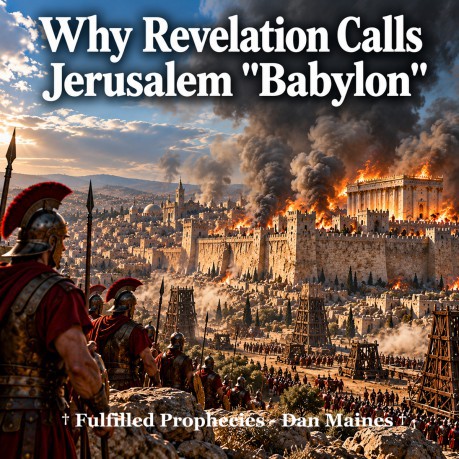
Why
Revelation Calls Jerusalem "Babylon" Introduction † The
identity of Babylon in Revelation isn't established by geography
alone. It's established by covenant history, prophetic language,
spiritual adultery, persecution of God's messengers, and the judgment
Jesus announced against Jerusalem. Jerusalem
Was Already Called An Unfaithful Wife Ezekiel
16:32 † Ezekiel
wasn't describing ancient Babylon or Rome. He was addressing
Jerusalem, the city God had chosen and established in a covenant
relationship with Himself. Isaiah
1:21 † Isaiah
explicitly called Jerusalem a harlot. The faithful city had become
corrupt, exchanging righteousness for injustice and bloodshed. Jerusalem
Was Compared To Sodom Isaiah
1:10 † Isaiah
addressed Jerusalem's rulers as Sodom and her people as Gomorrah. He
wasn't claiming Jerusalem had physically become either ancient
city. The
Great City Was Where Jesus Was Crucified Revelation
11:8 † This
is one of Revelation's strongest geographical and theological
identifying statements. Babylon
Was The Harlot Of Covenant Unfaithfulness Revelation
17:5 † Babylon's
name is presented as a mystery, requiring the reader to understand
the symbolism rather than merely search for a city bearing that
literal name. Babylon
Was Drunk With The Blood Of The Saints Revelation
17:6 † John
identified Babylon by her persecution of the saints and the witnesses
of Jesus. Matthew
23:35-36 † Jesus
placed the responsibility for accumulated righteous blood upon the
covenant leadership He was addressing. Jerusalem
Was The City That Killed The Prophets Matthew
23:37-38 † Jesus
named Jerusalem directly. He identified her as the city that killed
the prophets and rejected those sent to her. All
The Blood Of The Prophets Was Found In Babylon Revelation
18:24 † This
accusation is remarkably similar to Jesus' statement that all the
righteous blood would come upon His generation. Babylon's
Judgment Was Announced As Near Revelation
1:1 † Revelation
opens by identifying its prophetic events as things that must soon
take place. Revelation
22:10 † John
was specifically instructed not to seal the prophecy because the time
was near. The
Harlot Was Replaced By The Bride Revelation
19:7-8 † Revelation
deliberately contrasts two women, the unfaithful harlot and the
faithful bride. Galatians
4:25-26 † Paul
distinguished between the earthly Jerusalem associated with Mount
Sinai and the Jerusalem above, which is free. The
New Jerusalem Is The Fulfilled Covenant Reality Revelation
21:2-3 † The
contrast is complete. The unfaithful city is judged, and the New
Jerusalem is revealed as the bride. Historical
References † Flavius
Josephus, a first-century Jewish historian and eyewitness to the
Jewish-Roman War, described the internal corruption, factional
violence, famine, destruction of the temple, and devastation of
Jerusalem in The Jewish War, Books 5-7. How
It Applies To Us Today † Understanding
Babylon as Jerusalem reminds us that God's covenant promises were
fulfilled through Jesus Christ, not abandoned or postponed. Q
& A Appendix Q:
Why does Revelation call Jerusalem Babylon instead of simply naming
Jerusalem? † This
is the fulfilled perspective we proclaim at Fulfilled Prophecies † ©
Fulfilled Prophecies - Dan Maines. Source
Index † Ezekiel
16:32; Isaiah 1:21; Isaiah 1:10; Revelation 11:8; Revelation 17:5;
Revelation 17:6; Matthew 23:35-36; Matthew 23:37-38; Revelation
18:24; Revelation 1:1; Revelation 22:10; Revelation 19:7-8; Galatians
4:25-26; Revelation 21:2-3;
By Dan Maines
† Many interpreters
immediately identify Babylon with ancient Rome, a future world
government, or a revived religious system. But Revelation gives
identifying characteristics that must be examined alongside the Old
Testament prophets and the words of Jesus.
† The central
question is which city had entered into a covenant relationship with
God, became unfaithful to that covenant, persecuted His prophets,
rejected His Son, and stood under the judgment Jesus said would fall
upon His own generation.
† When we follow the evidence from
the Law and the Prophets through the teachings of Jesus and into
Revelation, we discover that Babylon represents Jerusalem in her
final condition of covenant unfaithfulness, awaiting the judgment
fulfilled in AD 70.
You
adulteress wife, who takes strangers instead of her husband!
† Earlier in the chapter, God
described Jerusalem's covenant relationship as a marriage (Ezekiel
16:8). Her idolatry and alliances with foreign nations were therefore
portrayed as adultery.
† This matters because Revelation's
harlot imagery didn't originate with John. It came from an
established prophetic vocabulary used to condemn Jerusalem's covenant
unfaithfulness.
How the faithful city has become a prostitute, She who
was full of justice! Righteousness once dwelt in her, But now
murderers.
†
Notice the combination of spiritual unfaithfulness and murder. These
same characteristics appear in Revelation's description of Babylon.
†
Revelation's description of Babylon as a harlot therefore follows a
prophetic pattern already applied to Jerusalem centuries before
John's vision.
Hear
the word of the Lord, You rulers of Sodom; Listen to the instruction
of our God, You people of Gomorrah!
† He was using the names of historically wicked cities
to describe Jerusalem's spiritual condition and impending judgment.
†
Jerusalem could be called Sodom because of her corruption, Egypt
because of her oppression, and Babylon because of her rebellion and
covenant judgment. These symbolic names describe different aspects of
the same condemned city.
And
their dead bodies will lie on the street of the great city which
spiritually is called Sodom and Egypt, where also their Lord was
crucified.
† John described the great city as
spiritually called Sodom and Egypt, and then connected it with the
crucifixion of the Lord.
† Jesus was crucified at Jerusalem,
outside the city gate (Hebrews 13:12). Rome exercised political
authority over Judea, but Rome itself wasn't the city where Jesus was
crucified.
† Although interpreters debate whether every
occurrence of the great city must refer to the same location,
Revelation's repeated descriptions of covenant corruption,
persecution, and judgment strongly support reading them together.
and
on her forehead a name was written, a mystery: "BABYLON THE
GREAT, THE MOTHER OF PROSTITUTES AND OF THE ABOMINATIONS OF THE
EARTH."
† The woman is a harlot, which recalls the
prophetic accusations against Jerusalem in Isaiah, Jeremiah, Ezekiel,
and Hosea.
† Jerusalem had now repeated the pattern of the
nations that previously oppressed God's people. The city that should
have welcomed the Messiah rejected Him and persecuted His
messengers.
† This interpretation doesn't depend on the word
Babylon being a literal alternative name for Jerusalem. It depends on
the prophetic pattern that John was applying to the city under
covenant judgment.
And
I saw the woman drunk with the blood of the saints, and with the
blood of the witnesses of Jesus. When I saw her, I wondered greatly.
† Rome certainly persecuted Christians, and this is
an important reason many interpreters identify Babylon with Rome. But
Revelation's description must be compared with the judgment Jesus
pronounced against Jerusalem.
† Jesus repeatedly accused
Jerusalem of killing God's prophets. He also warned that the city
would continue persecuting the messengers He sent.
so
that upon you will fall the guilt of all the righteous blood shed on
earth, from the blood of righteous Abel to the blood of Zechariah,
the son of Berechiah, whom you murdered between the temple and the
altar. Truly I say to you, all these things will come upon this
generation.
† His accusation
reached backward through Israel's history, from Abel to Zechariah,
demonstrating the cumulative nature of the judgment.
† Most
importantly, Jesus identified the generation upon which this judgment
would fall. He didn't postpone it thousands of years into the future.
Jerusalem,
Jerusalem, who kills the prophets and stones those who have been sent
to her! How often I wanted to gather your children together, the way
a hen gathers her chicks under her wings, and you were unwilling.
Behold, your house is being left to you desolate!
† He also
announced the desolation of her house, a judgment that involved the
temple and the covenant order centered upon it.
† Revelation's
Babylon is likewise condemned for shedding the blood of God's
servants and is subsequently brought to desolation.
And
in her was found the blood of prophets and of saints, and of all who
have been slaughtered on the earth.
† Revelation
doesn't merely say Babylon persecuted Christians. It specifically
associates her with the blood of the prophets, the same accusation
Jesus directed against Jerusalem.
† The connection between
these passages is one of the strongest reasons to identify Babylon
with Jerusalem. Both describe a city held accountable for the blood
of God's messengers at the culmination of a covenant judgment.
The
Revelation of Jesus Christ, which God gave Him to show to His
bond-servants, the things which must soon take place; and He sent and
communicated it by His angel to His bond-servant John,
† The timing statement establishes the expectation
of the original recipients. They were being warned about events
approaching in their own historical circumstances.
† The
destruction of Jerusalem in AD 70 fits the first-century time frame
and the covenant judgment language already established by Jesus.
And he said to me, Do not seal up the words of the
prophecy of this book, for the time is near.
† This stands in meaningful contrast to Daniel, who
was instructed to seal his vision because its fulfillment concerned a
later time (Daniel 12:4).
† The identification of Babylon must
respect both the covenant evidence and the timing statements.
Jerusalem's first-century judgment satisfies both considerations.
Let's
rejoice and be glad and give the glory to Him, because the marriage
of the Lamb has come, and His bride has prepared herself." It
was given to her to clothe herself in fine linen, bright and clean;
for the fine linen is the righteous acts of the saints.
And it
was given unto her that she should array herself in fine linen,
bright and pure: for the fine linen is the righteous acts of the
saints.
† The harlot represents the covenant order
that rejected Christ and persecuted His people. The bride represents
the redeemed people of God united to Christ under the New Covenant.
†
The bride wasn't a replacement for God's promises to Israel. She
represented the fulfillment of those promises through Jesus Christ.
Now this Hagar is Mount Sinai in Arabia and
corresponds to the present Jerusalem, for she is enslaved with her
children. But the Jerusalem above is free; she is our mother.
But
the Jerusalem that is above is free, which is our mother.
† Paul
identified two covenant realities, one associated with slavery under
the Old Covenant and the other associated with freedom through
Christ.
† Revelation's contrast between the harlot and the
bride follows this same theological pattern.
And
I saw the holy city, new Jerusalem, coming down out of heaven from
God, prepared as a bride adorned for her husband. And I heard a loud
voice from the throne, saying, Behold, the tabernacle of God is among
the people, and He will dwell among them, and they shall be His
people, and God Himself will be among them,
† The New Jerusalem isn't
simply another physical city replacing the old one. It represents the
fulfilled covenant relationship between God and His redeemed
people.
† The central promise is God's dwelling with His
people. This is the goal toward which the biblical covenant story had
been moving.
† The harlot's judgment and the bride's glory
belong together. The former Jerusalem stood condemned for rejecting
the Messiah, while the New Jerusalem reveals the fulfilled promises
of God in Christ.
† Tacitus, the Roman
historian, described the conflict involving Jerusalem and the temple
in Histories, Book 5. His account provides additional non-Christian
historical testimony concerning the Jewish-Roman conflict.
†
Eusebius, writing in Ecclesiastical History, Book 3, chapters 5-7,
connected Jerusalem's destruction with the consequences of the Jewish
nation's rejection of Christ and described the departure of
Jerusalem's Christian community before the catastrophe.
†
These historical sources establish the reality and severity of
Jerusalem's first-century destruction. The identification of Babylon
itself must ultimately rest upon the biblical evidence rather than
upon the historians alone.
†
We aren't waiting for another Babylon to arise before Christ can
complete the redemption He accomplished. The judgment associated with
the passing of the Old Covenant order belongs to the first-century
fulfillment.
† Today, our confidence isn't found in a physical
temple, a geographical city, or a future prophetic timetable. It's
found in Jesus Christ, our great High Priest, who has opened the way
to the Father.
† The New Jerusalem isn't merely a distant
hope. Believers have already come to Mount Zion, the heavenly
Jerusalem, through Christ (Hebrews 12:22-24).
† We should
therefore live as citizens of His kingdom, demonstrating faith, love,
holiness, mercy, and gratitude for the redemption we've received.
A: Revelation uses symbolic prophetic language
throughout the book. Isaiah had already called Jerusalem a harlot and
compared her rulers to Sodom (Isaiah 1:10, 21). John likewise
described the great city as spiritually called Sodom and Egypt
(Revelation 11:8).
Q: Doesn't Revelation 17:18 say
Babylon reigns over the kings of the earth, which points to Rome?
A:
This is a significant argument for the Roman interpretation. However,
the Greek word translated earth can also mean land, depending on
context. The covenant imagery and blood of the prophets provide
reasons to understand the description in relation to Jerusalem
(Revelation 11:8; 18:24).
Q: Why does Revelation describe
seven mountains?
A: The seven mountains are a strong
argument for Rome, the famous city of seven hills. The vision also
interprets the heads as kings (Revelation 17:9-10). The imagery alone
doesn't settle the other identifying features.
Q: Why is
Babylon called a harlot?
A: The prophets repeatedly
portrayed Jerusalem's unfaithfulness as spiritual adultery (Ezekiel
16:32; Isaiah 1:21).
Q: Why is the blood of the prophets
important?
A: Jesus accused Jerusalem of killing the
prophets and declared that righteous blood would come upon His
generation (Matthew 23:35-38; Revelation 18:24).
Q: Was
Rome involved in Jerusalem's destruction?
A: Yes. Roman
armies under Titus destroyed Jerusalem and its temple in AD 70. Rome
was the military instrument, while Jesus announced covenant judgment
against Jerusalem (Luke 21:20-22).
Q: Does this mean all
Jewish people were rejected?
A: No. Jesus, His apostles,
and the earliest believers were Jewish. Salvation remains available
through Christ without ethnic distinction (Romans 10:12-13; Galatians
3:28-29).
Q: Did Babylon's destruction happen in AD
70?
A: From the fulfilled perspective, yes. Revelation's
declarations of nearness and Jesus' prediction of judgment upon His
generation point to the first century (Matthew 23:36; Revelation 1:1;
22:10).
Q: What replaced the old Jerusalem?
A:
The New Jerusalem represents God's redeemed people in their fulfilled
New Covenant relationship with Christ (Galatians 4:25-26; Revelation
21:2-3).
Q: What is the greatest lesson?
A:
God's promises are fulfilled in Jesus Christ. Our inheritance is
found in His completed work and our present relationship with God
through Him (Hebrews 12:22-24; Ephesians 2:18-22).
Links