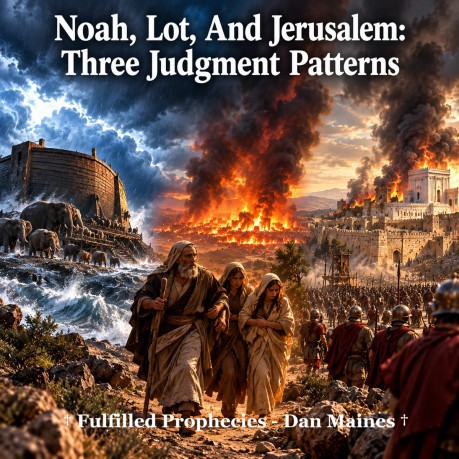
Noah,
Lot, And Jerusalem: Three Judgment Patterns Matthew
24 and Luke 17 Compared With Genesis Introduction †
Jesus didn't introduce an unfamiliar kind of judgment when He warned
His disciples about Jerusalem. He pointed them back to Noah and Lot,
two accounts in Genesis where ordinary life continued until a
decisive judgment arrived. †
These accounts weren't identical in every detail. The flood was
widespread, Sodom's destruction was local, and Jerusalem's judgment
was carried out through war. Their shared pattern was warning,
ordinary activity, separation, sudden destruction, and deliverance
for those who obeyed God's word. †
The question isn't whether the flood and Sodom were real. They were.
The question is why Jesus used them when speaking to His own
generation about the coming judgment. Matthew 24 and Luke 17 supply
the context, and Luke 21 identifies the city in danger. Genesis
6:11-13 Now
the earth was corrupt in the sight of God, and the earth was filled
with violence. And God looked on the earth, and behold, it was
corrupt; for humanity had corrupted its way upon the earth. Then God
said to Noah, The end of humanity has come before Me; for the earth
is filled with violence because of people; and behold, I am about to
destroy them with the earth.
†
God's judgment in Noah's days wasn't arbitrary. Genesis describes a
world corrupted by violence, and God announced the destruction that
was coming. †
The warning came before the catastrophe. Noah's obedience showed that
deliverance depended on taking God's word seriously rather than
following the surrounding culture (Genesis 6:22). Genesis
7:1, 7, 16, 21-23 Then
the Lord said to Noah, Enter the ark, you and all your household, for
you alone I have seen to be righteous before Me in this generation.
Then Noah and his sons, his wife, and his sons' wives with him
entered the ark because of the waters of the flood. Those that
entered, male and female of all flesh, entered as God had commanded
him; and the Lord closed the door behind him. So all creatures that
moved on the earth perished: birds, livestock, animals, and every
swarming thing that swarms upon the earth, and all mankind; of all
that was on the dry land, all in whose nostrils was the breath of the
spirit of life, died. So He wiped out every living thing that was
upon the face of the land, from mankind to animals, to crawling
things, and the birds of the sky, and they were wiped out from the
earth; and only Noah was left, together with those that were with him
in the ark. †
Noah entered the ark with his household before the waters overwhelmed
those outside. God provided the means of preservation before the
judgment arrived. †
The door's closing marked a decisive separation. Jesus later drew
attention to the fact that the people who ignored the warning didn't
recognize the danger until judgment overtook them (Matthew 24:38-39). †
The historical flood and the later judgment on Jerusalem weren't the
same event. Jesus used the earlier event as a pattern that His
listeners could recognize. Genesis
19:12-17 Then
the two men said to Lot, "Whom else do you have here? A
son-in-law and your sons and daughters, and whomever you have in the
city, bring them out of the place; for we are about to destroy this
place, because their outcry has become so great before the Lord that
the Lord has sent us to destroy it." So Lot went out and spoke
to his sons-in-law, who were to marry his daughters, and said, "Up,
get out of this place, for the Lord is destroying the city." But
he appeared to his sons-in-law to be joking. When morning dawned, the
angels urged Lot, saying, "Up, take your wife and your two
daughters who are here, or you will be swept away in the punishment
of the city." But he hesitated. So the men grasped his hand and
the hand of his wife and the hands of his two daughters, because the
compassion of the Lord was upon him; and they brought him out and put
him outside the city. When they had brought them outside, one said,
"Escape for your life! Do not look behind you, and do not stay
anywhere in the surrounding area; escape to the mountains, or you
will be swept away."
†
Lot was told to leave Sodom before its destruction. The instruction
wasn't to remain in the city and wait for a rescue after judgment had
begun. †
The angels urged immediate departure. Lot's deliverance required
action, and the warning concerned a specific place that was about to
be destroyed. †
This prepares us to understand why Jesus later told people in Judea
to flee rather than return to collect their possessions (Luke 17:31;
Luke 21:21). Genesis
19:24-26 Then
the Lord rained brimstone and fire on Sodom and Gomorrah from the
Lord out of heaven, and He overthrew those cities, and all the
surrounding area, and all the inhabitants of the cities, and what
grew on the ground. But Lot's wife, from behind him, looked back, and
she became a pillar of salt. †
Sodom's destruction came after Lot had been brought out. The contrast
was between those who escaped and those who remained in the condemned
city. †
Lot's wife became a warning because she looked back. Jesus' brief
command to remember her makes sense in a setting where hesitation and
attachment to possessions could cost a person their life (Luke
17:32). †
The lesson isn't that every city faces the same historical event.
It's that a clear warning must be obeyed before the opportunity to
escape is gone. Matthew
24:15-22 "Therefore
when you see the abomination of desolation which was spoken of
through Daniel the prophet, standing in the holy place-let the reader
understand-then those who are in Judea must flee to the mountains.
Whoever is on the housetop must not go down to get things out of his
house. And whoever is in the field must not turn back to get his
cloak. But woe to those women who are pregnant, and to those who are
nursing babies in those days! Moreover, pray that when you flee, it
will not be in the winter, or on a Sabbath. For then there will be a
great tribulation, such as has not occurred since the beginning of
the world until now, nor ever will again. And if those days had not
been cut short, no life would have been saved; but for the sake of
the elect those days will be cut short. †
Jesus gave a recognizable sign and told those in Judea to flee to the
mountains. The instruction was geographical, urgent, and suited to
the danger facing first-century Judea. †
People on rooftops and in fields weren't to return for their
belongings. That urgency closely resembles Lot's departure from Sodom
(Genesis 19:17). †
Jesus spoke of great tribulation, but He also described a shortened
period for the sake of the elect. The warning concerned real people
who could act on what He said. Matthew
24:34-39 Truly
I say to you, this generation will not pass away until all these
things take place. Heaven and earth will pass away, but My words will
not pass away. But about that day and hour no one knows, not even
the angels of heaven, nor the Son, but the Father alone. For the
coming of the Son of Man will be just like the days of Noah. For as
in those days before the flood they were eating and drinking,
marrying and giving in marriage, until the day that Noah entered the
ark, and they did not understand until the flood came and took them
all away; so will the coming of the Son of Man be.
†
Jesus placed the events He had described within the lifetime of that
generation. His statement controls the time frame of the warnings
that came before it. †
The comparison with Noah focuses on ordinary activities continuing
until destruction arrived. Eating, drinking, and marrying weren't
themselves the offenses. The danger was carrying on without
recognizing the approaching judgment. †
Jesus wasn't telling His disciples to calculate an event thousands of
years beyond their lifetime. He was telling them to watch and remain
faithful in the crisis He had described (Matthew 24:42). Luke
17:26-33 And
just as it happened in the days of Noah, so will it also be in the
days of the Son of Man: people were eating, they were drinking, they
were marrying, and they were being given in marriage, until the day
that Noah entered the ark, and the flood came and destroyed them all.
It was the same as happened in the days of Lot: they were eating,
they were drinking, they were buying, they were selling, they were
planting, and they were building; but on the day that Lot left Sodom,
it rained fire and brimstone from heaven and destroyed them all. It
will be just the same on the day that the Son of Man is revealed. On
that day, the one who will be on the housetop, with his goods in the
house, must not go down to take them out; and likewise the one in the
field must not turn back. Remember Lot's wife. Whoever strives to
save his life will lose it, and whoever loses his life will keep it. †
Luke records both comparisons together. In Noah's days people carried
on with daily life until the flood came; in Lot's days they did the
same until Sodom was destroyed. †
Jesus then connected these patterns with the day the Son of Man was
revealed. His immediate instructions about rooftops, possessions, and
not turning back recall Lot's escape. †
The command to remember Lot's wife emphasizes the cost of clinging to
what was passing away. Preserving one's life at any cost wasn't the
same as faithful obedience. Luke
21:20-24 But
when you see Jerusalem surrounded by armies, then recognize that her
desolation is near. Then those who are in Judea must flee to the
mountains, and those who are inside the city must leave, and those
who are in the country must not enter the city; because these are
days of punishment, so that all things which have been written will
be fulfilled. Woe to those women who are pregnant, and to those who
are nursing babies in those days; for there will be great distress
upon the land, and wrath to this people; and they will fall by the
edge of the sword, and will be led captive into all the nations; and
Jerusalem will be trampled underfoot by the Gentiles until the times
of the Gentiles are fulfilled. †
Luke names the concrete sign: Jerusalem surrounded by armies. He then
instructs those in Judea to flee and those inside the city to leave. †
Jesus calls these days of vengeance, when what had been written would
be fulfilled. The destruction of Jerusalem wasn't an unexplained
disaster but a covenant judgment announced beforehand. †
The warning fits the pattern of Noah and Lot: God announces judgment,
gives an opportunity to escape, and then the threatened destruction
falls. Jerusalem is the named location in Luke's account. Luke
21:32-33 Truly
I say to you, this generation will not pass away until all things
take place. Heaven and earth will pass away, but My words will not
pass away. †
Luke preserves the same generational time marker found in Matthew.
Jesus said that generation wouldn't pass away until all these things
had taken place. †
The language of heaven and earth passing away underscores the
certainty of His words. It shouldn't be used to erase the explicit
first-century setting of the siege warning. †
The central issue is whether we let Jesus' audience, geography, and
time statements guide our interpretation. Historical
References †
Flavius Josephus, The Jewish War, Books 5-6, describes the Roman
siege of Jerusalem, famine within the city, fierce internal conflict,
and the destruction of the temple in AD 70. †
Tacitus, Histories 5.10-13, provides a Roman account of the conflict
surrounding Jerusalem and its siege. His testimony comes from outside
the Christian community. †
Eusebius, Ecclesiastical History 3.5, reports a tradition that
members of the Jerusalem church departed for Pella before the war.
This is a later historical report, not an eyewitness account, and it
should be distinguished from Jesus' recorded command to flee. †
These sources don't prove every detail of a theological
interpretation, but they establish the historical reality of the
catastrophe that followed Jesus' warning. How
It Applies To Us Today †
We're not waiting for a future Roman siege to fulfill Jesus'
instructions to first-century Judea. The judgment He warned about
belongs to the historical setting He identified (Luke 21:20-24, 32). †
Noah teaches us to trust God's warning even when ordinary life
continues. Lot teaches us not to let possessions or familiarity keep
us from obedience. Jerusalem teaches us to read prophecy in its
stated historical context. †
We live under the reign of Christ, not under a threat that
Jerusalem's covenant judgment still lies ahead. Our calling is to
remain faithful, love one another, and proclaim the salvation
accomplished through Jesus Christ (Hebrews 12:22-24). †
The fulfilled perspective doesn't remove the moral seriousness of
Scripture. It shows that Jesus kept His word to His own generation,
and that His faithfulness gives us confidence today. Q
& A Appendix Q:
Did Jesus say the flood and Sodom were only symbols? A:
No. He used the accounts in Genesis as historical examples of how
judgment overtook people who ignored the warning (Genesis 7:21-23;
Genesis 19:24-26; Luke 17:26-30). Q:
Why connect these accounts with Jerusalem? A:
Jesus repeated the same urgent instructions about leaving without
returning for possessions, and Luke explicitly identified Jerusalem
surrounded by armies as the sign to flee (Luke 17:31-32; Luke
21:20-21). Q:
Does Matthew 24:34 refer to a generation thousands of years later? A:
In the fulfilled interpretation, no. Jesus addressed His
contemporaries and said that generation wouldn't pass away until all
these things took place (Matthew 24:34; Luke 21:32). Q:
Were believers promised that no one would suffer during the war? A:
No. Jesus gave warnings to flee, not a guarantee that every believer
would escape every hardship. The command itself shows the danger was
real (Matthew 24:16-22). Q:
Does fulfillment mean we no longer need to obey Christ? A:
Not at all. His fulfilled warnings demonstrate His reliability, while
His commands to love and remain faithful still guide our lives (John
13:34-35). †
This is the fulfilled perspective we proclaim at Fulfilled Prophecies
† ©
Fulfilled Prophecies - Dan Maines. Source
Index †
Genesis 6:11-13; Genesis 7:1, 7, 16, 21-23; Genesis 19:12-17; Genesis
19:24-26; Matthew 24:15-22; Matthew 24:34-39; Luke 17:26-33; Luke
21:20-24; Luke 21:32-33 †
Flavius Josephus, The Jewish War, Books 5-6; Tacitus, Histories
5.10-13; Eusebius, Ecclesiastical History 3.5
By Dan Maines
Links