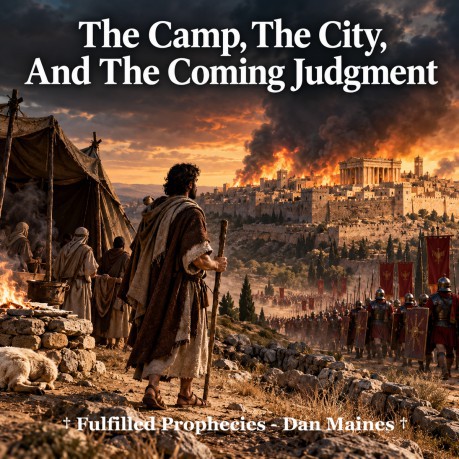
The Camp, The City, And The
Coming Judgment Introduction Hebrews 13:11-14 Hebrews 8:13 Hebrews 10:25-27 Hebrews 12:22-24 Luke 21:20-22 Matthew 24:15-18 Hebrews 12:26-28 Hebrews 13:12-13 Historical References How It Applies To Us Today Q & A Appendix Q: What was the city that didn't continue? Q: What was the city to come? Q: Does Hebrews 13:14 mean Christians are still
waiting for the heavenly Jerusalem to arrive? Q: How does Jerusalem's destruction fit Hebrews
13? Q: What remains for believers today? † This is the fulfilled perspective we proclaim at
Fulfilled Prophecies †
By Dan Maines
† Hebrews 13
was written to believers who were living during the closing years of
the Old Covenant age. The writer wasn't describing the end of the
physical universe. He was urging believers to separate themselves
from the old covenant system centered in earthly Jerusalem because
that system was approaching its covenant judgment.
†
The language of the camp, the city, and the city to come becomes
especially powerful when read alongside Jesus' warnings concerning
Jerusalem. Jesus had already told His disciples that Jerusalem would
be surrounded by armies and that they were to flee when they saw that
judgment approaching (Luke 21:20-22).
†
Hebrews repeatedly emphasizes that the Old Covenant was becoming
obsolete and was ready to disappear (Hebrews 8:13). Hebrews 13 brings
that message to a practical conclusion. They were to go outside the
camp to Christ because the earthly city they knew wasn't their
lasting city.
For the bodies of those
animals whose blood is brought into the Holy Place by the high priest
as an offering for sin are burned outside the camp. Therefore Jesus
also suffered outside the gate, that He might sanctify the people
through His own blood. So then, let us go out to Him outside the
camp, bearing His reproach. For here we do not have a lasting city,
but we are seeking the city which is to come.
†
The writer deliberately connects Jesus' suffering outside Jerusalem
with the Old Covenant practice of taking the bodies of the sin
offerings outside the camp. Jesus suffered outside the gate, and His
followers were called to go outside the camp to Him.
†
Going outside the camp wasn't merely about geography. It pictured
separation from the Old Covenant order that had rejected Christ. The
believers receiving Hebrews were being called to identify completely
with Jesus even when doing so brought rejection and reproach (Hebrews
10:32-34).
† The statement, we have not here
an abiding city, had tremendous significance for first-century Jewish
believers. Earthly Jerusalem wasn't going to continue as the center
of God's covenant people. Jesus had already pronounced judgment upon
that city and its temple (Matthew 23:37-38).
†
The city they were seeking wasn't another earthly capital. Hebrews
had already identified their true destination as Mount Zion, the city
of the living God, the heavenly Jerusalem (Hebrews 12:22-24).
When He said, "A new
covenant," He has made the first obsolete. But whatever is
becoming obsolete and growing old is about to disappear.
†
The Old Covenant wasn't described as permanently continuing alongside
the New Covenant. It was becoming obsolete, growing old, and ready to
disappear.
† When Hebrews was written, the
temple, priesthood, sacrifices, and earthly Jerusalem were still
standing. Yet their covenant significance had already been surpassed
by Christ and the New Covenant (Hebrews 9:11-12).
†
The approaching removal of that old order explains the urgency
running throughout Hebrews. The believers weren't to return to what
was ready to disappear. They were to remain faithful to Christ
(Hebrews 10:35-39).
not abandoning our own
meeting together, as is the habit of some people, but encouraging one
another; and all the more as you see the day drawing near. For if we
go on sinning willfully after receiving the knowledge of the truth,
there no longer remains a sacrifice for sins, but a terrifying
expectation of judgment and the fury of a fire which will consume the
adversaries.
† These believers could see the
day drawing near. The warning was meaningful because the judgment
belonged to their historical horizon, not to an event thousands of
years beyond their lifetime.
† The
approaching day involved judgment upon the covenant order that had
rejected the Son of God. Earlier, Jesus had warned that judgment
would come upon that generation (Matthew 23:35-36).
†
Hebrews wasn't encouraging believers to calculate an unknown date in
the distant future. They were already watching the day approach and
were commanded to encourage one another as it drew closer.
But you have come to Mount
Zion and to the city of the living God, the heavenly Jerusalem, and
to myriads of angels, to the general assembly and church of the
firstborn who are enrolled in heaven, and to God, the Judge of all,
and to the spirits of the righteous made perfect, and to Jesus, the
mediator of a new covenant, and to the sprinkled blood, which speaks
better than the blood of Abel.
† Hebrews
doesn't say believers were waiting thousands of years to come to
Mount Zion. It says they had come to Mount Zion and the heavenly
Jerusalem.
† This identifies the city of
Hebrews 13:14. The contrast wasn't between Jerusalem and a future
physical city descending onto a reconstructed earth. The contrast was
between earthly Jerusalem under the fading Old Covenant and heavenly
Jerusalem under the New Covenant.
† Jesus is
the mediator of this New Covenant. His blood established what the
blood of animals could never accomplish, permanent access to God and
covenant cleansing (Hebrews 10:19-22).
But when you see Jerusalem
surrounded by armies, then recognize that her desolation is near.
Then those who are in Judea must flee to the mountains, and those who
are inside the city must leave, and those who are in the country must
not enter the city; because these are days of punishment, so that all
things which have been written will be fulfilled.
†
Jesus specifically identified Jerusalem as the city facing
approaching desolation. His disciples were given a visible sign,
Jerusalem surrounded by armies.
† They
weren't instructed to gather inside Jerusalem for protection. They
were told to leave it. That gives remarkable historical force to
Hebrews' command to go outside the camp and its declaration that they
had no lasting city there.
† Jesus called
these the days of vengeance and said they were connected with the
fulfillment of what had been written. The destruction of Jerusalem
wasn't an unrelated historical accident. It stood within the covenant
judgment Jesus had announced (Luke 19:41-44).
Therefore when you see the
abomination of desolation which was spoken of through Daniel the
prophet, standing in the holy place - let the reader understand -
then those who are in Judea must flee to the mountains. Whoever is on
the housetop must not go down to get things out of his house. And
whoever is in the field must not turn back to get his cloak.
†
Jesus' warning was directed to people in Judea who could personally
respond when the signs appeared. They could flee, leave their houses,
and escape the approaching calamity.
† The
urgency matches Hebrews. Don't turn back to the old system. Don't
place confidence in earthly Jerusalem. Follow Christ outside the
camp.
† Jesus later placed the fulfillment
within that generation (Matthew 24:34). Hebrews was written to
believers living within that same first-century period of
expectation.
And His voice shook the
earth then, but now He has promised, saying, "Yet once more I
will shake not only the earth, but also the heaven." This
expression, "Yet once more," denotes the removing of those
things which can be shaken, as of created things, so that those
things which cannot be shaken may remain. Therefore, since we receive
a kingdom which cannot be shaken, let's show gratitude, by which we
may offer to God an acceptable service with reverence and awe;
†
Hebrews describes a removal and a remaining. What could be shaken was
being removed, while God's unshakable kingdom remained.
†
The believers were already receiving that kingdom. Their security
wasn't found in the temple, the Levitical priesthood, animal
sacrifices, or earthly Jerusalem. Their security was in Christ and
His kingdom (Hebrews 12:28).
† This is why
Hebrews 13 could tell them they had no lasting city there. The
physical city could fall, but the kingdom they were receiving
couldn't be shaken.
Therefore Jesus also
suffered outside the gate, that He might sanctify the people through
His own blood. So then, let us go out to Him outside the camp,
bearing His reproach.
† The central message
is Christ. Jesus stood outside the gate, rejected by the religious
establishment, yet His blood was the blood that truly sanctified His
people.
† Going to Christ meant leaving
confidence in the system that had rejected Him. The choice
confronting those first-century believers was increasingly clear,
remain attached to the old camp or follow Jesus outside it.
†
When Jerusalem and the temple fell in AD 70, Christ remained. The New
Covenant remained. The kingdom remained. The heavenly Jerusalem
remained. What God established through His Son couldn't be destroyed
by Roman armies.
†
Josephus, writing about the Jewish-Roman War, described Jerusalem's
siege, famine, internal violence, burning, and eventual destruction
by the Romans. His account provides important historical testimony
concerning the catastrophe that overtook Jerusalem in AD 70.
†
Josephus also described the destruction of the temple during the
Roman conquest. The earthly sanctuary that had dominated Jewish
religious life was reduced to ruins, demonstrating historically how
completely that first-century order was brought down.
†
Eusebius later recorded a tradition that believers in Jerusalem had
been instructed to leave the city before the war and settle at Pella.
Whatever questions remain concerning the details of that tradition,
it shows that early Christians understood Jesus' warning to flee
Jerusalem as connected with the first-century Jewish war.
†
These historical accounts don't establish doctrine. Scripture
establishes doctrine. History provides valuable testimony that the
first-century setting described by Jesus and anticipated throughout
Hebrews culminated in Jerusalem's destruction.
†
We don't stand where the original Hebrew believers stood. We aren't
waiting for Jerusalem's AD 70 judgment to arrive. That judgment
belongs to first-century history.
† We don't
need an earthly temple, earthly priesthood, animal sacrifices, or an
earthly Jerusalem to approach God. Through Christ we have access to
God in the New Covenant (Hebrews 10:19-22).
†
We have come to Mount Zion and the heavenly Jerusalem. Our
relationship with God isn't centered on a geographical city but on
Jesus Christ, the mediator of the New Covenant (Hebrews 12:22-24).
†
The lesson remains powerful. Everything built by human hands can be
shaken, but Christ's kingdom can't be shaken. Our confidence rests in
what God established through His Son.
† The
camp was left behind. The earthly city faced its appointed judgment.
The heavenly city remained. Christ brought His people into the
covenant reality toward which the old system had always pointed
(Hebrews 13:14).
Q: What
was the camp in Hebrews 13?
A: In context, the
camp represents the Old Covenant religious order from which believers
were being called to separate themselves and identify with Christ
outside the gate (Hebrews 13:11-13).
A:
The immediate contrast includes earthly Jerusalem, the center of the
Old Covenant system that was approaching judgment. Jesus had already
announced its coming desolation (Luke 21:20-22).
A:
Hebrews identifies it as Mount Zion, the city of the living God, the
heavenly Jerusalem. The believers had already come to this heavenly
city through Christ and the New Covenant (Hebrews 12:22-24).
A:
Hebrews 12:22 says, but ye are come unto mount Zion, and unto the
city of the living God, the heavenly Jerusalem. The city was a
present covenant reality for believers even while the old earthly
city was approaching its judgment (Hebrews 12:22-24).
A: Jesus had warned that Jerusalem would be
surrounded by armies and told His followers to flee (Luke 21:20-22).
Hebrews likewise called believers outside the camp and reminded them
that they had no lasting city there (Hebrews 13:13-14).
A:
We live in the reality of the New Covenant and the kingdom that can't
be shaken. We have access to God through Christ and have come to the
heavenly Jerusalem (Hebrews 10:19-22; 12:22-28).
© Fulfilled Prophecies - Dan
Maines.
Source Index
†
Hebrews 13:11-14; Hebrews 8:13; Hebrews 10:25-27; Hebrews 12:22-24;
Luke 21:20-22; Matthew 24:15-18; Hebrews 12:26-28; Hebrews 13:12-13
†
Josephus, The Wars of the Jews; Eusebius, Ecclesiastical History
Links