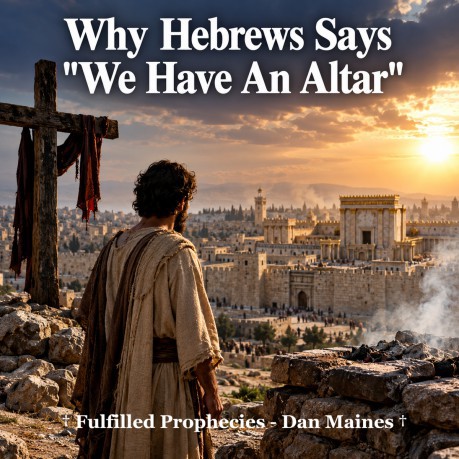
Why Hebrews Says "We
Have An Altar" Introduction Hebrews 13:10-14 Leviticus 16:27 John 19:20 Hebrews 10:19-22 Hebrews 12:22-24 Galatians 4:25-26 Hebrews 8:13 Hebrews 13:15-16 Historical References How It Applies To Us Today Q & A Appendix Q: Is Hebrews teaching that Christians need a
physical altar? Q: What does going outside the camp mean? Q: What was the city that was to come? Q: Why is AD 70 important to this passage? Q: Does this mean believers today are still
waiting to enter the heavenly Jerusalem? † This is the fulfilled perspective we proclaim at
Fulfilled Prophecies † Source Index
By Dan Maines
† Hebrews
closes with one of the strongest statements about the transition from
the old covenant order to the new covenant reality in Christ. The
writer declares, We have an altar, and immediately contrasts that
altar with those who continued serving the tabernacle.
†
This wasn't an invitation to discover another physical altar. It was
a declaration that believers possessed in Christ what the old
covenant altar, sacrifices, priesthood, and sanctuary had only
foreshadowed (Hebrews 8:5; 10:1).
† Hebrews
was written to believers facing pressure to return to the old
covenant system. The writer's answer was clear, don't go back. Jesus
had already opened the way into God's presence, and the old system
was becoming obsolete and ready to disappear (Hebrews 8:13).
†
The command to go outside the camp therefore carries enormous
covenant significance. They were being called away from the old
covenant order centered in earthly Jerusalem and into the lasting
city found in Christ.
We have an altar from which
those who serve the tabernacle have no right to eat. For the bodies
of those animals whose blood is brought into the Holy Place by the
high priest as an offering for sin are burned outside the camp.
Therefore Jesus also suffered outside the gate, that He might
sanctify the people through His own blood. So then, let us go out to
Him outside the camp, bearing His reproach. For here we do not have a
lasting city, but we are seeking the city which is to come.
†
The contrast couldn't be stronger. We have an altar, but those
continuing to serve the tabernacle had no right to eat from it. The
writer was distinguishing the new covenant reality in Christ from the
old covenant worship system (Hebrews 9:11-12).
†
The altar isn't presented as another physical structure in Jerusalem.
Christ Himself is the fulfillment of the sacrificial system. His
sacrifice was offered once for all, something the repeated sacrifices
of the old covenant could never accomplish (Hebrews 10:10-12).
†
Going outside the camp meant identifying with Jesus rather than
returning to the covenant order that rejected Him. The readers were
being called to leave behind dependence upon the earthly sanctuary,
priesthood, sacrifices, and city (Philippians 3:3).
†
The statement that they didn't have an abiding city points directly
at the temporary nature of earthly Jerusalem. They were seeking the
city that was coming, the heavenly Jerusalem identified elsewhere in
Hebrews as the city of the living God (Hebrews 12:22).
But the bull of the sin
offering and the goat of the sin offering, whose blood was brought in
to make atonement in the Holy Place, shall be taken outside the camp,
and they shall burn their hides, their flesh, and their refuse in the
fire.
† Hebrews deliberately draws from the
Day of Atonement pattern. The bodies of the sin offerings were taken
outside the camp after their blood had been carried into the
sanctuary (Hebrews 13:11).
† Jesus fulfilled
the pattern. He suffered outside Jerusalem's gate, showing that
redemption wasn't found by remaining attached to the old covenant
camp (Hebrews 9:13-14).
† The shadow pointed
beyond itself. The animal sacrifices could never perfect the
worshiper, but Christ's sacrifice accomplished what those repeated
offerings couldn't accomplish (Hebrews 10:1-4).
Therefore many of the Jews read
this inscription, because the place where Jesus was crucified was
near the city; and it was written in Hebrew, Latin, and in Greek.
†
Jesus was crucified outside the city. Hebrews takes that geographical
fact and gives it covenant significance, He suffered outside the gate
so that He might sanctify the people through His own blood (Hebrews
13:12).
† The rejected Messiah became the
meeting place between God and His people. Access to God would no
longer depend upon approaching an earthly temple in Jerusalem (John
4:21-24).
† What appeared to be rejection and
shame outside Jerusalem became the place where the old sacrificial
shadows reached their fulfillment in Christ (Colossians 2:16-17).
Therefore, brothers and
sisters, since we have confidence to enter the holy place by the
blood of Jesus, by a new and living way which He inaugurated for us
through the veil, that is, through His flesh, and since we have a
great priest over the house of God, let's approach God with a sincere
heart in full assurance of faith, having our hearts sprinkled clean
from an evil conscience and our bodies washed with pure water.
†
Under the old covenant, access to the Most Holy Place was restricted.
Under the new covenant, believers were given confidence to draw near
through the blood of Jesus (Hebrews 9:7-8).
†
The way into God's presence wasn't through continued animal sacrifice
or service at the earthly temple. Jesus opened the new and living
way.
† This explains why returning to the old
system was so serious. Going back to the shadows after the reality
had come would mean abandoning the superior access provided through
Christ (Hebrews 7:19, 25).
But you have come to Mount
Zion and to the city of the living God, the heavenly Jerusalem, and
to myriads of angels, to the general assembly and church of the
firstborn who are enrolled in heaven, and to God, the Judge of all,
and to the spirits of the righteous made perfect, and to Jesus, the
mediator of a new covenant, and to the sprinkled blood, which speaks
better than the blood of Abel.
† Notice the
writer says they had come to Mount Zion and the heavenly Jerusalem.
Their covenant identity had already shifted away from earthly
Jerusalem toward the heavenly city.
† This is
the city that explains the city to come later in Hebrews. The
first-century believers were living during the transition in which
the old covenant order was becoming obsolete while the new covenant
reality was being established openly and completely (Hebrews 8:13).
†
Jesus is identified as the mediator of the new covenant. Therefore
the city, the covenant, the blood, the assembly, and access to God
all center in Him, not in the earthly temple system (Hebrews 9:15).
Now this Hagar is Mount
Sinai in Arabia and corresponds to the present Jerusalem, for she is
enslaved with her children. But the Jerusalem above is free; she is
our mother.
† Paul makes the same covenant
distinction. The Jerusalem existing in his day corresponded to Sinai
and slavery, while the Jerusalem above represented freedom.
†
This helps explain the command to leave the camp. The issue wasn't
merely geography. It was covenant allegiance. Believers weren't to
seek their identity in the Jerusalem associated with the old covenant
(Galatians 4:30-31).
† The Jerusalem above
wasn't a future physical city descending onto the planet. It was the
covenant community belonging to Christ, the reality believers were
already entering through Him (Ephesians 2:19-22).
When He said, "A new
covenant," He has made the first obsolete. But whatever is
becoming obsolete and growing old is about to disappear.
†
When Hebrews was written, the old covenant had been made obsolete,
yet its temple system was still standing. That explains the
transitional language throughout the book.
†
The old covenant order was near its disappearance. The writer wasn't
describing something thousands of years away. He told his original
audience that the obsolete covenant system was ready to disappear.
†
In AD 70 the temple was destroyed, the sacrificial system ceased, and
the earthly priesthood could no longer perform its temple service.
The visible structure of the old covenant world was removed just as
Jesus had foretold concerning the temple (Matthew 24:1-2).
Through Him then, let's
continually offer up a sacrifice of praise to God, that is, the fruit
of lips praising His name. And do not neglect doing good and sharing,
for with such sacrifices God is pleased.
†
Hebrews immediately explains the kind of sacrifices belonging to the
new covenant. They're sacrifices of praise, doing good, and sharing
with others.
† There is no command here to
establish another animal altar or rebuild another temple. Worship has
moved from the shadow to the reality found in Christ (John
4:23-24).
† Through Him we continually
approach God. Christ isn't one sacrifice among many. His finished
sacrifice established the basis upon which God's people worship and
draw near (Hebrews 10:14).
†
Josephus described the catastrophic destruction of Jerusalem and the
temple by the Romans in AD 70. His account records the burning of the
sanctuary, the devastation of the city, and the collapse of the world
centered around Jerusalem's temple worship.
†
Josephus is especially important because he was a first-century
Jewish eyewitness connected with the events of the Jewish-Roman War.
His history provides an external witness to the destruction of the
city and sanctuary that formed the physical center of the old
covenant system.
† Eusebius later recorded
the early Christian tradition that believers in Jerusalem departed
from the city before the war and went to Pella. Whatever questions
remain concerning the details of that tradition, it reflects an early
understanding that Christians didn't regard earthly Jerusalem as the
permanent center of their covenant hope.
†
These historical events fit the setting of Hebrews. The readers were
told that they didn't have a lasting city there, and within that
generation Jerusalem and its temple were destroyed.
†
We don't need to return to the old covenant camp. We don't need an
earthly temple, Levitical priesthood, animal sacrifices, or a
physical altar in Jerusalem. Christ fulfilled what those things
anticipated.
† We have access to God through
Jesus Christ. Our confidence isn't based on geography, buildings,
rituals, or an earthly priesthood, but upon His completed sacrifice
and His continuing position as our great High Priest (Hebrews
4:14-16).
† We have come to the heavenly
Jerusalem. God's people aren't waiting for another Jerusalem to
become the center of redemption. Our citizenship and covenant
identity are found in Christ (Philippians 3:20).
†
We offer sacrifices of praise, thanksgiving, good works, generosity,
and faithful confession of Christ. These are the sacrifices pleasing
to God under the new covenant (Romans 12:1; 1 Peter 2:5).
†
The message of Hebrews remains powerful today, don't go backward to
the shadows when the reality has come. The altar, priesthood,
sacrifice, sanctuary, covenant, and city all find their fulfillment
in Christ.
Q: What
does Hebrews mean when it says, We have an altar?
A:
It means believers possess the new covenant reality through Christ
and His sacrifice. Hebrews contrasts what believers have in Christ
with those continuing to serve the old tabernacle system (Hebrews
9:11-14; 10:10-14).
A: No. The argument moves away
from the physical sacrificial system and toward Christ's once-for-all
sacrifice. The sacrifices believers now offer include praise, doing
good, and sharing with others (Hebrews 13:15-16).
A:
It means joining Christ outside the old covenant order rather than
returning to the system centered in earthly Jerusalem. Jesus suffered
outside the gate, and His followers were called to identify with Him
(Hebrews 13:12-13).
A:
Hebrews identifies the covenant destination as Mount Zion, the city
of the living God, the heavenly Jerusalem. The believers had already
come to that heavenly reality through Christ while awaiting the
complete removal of the obsolete old covenant order (Hebrews
12:22-24; 8:13).
A:
Jerusalem and the temple were destroyed in AD 70. The earthly system
that was already described as obsolete and near disappearance was
visibly removed. The lasting covenant reality wasn't earthly
Jerusalem, but the kingdom and heavenly city established in Christ
(Hebrews 12:28; 13:14).
A: No.
Hebrews told first-century believers that they had come to Mount Zion
and the heavenly Jerusalem. We live in the established new covenant
reality that Christ brought through His finished work (Hebrews
12:22-24).
© Fulfilled Prophecies - Dan
Maines.
† Hebrews
13:10-14; Leviticus 16:27; John 19:20; Hebrews 10:19-22; Hebrews
12:22-24; Galatians 4:25-26; Hebrews 8:13; Hebrews 13:15-16
†
Josephus, The Wars of the Jews; Eusebius, Ecclesiastical History
Links