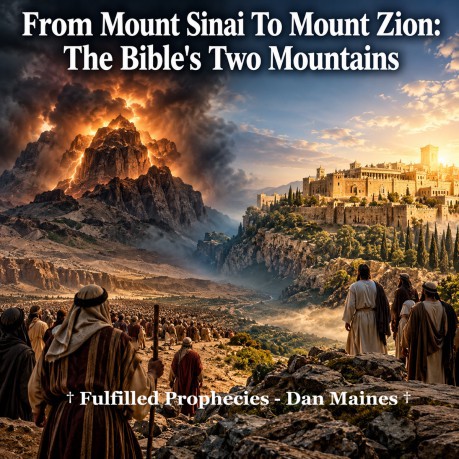
From Mount Sinai To Mount
Zion: The Bible's Two Mountains Introduction Exodus 19:10-12 Exodus 19:16-18 Galatians 4:22-24 Galatians 4:25-26 Galatians 4:28-31 Hebrews 12:18-21 Hebrews 12:22-24 Hebrews 12:25-28 Historical References How It Applies To Us Today Q & A Appendix Q: Did the first-century believers have to wait
until the end of the physical universe to come to Mount Zion? Q: Why did Paul connect the Jerusalem of his day
with Mount Sinai? Q: Does this mean God's promises failed? Q: What was being shaken and removed in Hebrews
12? Q: Are Christians still waiting for the
kingdom? † This is the fulfilled perspective we proclaim at
Fulfilled Prophecies †
By Dan Maines
† The Bible
presents two mountains that represent two very different covenant
realities. Mount Sinai represents the covenant given through Moses,
while Mount Zion represents the heavenly Jerusalem and the New
Covenant established through Jesus Christ.
†
Sinai was surrounded by fear, trembling, darkness, fire, and
separation. Zion is described as the heavenly Jerusalem, the city of
the living God, where God's people have been brought near through
Christ.
† Paul used the same contrast when he
compared Hagar with Mount Sinai and slavery, while identifying the
Jerusalem above as free. The writer of Hebrews then declared to
first-century believers that they had not come to Sinai, but had come
to Mount Zion.
† This isn't a story about
believers waiting thousands of years to reach another physical
mountain. It's the biblical story of covenant transition, from the
old covenant represented by Sinai to the New Covenant reality
represented by Zion.
The Lord also said to Moses,
Go to the people and consecrate them today and tomorrow, and have
them wash their garments; and have them ready for the third day, for
on the third day the Lord will come down on Mount Sinai in the sight
of all the people. But you shall set boundaries for the people all
around, saying, Beware that you do not go up on the mountain or touch
the border of it; whoever touches the mountain shall certainly be put
to death.
† Sinai established a boundary
between the people and the presence of God. They couldn't simply
approach the mountain because the holiness of God exposed the problem
of sin and separation.
† The boundary around
Sinai pictured the limitations of the old covenant. Access to God's
presence was restricted, and the people needed priests, sacrifices,
and repeated cleansing to approach Him (Hebrews 9:6-10).
†
This prepares us for the contrast in Hebrews. Under the New Covenant,
God's people aren't commanded to remain at a distance. Through
Christ, they have been brought near (Ephesians 2:13, 18).
So it came about on the
third day, when it was morning, that there were thunder and lightning
flashes and a thick cloud over the mountain and a very loud trumpet
sound, so that all the people who were in the camp trembled. And
Moses brought the people out of the camp to meet God, and they stood
at the foot of the mountain. Now Mount Sinai was all in smoke
because the Lord descended upon it in fire; and its smoke ascended
like the smoke of a furnace, and the entire mountain quaked
violently.
† Sinai was deliberately
presented with terrifying imagery. Thunder, lightning, thick clouds,
trumpet blasts, smoke, fire, and an earthquake surrounded the giving
of the covenant.
† Hebrews later returned
directly to this scene to contrast Sinai with Zion. The writer wasn't
introducing two unrelated mountains. He was contrasting two covenant
orders.
† The physical signs at Sinai
demonstrated God's holiness and the seriousness of the covenant being
established with Israel. The people trembled because they were
standing before the God who had entered into covenant with their
nation.
For it is written that
Abraham had two sons, one by the slave woman and one by the free
woman. But the son by the slave woman was born according to the
flesh, and the son by the free woman through the promise. This is
speaking allegorically, for these women are two covenants: one coming
from Mount Sinai giving birth to children who are to be slaves; she
is Hagar.
† Paul tells us exactly how he
wanted this contrast understood. The two women represented two
covenants. Hagar corresponded to Mount Sinai and represented
slavery.
† This means Sinai wasn't merely a
geographical location in Paul's argument. It represented the Mosaic
covenant and the condition of those who remained under it.
†
Paul wasn't attacking God's law as though it had been evil. The Law
served the purpose God intended for it until the promised Seed came
(Galatians 3:19). The problem was attempting to remain under that
covenant after Christ had brought its purpose to fulfillment.
Now this Hagar is Mount
Sinai in Arabia and corresponds to the present Jerusalem, for she is
enslaved with her children. But the Jerusalem above is free; she is
our mother.
† Paul's words are especially
important because he identified the Jerusalem of his own day with
Sinai. He said the Jerusalem that existed then was in slavery with
her children.
† He then contrasted that
earthly Jerusalem with the Jerusalem above. One represented slavery
under the old covenant, while the other represented freedom in
Christ.
† Paul wasn't waiting for the earthly
Jerusalem to become the Jerusalem above. He distinguished them. The
Jerusalem above belonged to the New Covenant reality already being
revealed through Christ (Hebrews 12:22-24).
†
This is why the New Jerusalem shouldn't be reduced to a future
physical city descending onto a reconstructed earth. The apostles
identified God's covenant city with the people who belonged to Christ
(Revelation 21:2-3, 9-10).
And you, brothers and
sisters, like Isaac, are children of promise. But as at that time the
son who was born according to the flesh persecuted the one who was
born according to the Spirit, so it is even now. But what does the
Scripture say? "Drive out the slave woman and her son, For the
son of the slave woman shall not be an heir with the son of the free
woman." So then, brothers and sisters, we are not children of a
slave woman, but of the free woman.
† Notice
Paul's repeated first-century language. He said, so also it is now.
The conflict between the two covenant communities was occurring in
Paul's own generation.
† The command to cast
out the slave woman and her son pointed to the removal of the
covenant represented by Hagar and Sinai. The inheritance belonged to
the children of promise in Christ.
† This
covenant transition explains why the New Testament repeatedly speaks
about something old passing away while something better was being
established (Hebrews 8:13).
† The destruction
of Jerusalem and the temple in AD 70 visibly ended the old covenant
system that could no longer continue after Christ had accomplished
redemption.
For you have not come to a
mountain that can be touched and to a blazing fire, and to darkness
and gloom and whirlwind, and to the blast of a trumpet and the sound
of words, which sound was such that those who heard begged that no
further word be spoken to them. For they could not cope with the
command, "If even an animal touches the mountain, it shall be
stoned." And so terrible was the sight, that Moses said, "I
am terrified and trembling."
† The
writer takes his readers directly back to Exodus 19. The fire,
darkness, storm, trumpet, fear, and trembling identify Mount Sinai
unmistakably.
† But his message begins with
what they had not come to. They weren't being called back to Sinai.
They weren't being called back into the covenant represented by that
mountain.
† The old covenant couldn't provide
the final access to God that Christ provided. It contained shadows
pointing forward to the reality found in Christ (Colossians 2:17;
Hebrews 10:1).
But you have come to Mount
Zion and to the city of the living God, the heavenly Jerusalem, and
to myriads of angels, to the general assembly and church of the
firstborn who are enrolled in heaven, and to God, the Judge of all,
and to the spirits of the righteous made perfect, and to Jesus, the
mediator of a new covenant, and to the sprinkled blood, which speaks
better than the blood of Abel.
† These are
some of the clearest words in the entire New Testament concerning
Zion. The writer didn't tell these believers that someday they would
come to Mount Zion. He told them, you have come to Mount Zion.
†
Zion is identified as the city of the living God and the heavenly
Jerusalem. This is covenant language describing the reality believers
entered through Jesus, the mediator of the New Covenant.
†
Notice everything connected with Zion, the heavenly Jerusalem, the
assembly, the church of the firstborn, God the Judge of all, the
righteous made perfect, Jesus the mediator, and His blood.
†
This is why the movement from Sinai to Zion is central to
understanding biblical prophecy. God's purpose wasn't to restore
people permanently to Sinai. His purpose was to bring His people into
the better covenant established through Christ (Hebrews 8:6).
†
Sinai said that boundaries surrounded the mountain. Zion declares
that God's people have come near. Sinai was associated with slavery
in Paul's argument. Zion is associated with the heavenly Jerusalem
and New Covenant access to God.
See to it that you do not
refuse Him who is speaking. For if those did not escape when they
refused him who warned them on earth, much less will we escape who
turn away from Him who warns us from heaven. And His voice shook the
earth then, but now He has promised, saying, "Yet once more I
will shake not only the earth, but also the heaven." This
expression, Yet once more," denotes the removing of those things
which can be shaken, as of created things, so that those things which
cannot be shaken may remain. Therefore, since we receive a kingdom
which cannot be shaken, let's show gratitude, by which we may offer
to God an acceptable service with reverence and awe;
†
The transition from Sinai to Zion involved a shaking. The writer said
things that could be shaken were going to be removed so that what
couldn't be shaken would remain.
† His
first-century readers were receiving an unshakable kingdom. The old
covenant world centered on the earthly sanctuary was approaching its
removal, while the kingdom established through Christ would remain
(Hebrews 8:13).
† This shaking wasn't the
destruction of planet Earth. It was covenant judgment and
transformation. What belonged to the temporary order was removed,
while the kingdom of Christ remained.
† The
earthly temple could be destroyed, Jerusalem could fall, and the old
covenant system could disappear, but the heavenly Jerusalem couldn't
be destroyed. Mount Zion couldn't be shaken because its foundation is
Christ Himself.
†
Josephus described the destruction of Jerusalem and the temple in AD
70 in great detail. His account records the devastation of the city,
the burning of the temple, and the collapse of the Jewish sacrificial
center that had dominated the old covenant world.
†
Josephus also described extraordinary disturbances surrounding
Jerusalem during the period leading to its destruction, including
signs associated with the temple and the city. His account provides
important historical background for the generation that experienced
the end of the temple system.
† Eusebius
later recorded the early Christian tradition that believers in
Jerusalem left the city before the war and went to Pella. This
corresponds with Jesus' warning that His disciples should flee when
they saw Jerusalem surrounded by armies (Luke 21:20-22).
†
These historical witnesses don't establish doctrine, Scripture does.
But they help us understand the historical setting in which the New
Testament's warnings of approaching judgment were fulfilled.
†
We aren't standing at Mount Sinai waiting for permission to approach
God. In Christ, we've come to Mount Zion, the city of the living God,
the heavenly Jerusalem.
† We don't approach
God through an earthly temple, an earthly priesthood, animal
sacrifices, or the Mosaic covenant. We approach the Father through
Jesus Christ (Ephesians 2:18).
† Our
citizenship isn't defined by an earthly Jerusalem. Paul said the
Jerusalem above is free, and Hebrews identifies Mount Zion as the
heavenly Jerusalem.
† We live in the
unshakable kingdom. Governments rise and fall, nations change,
buildings disappear, and earthly institutions pass away, but Christ's
kingdom remains.
† The Bible's movement from
Sinai to Zion is the movement from shadow to substance, slavery to
freedom, distance to access, and the old covenant to the New
Covenant.
† We don't need to travel back to
Sinai, rebuild the old covenant system, or wait for another earthly
Jerusalem to become the center of God's redemptive plan. In Christ,
God's people have already been brought to the heavenly Jerusalem.
†
The question isn't when we'll someday come to Zion. Hebrews declared
to believers nearly two thousand years ago that they had already come
to Zion. We now live in the completed New Covenant reality secured
through Jesus Christ.
Q: What
do Mount Sinai and Mount Zion represent?
A:
Mount Sinai represents the old covenant associated with Moses, while
Mount Zion represents the heavenly Jerusalem and the New Covenant
established through Jesus Christ (Galatians 4:24-26; Hebrews
12:18-24).
A:
No. Hebrews told them that they had come to Mount Zion, the city of
the living God, the heavenly Jerusalem (Hebrews 12:22). The language
describes a covenant reality, not a future journey to a physical
mountain.
A: Because the earthly
Jerusalem of Paul's day remained connected with the Mosaic covenant.
Paul said that Jerusalem was in slavery with her children, while the
Jerusalem above was free (Galatians 4:25-26).
A:
No. God's promises reached their fulfillment in Christ. The Law
pointed forward to Christ, and the inheritance belongs to those who
are in Him (Galatians 3:16, 24-29).
A: The context contrasts Sinai and Zion,
the old covenant order and the unshakable kingdom. The temporary
covenant order was being removed, while the kingdom received through
Christ remained (Hebrews 12:18-28).
A: No. The first-century believers
were already receiving the kingdom that couldn't be shaken (Hebrews
12:28). Christ's kingdom isn't dependent upon an earthly temple,
earthly Jerusalem, or restoration of the Mosaic covenant.
© Fulfilled Prophecies - Dan
Maines.
Source Index
†
Exodus 19:10-12; Exodus 19:16-18; Galatians 4:22-24; Galatians
4:25-26; Galatians 4:28-31; Hebrews 12:18-21; Hebrews 12:22-24;
Hebrews 12:25-28
† Josephus, The Wars of the
Jews; Eusebius, Ecclesiastical History
Links