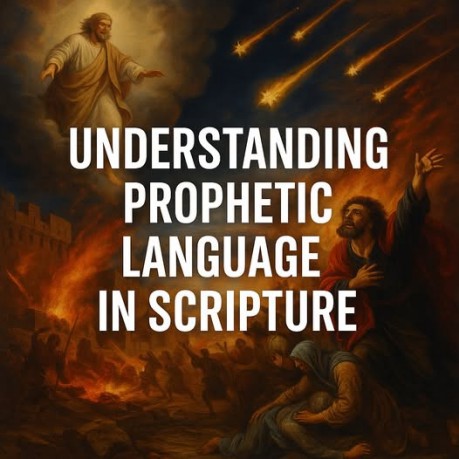
Literal
or Figurative? Understanding Prophetic Language in Scripture
When people read Bible prophecy, especially books like Daniel,
Matthew 24, and Revelation, they often expect literal fulfillments.
They ask questions like, "When did the stars fall from heaven?"
or "When did the whole world mourn as Jesus returned?"
These objections miss the core truth about how prophecy works. The
reason none of these can be taken literally is because the language
of prophecy was never meant to be. Jesus, Daniel, and John all used
symbolic, covenantal language drawn from the Old Testament to
describe real historical judgments, not cosmic destruction. Let me show you why, using Scripture
itself. Symbolic Language in the Old Testament Isaiah 13:10 speaks of the sun
and moon being darkened and the stars ceasing to give light. Was
this a prophecy about the end of the world? No. It was about the
judgment and fall of Babylon. This is symbolic language of national
upheaval and divine judgment. Ezekiel 32:7-8 uses the same type of language to describe
the fall of Egypt:
"And when I extinguish you, I will
cover the heavens and darken their stars, I will cover the sun with
a cloud, and the moon will not give its light. All the shining
lights in the heavens I will darken over you." Did the literal sky fall when Egypt
fell? No. This was poetic, covenantal language to describe God's
judgment. Jesus Spoke in the Same Prophetic Language In Matthew 24:29, Jesus said,
"But immediately
after the tribulation of those days, the sun will be darkened, and
the moon will not give its light, and the stars will fall from the
sky, and the powers of the heavens will be shaken." He was not predicting the collapse of the physical universe. He
was using the language of the prophets to describe the fall of
Jerusalem in 70 AD. The entire context of Matthew 24 is rooted in
the disciples' question in verse 3 about the destruction of the
temple. Jesus was answering them, not forecasting global catastrophe
thousands of years later. Matthew 24:34 proves this interpretation:
"Truly I
say to you, this generation will not pass away until all these
things take place." The generation that heard Jesus would
see the signs He described. If you take that literally, then you
cannot take the cosmic imagery literally, or you have a
contradiction. Revelation: A Book of Symbols Revelation 1:1 begins with this:
"The Revelation
of Jesus Christ, which God gave Him to show to His bond-servants,
the things which must soon take place..." And Revelation 1:3 says,
"Blessed
is the one who reads, and those who hear the words of the prophecy,
and keep the things which are written in it, for the time is near." If these things were near, then they
were for the first-century audience, not future generations.
Revelation is filled with symbols. It speaks of beasts, dragons,
stars falling, a woman clothed with the sun, and a new Jerusalem.
Taking this literally would result in absurdity. These images are
apocalyptic language meant to convey theological truths and
covenantal transitions. Jesus Did Return in Judgment Revelation 1:7 says,
"Behold, He is coming with
the clouds, and every eye will see Him, even those who pierced Him,
and all the tribes of the earth will mourn over Him." The Greek word for "earth"
is ge, meaning land. This is a reference to Israel. And those who
pierced Him? That is the Jewish leadership, not people living 2,000
years later. Jesus came on the clouds, just as God had in judgment
throughout the Old Testament (see Isaiah 19:1). The Twelve Thrones In Matthew 19:28, Jesus told His disciples,
"Truly
I say to you, that you who have followed Me, in the regeneration,
when the Son of Man will sit on His glorious throne, you also shall
sit on twelve thrones, judging the twelve tribes of Israel." This is not about literal furniture in
a physical kingdom. It is about authority in the New Covenant. The
apostles judged Israel through their message. When Israel rejected
it, they were judged in 70 AD. This fulfilled Jesus' words. Coming from East and West to Sit with the Patriarchs Matthew 8:11 says,
"I say to you that many will
come from the east and west, and will recline at the table with
Abraham, Isaac, and Jacob in the kingdom of heaven." This is a spiritual reality, not a
physical banquet. Gentiles were being brought into the kingdom by
faith, joining the faithful remnant of Israel in Christ. This was
happening in the first century. The Point of All This Literal expectations for symbolic
prophecy lead to confusion. People are still waiting for sky signs,
beasts, thrones, and disasters, when Jesus already fulfilled these
prophecies in the first century. The destruction of Jerusalem in 70
AD was the end of the Old Covenant world. That is what the stars
falling, the sun going dark, and the heavens shaking was all about.
It was not about the end of the physical earth but the end of the
covenantal world of Israel. Conclusion We cannot read apocalyptic prophecy
the same way we read the Gospels or the letters of Paul. The genre
itself is symbolic, and the audience and context determine the
meaning. Jesus, Daniel, and John were all faithful to the pattern of
Old Testament prophets who used poetic, powerful images to describe
real historical events. Once we understand this, the fulfilled view
makes perfect sense, and the glory of the New Covenant shines even
brighter. Let those with eyes to see, see. Let
those with ears to hear, hear.
By Dan Maines
Links