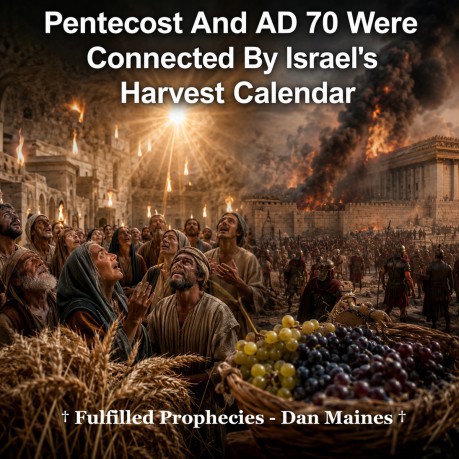
Pentecost And AD 70 Were
Connected By Israel's Harvest Calendar Introduction Leviticus 23:5-6 Leviticus 23:10-11 Leviticus 23:15-17 Acts 2:1-4 Matthew 13:39-43 Leviticus 23:24-25 Leviticus 23:27-28 Leviticus 23:34, 39 James 5:7-9 Revelation 14:15-16 Historical References How It Applies To Us Today Q: Was Pentecost the completed harvest? Q: Does this mean Jesus fulfilled every feast on the exact
calendar date? Q: Why connect AD 70 with harvest? Q: Did AD 70 accomplish the sacrifice for sin? Q: What does Tabernacles contribute to the picture? † This is the fulfilled perspective we proclaim at
Fulfilled Prophecies † Source Index
By Dan Maines
† Israel's
feast calendar wasn't a collection of disconnected religious
ceremonies. God arranged the feasts around Israel's agricultural
year, and together they formed a prophetic picture of redemption,
beginning with sacrifice and ending with the completed harvest and
joyful dwelling with God.
† Passover pointed
to Christ's sacrifice, Firstfruits pointed to His resurrection,
Pentecost marked the first gathering of the harvest, and the later
feasts of Trumpets, Atonement, and Tabernacles pictured the
approaching judgment, cleansing, final ingathering, and dwelling of
God with His people.
† This gives us an
important framework for understanding the period between Pentecost
and AD 70. Pentecost wasn't the end of the harvest story. It was the
beginning of the first-century gathering that moved toward its
covenantal completion.
† Jesus and the
apostles repeatedly used harvest language for events belonging to
their generation (Matthew 13:39-43; Matthew 24:30-34; James 5:7-9;
Revelation 14:14-20). When we read that language against Israel's
feast calendar, the connection becomes powerful.
In the first month, on the
fourteenth day of the month at twilight is the Lord's Passover. Then
on the fifteenth day of the same month there is the Feast of
Unleavened Bread to the Lord; for seven days you shall eat unleavened
bread.
† The redemptive calendar began with
Passover. Before there could be Firstfruits, Pentecost, or the final
harvest, there had to be a sacrifice.
† Jesus
fulfilled the Passover pattern through His death. Paul directly
identified Christ with the Passover sacrifice when he wrote, For our
passover also hath been sacrificed, even Christ (1 Corinthians
5:7).
† The harvest story therefore begins at
the cross. Redemption didn't begin with human achievement, it began
with the Lamb.
"Speak to the sons
of Israel and say to them, 'When you enter the land which I am going
to give to you and you gather its harvest, then you shall bring in
the sheaf of the first fruits of your harvest to the priest. He shall
wave the sheaf before the Lord for you to be accepted; on the day
after the Sabbath the priest shall wave it.
†
Firstfruits wasn't the entire harvest. It was the first portion
presented to God as the beginning and pledge of what was still to
come.
† Paul used exactly this harvest
imagery for Christ's resurrection, calling Christ the firstfruits of
those who had fallen asleep (1 Corinthians 15:20-23).
†
Christ's resurrection therefore wasn't disconnected from Israel's
feast calendar. The first sheaf pointed forward to the risen Christ,
and the firstfruits guaranteed that God's redemptive harvest had
begun.
You shall also count for
yourselves from the day after the Sabbath, from the day when you
brought in the sheaf of the wave offering; there shall be seven
complete Sabbaths. You shall count fifty days to the day after the
seventh Sabbath; then you shall present a new grain offering to the
Lord. You shall bring in from your dwelling places two loaves of
bread as a wave offering, made of two-tenths of an ephah; they shall
be of a fine flour, baked with leaven as first fruits to the Lord.
†
Fifty days after Firstfruits came Pentecost, also called the Feast of
Weeks. It was explicitly connected with harvest and firstfruits.
†
This makes Acts 2 far more significant than simply the day the Holy
Spirit was poured out. God chose a harvest feast for the beginning of
the great first-century gospel gathering.
†
Pentecost was firstfruits, not the completed harvest. That
distinction matters. What began in Acts 2 continued throughout the
apostolic generation as the gospel gathered God's people before the
end of the old covenant age.
When the day of Pentecost had
come, they were all together in one place. And suddenly a noise like
a violent rushing wind came from heaven, and it filled the whole
house where they were sitting. And tongues that looked like fire
appeared to them, distributing themselves, and a tongue rested on
each one of them. And they were all filled with the Holy Spirit and
began to speak with different tongues, as the Spirit was giving them
the ability to speak out.
† Luke specifically
tells us that this happened when the day of Pentecost had arrived.
The timing wasn't meaningless. The harvest feast became the setting
for the first great gathering under the gospel.
†
That same day about three thousand people received the word and were
added to them (Acts 2:41). The imagery couldn't be more appropriate,
Pentecost was a harvest feast, and thousands were gathered into
Christ.
† James later called first-century
believers a kind of firstfruits of God's creatures (James 1:18). The
apostles understood themselves to be living during God's harvest.
and the enemy who sowed
them is the devil, and the harvest is the end of the age; and the
reapers are angels. So just as the weeds are gathered up and burned
with fire, so shall it be at the end of the age. The Son of Man will
send forth His angels, and they will gather out of His kingdom all
stumbling blocks, and those who commit lawlessness, and they will
throw them into the furnace of fire; in that place there will be
weeping and gnashing of teeth. Then the righteous will shine forth
like the sun in the kingdom of their Father. The one who has ears,
let him hear.
† Jesus Himself connected
harvest with the end of the age. The Greek word translated world here
is aion, meaning age. Jesus wasn't predicting the destruction of
planet Earth. He was describing an age-ending harvest.
†
That harvest language fits the covenant transition taking place in
the first century. The gospel was gathering the wheat while judgment
was approaching the covenant system centered in Jerusalem (Matthew
23:36-38; Matthew 24:1-3, 34).
† Pentecost
began the great gathering, but Jesus had already taught that harvest
involved both gathering and judgment. Salvation and judgment were two
sides of the approaching end of the age.
"Speak to the sons
of Israel, saying, 'In the seventh month on the first of the month
you shall have a rest, a reminder by blowing of trumpets, a holy
convocation. You shall not do any laborious work, but you shall
present an offering by fire to the Lord.'"
†
After the spring feasts came the seventh-month feasts, beginning with
Trumpets. Trumpets announced, warned, assembled, and prepared the
people for what followed.
† Jesus used
trumpet and gathering language when describing His coming within that
generation (Matthew 24:30-34). Paul also used the trumpet as
resurrection and transformation imagery (1 Corinthians 15:51-52).
†
The point isn't that every prophetic trumpet must be forced onto the
exact calendar date of the Feast of Trumpets. The point is that the
feast supplied biblical imagery for announcement, gathering,
judgment, and covenantal transition.
On exactly the tenth day
of this seventh month is the Day of Atonement; it shall be a holy
convocation for you, and you shall humble yourselves and present an
offering by fire to the Lord. You shall not do any work on this very
day, for it is a Day of Atonement, to make atonement on your behalf
before the Lord your God.
† The Day of
Atonement followed Trumpets. Christ accomplished the sacrifice
necessary for atonement at the cross, but Hebrews describes the
first-century saints as waiting for the appearing associated with the
completion of the high-priestly pattern (Hebrews 9:24-28).
†
The cross and AD 70 therefore shouldn't be confused. Jesus didn't
need to die again in AD 70. His sacrifice was completed once for all.
AD 70 publicly and covenantally demonstrated the removal of the old
temple order that His sacrifice had already made obsolete (Hebrews
8:13; Hebrews 10:9-14).
† The destruction of
the earthly sanctuary showed that access to God was no longer
centered on Jerusalem, animal sacrifices, or the Levitical
priesthood. Christ was the final High Priest and His sacrifice was
sufficient.
Speak to the sons of
Israel, saying, On the fifteenth of this seventh month is the Feast
of Booths for seven days to the Lord. 'On exactly the fifteenth day
of the seventh month, when you have gathered in the crops of the
land, you shall celebrate the feast of the Lord for seven days, with
a rest on the first day and a rest on the eighth day.
†
Tabernacles came when the produce had been gathered in. This was the
great feast of completed ingathering and rejoicing.
†
Notice the language, when you have gathered in the fruits of the
land. The calendar that began with Passover sacrifice moved through
Firstfruits and Pentecost until it reached completed ingathering.
†
This pattern helps explain why Revelation combines harvest, judgment,
temple, and dwelling imagery. The story moves toward God dwelling
with His people in the New Jerusalem (Revelation 14:14-20; Revelation
21:2-3).
† The biblical movement is therefore
sacrifice, resurrection, firstfruits, harvest, judgment, completed
gathering, and God's dwelling with His covenant people.
Therefore be patient, brothers
and sisters, until the coming of the Lord. The farmer waits for the
precious produce of the soil, being patient about it, until it gets
the early and late rains. You too be patient; strengthen your hearts,
for the coming of the Lord is near. Do not complain, brothers and
sisters, against one another, so that you may not be judged; behold,
the Judge is standing right at the door.
†
James brought the harvest picture directly into the expectation of
Christ's first-century coming. He told his original readers to be
patient like a farmer waiting for precious fruit.
†
He didn't tell them that this harvest was thousands of years away. He
said the coming of the Lord was near and that the Judge was right at
the door.
† This is exactly what we'd expect
if Pentecost had begun an end-of-the-age harvest that was approaching
its covenantal climax in that generation.
And another angel came
out of the temple, calling out with a loud voice to Him who sat on
the cloud, "Put in Your sickle and reap, for the hour to reap
has come, because the harvest of the earth is ripe." Then He who
sat on the cloud swung His sickle over the earth, and the earth was
reaped.
† Revelation doesn't describe a
harvest that had barely begun. It announces that the hour to reap had
arrived and that the harvest was ripe.
†
Revelation opened by saying these things must shortly come to pass
and that the time was near (Revelation 1:1-3). It closed with the
same urgency (Revelation 22:6, 10).
†
Pentecost and Revelation therefore belong within the same
first-century redemptive movement, firstfruits followed by
maturation, gathering, judgment, and completed harvest.
†
Josephus records that Jerusalem became crowded with people during
Passover when the Roman siege tightened around the city. This is
significant because the war that brought the old covenant center to
its end unfolded against the background of Israel's own feast system.
Josephus, Wars of the Jews, Book 5.
†
Josephus describes famine, internal violence, the burning of the
temple, and the devastation of Jerusalem as the Roman war reached its
terrible climax in AD 70. Josephus, Wars of the Jews, Books 5-6.
†
Tacitus also records the Roman siege of Jerusalem under Titus and
describes the enormous population gathered in the city, connecting
the catastrophe with the Jewish national and religious setting.
Tacitus, Histories, Book 5.
† Eusebius later
preserved the Christian tradition that believers in Jerusalem left
the city before the war and went to Pella, connecting their escape
with the warning given to them before Jerusalem's destruction.
Eusebius, Ecclesiastical History, Book 3, Chapter 5.
†
These historical writers don't prove the theological meaning of the
feasts. Scripture does that. History confirms that the first-century
judgment Jesus warned about actually came upon Jerusalem and the
temple generation.
†
We aren't waiting for another Passover sacrifice. Christ our Passover
has already been sacrificed (1 Corinthians 5:7).
†
We aren't waiting for Christ to become Firstfruits. He has already
risen and become the Firstfruits (1 Corinthians 15:20).
†
We aren't waiting for another Pentecost to begin the first-century
harvest. The Holy Spirit was poured out and the gospel harvest began
in Acts 2.
† We aren't living under Israel's
old covenant feast calendar waiting for its prophetic story to start
over again. Those shadows pointed to the redemptive work accomplished
in Christ (Colossians 2:16-17).
† We live on
the fulfilled side of that covenant transition. Our access to God
isn't through an earthly temple, an earthly priesthood, or Israel's
agricultural feast calendar. We come to God through Jesus Christ.
†
The feast calendar tells one magnificent story, Passover sacrifice,
Firstfruits resurrection, Pentecost gathering, Trumpets announcement,
Atonement through Christ, and Tabernacles ingathering and dwelling.
†
Pentecost and AD 70 weren't disconnected events separated by
meaningless decades. They stood within the same first-century harvest
period, Pentecost displaying the firstfruits gathering and AD 70
marking the decisive covenantal judgment at the end of the old
covenant age.
A:
No. Pentecost was associated with firstfruits. The New Testament
continued to speak about an approaching harvest after Pentecost
(James 5:7-9; Revelation 14:15-16).
A: That's not necessary
to establish the pattern. Scripture itself uses Passover,
firstfruits, harvest, trumpet, atonement, and ingathering imagery to
explain Christ's redemptive work and the first-century covenant
transition (1 Corinthians 5:7; 1 Corinthians 15:20-23; Hebrews
9:24-28).
A:
Because Jesus connected the harvest with the end of the age, then
placed the judgment of Jerusalem within His own generation (Matthew
13:39-43; Matthew 23:36-38; Matthew 24:1-3, 34).
A:
No. Jesus accomplished His sacrifice once for all at the cross. AD 70
removed the old covenant temple system that had become obsolete and
demonstrated historically what Christ's finished sacrifice had
already established (Hebrews 8:13; Hebrews 10:9-14).
A:
Tabernacles celebrated completed ingathering and dwelling. That
imagery reaches its redemptive goal in God's dwelling with His
covenant people in the New Jerusalem (Revelation 21:2-3).
© Fulfilled Prophecies - Dan
Maines.
† Leviticus
23:5-6; Leviticus 23:10-11; Leviticus 23:15-17; Acts 2:1-4; Matthew
13:39-43; Leviticus 23:24-25; Leviticus 23:27-28; Leviticus 23:34,
39; James 5:7-9; Revelation 14:15-16
†
Josephus, Wars of the Jews, Books 5-6; Tacitus, Histories, Book 5;
Eusebius, Ecclesiastical History, Book 3, Chapter 5
Links