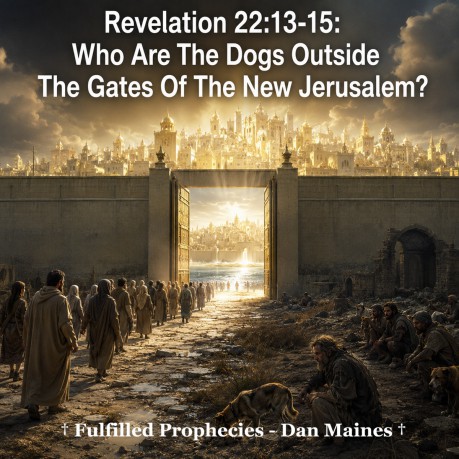
Revelation 22:13-15: Who Are
The Dogs Outside The Gates Of The New Jerusalem? Introduction Revelation 22:13-15 Revelation 21:2-3 Hebrews 12:22-24 Galatians 4:25-26 John 3:18 John 10:9 Revelation 21:24-27 Revelation 22:17 Who Are The Dogs In Revelation 22:15? Were Those Outside The Gates Those Who Rejected Christ? Historical References How It Applies To Us Today Q & A Appendix Q: Were those outside the city people who
rejected Christ? Q: Does "outside" mean they were
physically outside Jerusalem? Q: Are there still people spiritually outside the
New Jerusalem today? Q: Can someone who is outside come in? Q: Does Revelation 22:15 prove that sinful people
continue to exist after the New Jerusalem is established? Q: Why are the gates of the New Jerusalem never
shut? Q: Is Revelation 22:15 describing eternal
conscious torment? Q: What is the main message of Revelation
22:13-15 for us? † This is the fulfilled perspective we proclaim at
Fulfilled Prophecies † Source Index
By Dan Maines
† Revelation
22:13-15 raises an important question. If the New Jerusalem
represents the fulfilled New Covenant reality, who are the people
described as being "without" the city in verse 15?
†
The answer becomes clear when Scripture interprets Scripture.
Revelation isn't describing people physically standing outside the
walls of a gigantic city that descended from outer space. It uses
covenantal and spiritual imagery to contrast those who belong to
Christ with those who remain outside of Him.
†
Revelation 22 presents the New Jerusalem as an existing covenantal
reality where the servants of God worship Him, see His face, have His
name upon them, and receive the water of life. Those outside are
outside the covenant blessings of the city.
†
In its first-century judgment setting, this language had a direct
application to those who rejected Christ and remained identified with
the condemned order that was passing away. Yet the spiritual
distinction remains true today, life is found in Christ, and those
who reject Him remain outside the blessings found in Him (John 3:36;
1 John 5:11-12).
I am the Alpha and the
Omega, the first and the last, the beginning and the end."
Blessed are those who wash their robes, so that they will have the
right to the tree of life, and may enter the city by the gates.
Outside are the dogs, the sorcerers, the sexually immoral persons,
the murderers, the idolaters, and everyone who loves and practices
lying.
† Verse 15 says "Without are the
dogs." The contrast is between those who enter the city and
those who remain outside it. The language is covenantal and
spiritual, not a geographical description of people standing outside
literal walls.
† Notice that verse 14 speaks
of entering the city and having access to the tree of life. Verse 15
immediately contrasts those people with those who are "without."
The issue is access to covenant life in Christ.
†
Jesus is the beginning and the end. Therefore, the New Jerusalem
can't be understood apart from Him. Those who belong to Christ
participate in its life, while those who reject Him remain outside
its covenant blessings (Galatians 3:26-29; Hebrews 12:22-24).
†
This also shows why Revelation 22 doesn't describe the annihilation
of planet Earth. There are still people described outside the city
while the nations receive the invitation to the water of life
(Revelation 22:17).
And I saw the holy city,
new Jerusalem, coming down out of heaven from God, prepared as a
bride adorned for her husband. And I heard a loud voice from the
throne, saying, "Behold, the tabernacle of God is among the
people, and He will dwell among them, and they shall be His people,
and God Himself will be among them,
† John
identifies the New Jerusalem with bridal imagery. The city is "made
ready as a bride adorned for her husband." This isn't primarily
about buildings, streets, walls, or physical geography. It's about
God's covenant people and God's dwelling with them.
†
The New Jerusalem comes down from heaven because its origin is God.
The emphasis isn't humanity traveling to a physical city somewhere in
the universe, but God's dwelling being established with His redeemed
people.
† This agrees with the rest of the
New Testament, where believers are described as God's household,
God's temple, and God's dwelling place (Ephesians 2:19-22; 1 Peter
2:5).
But you have come to Mount
Zion and to the city of the living God, the heavenly Jerusalem, and
to myriads of angels, to the general assembly and church of the
firstborn who are enrolled in heaven, and to God, the Judge of all,
and to the spirits of the righteous made perfect, and to Jesus, the
mediator of a new covenant, and to the sprinkled blood, which speaks
better than the blood of Abel.
† Hebrews
doesn't say believers will someday come to the heavenly Jerusalem. It
says they had already come to Mount Zion, the city of the living God,
the heavenly Jerusalem. The writer was describing a covenantal
reality they were already entering through Christ.
†
This is one of the clearest passages for understanding Revelation 21
and 22. Mount Zion, the heavenly Jerusalem, the assembly, Jesus, and
the New Covenant are connected together.
†
Therefore, being inside the New Jerusalem means belonging to the
covenantal city through Christ. Being outside means being outside
that covenant relationship and its blessings (Hebrews 13:12-14).
Now this Hagar is Mount
Sinai in Arabia and corresponds to the present Jerusalem, for she is
enslaved with her children. But the Jerusalem above is free; she is
our mother.
† Paul establishes two
Jerusalems. One was the earthly Jerusalem associated with bondage,
and the other was "the Jerusalem that is above."
†
This distinction is essential. Revelation's New Jerusalem is the
Jerusalem from above, not a rebuilt earthly Jerusalem and not a
future political capital in the Middle East.
†
Those who rejected Christ and clung to the old covenantal order
remained identified with the Jerusalem that was in bondage. Those who
belonged to Christ belonged to the Jerusalem above (Galatians
4:21-31).
The one who believes in Him is not
judged; the one who does not believe has been judged already, because
he has not believed in the name of the only Son of God.
†
Jesus established the fundamental distinction. Those who believe in
Him aren't condemned, while those who reject Him remain under
judgment.
† This helps explain what being
outside the city means spiritually. The issue isn't physical distance
from a city gate. The issue is a person's relationship to Christ.
†
A person can physically live anywhere on Earth and still participate
in the spiritual blessings of the New Jerusalem through Christ.
Likewise, a person can reject Christ and remain outside those
blessings (John 5:24; John 10:9).
I am the door; if anyone enters
through Me, he will be saved, and will go in and out and find
pasture.
† Jesus said that He is the door.
Entrance into God's saving presence has always centered upon Christ,
not physical geography.
† This makes
Revelation's language about entering through the gates
understandable. The gates represent access to the blessings of God's
covenant city, and that access exists only through Christ.
†
No one enters the New Jerusalem through nationality, ancestry, law
keeping, earthly Jerusalem, or religious tradition. Entrance is
through Jesus Christ (John 14:6; Acts 4:12).
The nations will walk by
its light, and the kings of the earth will bring their glory into it.
In the daytime (for there will be no night there) its gates will
never be closed; and they will bring the glory and the honor of the
nations into it; and nothing unclean, and no one who practices
abomination and lying, shall ever come into it, but only those whose
names are written in the Lamb's book of life.
†
This passage provides one of the strongest explanations of Revelation
22:15. The gates remain open while the nations walk by the city's
light.
† If this described the condition
after the physical universe had ended and every human destiny had
been removed from earthly history, permanently open gates and nations
walking by the city's light would be difficult to explain.
†
The picture instead shows the continuing glory and influence of God's
fulfilled covenant kingdom. The city is holy, its gates are open, and
nothing unclean becomes part of the city.
†
Revelation 22:15 therefore doesn't mean sinful people are physically
gathered immediately outside literal gates. It identifies people who
remain spiritually outside the holy covenant community and its
blessings.
The Spirit and the bride
say, "Come." And let the one who hears say, "Come."
And let the one who is thirsty come; let the one who desires, take
the water of life without cost.
† This
invitation is extremely important for understanding verse 15.
Revelation has just described people outside the city, and then the
invitation is given, "Come."
† The
bride still says, "Come." The thirsty are still invited to
take the water of life freely. This makes sense in the fulfilled
kingdom, where the New Jerusalem is present and the gospel invitation
continues to go to the nations.
† Those
outside aren't being told that they can physically walk through
architectural gates. They're being invited to come to Christ and
receive life (John 4:13-14; John 7:37-38).
†
The city remains holy, but its invitation remains open. Those outside
can hear the gospel, believe in Christ, and become citizens of God's
kingdom (Colossians 1:13; Philippians 3:20).
†
The word "dogs" shouldn't automatically be interpreted as
literal animals or as a mysterious group existing after the end of
human history. Scripture uses "dogs" figuratively for
people characterized by uncleanness, opposition, and rejection of
God's truth (Philippians 3:2; Psalm 22:16).
†
Revelation 22:15 groups the dogs with sorcerers, sexually immoral
people, murderers, idolaters, and those who love and practice
falsehood. These descriptions identify people by their sinful
character and their exclusion from the holiness of God's covenant
city.
† In Revelation's original
first-century setting, this had particular force against the enemies
of Christ and His people. They rejected the Messiah, persecuted His
followers, and stood outside the covenant blessings that were found
in Christ (Matthew 23:34-36; John 8:42-44).
†
After the judgment of the old covenantal world, the principle
remains. The New Jerusalem is God's fulfilled covenant dwelling, and
those who reject Christ remain spiritually outside its saving
blessings.
†
Yes, in Revelation's first-century context, those who rejected Christ
and remained opposed to Him were outside the covenant city. They
didn't share in the life, righteousness, citizenship, and fellowship
found in Christ (John 3:18; John 3:36).
†
This doesn't mean every individual described outside the city was
physically standing outside Jerusalem after AD 70. "Outside"
describes covenantal exclusion, not geographical location.
†
The distinction continues today. The New Jerusalem represents God's
people dwelling with Him in the fulfilled New Covenant. Those who
belong to Christ are citizens of that heavenly city, while those who
reject Christ remain outside its covenant blessings (Hebrews
12:22-24; Galatians 4:26).
† This is why the
invitation remains, "Come." The gates aren't closed. The
water of life is still freely offered. The nations can still walk in
the light of the city, and the gospel continues to call people into
life in Christ (Revelation 21:24-25; Revelation 22:17).
†
Josephus described the terrible condition of first-century Jerusalem
during the Jewish-Roman War, including violence, murder, famine,
deception, and internal corruption before the city's destruction. His
history provides important background for the judgment setting
surrounding the end of the old covenantal age. (Josephus, Wars of the
Jews, Books 5-7)
† Tacitus recorded the Roman
siege and the desperate circumstances surrounding Jerusalem during
the war. His account independently confirms the historical setting of
catastrophic first-century judgment. (Tacitus, Histories, Book 5)
†
Eusebius later connected Jesus' warnings with the destruction that
came upon Jerusalem and recorded the tradition that believers left
the city before the war overtook it. (Eusebius, Ecclesiastical
History, Book 3, Chapters 5-7)
†
Revelation 22:15 doesn't teach that we're waiting for a future
physical New Jerusalem to descend onto a destroyed planet. God's
people have come to the heavenly Jerusalem through Jesus Christ
(Hebrews 12:22-24).
† We don't need to search
for the New Jerusalem on a map. Our citizenship is found in Christ
and His kingdom (Philippians 3:20; Colossians 1:13).
†
The distinction between inside and outside remains spiritually
meaningful. Life is in Christ. Those who have the Son have life,
while those who don't have the Son don't have that life (1 John
5:11-12).
† Our responsibility isn't to
frighten people with predictions of a future destruction of planet
Earth. It's to proclaim the water of life freely and invite people to
Christ (Revelation 22:17).
† The gates are
open. The invitation continues. The bride still says, "Come."
God's kingdom isn't waiting to begin. We live in the reality of the
fulfilled New Covenant and proclaim Christ to the world.
Q: Is
Revelation 22:15 describing people physically standing outside the
gates of the New Jerusalem?
A: No. The language
is covenantal and spiritual. Revelation contrasts those who
participate in the life of God's holy city with those who remain
outside its blessings (Revelation 21:24-27; Revelation 22:14-17).
A: Yes. In the first-century
context, those who rejected Christ and remained opposed to Him stood
outside the blessings of the New Covenant. Jesus had already said
that the one who didn't believe was judged already (John 3:18).
A: No. Physical
location isn't the issue. Hebrews says believers had come to the
heavenly Jerusalem, showing that this is covenantal and spiritual
language (Hebrews 12:22-24).
A: Yes. The fulfilled New
Jerusalem is the covenantal dwelling of God with His people, but
people who don't belong to Christ remain outside its saving
blessings. This is why the invitation still goes out, "Come,"
and the water of life is still offered freely (Revelation 22:17; 1
John 5:11-12).
A:
Yes. That's exactly why Revelation ends with an invitation. The
Spirit and the bride say, "Come." Whoever is thirsty may
come and take the water of life freely (Revelation 22:17).
A:
It shows that the presence of the New Jerusalem doesn't require the
end of human life on planet Earth. Revelation describes nations
walking by the city's light, open gates, people outside, and an
invitation to come and drink the water of life (Revelation 21:24-27;
Revelation 22:15-17).
A: Because access to God's covenant
blessings through Christ remains open. The nations are invited into
the light and life found in Him (Revelation 21:24-25; John 10:9).
A: The verse itself doesn't
describe people being tortured. It describes them as "without,"
meaning outside the holy city and its covenant blessings. We
shouldn't force something into the verse that the verse doesn't say
(Revelation 22:14-15).
A: Jesus is the Alpha and
Omega. Life, cleansing, and entrance into God's covenant city are
found in Him. Those apart from Christ remain outside those blessings,
but the gospel invitation remains open, "Come" (Revelation
22:13-17).
© Fulfilled Prophecies - Dan
Maines.
† Revelation
22:13-15; Revelation 21:2-3; Hebrews 12:22-24; Galatians 4:25-26;
John 3:18; John 10:9; Revelation 21:24-27; Revelation 22:17
†
Josephus, Wars of the Jews, Books 5-7; Tacitus, Histories, Book 5;
Eusebius, Ecclesiastical History, Book 3, Chapters 5-7
Links