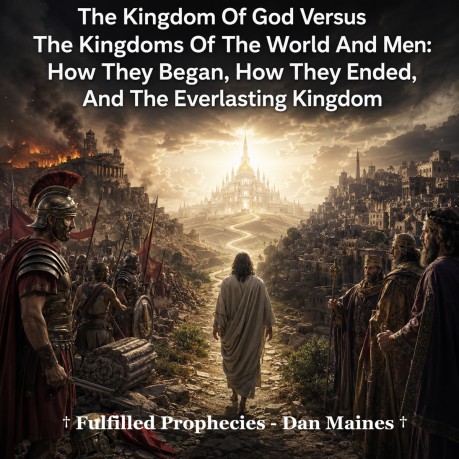
The Kingdom Of God Versus The
Kingdoms Of The World And Men: How They Began, How They Ended, And
The Everlasting Kingdom Introduction Exodus 19:5-6 1 Samuel 8:4-7 1 Samuel 12:12-13 Daniel 2:44 Daniel 7:13-14 Daniel 7:27 Matthew 3:1-2 Matthew 12:28 Luke 22:29-30 John 18:36 Colossians 1:12-13 Hebrews 12:28 Revelation 11:15 Historical References How It Applies To Us Today Q & A Appendix Q: Was God Israel's King before Saul? Q: Was having a human king itself sinful? Q: When did God's kingdom begin? Q: Is Christ's kingdom an earthly political
government? Q: Are Christians waiting to enter Christ's
kingdom? Q: Will Christ's kingdom eventually end? † This is the fulfilled perspective we proclaim at
Fulfilled Prophecies † Source Index
By Dan Maines
† The Bible
presents a major contrast between God's kingdom and the kingdoms
established by men. A kingdom involves a king, authority, subjects,
laws, and a realm in which that authority is exercised.
†
Israel was called to be a kingdom under God's direct rule. God had
already identified Israel as His kingdom of priests before Israel
ever demanded a human king (Exodus 19:5-6).
†
The problem wasn't that Israel eventually had kings. God had already
anticipated kingship in Israel (Deuteronomy 17:14-20). The problem in
1 Samuel 8 was Israel's desire to be like the surrounding nations and
its rejection of God's immediate kingship over them (1 Samuel 8:7,
19-20).
† The prophets then looked beyond
Israel's failing earthly kings and the temporary kingdoms of men to
the everlasting reign of the Messiah (Isaiah 9:6-7; Daniel 2:44).
†
Jesus announced that God's kingdom had drawn near, demonstrated its
presence through His works, and identified Himself as its King. The
New Testament then describes believers as already transferred into
Christ's kingdom (Matthew 12:28; John 18:36-37; Colossians 1:13).
†
Daniel's prophecy reaches its great covenantal climax when the
kingdom, dominion, and greatness are given to the saints of the Most
High. Unlike the kingdoms of men, His kingdom doesn't rise only to be
replaced by another. It's everlasting (Daniel 7:18, 22, 27).
Now then, if you will indeed
obey My voice and keep My covenant, then you shall be My own
possession among all the peoples, for all the earth is Mine; and you
shall be to Me a kingdom of priests and a holy nation. These are the
words that you shall speak to the sons of Israel.
†
God's kingdom didn't begin with Israel asking Samuel for a human
king. Long before Saul, God had already declared Israel to be His
kingdom of priests (Deuteronomy 33:5).
† God
was Israel's true King. Israel's national identity, covenant, law,
worship, and calling came from Him, not from human political
authority (Judges 8:22-23).
† Notice that
God's kingship wasn't limited by geography. He declared that all the
earth belonged to Him. Israel had a special covenant role, but God's
sovereignty extended over everything He had made (Psalm 24:1).
Then all the elders of Israel
gathered together and came to Samuel at Ramah; and they said to him,
"Behold, you have grown old, and your sons do not walk in your
ways. Now appoint us a king to judge us like all the nations."
But the matter was displeasing in the sight of Samuel when they said,
"Give us a king to judge us." And Samuel prayed to the
Lord. And the Lord said to Samuel, Listen to the voice of the people
regarding all that they say to you, because they have not rejected
you, but they have rejected Me from being King over them.
†
This passage tells us exactly what was wrong with Israel's demand.
They wanted a king like the nations around them, and God said their
demand represented a rejection of Him as their King (1 Samuel
10:19).
† Israel wasn't creating the concept
of kingship. Human kingdoms existed long before Saul. What changed
was Israel's demand to imitate those nations rather than remain
satisfied with God's covenant rule (Genesis 10:8-12).
†
Human kingdoms depend upon rulers who age, die, fail, and are
replaced. God's kingdom depends upon a King whose reign isn't ended
by death, political revolution, or military conquest (Psalm 145:13).
But when you saw that
Nahash the king of the sons of Ammon was coming against you, you said
to me, 'No, but a king shall reign over us!' Yet the Lord your God
was your king. And now, behold, the king whom you have chosen, whom
you have asked for, and behold, the Lord has put a king over you.
†
Samuel again stated the central issue, the Lord their God was their
King, but Israel demanded a visible human ruler like the nations (1
Samuel 8:19-20).
† Saul's appointment didn't
mean God surrendered His sovereignty. Even Israel's kings remained
accountable to the greater King who had authority to establish them
and remove them (1 Samuel 13:13-14).
† This
distinction is essential. Human governments exercise temporary
authority, but no earthly ruler becomes sovereign over God's kingdom
simply because people give that ruler political power (Daniel 4:17).
And in the days of those kings
the God of heaven will set up a kingdom which will never be
destroyed, and that kingdom will not be left for another people; it
will crush and put an end to all these kingdoms, but it will itself
endure forever.
† Daniel saw successive human
kingdoms rise and fall, but God's kingdom was fundamentally
different. It would never be destroyed and would never be replaced by
another kingdom (Daniel 2:31-43).
† The
expression "in the days of those kings" places the
establishment of this kingdom within the historical sequence Daniel
was describing. God's kingdom wasn't presented as something postponed
indefinitely into the distant future (Daniel 2:34-35).
†
Jesus came during the days of the Roman Empire announcing that the
appointed time had been fulfilled and the kingdom of God had drawn
near (Mark 1:14-15).
I kept looking in the night
visions, And behold, with the clouds of heaven One like a son of man
was coming, And He came up to the Ancient of Days And was presented
before Him. And to Him was given dominion, Honor, and a kingdom, So
that all the peoples, nations, and populations of all languages Might
serve Him. His dominion is an everlasting dominion Which will not
pass away; And His kingdom is one Which will not be destroyed.
†
Daniel's Son of Man comes to the Ancient of Days and receives
dominion, glory, and a kingdom. This is enthronement language, and
Jesus repeatedly identified Himself with Daniel's Son of Man (Matthew
26:64).
† Christ's kingdom isn't another
temporary political empire. His dominion is everlasting and His
kingdom can't be destroyed (Luke 1:32-33).
†
After His resurrection Jesus declared that all authority in heaven
and on earth had been given to Him. His kingship rests upon divine
authority, not human elections, armies, borders, or governments
(Matthew 28:18).
Then the sovereignty, the
dominion, and the greatness of all the kingdoms under the whole
heaven will be given to the people of the saints of the Highest One;
His kingdom will be an everlasting kingdom, and all the empires will
serve and obey Him.
† Daniel didn't merely
predict the reign of the Messiah. He also saw the saints
participating in the kingdom given by God (Daniel 7:18, 22).
†
The kingdom belongs ultimately to God and His Messiah, while His
people share in the blessings and reign of that kingdom. This is why
the New Testament can speak of believers receiving a kingdom that
can't be shaken (Hebrews 12:28).
† Daniel's
contrast couldn't be stronger. Beastly kingdoms rise, dominate,
persecute, and disappear. God's kingdom survives them because its
King and authority are everlasting (Daniel 7:3-12).
Now in those days John the
Baptist came, preaching in the wilderness of Judea, saying, "Repent,
for the kingdom of heaven has come near."
†
John didn't announce that the kingdom was thousands of years away. He
announced its nearness to his first-century audience (Matthew
3:1-2).
† The kingdom promised by the
prophets had reached its appointed time. Jesus soon proclaimed the
same message, saying that the time was fulfilled and God's kingdom
was near (Mark 1:14-15).
† The arrival of
Jesus was therefore central to the arrival of the kingdom. The
promised King was present, and the promised kingdom was breaking into
history through Him (Luke 17:20-21).
But if I cast out the demons
by the Spirit of God, then the kingdom of God has come upon you.
†
Jesus went beyond saying that the kingdom was near. He said His works
demonstrated that God's kingdom had come upon that generation (Luke
11:20).
† The kingdom wasn't defined by
political borders, military conquest, or an earthly throne in
Jerusalem. Its presence was demonstrated by the authority of Christ
over the powers opposed to God's rule (Matthew 12:25-29).
†
Jesus was showing that God's reign was actively invading the domain
of darkness. The King was present, exercising the authority of His
kingdom (Colossians 2:15).
and just as My Father has
granted Me a kingdom, I grant you that you may eat and drink at My
table in My kingdom, and you will sit on thrones judging the twelve
tribes of Israel.
† Jesus explicitly
connected the kingdom with what the Father had appointed to Him and
what He was appointing to His disciples (Luke 12:32).
†
The kingdom wasn't an accidental development in history. It belonged
to God's redemptive purpose centered in Christ (Acts 2:30-36).
†
The apostles were given a unique foundational role connected with
Israel's transition and the establishment of the New Covenant people
of God (Ephesians 2:19-22).
Jesus answered, "My kingdom
is not of this world. If My kingdom were of this world, My servants
would be fighting so that I would not be handed over to the Jews; but
as it is, My kingdom is not of this realm."
†
Jesus clearly distinguished His kingdom from earthly political
kingdoms. His kingdom doesn't originate from the world's systems of
power.
† Earthly kingdoms maintain authority
through armies, force, territory, and political institutions. Jesus
specifically pointed to the absence of military resistance as
evidence that His kingdom wasn't from that source (Matthew
26:52-54).
† This doesn't mean Christ has no
authority over the world. It means His authority doesn't originate
from the world. His authority comes from the Father (Daniel 7:13-14).
giving thanks to the
Father, who has qualified us to share in the inheritance of the
saints in light. For He rescued us from the domain of darkness, and
transferred us to the kingdom of His beloved Son,
†
Paul didn't tell the Colossians they would someday be transferred
into Christ's kingdom. He described their transfer as an accomplished
spiritual reality.
† This gives us one of the
clearest New Testament answers concerning whether Christ's kingdom
exists now. Christians had already been delivered from the authority
of darkness and transferred into the kingdom of God's Son (Ephesians
5:5).
† We don't wait for an earthly
political kingdom to make Jesus King. Christ already reigns, and
those who belong to Him are already citizens under His rule
(Philippians 3:20).
Therefore, since we receive a
kingdom which cannot be shaken, let's show gratitude, by which we may
offer to God an acceptable service with reverence and awe;
†
Human kingdoms can be shaken. Governments collapse, empires
disappear, borders change, and rulers die. God's kingdom can't be
shaken (Hebrews 12:26-27).
† Hebrews connects
the unshakable kingdom with the heavenly Mount Zion and heavenly
Jerusalem that its first-century believers had already approached
(Hebrews 12:22-24).
† This is the kingdom
Daniel said would stand forever. The temporary covenant order was
passing away, but the kingdom centered in Christ would remain
(Hebrews 8:13).
Then the seventh angel
sounded; and there were loud voices in heaven, saying, "The
kingdom of the world has become the kingdom of our Lord and of His
Christ; and He will reign forever and ever."
†
Revelation brings the contrast between the kingdoms of the world and
Christ's everlasting reign into powerful prophetic focus (Revelation
11:15).
† The message isn't that Christ
eventually becomes King because human governments permit Him to
reign. His authority comes from God, and His reign surpasses every
temporary dominion (Psalm 2:6-12).
† The
kingdoms of men rise and fall within history. Christ's kingdom
remains because His reign is forever (Daniel 7:14, 27).
†
Josephus describes the turmoil surrounding first-century Judea,
including competing rulers, revolutionary factions, internal
violence, and finally the destruction of Jerusalem under Rome. His
account vividly demonstrates how quickly human political and
religious power can collapse. Josephus, Wars of the Jews, Books
4-7.
† Tacitus records the Roman campaign
against Jerusalem and the political setting surrounding the Jewish
war. Rome appeared overwhelmingly powerful, yet even the Roman Empire
itself would eventually decline. Tacitus, Histories, Book 5.
†
Eusebius records the early Christian understanding that judgment came
upon Jerusalem and also describes the spread of Christ's followers
beyond Judea. The earthly city and temple fell, while Christianity
continued to spread. Eusebius, Ecclesiastical History, Books 2-3.
†
We don't need to build Christ's kingdom through political force.
Jesus already possesses all authority, and His kingdom isn't
dependent upon an earthly government recognizing Him (Matthew 28:18;
John 18:36).
† Our primary citizenship and
loyalty are centered in Christ. Governments change, rulers change,
nations change, but our King doesn't change (Philippians 3:20;
Hebrews 13:8).
† We shouldn't measure the
success of God's kingdom by elections, political parties, national
borders, or the rise and fall of governments. God's kingdom is
greater than every political system created by men (Daniel 2:44).
†
We live as citizens of the kingdom by serving Christ, loving others,
proclaiming the gospel, practicing righteousness, and recognizing
Jesus as Lord (Romans 14:17; Colossians 3:17).
†
The kingdom isn't waiting for another age to begin. Believers have
received the unshakable kingdom and have been transferred into the
kingdom of God's Son (Colossians 1:13; Hebrews 12:28).
†
The kingdoms of men have temporary rulers and temporary authority.
God's kingdom has an everlasting King and everlasting dominion
(Daniel 7:14, 27).
Q: What
makes a kingdom?
A: A kingdom has a king,
authority, subjects, laws, and a realm where the king's authority is
exercised. God's kingdom has Christ as King, His people as citizens,
and divine authority as its foundation (Daniel 7:13-14; Colossians
1:13).
A:
Yes. God explicitly said that Israel's demand for a human king was a
rejection of Him as their King (1 Samuel 8:7; 12:12).
A:
No. God had already provided instructions concerning a future king
(Deuteronomy 17:14-20). Israel's sin was demanding a king like the
surrounding nations and rejecting God's immediate rule over them (1
Samuel 8:5-7).
A:
God's sovereign rule has always existed, and Israel was explicitly
called His kingdom of priests at Sinai. The promised Messianic
kingdom foretold by Daniel arrived through Jesus Christ. John
announced that it was near, Jesus demonstrated that it had come upon
His generation, and the apostles taught that believers had already
been transferred into Christ's kingdom (Exodus 19:6; Daniel 2:44;
Matthew 12:28; Colossians 1:13).
A: No. Jesus said, "My kingdom
is not of this world." His kingdom doesn't derive its authority
from earthly political systems, armies, or governments (John 18:36;
Daniel 7:13-14).
A: No. Paul said believers had already
been transferred into the kingdom of God's beloved Son, and Hebrews
says believers were receiving a kingdom that can't be shaken
(Colossians 1:13; Hebrews 12:28).
A:
No. Daniel said His dominion is everlasting and His kingdom won't be
destroyed. Revelation declares that He reigns forever and ever
(Daniel 7:14, 27; Revelation 11:15).
© Fulfilled Prophecies - Dan
Maines.
† Exodus
19:5-6; 1 Samuel 8:4-7; 1 Samuel 12:12-13; Daniel 2:44; Daniel
7:13-14; Daniel 7:27; Matthew 3:1-2; Matthew 12:28; Luke 22:29-30;
John 18:36; Colossians 1:12-13; Hebrews 12:28; Revelation 11:15
†
Historical writers: Josephus, Wars of the Jews, Books 4-7; Tacitus,
Histories, Book 5; Eusebius, Ecclesiastical History, Books 2-3
Links