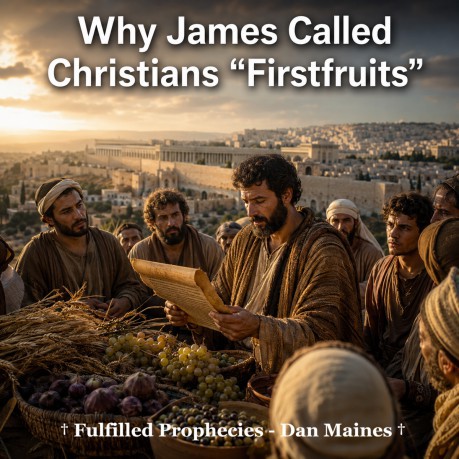
Why James Called Christians
"Firstfruits" Introduction James 1:18 Leviticus 23:10-11 Leviticus 23:15-17 Matthew 9:37-38 John 4:35-36 Matthew 13:39-40 Acts 2:41 Romans 11:5 Revelation 14:4 James 5:7-9 Historical References How It Applies To Us Today Q & A Appendix Q: Does firstfruits imply something more was
coming? Q: What harvest were they anticipating? Q: What does Pentecost have to do with
firstfruits? Q: Was James expecting the Lord's coming in his
readers' lifetime? Q: Are Christians today still waiting for that
first-century harvest to be completed? † This is the fulfilled perspective we proclaim at
Fulfilled Prophecies † Source Index
By Dan Maines
† James used
one word that opens an entire biblical picture of covenant
fulfillment, firstfruits.
† James wasn't
simply telling believers that they were important to God. He placed
them inside the harvest language of Israel's Scriptures.
†
Under Israel's covenant calendar, firstfruits weren't the entire
harvest. They were the beginning of the harvest, the portion gathered
first that demonstrated the rest of the harvest was approaching.
†
This makes James 1:18 much bigger than a statement about individual
salvation. James called first-century believers firstfruits because
they were living at the beginning of the great covenant harvest Jesus
had already announced.
† Jesus said the
harvest was present in His generation, the apostles were sent into
that harvest, Pentecost occurred on Israel's harvest calendar, and
Revelation later pictured the faithful remnant as firstfruits.
†
The question is simple. If those first-century believers were the
firstfruits, what harvest were they anticipating?
†
The answer runs through the teaching of Jesus, Pentecost, the
apostolic mission, and the approaching end of the age.
In the exercise of His will He
gave us birth by the word of truth, so that we would be a kind of
first fruits among His creatures.
† James
wasn't writing thousands of years after Christ to describe a distant
generation. He wrote to the twelve tribes in the Dispersion and spoke
directly about what God was doing among believers in their own time
(James 1:1).
† Their conversion through the
word of truth was evidence that God's promised harvest had begun.
They were the early covenant gathering produced through the gospel.
†
This also explains the urgency throughout James. The coming of the
Lord was near, the Judge was standing at the doors, and those
believers were told to remain patient until the precious fruit of the
earth was gathered (James 5:7-9).
†
Firstfruits and harvest belong together. James begins his letter by
calling them firstfruits and later describes believers waiting
patiently for the precious fruit associated with the Lord's
approaching coming.
Speak to the sons of
Israel and say to them, When you enter the land which I am going to
give to you and you gather its harvest, then you shall bring in the
sheaf of the first fruits of your harvest to the priest. He shall
wave the sheaf before the Lord for you to be accepted; on the day
after the Sabbath the priest shall wave it.
†
Israel already understood the meaning of firstfruits. The first sheaf
wasn't disconnected from the harvest. It announced that the harvest
had begun.
† God built this pattern directly
into Israel's covenant calendar. Firstfruits came first, then the
gathering continued toward its completion.
†
James didn't invent a new agricultural metaphor. He used language
deeply rooted in Israel's Scriptures and covenant life.
†
When James called believers firstfruits, his Jewish readers would've
immediately understood the harvest significance behind the word.
You shall also count for
yourselves from the day after the Sabbath, from the day when you
brought in the sheaf of the wave offering; there shall be seven
complete Sabbaths. You shall count fifty days to the day after the
seventh Sabbath; then you shall present a new grain offering to the
Lord. You shall bring in from your dwelling places two loaves of
bread as a wave offering, made of two-tenths of an ephah; they shall
be of a fine flour, baked with leaven as first fruits to the Lord.
†
Fifty days after the first sheaf came the feast later known as
Pentecost. Once again, God called the offering firstfruits.
†
This gives Acts 2 powerful covenant significance. The Holy Spirit was
poured out at Pentecost, and about three thousand people received the
word and were added (Acts 2:1, 41).
† That
wasn't an accidental date on God's calendar. The gospel harvest was
being gathered on a feast specifically associated with firstfruits
and harvest.
† What Israel had celebrated
agriculturally became a powerful picture of what God was
accomplishing through Christ and the gospel in the last days of the
old covenant age (Acts 2:16-17).
Then He said to His
disciples, "The harvest is plentiful, but the workers are few.
Therefore, plead with the Lord of the harvest to send out workers
into His harvest."
† Jesus didn't
describe the harvest as something beginning thousands of years later.
He said the harvest was already plentiful.
†
The disciples themselves were being prepared as workers in that
harvest. Their mission wasn't detached from the prophetic
expectations of Israel, it was part of their fulfillment.
†
Jesus was standing among covenant Israel, seeing the multitudes, and
announcing that harvest time had arrived.
†
James later calling believers firstfruits fits perfectly within the
harvest mission Jesus had already begun.
Do you not say, 'There are
still four months, and then comes the harvest'? Behold, I tell you,
raise your eyes and observe the fields, that they are white for
harvest. Already the one who reaps is receiving wages and is
gathering fruit for eternal life, so that the one who sows and the
one who reaps may rejoice together.
† Jesus
couldn't have made the timing much clearer. The disciples weren't
supposed to say the harvest was still far away. The fields were
already ready for harvest.
† The harvest had
begun during Christ's ministry and would continue through the
apostolic mission.
† Jesus connected this
gathering with fruit for eternal life. This wasn't merely about
crops, it was about people being gathered into the life of God's
kingdom.
† James' firstfruits language
belongs naturally inside this same first-century harvest setting.
and the enemy who sowed
them is the devil, and the harvest is the end of the age; and the
reapers are angels. So just as the weeds are gathered up and burned
with fire, so shall it be at the end of the age.
†
Jesus directly connected the harvest with the end of the age. The
Greek word translated world here is aion, referring to an age.
†
This wasn't teaching the destruction of planet Earth. Jesus was
describing a harvest connected with the conclusion of an age.
†
That fits the entire New Testament setting. The apostles said they
were living at the ends of the ages, the last days had arrived, and
the consummation was approaching (1 Corinthians 10:11; Hebrews 1:1-2;
Hebrews 9:26).
† James' firstfruits therefore
belonged to a harvest that was moving toward the end of the old
covenant age.
† Firstfruits at the beginning
and harvest at the end form one continuous covenant picture.
So then, those who had received
his word were baptized; and that day there were added about three
thousand souls.
† Pentecost gives us a
dramatic picture of the firstfruits harvest in action. About three
thousand people received the apostolic message in a single day.
†
The gospel wasn't waiting for a distant prophetic clock to begin. The
gathering was happening right there in Jerusalem.
†
Israelites from many nations had gathered for the feast, heard the
gospel, and were brought into the community of Christ (Acts
2:5-11).
† The harvest language of Israel's
feast calendar and the actual gathering recorded in Acts fit together
beautifully.
In the same way then, there has
also come to be at the present time a remnant according to God's
gracious choice.
† Paul specifically said
there was a remnant at that present time. That places the gathering
firmly within the first-century covenant transition.
†
God hadn't forgotten His promises to Israel. He was fulfilling them
by gathering the faithful remnant through Christ.
†
The firstfruits weren't evidence that God's promises had failed. They
were evidence that God's promises were being fulfilled.
†
The remnant according to grace became part of the believing people of
God while unbelief brought covenant judgment upon the hardened
portion of Israel (Romans 11:7-10).
These are the ones who have
not defiled themselves with women, for they are celibate. These are
the ones who follow the Lamb wherever He goes. These have been
purchased from mankind as first fruits to God and to the Lamb.
†
Revelation uses the same firstfruits language. These faithful
followers of the Lamb were purchased as firstfruits to God and the
Lamb.
† Once again, firstfruits language
appears in a book filled with imminent first-century expectations.
The things revealed were shortly to happen, and the time was near
(Revelation 1:1, 3).
† These firstfruits
belonged to the generation living through the transition from the old
covenant age into the fully established new covenant order.
†
The pattern remains consistent. Firstfruits appear before the
completed harvest, not thousands of years after it.
Therefore be patient, brothers
and sisters, until the coming of the Lord. The farmer waits for the
precious produce of the soil, being patient about it, until it gets
the early and late rains. You too be patient; strengthen your hearts,
for the coming of the Lord is near. Do not complain, brothers and
sisters, against one another, so that you may not be judged; behold,
the Judge is standing right at the door.
†
James brings the harvest picture directly into his discussion of the
coming of the Lord. The farmer was waiting for the precious fruit,
and James told his readers to be patient in the same way.
†
He didn't tell them the coming was thousands of years away. He said
it was at hand.
† He didn't tell them the
Judge would someday approach a distant generation. He said the Judge
was standing at the doors.
† This connects
beautifully with the beginning of the letter. In chapter 1 they were
firstfruits. In chapter 5 they were waiting for the approaching
completion associated with the Lord's coming.
†
The beginning and ending of James therefore carry the same harvest
framework, firstfruits had appeared, the fruit was maturing, and the
coming of the Lord was near.
† The harvest
they anticipated was the covenant gathering and separation connected
with the end of the old covenant age, culminating in the judgment
that Jesus had placed within that generation (Matthew 23:36; Matthew
24:34).
†
Josephus records the catastrophic events surrounding Jerusalem and
the temple in AD 70, including famine, internal violence, Roman
siege, massive death, captivity, and the destruction of the city and
sanctuary. His account provides historical background for
understanding the covenant judgment that overtook that generation.
Josephus, The Wars of the Jews, Books 5-7.
†
Tacitus also records the Roman campaign against Jerusalem and
describes the city as being under siege during the reign of
Vespasian. His Roman perspective independently confirms the
historical setting of Jerusalem's final catastrophe. Tacitus,
Histories, Book 5.
† Eusebius later recorded
the tradition that believers in Jerusalem were warned and departed
before the war, settling at Pella. This is significant when
considered alongside Jesus' warning that His disciples were to flee
when they recognized the approaching judgment. Eusebius,
Ecclesiastical History, Book 3, Chapter 5.
†
These historical writers don't establish the doctrine. Scripture
establishes the doctrine. Their writings help confirm that the
first-century generation actually experienced the historical judgment
and covenant upheaval Jesus and the apostles had warned about.
†
We aren't the firstfruits generation waiting for the old covenant age
to end. They were.
† We live on the completed
side of the covenant transition they were experiencing.
†
Their firstfruits status shouldn't be removed from its first-century
setting and stretched across thousands of years.
†
We can rejoice because the kingdom they were entering has been
established, Christ reigns, and access to God isn't through an
earthly temple, priesthood, or sacrificial system.
†
We don't wait for the destruction of the old covenant order. That
judgment happened in history.
† We proclaim
the gospel from the victory of Christ and the reality of the new
covenant, knowing that what the firstfruits anticipated reached its
covenant goal.
† James 1:18 isn't a small
statement. It's another piece of the New Testament's harvest
timeline. Firstfruits had appeared because harvest time had arrived.
Q: Why
did James call first-century Christians firstfruits?
A:
Because they were the early covenant gathering produced through the
word of truth during the harvest Jesus had already announced (James
1:18; Matthew 9:37-38; John 4:35-36).
A: Yes. In Israel's harvest pattern,
firstfruits represented the beginning of the harvest, not its
completion (Leviticus 23:10-17).
A:
They were living through the gospel gathering and covenant separation
associated with the end of the old covenant age (Matthew 13:39-40;
James 5:7-9).
A: Pentecost was part of Israel's
harvest calendar, and Acts records about three thousand people
receiving the word on that very day (Leviticus 23:15-17; Acts 2:41).
A: James told those
believers that the coming of the Lord was at hand and that the Judge
was standing at the doors (James 5:7-9).
A: No.
We live after the covenant transition those believers were
experiencing. We now live under the established new covenant reign of
Christ (Hebrews 12:22-24; Revelation 21:1-3).
© Fulfilled Prophecies - Dan
Maines.
† James
1:18; Leviticus 23:10-11; Leviticus 23:15-17; Matthew 9:37-38; John
4:35-36; Matthew 13:39-40; Acts 2:41; Romans 11:5; Revelation 14:4;
James 5:7-9
† Josephus, The Wars of the Jews,
Books 5-7; Tacitus, Histories, Book 5; Eusebius, Ecclesiastical
History, Book 3, Chapter 5
Links