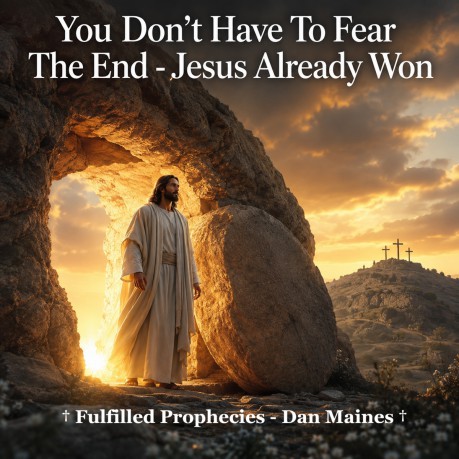
You Don't Have To Fear The
End - Jesus Already Won Introduction John 16:33 Colossians 2:15 Hebrews 2:14-15 1 John 2:18 Revelation 1:1-3 Matthew 24:34 Luke 21:20-22 Historical References How It Applies To Us Today Q & A Appendix Q: Should we be looking for the Antichrist
today? Q: Does fulfilled prophecy mean Christians will
never experience trouble? Q: Does fulfilled prophecy mean nothing matters
anymore? Q: Why shouldn't Christians live in fear of
prophecy? Q: What should Christians focus on instead of
constantly watching end-times predictions? † This is the fulfilled perspective we proclaim at
Fulfilled Prophecies † Source Index
By Dan Maines
† Millions
of Christians have been taught to look toward the future with fear.
They're told to expect a terrifying Antichrist, a world-dominating
beast, Armageddon, collapsing nations, global destruction, and events
so terrible that believers wonder whether they'll survive.
†
But the New Testament wasn't written to make Christians afraid of the
future. It was written to give first-century believers courage while
they were living through persecution, tribulation, and the
approaching judgment Jesus had already announced.
†
Jesus didn't tell His disciples that evil would ultimately win. He
told them that He had already overcome the world (John 16:33).
†
Paul didn't describe Satan and the powers of darkness as an
undefeated enemy waiting thousands of years for Christ to conquer
them. He proclaimed Christ's victory over them through the cross
(Colossians 2:15).
† Hebrews doesn't present
the devil as someone Christians should live in lifelong terror of.
Christ came to break the power of the one who held the power of death
and to release people from the fear that kept them in bondage
(Hebrews 2:14-15).
† Fulfilled prophecy isn't
a message of fear. It's a message of victory. Jesus kept His
promises, judged the old covenant world that rejected Him,
established His kingdom, and reigns today.
†
We don't need to spend our lives frightened by every war, politician,
technological development, disease, earthquake, or headline. Our
confidence isn't in the condition of the world. Our confidence is in
the finished victory of Jesus Christ.
These things I have spoken to you
so that in Me you may have peace. In the world you have tribulation,
but take courage; I have overcome the world.
†
Notice where Jesus placed their peace. He didn't promise His
disciples a life without trouble. Their peace was found in Him (John
14:27).
† Jesus said, be of good cheer,
because He had overcome the world. Christianity begins from the
position of Christ's victory, not from the expectation that evil will
eventually overpower His kingdom (Matthew 28:18).
†
The disciples were about to face persecution, rejection,
imprisonment, and even death, yet Jesus told them to have courage.
Their circumstances didn't determine whether Christ was victorious
(Acts 14:22).
† That same truth matters
today. We can experience hardship without believing that every
hardship is evidence that the world is approaching a prophetic
apocalypse.
When He had disarmed the
rulers and authorities, He made a public display of them, having
triumphed over them through Him.
† The cross
looked like defeat to the world, but Paul describes it as Christ's
triumph. Jesus publicly defeated the powers that stood against Him
(Colossians 1:13-14).
† Christianity isn't
waiting for Jesus to become victorious. His victory is the foundation
upon which the gospel stands (1 Corinthians 15:57).
†
This changes the way we read prophecy. We shouldn't interpret every
frightening symbol as proof that Jesus is losing control of history.
Revelation was given to suffering believers to assure them that
Christ would judge their enemies and vindicate His people (Revelation
6:9-11).
† The victorious Christ isn't hiding
from the powers of darkness. He has authority over them.
Therefore, since the
children share in flesh and blood, He Himself likewise also partook
of the same, so that through death He might destroy the one who has
the power of death, that is, the devil, and free those who through
fear of death were subject to slavery all their lives.
†
Jesus entered humanity and defeated death through His own death. What
appeared to be Satan's greatest victory became the means of his
defeat (1 Corinthians 15:54-57).
† The
purpose wasn't to create another generation of frightened believers.
Christ came to deliver people from bondage to the fear of death
(Romans 8:15).
† A theology that keeps
Christians constantly terrified of Satan, Antichrist, beasts,
Armageddon, and the end of the world misses the victorious direction
of the New Testament.
† Our message should
produce confidence in Christ, not endless speculation about which
modern person might be the next prophetic villain.
Children, it is the last hour;
and just as you heard that antichrist is coming, even now many
antichrists have appeared; from this we know that it is the last
hour.
† John didn't tell his readers that the
last hour would begin thousands of years after they died. He told
them, it is the last hour (1 John 2:18).
† He
also didn't describe one future political ruler called the
Antichrist. John said that many antichrists had already arisen in his
own time (1 John 2:22; 4:3; 2 John 7).
† John
even explained that the appearance of these antichrists was evidence
that they were living in the last hour.
†
When we allow John's words to remain in their original first-century
setting, much of the modern fear surrounding Antichrist disappears.
†
We don't need to examine every modern leader to determine whether
he's the Antichrist. John's antichrists belonged to the crisis his
original readers were already experiencing.
The Revelation of Jesus
Christ, which God gave Him to show to His bond-servants, the things
which must soon take place; and He sent and communicated it by His
angel to His bond-servant John, who testified to the word of God and
to the testimony of Jesus Christ, everything that he saw. Blessed is
the one who reads, and those who hear the words of the prophecy and
keep the things which are written in it; for the time is near.
†
Revelation begins by telling its original readers when its prophetic
events were expected. They were things that must shortly come to
pass, and the time was at hand.
† Those
statements weren't meaningless filler. They established the timeframe
for the visions that followed (Revelation 22:6, 10).
†
The beasts, judgments, warfare, Babylon, and other frightening images
must be interpreted within the timeframe John gave his original
audience.
† Revelation wasn't dropped into
the first century primarily to frighten Christians living thousands
of years later. It was given to real churches facing real persecution
and approaching events.
† Revelation was
intended to bless its readers, not trap every later generation in
fear that the latest international crisis must mean the end is
finally here.
Truly I say to you, this
generation will not pass away until all these things take place.
†
Jesus placed the events He had been describing within the lifetime of
that generation. He didn't say that generation would begin thousands
of years later.
† The disciples had asked
Jesus about the destruction of the temple they were looking at, and
Jesus warned them about events connected with that judgment (Matthew
24:1-3).
† This included wars, persecution,
false prophets, the gospel proclamation, tribulation, and His coming
in judgment.
† The controlling time statement
is unmistakable. This generation would not pass away until all these
things were accomplished.
† Moving those
events into our future removes them from the timeframe Jesus Himself
provided.
But when you see Jerusalem
surrounded by armies, then recognize that her desolation is near.
Then those who are in Judea must flee to the mountains, and those who
are inside the city must leave, and those who are in the country must
not enter the city; because these are days of punishment, so that all
things which have been written will be fulfilled.
†
Jesus gave His disciples something they could recognize. When they
saw Jerusalem surrounded by armies, they were to know that its
desolation was near.
† This wasn't a warning
for Christians thousands of years later living in America, Europe,
Africa, Asia, or Australia. Jesus specifically addressed people who
could flee from Judea when Jerusalem came under threat.
†
Jesus called these the days of vengeance and connected them with the
fulfillment of what had been written.
†
Jerusalem was surrounded by Roman forces in the events leading to its
destruction in AD 70. The temple was destroyed, exactly as Jesus had
warned (Matthew 24:2).
† Instead of turning
Jesus' warning into an endlessly future prediction, we should
recognize the historical judgment toward which His words pointed.
†
Josephus, a first-century Jewish historian and eyewitness to the
Jewish-Roman War, recorded the siege, famine, internal violence,
destruction, and terrible suffering surrounding Jerusalem's fall in
AD 70 in The Wars of the Jews, especially Books 5-7.
†
Josephus' account provides important historical background for
understanding the severity of the judgment that came upon Jerusalem
and the generation Jesus had warned.
†
Tacitus, the Roman historian, also recorded the Roman campaign
against Jerusalem and the circumstances surrounding the city's
destruction in Histories, Book 5.
† Eusebius
later recorded the Christian tradition that believers in Jerusalem
left the city before the war and went to Pella, connecting the escape
of Christians with the warnings Christ had given His disciples in
Ecclesiastical History, Book 3, chapter 5.
†
These historical witnesses don't replace Scripture. They help us see
that the first-century world actually experienced the kind of
historical crisis described in Jesus' warnings.
†
You don't have to wake up every morning wondering whether today's
news has finally triggered the end of the world.
†
You don't have to fear every war because someone calls it
Armageddon.
† You don't have to fear every
politician because someone calls that person the Antichrist.
†
You don't have to fear every new technology because someone connects
it with the mark of the beast.
† You don't
have to fear every conflict in the Middle East because a prophecy
teacher says the prophetic clock has started again.
†
You don't have to live watching for Christ's kingdom to arrive.
Believers have already been transferred into the kingdom of God's
beloved Son (Colossians 1:13).
† You don't
have to live as though Satan and evil have defeated Jesus. Christ
triumphed over the powers through His redemptive work (Colossians
2:15).
† You don't have to live in bondage to
the fear of death. Jesus came to deliver His people from that fear
(Hebrews 2:14-15).
† Prophecy should
strengthen our faith because fulfilled prophecy demonstrates that God
keeps His word.
† Jesus warned His
generation. Jesus told them what was coming. Jesus gave them signs
they could recognize. Jesus told them when those things would occur.
History records Jerusalem's fall and the temple's destruction.
†
The Christian life isn't supposed to be spent staring anxiously
toward the horizon waiting for Jesus to win.
†
Jesus already won.
† That's why we can live
with peace instead of panic, confidence instead of fear, hope instead
of dread, and joy instead of endless end-times anxiety.
†
The kingdom isn't waiting helplessly for its King. Christ reigns.
†
Whatever difficulties we face today, our message remains the same. In
Christ we have peace. In this world we'll experience trouble, but we
can have courage because Jesus has overcome the world (John 16:33).
Q:
Should Christians be afraid that Armageddon could happen in our
lifetime?
A: No. Revelation announced events
that were shortly to take place and said the time was at hand for its
original readers (Revelation 1:1-3; 22:6, 10). Its judgment imagery
shouldn't be disconnected from those inspired time statements.
A: No. John said many antichrists had
already arisen and used their presence as evidence that it was the
last hour (1 John 2:18, 22; 4:3).
A: No. Jesus
specifically said His followers would experience tribulation in the
world, but He told them to have courage because He had overcome the
world (John 16:33).
A: Absolutely not. It means we live
from Christ's victory instead of waiting for it. We're called to
faith, love, righteousness, service, and the proclamation of the
gospel (Matthew 28:18-20; Galatians 5:13-14).
A: Because biblical prophecy reveals
God's faithfulness. Jesus told His disciples what was coming and
assured them that He was victorious. Fulfillment gives us greater
reason to trust Him, not greater reason to fear.
A:
We should focus on Christ, His kingdom, loving God, loving others,
sharing the gospel, and faithfully living the life He's given us
(Matthew 22:37-39; Colossians 3:1-4).
© Fulfilled Prophecies - Dan
Maines.
† John
16:33; Colossians 2:15; Hebrews 2:14-15; 1 John 2:18; Revelation
1:1-3; Matthew 24:34; Luke 21:20-22
†
Historical writers: Josephus, The Wars of the Jews, Books 5-7;
Tacitus, Histories, Book 5; Eusebius, Ecclesiastical History, Book 3,
chapter 5
Links