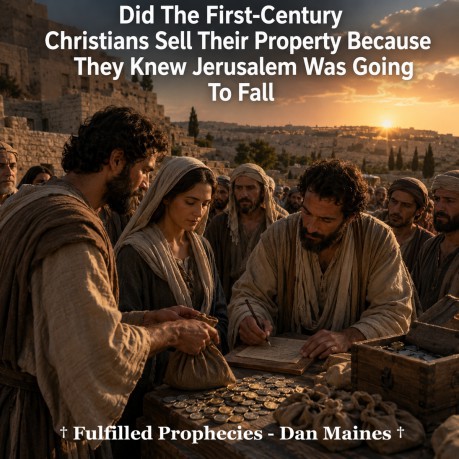
Did The First-Century
Christians Sell Their Property Because They Knew Jerusalem Was Going
To Fall? Introduction Acts 2:44-45 Acts 4:34-35 Acts 4:36-37 Acts 5:4 Matthew 24:15-18 Luke 21:20-22 1 Corinthians 7:26-27 1 Corinthians 7:29-31 Hebrews 10:34 Historical References How It Applies To Us Today Q & A Appendix † This is the fulfilled perspective we proclaim at
Fulfilled Prophecies † Source Index
By Dan Maines
† The book
of Acts records something remarkable. Believers sold lands and
possessions and distributed the proceeds among those who were in
need. The immediate reason stated by Acts is unmistakable, they were
caring for one another in extraordinary generosity and unity.
†
But there's another part of the historical setting that shouldn't be
ignored. Jesus had already warned His disciples that Jerusalem and
the temple were heading toward catastrophic judgment within their
generation (Matthew 23:36; Matthew 24:2, 34).
†
That raises an interesting question. Did some believers recognize
that holding property in and around Jerusalem wasn't nearly as
important as it once had been because Jesus had told them what was
coming?
† Scripture never says that the
believers sold their property because they expected a real estate
crash. We shouldn't turn an interesting possibility into a biblical
statement. However, the coming judgment certainly changes the context
in which their extraordinary behavior should be understood.
†
Acts emphasizes charity and communal needs, while Jesus' warnings
explain why first-century believers could hold earthly possessions
unusually loosely. Paul likewise described his own generation as
living through a present distress in which ordinary priorities,
including marriage and possessions, had to be viewed differently (1
Corinthians 7:26-31).
† The evidence
therefore points to immediate generosity as the explicitly stated
reason, with first-century eschatological urgency forming part of the
larger background.
And all the believers were
together and had all things in common; and they would sell their
property and possessions and share them with all, to the extent that
anyone had need.
† Notice the reason Luke
actually gives. Their possessions were distributed according to need.
This was an extraordinary expression of love and fellowship among the
believers.
† The text doesn't say they sold
everything because they expected property values to collapse. That
idea goes beyond what Luke actually wrote.
†
At the same time, these believers were living in the very generation
Jesus had warned about. They knew Jerusalem's covenant world was
approaching judgment (Matthew 23:36; 24:34).
†
Their generosity shouldn't be separated from their first-century
circumstances, but neither should we replace Luke's stated reason
with speculation.
For there was not a needy
person among them, for all who were owners of land or houses would
sell them and bring the proceeds of the sales and lay them at the
apostles' feet, and they would be distributed to each to the extent
that any had need.
† Again Luke tells us
exactly what happened. People who owned lands or houses sold them,
and the money was distributed according to need.
†
This wasn't ordinary Christian teaching requiring every believer in
every generation to liquidate his property. Acts describes an
extraordinary situation in the Jerusalem church.
†
Their actions demonstrated that people had become more important to
them than property. They were willing to surrender earthly wealth to
care for brothers and sisters during a unique period of transition
and increasing difficulty.
† We should also
notice that Acts speaks of possessors of lands or houses selling
them. Whatever restrictions existed concerning ancestral inheritance
under the Mosaic system, Scripture itself presents these transactions
as legitimate acts of generosity.
Now Joseph, a Levite of Cyprian
birth, who was also called Barnabas by the apostles (which translated
means Son of Encouragement), owned a tract of land. So he sold it,
and brought the money and laid it at the apostles' feet.
†
Barnabas provides a specific example. He owned a field, sold it, and
gave the proceeds for the work of the believing community.
†
This is especially interesting because Barnabas was a Levite. Luke
doesn't condemn the transaction as illegal. Instead, he presents
Barnabas as an example of generosity.
†
Therefore, we need to be careful with the claim that selling property
would necessarily have been illegal because of family inheritance
laws. The Old Testament contained important regulations concerning
land, redemption, inheritance, and tribal holdings, but Acts plainly
records believers selling property.
†
Whatever legal details applied to particular parcels of land, Luke
doesn't portray these sales as violations of God's law.
While it remained unsold, did it
not remain your own? And after it was sold, was it not under your
control? Why is it that you have conceived this deed in your heart?
You have not lied to men, but to God.
†
Peter's words concerning Ananias give us an extremely important
detail. The property remained his while he possessed it, and after it
was sold the proceeds remained under his authority.
†
This means the selling wasn't compulsory. The Jerusalem church wasn't
practicing forced confiscation of private property.
†
Ananias' sin wasn't that he retained property or money. His sin was
deception concerning what he had done (Acts 5:1-3).
†
This makes the generosity described in Acts even more significant.
People were voluntarily releasing possessions for the benefit of
others.
Therefore when you see the
abomination of desolation which was spoken of through Daniel the
prophet, standing in the holy place-let the reader understand-then
those who are in Judea must flee to the mountains. Whoever is on the
housetop must not go down to get things out of his house. And whoever
is in the field must not turn back to get his cloak.
†
Now the prophetic background becomes impossible to ignore. Jesus told
His disciples that a time would come when people in Judea needed to
flee immediately.
† Think about what that
meant for attachment to property. Jesus told the person on the
housetop not even to go back into the house for possessions. The
person in the field wasn't to return for clothing.
†
Jesus wasn't teaching ordinary financial planning for Christians
throughout history. He was preparing His first-century disciples for
a specific approaching crisis in Judea (Matthew 24:16, 34).
†
A house that someone wouldn't be able to return to and land that
someone would have to abandon suddenly couldn't provide ultimate
security.
But when you see Jerusalem
surrounded by armies, then recognize that her desolation is near.
Then those who are in Judea must flee to the mountains, and those who
are inside the city must leave, and those who are in the country must
not enter the city; because these are days of punishment, so that all
things which have been written will be fulfilled.
†
Luke makes the historical setting even clearer. Jerusalem would be
surrounded by armies, and those in Judea were commanded to flee.
†
Jesus wasn't telling them to defend their homes, protect their
property values, or preserve their land. He told them to leave.
†
This doesn't prove that the Acts believers sold property specifically
because they were anticipating the Roman siege. Scripture never
directly makes that statement.
† But it does
show that the early Jerusalem believers lived under a prophetic
warning that made permanent attachment to property in Judea very
different from ordinary circumstances.
† When
the sign Jesus gave finally appeared, survival required leaving
property behind.
I think, then, that
this is good in view of the present distress, that it is good for a
man to remain as he is. Are you bound to a wife? Do not seek to be
released. Are you released from a wife? Do not seek a wife.
†
Paul gives us another important piece of the first-century picture.
He specifically refers to the distress that was upon them.
†
This is why Paul's advice about marriage sounds unusual if it's
removed from its historical setting. Paul wasn't declaring marriage
undesirable. Elsewhere he spoke positively about marriage (1
Corinthians 7:2; Ephesians 5:25).
† He was
addressing believers living through extraordinary circumstances.
Starting a family during severe and approaching distress could create
additional burdens.
† This demonstrates why
we shouldn't automatically turn every first-century crisis
instruction into a universal command for every Christian generation.
But this I say,
brothers, the time has been shortened, so that from now on those who
have wives should be as though they had none; and those who weep, as
though they did not weep; and those who rejoice, as though they did
not rejoice; and those who buy, as though they did not possess; and
those who use the world, as though they did not make full use of it;
for the present form of this world is passing away.
†
Paul's language is striking. The time was shortened. Those who bought
were to live as though they didn't possess.
†
This fits remarkably well with the attitude we see among the early
believers in Acts. Their earthly possessions couldn't be allowed to
control them.
† Paul wasn't saying the
physical planet was about to disappear. He was describing a present
and rapidly changing situation in their world (1 Corinthians 7:26).
†
Marriage, buying, possessions, sorrow, and ordinary social life were
being viewed through the reality of an extraordinary first-century
crisis.
† This is powerful supporting
evidence that the early church's unusual relationship to property
shouldn't be interpreted without considering the historical
circumstances surrounding them.
For you showed sympathy to the
prisoners and accepted joyfully the seizure of your property, knowing
that you have for yourselves a better and lasting possession.
†
First-century believers were learning that earthly possessions
weren't their ultimate treasure.
† Some had
their possessions taken from them and accepted the loss because they
understood that what they possessed in Christ couldn't be
destroyed.
† This doesn't mean Christians
today should deliberately abandon property or financial
responsibility. It means earthly possessions must never become more
important than Christ, His kingdom, or His people.
†
Josephus describes the terrible conditions surrounding Jerusalem
during the Jewish War, including famine, internal violence,
destruction, and finally the Roman conquest of the city in AD 70. His
account demonstrates how completely normal economic and social life
collapsed during the catastrophe Jesus had warned about.
†
Josephus also describes people losing homes, property, security, and
life itself during the siege. Whatever property had once been worth,
ownership provided little security once Jerusalem was surrounded and
destroyed.
† Eusebius later reported that
believers belonging to the church at Jerusalem departed the city
before the war and went to Pella. His account reflects an early
Christian tradition that the Jerusalem believers escaped before the
city's destruction.
† These historical
accounts don't prove that Acts 2 and Acts 4 were describing a
calculated attempt to sell property before a market collapse. They
do, however, show why Jesus' warnings about fleeing Jerusalem had
enormous practical significance.
†
We shouldn't read Acts 2 and Acts 4 and conclude that Christians
today are commanded to sell their houses, land, retirement accounts,
or other possessions.
† We also shouldn't
tell Christians not to marry because Paul said it was good for
certain believers to remain as they were during the distress that was
upon them.
† Historical context matters. The
first-century church was approaching events that Jesus had
specifically predicted for that generation (Matthew 24:34).
†
The spiritual principle remains powerful. Our possessions belong
under the lordship of Christ. We should willingly help believers who
are genuinely in need (1 John 3:17).
†
Houses, land, investments, and money are temporary. They can be
useful blessings, but they aren't the kingdom of God and they aren't
our ultimate security.
† The Acts believers
understood something that Christians in every generation need to
remember, people are more important than possessions.
†
So, did they sell because they knew the Jerusalem real estate market
was going to crash? Scripture doesn't say that, and we shouldn't say
that it does.
† Did they sell because fellow
believers had immediate needs? Yes. Acts explicitly tells us that.
†
Did they also live with the knowledge that Jesus had predicted
Jerusalem's coming destruction and commanded His followers in Judea
to flee when the time arrived? Absolutely.
†
The strongest biblical conclusion is therefore not either-or. Their
selling was explicitly motivated by love, generosity, and immediate
need, while the extraordinary prophetic circumstances of that
generation help us understand why possessions could be held so
loosely.
† They weren't building their hope
around property that could be lost. They were building their lives
around a kingdom that couldn't be shaken (Hebrews 12:28).
Q: Does
Acts actually say Christians sold their property because they knew
Jerusalem would be destroyed?
A: No. Acts says
the proceeds were distributed according to people's needs (Acts 2:45;
4:34-35). Connecting the sales directly to Jerusalem's coming
destruction is a reasonable historical consideration, but Scripture
doesn't explicitly state that this was their motive.
Q:
Is it accurate to say they knew the real estate market was going to
crash?
A: Not as a direct biblical statement.
Jesus did tell them Jerusalem would be surrounded and Judea would
have to be abandoned (Luke 21:20-22). That certainly meant property
couldn't provide lasting security, but Scripture never describes
their selling as an attempt to beat a real estate crash.
Q:
Was selling property mandatory for Christians?
A:
No. Peter told Ananias that while the property remained unsold it was
his, and after selling it the money was still under his authority
(Acts 5:4). The giving was voluntary.
Q: Was
selling family property illegal under biblical inheritance laws?
A:
We need to be careful with that claim. Israel had laws regulating
ancestral land and inheritance (Leviticus 25:23-34), but Acts openly
records believers selling lands and houses, including Barnabas
selling a field (Acts 4:34-37). Luke doesn't portray these
transactions as illegal.
Q: Why did Paul
suggest that some men shouldn't seek marriage?
A:
Paul connected his advice to the distress that was upon them and said
the time was shortened (1 Corinthians 7:26, 29). This wasn't a
condemnation of marriage. It was practical instruction during
extraordinary first-century circumstances.
Q:
Should Christians today sell everything because the believers in Acts
did?
A: No. Acts doesn't establish compulsory
property liquidation as a permanent Christian command. The continuing
principle is generosity, caring for people in need, and refusing to
make possessions our ultimate security (1 John 3:17; 1 Timothy
6:17-19).
Q: What does all of this tell us
about Matthew 24?
A: It reminds us that Jesus'
prophecy wasn't abstract theology to the people who first heard it.
His disciples lived in the generation He warned, and His instructions
eventually affected practical decisions about homes, possessions,
families, travel, and fleeing Judea (Matthew 24:15-18, 34; Luke
21:20-22).
© Fulfilled Prophecies - Dan
Maines.
† Acts
2:44-45; Acts 4:34-35; Acts 4:36-37; Acts 5:4; Matthew 24:15-18; Luke
21:20-22; 1 Corinthians 7:26-27; 1 Corinthians 7:29-31; Hebrews
10:34
† Historical writers: Josephus, The
Wars of the Jews, Books 5-7; Eusebius, Ecclesiastical History 3.5
Links