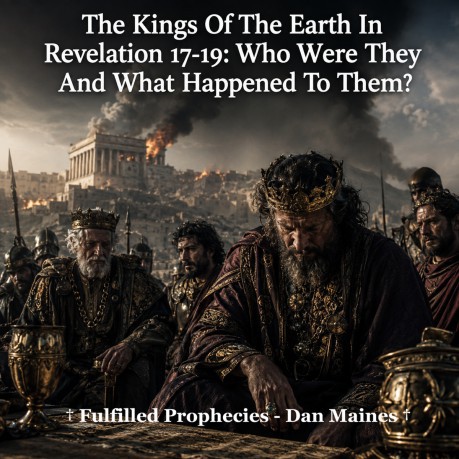
The Kings Of The Earth In
Revelation 17-19: Who Were They And What Happened To Them? Introduction Revelation 17:1-2 Revelation 17:9-11 Revelation 17:12-14 Revelation 17:16-18 Revelation 18:3 Revelation 18:9-10 Revelation 19:19-21 Acts 4:26-28 Historical References How It Applies To Us Today Q & A Appendix Q: Does "kings of the earth" mean
modern world leaders? Q: Who are the seven kings in Revelation 17? Q: Who were the ten kings? Q: Why did the beast and the kings turn against
the harlot? Q: Is Revelation 19 describing a future world
war? Q: What should Christians do when modern wars and
political crises happen? Q: What is the main message of the kings of the
earth in Revelation? † This is the fulfilled perspective we proclaim at
Fulfilled Prophecies † Source Index
By Dan Maines
† The "kings
of the earth" in Revelation 17-19 weren't mysterious rulers
thousands of years removed from John's original audience. Revelation
places these kings inside the first-century conflict surrounding the
beast, the harlot, and the judgment that John was told was near
(Revelation 1:1-3; 22:6, 10).
† Revelation 17
identifies kings who were already part of the political world known
to John. Some had already fallen, one was reigning when John wrote,
and others were connected with the beast. That language gives us a
historical setting, not an unlimited timeline stretching thousands of
years into the future.
† Revelation 18 shows
the kings participating with the harlot and mourning when her
judgment arrives. Revelation 19 then shows the kings gathered with
the beast against Christ and being defeated. Chapters 17, 18, and 19
belong together.
† The phrase "kings of
the earth" also has an important biblical background. Psalm 2
describes kings and rulers opposing the Lord and His Anointed, and
Acts 4 applies that language directly to the rulers involved in the
rejection and crucifixion of Jesus (Psalm 2:2; Acts 4:25-28).
†
This means we shouldn't automatically read modern presidents, prime
ministers, governments, or future world leaders into Revelation. We
need to begin with John's world, John's audience, and the rulers
involved in the first-century conflict. Note: In this lesson, the
word "harlot" is used instead of the P-word because
Facebook doesn't allow that word.
Then one of the seven
angels who had the seven bowls came and spoke with me, saying, "Come
here, I will show you the judgment of the great harlot who sits on
many waters, with whom the kings of the earth committed acts of
sexual immorality, and those who live on the earth became drunk with
the wine of her sexual immorality."
†
The kings are introduced in connection with the great harlot who was
about to be judged. They aren't introduced as rulers living thousands
of years later.
† The harlot's relationship
with these kings is described as spiritual and political
unfaithfulness. She had joined herself to earthly power rather than
remaining faithful to God (Isaiah 1:21; Ezekiel 16:26-29).
†
Revelation later identifies the great city in ways that connect its
guilt with the blood of God's servants, a theme Jesus had already
placed upon first-century Jerusalem (Matthew 23:34-36; Luke
13:33-35).
† Therefore, the kings must be
understood within the same historical judgment setting as the woman
with whom they committed fornication.
Here is the mind which
has wisdom. The seven heads are seven mountains upon which the woman
sits, and they are seven kings; five have fallen, one is, the other
has not yet come; and when he comes, he must remain a little while.
The beast which was, and is not, is himself also an eighth and is one
of the seven, and he goes to destruction.
†
This is one of the strongest time indicators in the chapter. John
wasn't told that all seven kings were future. He was told that five
had fallen and one was presently reigning.
†
The words "the one is" anchor the vision to John's own
historical world. Whatever interpretation we give the individual
kings, John's language requires us to take his present tense
seriously.
† The seven mountains naturally
called Rome to mind for ancient readers because Rome was famously
associated with seven hills. The political beast in Revelation is
therefore connected with the Roman imperial world.
†
The passage doesn't invite us to begin counting rulers in the
twenty-first century. John gives his audience a political framework
they could recognize.
The ten horns which you
saw are ten kings who have not yet received a kingdom, but they
receive authority as kings with the beast for one hour. These have
one purpose, and they give their power and authority to the beast.
These will wage war against the Lamb, and the Lamb will overcome them
because He is Lord of lords and King of kings; and those who are with
Him are the called and chosen and faithful.
†
The ten horns are specifically interpreted as kings. Their authority
is tied directly to the beast, and their period of authority is
described as brief.
† These kings share their
authority with the beast. This fits the Roman imperial system, in
which subordinate and client rulers operated under Rome's greater
political and military authority.
† Their war
against the Lamb doesn't require Jesus to be physically standing on a
battlefield fighting with a sword. Governments warred against Christ
by persecuting His people and resisting His kingdom (Acts 9:4-5; 1
Corinthians 15:9).
† Yet the outcome was
never in doubt. The Lamb overcame because He is King of kings and
Lord of lords. Rome, its allied rulers, and every earthly authority
remained beneath the authority of Christ (Ephesians 1:20-22;
Colossians 2:15).
And the ten horns which
you saw, and the beast, these will hate the harlot and will make her
desolate and naked, and will eat her flesh and will burn her up with
fire. For God has put it in their hearts to execute His purpose by
having a common purpose, and by giving their kingdom to the beast,
until the words of God will be fulfilled. The woman whom you saw is
the great city, which reigns over the kings of the earth.
†
Here the relationship changes dramatically. The same political powers
associated with the beast turn against the harlot and destroy her.
†
This is extremely important to the fulfilled interpretation. God used
political and military powers to accomplish His judgment, even though
those powers weren't righteous themselves (Isaiah 10:5-7; Habakkuk
1:6).
† Jerusalem had relied upon political
alliances and had rejected her Messiah, but Rome eventually became
the instrument that devastated the city and destroyed the temple in
AD 70 (Luke 19:41-44; 21:20-22).
† Notice
that God remained sovereign over the entire event. The kings and the
beast acted according to their own political interests, but God's
judicial purpose was accomplished.
For all the nations have
fallen because of the wine of the passion of her sexual immorality,
and the kings of the earth have committed acts of sexual immorality
with her, and the merchants of the earth have become rich from the
excessive wealth of her luxury.
† Revelation
again connects the kings with the harlot. This wasn't simply military
cooperation. The imagery describes a corrupt relationship involving
political power, wealth, influence, and spiritual unfaithfulness.
†
Jerusalem wasn't an insignificant city in the first century. It was
the center of the Jewish religious world, filled with pilgrims,
sacrifices, commerce, wealth, priestly influence, and international
connections (Acts 2:5-11).
† Revelation isn't
giving us a prediction about some future global economic system. John
is describing the corrupt world surrounding the city whose judgment
was approaching in his own generation.
And the kings of the
earth, who committed acts of sexual immorality and lived luxuriously
with her, will weep and mourn over her when they see the smoke of her
burning, standing at a distance because of the fear of her torment,
saying, 'Woe, woe, the great city, Babylon, the strong city! For in
one hour your judgment has come.'
† The kings
who benefited from their relationship with the city mourn when they
see her destruction. Her judgment is sudden, devastating, and
irreversible.
† Jesus had already predicted
Jerusalem's destruction and said that her enemies would surround her,
crush her, and leave no stone upon another because she didn't
recognize the time of her visitation (Luke 19:41-44).
†
Jesus also placed the judgment of accumulated covenant blood upon His
own generation (Matthew 23:35-36). Revelation's judgment imagery
follows the same covenant lawsuit.
† The
burning city isn't a warning that modern Christians should watch
today's political leaders for fulfillment. It belongs to the judgment
drama that Revelation said would soon take place.
And I saw the beast and
the kings of the earth and their armies, assembled to make war
against Him who sat on the horse, and against His army. And the
beast was seized, and with him the false prophet who performed the
signs in his presence, by which he deceived those who had received
the mark of the beast and those who worshiped his image; these two
were thrown alive into the lake of fire, which burns with brimstone.
And the rest were killed with the sword which came from the mouth of
Him who sat on the horse, and all the birds were filled with their
flesh.
† Revelation 19 brings the conflict to
its climax. The beast, the kings, and their armies stand against the
victorious Christ.
† The sword comes from
Christ's mouth. That detail tells us immediately that Revelation is
using prophetic symbolism. Christ conquers through His authoritative
word and judicial decree (Isaiah 11:4; Hebrews 4:12).
†
The imagery of birds consuming the defeated comes from Old Testament
judgment language, especially Ezekiel's description of God's judgment
against hostile powers (Ezekiel 39:17-20).
†
Revelation isn't describing modern military technology or a future
battlefield where Jesus uses a literal sword from His mouth. It's
apocalyptic language announcing the complete victory of Christ over
the powers opposing Him.
† By the end of the
story, the harlot has fallen, the beast is defeated, the hostile
kings are defeated, and Christ remains victorious. The kingdom
belongs to the Lamb.
The kings of the earth took
their stand, And the rulers were gathered together Against the Lord
and against His Christ. For truly in this city there were gathered
together against Your holy Servant Jesus, whom You anointed, both
Herod and Pontius Pilate, along with the Gentiles and the peoples of
Israel, to do whatever Your hand and purpose predestined to occur.
†
Acts gives us an inspired interpretation of the phrase "kings of
the earth." The apostles quote Psalm 2 and apply it to actual
first-century rulers who opposed Jesus.
†
They specifically identify Herod, Pontius Pilate, the Gentiles, and
the people of Israel as participants in that opposition. The language
of kings and rulers opposing God's Anointed was already being
fulfilled in their generation.
† This doesn't
prove that every occurrence of "kings of the earth" must
refer to exactly the same individuals. It does prove that the phrase
was already meaningful in the first-century conflict between earthly
rulers and Christ.
† Revelation continues
that biblical theme. Earthly powers oppose the Lamb, but the Lamb
wins.
†
Josephus describes the Roman war against Jerusalem in great detail in
The Wars of the Jews, especially Books 5-7. His account records the
siege, famine, internal violence, burning of the temple, destruction
of Jerusalem, and enormous loss of life.
†
Josephus also records rulers and forces cooperating within the Roman
political and military world surrounding the Jewish War. This
provides important historical background for Revelation's picture of
kings giving their authority to the beast.
†
Tacitus records that King Agrippa and King Sohaemus joined Titus,
while Antiochus sent additional forces for the campaign. This gives
us direct historical evidence that kings allied with Roman power were
involved in the events surrounding the war against Judea and
Jerusalem (Tacitus, Histories 5.1).
† Tacitus
also describes Jerusalem, its temple, and the Roman campaign against
the city, providing a Roman historical witness independent of
Josephus (Tacitus, Histories 5.8-13).
†
Eusebius later preserved the Christian tradition that believers in
Jerusalem escaped to Pella before the war overwhelmed the city,
connecting the first-century Christian community with the approaching
judgment Jesus had warned about (Eusebius, Ecclesiastical History
3.5).
†
We don't need to fear the "kings of the earth" as though
Revelation is predicting a future coalition of modern rulers that
Christians must identify.
† We don't need to
turn every war, political alliance, election, treaty, or
international organization into another attempt to fulfill Revelation
17-19.
† Christ already demonstrated that
earthly rulers can't overthrow His kingdom. Kings rise and fall,
nations rise and fall, governments change, but Jesus remains King of
kings and Lord of lords (1 Timothy 6:15; Revelation 1:5).
†
Our confidence isn't in earthly political power. Our confidence is in
Christ, who reigns over every authority and has transferred His
people into His kingdom (Colossians 1:13; 2:10).
†
Revelation was written to encourage persecuted believers, not terrify
Christians thousands of years later. Its message is victory. The Lamb
wins, His enemies are judged, His bride is vindicated, and His
kingdom remains.
† We aren't waiting for
Jesus to become King. He is King now. We aren't waiting for His
kingdom to begin. We have already been transferred into it.
†
The fulfilled message of Revelation isn't "Be afraid, the kings
are coming." It's "Be faithful, the Lamb has overcome."
Q: Who
were the "kings of the earth" in Revelation 17-19?
A:
They were first-century rulers connected with the political world of
the beast and the events surrounding the judgment described in
Revelation. The text itself places kings within John's own historical
setting, including a king who was reigning when John wrote
(Revelation 17:10-14).
A: Revelation never tells
John's readers to look thousands of years into the future for modern
presidents or prime ministers. Acts had already applied the language
of the "kings of the earth" to first-century rulers such as
Herod and Pontius Pilate (Acts 4:26-28).
A:
They belong to the Roman political setting represented by the beast.
Five had already fallen, one was presently reigning, and another was
still to come. The phrase "the one is" is especially
important because it anchors the prophecy in John's historical world
(Revelation 17:9-11).
A:
Revelation describes them as rulers who received authority with the
beast and gave their authority to the beast. Rome operated through
subordinate and allied rulers, and historical records confirm that
client kings supported Rome during the Jewish War (Revelation
17:12-14; Tacitus, Histories 5.1).
A: Revelation says God used them to
accomplish His purpose. The political power with which the harlot had
been associated eventually became the instrument of her destruction
(Revelation 17:16-17; Luke 21:20-22).
A: The passage uses prophetic and
apocalyptic imagery. The sword comes from Christ's mouth, and the
imagery of birds consuming the defeated comes from earlier prophetic
judgment language. The emphasis is Christ's judicial victory over His
enemies, not modern military warfare (Isaiah 11:4; Ezekiel 39:17-20).
A: We should respond
with wisdom, prayer, faithfulness, and compassion, but we shouldn't
automatically turn current events into fulfillment of Revelation.
Christ already reigns above every earthly authority (Ephesians
1:20-22; Colossians 1:13).
A: No earthly ruler can
defeat Christ. Political powers may oppose Him and persecute His
people, but the Lamb overcomes because He is Lord of lords and King
of kings (Revelation 17:14).
© Fulfilled Prophecies - Dan
Maines.
† Revelation
17:1-2; Revelation 17:9-11; Revelation 17:12-14; Revelation 17:16-18;
Revelation 18:3; Revelation 18:9-10; Revelation 19:19-21; Acts
4:26-28
† Josephus, The Wars of the Jews,
Books 5-7; Tacitus, Histories 5.1, 5.8-13; Eusebius, Ecclesiastical
History 3.5
Links