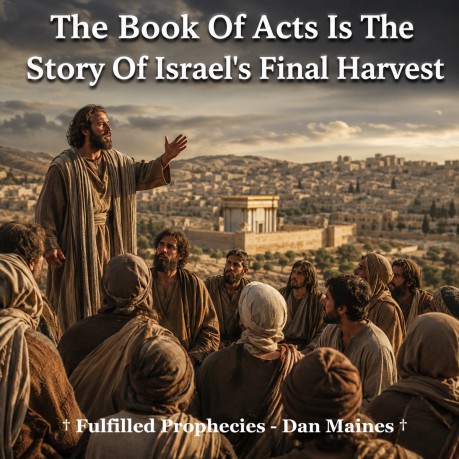
The Book Of Acts Is The Story
Of Israel's Final Harvest Introduction Matthew 13:39-40 Matthew 9:36-38 Acts 2:5, 41 Acts 4:4 James 1:18 Acts 13:46-48 Matthew 24:31 James 5:7-9 Revelation 14:14-16 The Book Of Acts And The Harvest Historical References How It Applies To Us Today Q & A Appendix † This is the fulfilled perspective we proclaim at
Fulfilled Prophecies † Source Index
By Dan Maines
† The book
of Acts isn't merely the history of how the church began. It's the
inspired record of a harvest that Jesus had already announced.
†
Jesus placed the harvest at the end of the age, then Acts records the
gospel spreading through Jerusalem, Judea, Samaria, and outward to
the nations as that age approached its conclusion.
†
Pentecost wasn't an accidental starting point. Pentecost was a
harvest feast, and on that very day thousands were gathered into
Christ.
† James called first-century
believers firstfruits. Jesus spoke about gathering His elect. Paul
preached that the gospel had gone throughout the world. James said
the Judge was standing right at the door. Revelation pictured the
earth being harvested.
† Put those passages
together and an amazing picture appears. Acts records the great
covenant harvest between the ministry of Jesus and the approaching
judgment upon the old covenant world.
† This
doesn't mean the gospel stopped in AD 70. It means the prophetic
harvest connected with the end of that age reached its appointed
fulfillment, while the everlasting kingdom and gospel continue
without end (Isaiah 9:7; Ephesians 3:21).
and the enemy who sowed
them is the devil, and the harvest is the end of the age; and the
reapers are angels. So just as the weeds are gathered up and burned
with fire, so shall it be at the end of the age.
†
Jesus directly connected the harvest with the end of the age. The
Greek word translated world here is aion, referring to an age. Jesus
wasn't predicting the destruction of the physical planet.
†
The disciples were living near the conclusion of the old covenant
age. Jesus described a harvest in which the righteous and wicked
would be separated as that age reached its appointed end (Matthew
13:41-43).
† This gives us the prophetic
framework for Acts. Acts isn't happening in a theological vacuum. The
gospel mission recorded there unfolds during the very generation
Jesus identified with the approaching end (Matthew 24:34).
†
The harvest had already begun during Jesus' ministry. He told His
disciples that the fields were already white for harvest, showing
that the gathering wasn't thousands of years away (John 4:35-38).
Seeing the crowds, He felt
compassion for them, because they were distressed and downcast, like
sheep without a shepherd. Then He said to His disciples, "The
harvest is plentiful, but the workers are few. Therefore, plead with
the Lord of the harvest to send out workers into His harvest."
†
Notice the setting. Jesus was looking at people standing in front of
Him when He spoke about the harvest. He wasn't describing a harvest
that wouldn't begin for thousands of years.
†
Israel was scattered like sheep without a shepherd. Jesus came as
Israel's promised Shepherd, and His disciples became laborers sent
into that harvest (Ezekiel 34:11-16; Matthew 10:5-7).
†
Acts shows those laborers doing exactly what Jesus commissioned them
to do. They preached first in Jerusalem, then Judea and Samaria, and
finally carried the gospel throughout the Roman world (Acts 1:8).
†
What Jesus called a plentiful harvest in the Gospels becomes a
visible gathering of thousands in Acts.
Now there were Jews residing in
Jerusalem, devout men from every nation under heaven. So then, those
who had received his word were baptized; and that day there were
added about three thousand souls.
† Pentecost
was one of Israel's appointed feast days, associated with the
firstfruits of the harvest (Leviticus 23:15-21). Acts 2 deliberately
places this enormous spiritual gathering on Pentecost.
†
Jews from every nation under heaven were gathered in Jerusalem, heard
the gospel, and approximately three thousand received the message.
†
This is harvest imagery becoming historical reality. Jesus had
announced the harvest, and now thousands were being gathered into His
kingdom.
† There's also a remarkable covenant
contrast with Sinai. After Israel's sin with the golden calf, about
three thousand died. At Pentecost, about three thousand received the
gospel and were added to the people of God (Exodus 32:28).
†
The ministry of the Spirit was producing life where the old covenant
exposed sin and condemnation (2 Corinthians 3:6-11).
But many of those who had heard the
message believed; and the number of the men came to be about five
thousand.
† The harvest continued immediately
after Pentecost. Thousands more believed as the apostles preached
Christ in Jerusalem.
† Acts repeatedly gives
numerical growth reports because Luke is showing the rapid expansion
of the gospel during this crucial covenant generation.
†
The gathering wasn't moving slowly toward some event thousands of
years away. The field was being harvested in their lifetime.
†
Soon Acts would say that the word of God increased and that the
number of disciples multiplied exceedingly in Jerusalem, including
many priests who became obedient to the faith (Acts 6:7).
In the exercise of His will He
gave us birth by the word of truth, so that we would be a kind of
first fruits among His creatures.
† James
actually calls these believers firstfruits. That's harvest language,
and it fits perfectly with what was happening throughout Acts.
†
Firstfruits belong to the beginning of a harvest. These first-century
Jewish believers were being gathered into Christ as the promised
kingdom came to its covenant fullness.
† This
is especially significant because James addressed the twelve tribes
scattered abroad (James 1:1). His language is rooted directly in
Israel's covenant and harvest imagery.
† The
firstfruits weren't waiting thousands of years for the harvest to
begin. They were evidence that the harvest was already underway.
Paul and Barnabas spoke out
boldly and said, "It was necessary that the word of God be
spoken to you first. Since you repudiate it and consider yourselves
unworthy of eternal life, behold, we are turning to the Gentiles. For
so the Lord has commanded us, 'I have appointed You as a light to the
Gentiles, That You may bring salvation to the end of the earth.'"
When the Gentiles heard this, they began rejoicing and glorifying the
word of the Lord; and all who had been appointed to eternal life
believed.
† The harvest expands dramatically
here. The message went to Israel first, but it wasn't going to remain
confined to ethnic Israel.
† The inclusion of
the Gentiles wasn't a second plan after Israel failed. It was part of
God's prophetic purpose that salvation would extend to the nations
through Israel's Messiah (Isaiah 49:6).
†
Acts records this movement again and again, from synagogue to
synagogue and city to city, until the gospel was being proclaimed
throughout the Roman world.
† Paul could
eventually say that the gospel had been proclaimed in all creation
under heaven, demonstrating the astonishing reach of that
first-century mission (Colossians 1:23).
And He will send forth His
angels with a great trumpet blast, and they will gather together His
elect from the four winds, from one end of the sky to the other.
†
Jesus promised a gathering of His elect, and the New Testament shows
that gathering taking place through the proclamation of the gospel.
†
The trumpet is familiar prophetic language for announcing God's
intervention and gathering His people (Isaiah 27:13).
†
Jesus placed this gathering within the same prophecy in which He
declared that all these things would happen within that generation
(Matthew 24:34).
† Acts shows believers being
gathered from Jerusalem outward until Jews and Gentiles were becoming
one body in Christ (Ephesians 2:14-18).
† The
gathering of God's people wasn't about transporting Christians away
from planet Earth. It was about gathering God's covenant people into
Christ and His kingdom.
Therefore be patient, brothers
and sisters, until the coming of the Lord. The farmer waits for the
precious produce of the soil, being patient about it, until it gets
the early and late rains. You too be patient; strengthen your hearts,
for the coming of the Lord is near. Do not complain, brothers and
sisters, against one another, so that you may not be judged; behold,
the Judge is standing right at the door.
†
James brings harvest language and imminence together in one passage.
The farmer was waiting for the precious fruit of the earth, and James
immediately told his readers that the coming of the Lord was near.
†
He didn't tell them that the harvest was thousands of years away. He
told those believers to be patient because the coming of the Lord was
at hand.
† He made the timing even stronger
by saying the Judge was standing right at the door. That's immediate
first-century expectation, not a prediction directed primarily toward
the twenty-first century.
† Acts records the
gathering, while James tells those same first-century believers that
the harvest was approaching its covenant climax (Hebrews 10:25, 37).
Then I looked, and
behold, a white cloud, and sitting on the cloud was one like a son of
man, with a golden crown on His head and a sharp sickle in His hand.
And another angel came out of the temple, calling out with a loud
voice to Him who sat on the cloud, "Put in Your sickle and reap,
for the hour to reap has come, because the harvest of the earth is
ripe." Then He who sat on the cloud swung His sickle over the
earth, and the earth was reaped.
† Revelation
brings the harvest imagery to its dramatic conclusion. The harvest
that Jesus announced is pictured as ripe and ready to be reaped.
†
Notice the language, the hour to reap is come. Revelation doesn't
describe the harvest as something indefinitely postponed.
†
Revelation begins by saying that the things revealed must shortly
come to pass and that the time was near, and it closes with the same
urgency (Revelation 1:1-3; 22:6, 10).
†
Revelation 14 also moves from harvest to judgment. This fits Jesus'
teaching in Matthew 13, where the end-of-the-age harvest involved
both gathering and separation.
† The gospel
gathered God's people into Christ, while covenant judgment removed
the old order that had rejected its Messiah.
†
Read Acts through the harvest language of Jesus and its structure
becomes much clearer.
† Jesus announces that
the fields are ready. He sends laborers into the field. Pentecost
produces thousands of converts. The word multiplies. Samaritans
receive the gospel. Gentiles are brought in. Paul travels throughout
the empire. Churches appear across the Roman world.
†
What begins in Jerusalem reaches outward exactly as Jesus said it
would (Acts 1:8).
† Paul later writes that
Israel's fall brought salvation to the Gentiles and that Gentile
inclusion was provoking Israel to jealousy (Romans 11:11-14).
†
Acts is therefore much more than a collection of missionary
adventures. It's the historical record of the gospel advancing
through the final generation of the old covenant age.
†
The destruction of Jerusalem in AD 70 didn't end Christianity. It
ended the covenant age that had centered on the earthly temple,
priesthood, sacrifices, and Jerusalem.
†
Christ's kingdom continued, the gospel continued, and the nations
continued entering the New Jerusalem after the old covenant age had
passed away (Hebrews 12:22-24; Revelation 21:24-26).
†
Josephus described the enormous crowds gathered in Jerusalem during
the Jewish festivals shortly before the city's destruction. His
account shows how deeply the national life of Israel still revolved
around Jerusalem and the temple during the very generation in which
Acts and the New Testament letters were written (Josephus, Wars
6.9.3).
† Josephus also described the
catastrophic Roman siege, famine, slaughter, and destruction of
Jerusalem in AD 70. His history provides an important non-Christian
witness to the national judgment that brought the temple-centered
Jewish order to its devastating conclusion (Josephus, Wars 5-6).
†
Tacitus recorded the Roman campaign against Jerusalem and described
the city and temple during the conflict. His account independently
confirms the historical setting surrounding Jerusalem's destruction
under Titus (Tacitus, Histories 5.10-13).
†
Eusebius later recorded the Christian tradition that believers in
Jerusalem departed the city before the war and went to Pella. Whether
every detail of the later tradition can be independently verified, it
shows that early Christians connected Jesus' warnings with the
first-century catastrophe that overtook Jerusalem (Eusebius,
Ecclesiastical History 3.5).
†
We aren't waiting for Israel's final harvest to begin. We live in the
kingdom that the first-century believers were entering while the old
covenant age was approaching its end.
† We
don't need to move Jesus' harvest warnings thousands of years away
from the people to whom He originally gave them.
†
Understanding the harvest helps us read Acts as part of one
continuous story, promise, firstfruits, gathering, harvest, judgment,
and kingdom fulfillment.
† The gospel didn't
expire when that harvest reached its prophetic climax. Christ's
kingdom has no end, and the invitation of the gospel continues to go
into the nations (Luke 1:32-33; Revelation 22:17).
†
We now proclaim a completed redemption, an established kingdom, an
open New Jerusalem, and a reigning King.
†
Acts shows us how faithfully God gathered His people before the old
covenant age disappeared. That should give us confidence that God
keeps His promises exactly as He gives them.
Q: Was
the harvest in Matthew 13 the end of the physical world?
A:
No. Jesus connected the harvest with the end of the age, and He
placed the fulfillment of His end-of-the-age prophecy within that
generation (Matthew 13:39-43; Matthew 24:34).
Q:
Why is Pentecost important to the harvest theme?
A:
Pentecost was connected with Israel's harvest and firstfruits, and
Acts records approximately three thousand people receiving the gospel
on that very feast day (Leviticus 23:15-21; Acts 2:41).
Q:
Were only Jews included in the harvest?
A: No.
The gospel went to Israel first and then expanded to the Gentiles,
fulfilling God's promise that salvation would reach the nations (Acts
13:46-48; Isaiah 49:6).
Q: Did the gospel stop
after AD 70?
A: No. The prophetic
end-of-the-age harvest reached its covenant fulfillment, but Christ's
kingdom and gospel continue. His kingdom has no end, and the nations
continue being invited into the life of the New Jerusalem (Luke
1:32-33; Revelation 21:24-26; Revelation 22:17).
Q:
Why does James matter to this interpretation?
A:
James called his first-century readers firstfruits and later told
them that the coming of the Lord was near and that the Judge was
standing right at the door. His language connects the harvest
directly with their first-century expectation (James 1:18; James
5:7-9).
Q: What does Revelation 14 add to the
picture?
A: Revelation shows the Son of Man
with a sickle and declares that the hour to reap had come. That
agrees with Revelation's repeated statements that its fulfillment was
near (Revelation 14:14-16; Revelation 1:1-3; Revelation 22:6, 10).
Q:
So what is the book of Acts really showing us?
A:
Acts shows the gospel harvest moving from Jerusalem outward during
Israel's final covenant generation, gathering God's people into
Christ before the old covenant age reached its end (Acts 1:8; Matthew
24:14, 34).
© Fulfilled Prophecies - Dan
Maines.
† Matthew
13:39-40; Matthew 9:36-38; Acts 2:5, 41; Acts 4:4; James 1:18; Acts
13:46-48; Matthew 24:31; James 5:7-9; Revelation 14:14-16
†
Josephus, Wars 5-6; 6.9.3; Tacitus, Histories 5.10-13; Eusebius,
Ecclesiastical History 3.5
Links