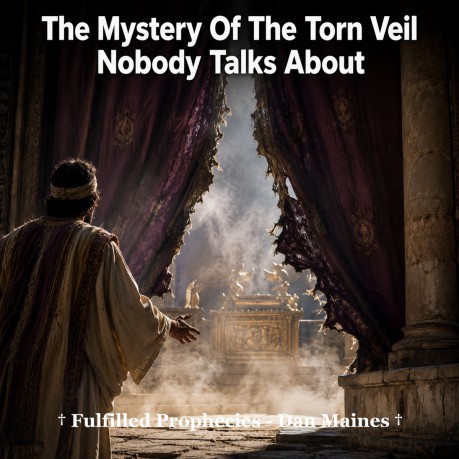
The
Mystery Of The Torn Veil Nobody Talks About Introduction † Most
Christians have been taught that the torn veil simply means we now
have access to God. While that is certainly true, the Scriptures
reveal something much greater. The veil represented the entire Old
Covenant system that separated God's people from His immediate
presence. When God tore the veil from top to bottom, He publicly
declared that the Old Covenant order had reached its appointed end.
Yet the temple continued standing until AD 70, revealing a covenant
transition that the book of Hebrews carefully explains. Exodus 26:31-33
You shall also make a veil of violet, purple, and scarlet material,
and fine twisted linen; it shall be made with cherubim, the work of a
skilled embroiderer. Then you shall hang it on four pillars of acacia
overlaid with gold, their hooks also of gold, on four bases of
silver. You shall hang up the veil under the clasps, and bring in the
ark of the testimony there within the veil; and the veil shall serve
as a partition for you between the Holy Place and the Most Holy
Place.
† Under the
Old Covenant, access into God's immediate presence was restricted to
the high priest, and only once each year. (Leviticus 16:2, 29-34) † The veil
continually reminded Israel that the way into God's presence had not
yet been fully revealed. (Hebrews 9:6-8) This shows exactly why
the veil existed. Tell your brother Aaron that he shall
not enter at any time into the Holy Place inside the veil, before the
atoning cover which is on the ark, or he will die; for I will appear
in the cloud over the atoning cover.
† God warned
that no one could freely pass beyond the veil because His holy
presence dwelt above the mercy seat. (Leviticus 16:2; Exodus 26:33) † The veil
reminded Israel that sin still separated mankind from God's immediate
presence under the Old Covenant. (Hebrews 9:7-8) Matthew 27:50-51
And Jesus cried out again with a loud voice, and gave up His spirit.
And behold, the veil of the temple was torn in two from top to
bottom; and the earth shook and the rocks were split. † God tore the
veil from top to bottom, showing that this was His work, not man's.
(Matthew 27:51) † The tearing
of the veil declared that Christ's sacrifice had accomplished what
the animal sacrifices never could. (Hebrews 10:11-14) † The veil's
destruction announced that the Old Covenant priestly system had
reached its fulfillment in Christ. (Hebrews 9:11-12) Jesus had already pronounced
judgment on the temple
Behold, your house is being left to you desolate! † Before the
veil was torn, Jesus had already declared that the temple was no
longer God's house but "your house." (Matthew 23:38) † The torn
veil visibly confirmed what Jesus had already announced concerning
the temple's coming desolation. (Matthew 23:38; Matthew 27:51) Hebrews 9:6-10
Now when these things have been so prepared, the priests are
continually entering the outer tabernacle, performing the divine
worship, but into the second, only the high priest enters once a
year, not without taking blood which he offers for himself and for
the sins of the people committed in ignorance. The Holy Spirit is
signifying this, that the way into the holy place has not yet been
disclosed while the outer tabernacle is still standing, which is a
symbol for the present time. Accordingly both gifts and sacrifices
are offered which cannot make the worshiper perfect in conscience,
since they relate only to food, drink, and various washings,
regulations for the body imposed until a time of reformation. † Hebrews
explains the meaning of the veil better than any other passage in
Scripture. (Hebrews 9:8) † As long as
the first tabernacle remained standing, it testified that the Old
Covenant order was still present. (Hebrews 9:8-10) † The torn
veil announced the arrival of the promised reformation through
Christ, even while the physical temple still stood during the
transition period. (Hebrews 8:13; Hebrews 9:10) † Notice that
the Holy Spirit said the way into the Holy Place had not
yet been made manifest while the first tabernacle was still standing.
This explains why Hebrews could be written after the cross while the
temple was still functioning. The torn veil announced the end, while
AD 70 completed the transition. (Hebrews 9:8; Hebrews 8:13; Luke
21:20-22)
Hebrews 8:13
When He said, "A new covenant," He has made the first
obsolete. But whatever is becoming obsolete and growing old is about
to disappear. † Hebrews was
written while the temple still stood, showing that the Old Covenant
was becoming obsolete but had not yet completely vanished. (Hebrews
8:13) † This
explains why the veil could be torn while the temple itself remained
standing for a short time longer. (Matthew 27:51; Hebrews 8:13) † The complete
removal of the Old Covenant system came with the destruction of
Jerusalem and its temple in AD 70, exactly as Jesus foretold.
(Matthew 24:1-2; Luke 21:20-22) † The torn
veil wasn't the final act. Jesus also foretold that not one stone of
the temple would remain upon another. (Matthew 24:1-2) † AD 70
completed what the torn veil had already declared. (Luke 21:20-22) Hebrews 10:19-22
Therefore, brothers and sisters, since we have confidence to enter
the holy place by the blood of Jesus, by a new and living way which
He inaugurated for us through the veil, that is, through His flesh,
and since we have a great priest over the house of God, let's
approach God with a sincere heart in full assurance of faith, having
our hearts sprinkled clean from an evil conscience and our bodies
washed with pure water. † Christ
Himself became the new and living way into God's presence. (Hebrews
10:19-20) † The writer
identifies the true veil with Christ's flesh, showing that everything
the temple foreshadowed found its fulfillment in Him. (John 2:19-21;
Hebrews 10:20) † Believers no
longer approach God through an earthly priesthood or temple but
through the finished work of Christ. (Ephesians 2:18; 1 Timothy 2:5) John 2:19-21
Jesus answered them, "Destroy this temple, and in three days I
will raise it up." The Jews then said, "It took forty-six
years to build this temple, and yet You will raise it up in three
days?" But He was speaking about the temple of His body. † Even before
His crucifixion, Jesus declared that He Himself was the true temple.
(John 2:19-21) † The torn
veil pointed away from the earthly sanctuary and toward Christ as the
fulfillment of everything the temple represented. (Hebrews 10:20;
John 2:21) Ephesians 2:18-22
for through Him we both have our access in one Spirit to the Father.
So then you are no longer strangers and foreigners, but you are
fellow citizens with the saints, and are of God's household, having
been built on the foundation of the apostles and prophets, Christ
Jesus Himself being the cornerstone, in whom the whole building,
being fitted together, is growing into a holy temple in the Lord, in
whom you also are being built together into a dwelling of God in the
Spirit. † The true
temple is no longer a building made with hands but God's people
joined together in Christ. (Ephesians 2:21-22) † The torn
veil pointed beyond the earthly temple to the greater reality of
God's New Covenant dwelling place. (Acts 7:48-50; Ephesians 2:21-22) † What the
veil once concealed is now fully revealed in Christ and His body.
(Colossians 2:16-17; Hebrews 10:19-22) † Stephen
declared that the Most High does not dwell in temples made with
hands. (Acts 7:48-50) † His words
confirmed that God's dwelling was never intended to remain confined
to an earthly building. (Isaiah 66:1-2; Acts 7:48-50) Historical References † The Jewish
historian Josephus records that the temple was destroyed by the
Romans in AD 70, bringing the Old Covenant temple system to its
complete historical end. † The writer
of Hebrews described the first covenant as becoming obsolete while
the temple was still standing, confirming a first-century transition
from shadow to reality. (Hebrews 8:13; Hebrews 9:8-10) How It Applies To Us
Today † We don't
seek God through an earthly temple because Christ fulfilled
everything the temple and its veil foreshadowed. (Hebrews 10:19-22) † Our
confidence rests entirely in Christ's finished work, not in earthly
rituals, sacrifices, or priesthood. (Hebrews 9:11-12; Ephesians 2:18) † The torn
veil reminds us that God has fulfilled His promise to dwell with His
people through Christ under the New Covenant. (Ephesians 2:21-22;
Revelation 21:2-3) † John's
vision reaches the same conclusion as Hebrews. No temple remains
because God and the Lamb are now the true temple of His people.
(Revelation 21:22; Ephesians 2:21-22)
Q & A Appendix Q:
Why was the veil torn from top to bottom? A:
God tore the veil to declare that Christ had fulfilled the Old
Covenant sacrificial system and opened the new and living way into
His presence. (Matthew 27:51; Hebrews 10:19-20) Q:
If the veil was torn at the cross, why did the temple remain
standing? A:
Hebrews explains that the Old Covenant was becoming obsolete and
ready to vanish away, with its complete historical end occurring in
the destruction of the temple in AD 70. (Hebrews 8:13; Luke 21:20-22) Q:
What is God's temple today? A:
God's people are His spiritual temple, built together in Christ as
His dwelling place. (Ephesians 2:19-22; 1 Peter 2:5) Q:
Did God tear the veil or did man? A:
God tore the veil from top to bottom, showing that the Old Covenant
system was brought to its fulfillment by His work through Christ, not
by man's efforts. (Matthew 27:51; Hebrews 10:19-20) Q:
Why did God leave the temple standing after the veil was torn? A:
The torn veil announced the end of the Old Covenant, but Hebrews
explains that the first covenant was becoming obsolete and ready to
vanish away. The destruction of the temple in AD 70 completed that
covenant transition. (Hebrews 8:13; Hebrews 9:8-10; Luke 21:20-22) Q:
Did the torn veil mean the temple no longer had God's approval? A:
Yes. Jesus had already declared, "Your house is left unto you
desolate." The torn veil confirmed that the earthly temple had
fulfilled its purpose in God's redemptive plan. (Matthew 23:38;
Matthew 27:51) Q:
What did the veil separate? A:
The veil separated the Holy Place from the Most Holy Place, allowing
only the high priest to enter God's presence once each year. (Exodus
26:33; Leviticus 16:2; Hebrews 9:6-8) Q:
Why does Hebrews still speak of the tabernacle standing after
Christ's death? A:
Hebrews was written while the temple was still standing, during the
transition from the Old Covenant to the New Covenant. The temple's
destruction in AD 70 brought that transition to its historical
completion. (Hebrews 8:13; Hebrews 9:8-10; Matthew 24:1-2) Q:
What is God's temple today? A:
God's people are His holy temple, built together in Christ as His
dwelling place through the Spirit. (Ephesians 2:19-22; 1 Peter 2:5) † This is the fulfilled
perspective we proclaim at Fulfilled Prophecies † © Fulfilled Prophecies - Dan Maines. Source Index † Exodus
26:31-33, Matthew 27:50-51, Hebrews 9:6-10, Hebrews 8:13, Hebrews
10:19-22, Ephesians 2:18-22 † Josephus,
The Wars of the Jews, Book 6
By Dan Maines
†
The veil was God's appointed barrier separating the Holy Place from
the Most Holy Place. (Exodus 26:33)
Leviticus 16:2
Matthew
23:38
Links