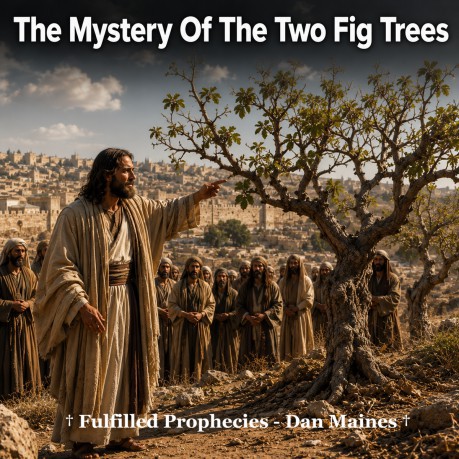
The
Mystery Of The Two Fig Trees Introduction † Throughout
the Bible, the fig tree was never just a tree. God repeatedly used it
as a covenant symbol of Israel. Long before Jesus walked the roads of
Judea, the prophets spoke of Israel as God's fig tree, expected to
bear fruit for His glory. When Jesus later approached a barren fig
tree, He wasn't reacting to a lack of breakfast. He was revealing the
final chapter of Israel's covenant history. By following the
Scriptures from the prophets to Christ, the mystery of the two fig
trees becomes one remarkable story of God's patience, Israel's
unfruitfulness, and the fulfillment of covenant judgment. Jeremiah 24:1-10
After Nebuchadnezzar king of Babylon had taken into exile Jeconiah
the son of Jehoiakim, king of Judah, and the officials of Judah with
the craftsmen and metalworkers from Jerusalem and had brought them to
Babylon, the Lord
showed me: behold, two baskets of figs placed before the temple of
the Lord. One basket
had very good figs, like first-ripe figs, and the other basket had
very bad figs which could not be eaten due to rottenness. Then the
Lord said to me, "What
do you see, Jeremiah?" And I said, "Figs: the good figs are
very good, and the bad ones, very bad, which cannot be eaten due to
rottenness."
Then the word of the Lord
came to me, saying, "This is what the Lord,
the God of Israel says: 'Like these good figs, so I will regard as
good the captives of Judah, whom I have sent out of this place into
the land of the Chaldeans. For I will set My eyes on them for good,
and I will bring them back to this land; and I will build them up and
not overthrow them, and I will plant them and not uproot them. I will
also give them a heart to know Me, for I am the Lord;
and they will be My people, and I will be their God, for they will
return to Me wholeheartedly.
'But like the bad figs which cannot be eaten due to rottenness,'
indeed, this is what the Lord
says, 'so will I give up Zedekiah king of Judah and his officials,
and the remnant of Jerusalem who remain in this land, and the ones
who live in the land of Egypt. I will make them an object of terror
and an evil for all the kingdoms of the earth, as a disgrace and a
proverb, a taunt and a curse in all the places where I will scatter
them. And I will send the sword, the famine, and the plague upon them
until they are eliminated from the land which I gave to them and
their forefathers.'" † Jeremiah
establishes the biblical meaning of the fig tree. It represented
God's covenant people, not a nation in the distant future. † The good
figs pictured those who humbled themselves before God, while the bad
figs represented those who rejected Him and remained under judgment. † From this
point forward, the prophets repeatedly used the fig tree to describe
Israel's spiritual condition. (Hosea 9:10; Micah 7:1) Hosea 9:10
I found Israel like grapes in the wilderness; † God compared
Israel to the first-ripe figs that brought delight to the owner. † Instead of
remaining faithful, Israel turned to idolatry and became corrupt. † The fig tree
continued to represent Israel's covenant relationship with God,
showing both His love for His people and their repeated
unfaithfulness. (Jeremiah 2:21) Jeremiah 8:13 "I will
certainly snatch them away," declares the Lord. † God warned
Israel centuries before Christ that the fig tree would become barren
because of covenant unfaithfulness. (Jeremiah 8:5-13) † The missing
figs and fading leaves match the condition Jesus later found when He
approached the fig tree outside Jerusalem. (Jeremiah 8:13; Matthew
21:18-19) † The prophets
had already declared the judgment, and Jesus brought that prophetic
picture to its fulfillment. (Jeremiah 8:13; Luke 21:20-22) Micah 7:1-2
Woe to me! For I am † Micah
searched for good fruit but found none. † The missing
fruit represented the absence of righteousness among God's covenant
people. † This
prepares us for Jesus' ministry centuries later when He also came
seeking fruit from Israel. (Matthew 21:43) † Isaiah shows
that God expected covenant fruit but found rebellion. † Jesus later
applies this same vineyard imagery to Israel in His own parables. Isaiah 5:1-7 Let me sing
now for my beloved
"And now, you inhabitants of Jerusalem and people of
Judah, For the
vineyard of the Lord of
armies is the house of Israel, † Isaiah
clearly identifies the vineyard as the house of Israel and the men of
Judah. (Isaiah 5:7) † God expected
covenant fruit, but Israel produced corruption and injustice instead.
(Isaiah 5:2, 7) † Jesus later
used the same vineyard imagery to announce judgment upon the leaders
who rejected God's Son. (Matthew 21:33-46) Matthew 3:10
And the axe is already laid at the root of the trees; therefore,
every tree that does not bear good fruit is being cut down and thrown
into the fire. † John the
Baptist announced that covenant judgment was already near before
Jesus began His public ministry. (Matthew 3:7-10) † The axe was
already at the root because Israel's final opportunity to bear fruit
had arrived. (Luke 3:7-9; Luke 13:6-9) † John, Jesus,
and the prophets all used fruitless trees to describe the same
approaching judgment upon unbelieving Israel. (Jeremiah 8:13; Matthew
3:10; Matthew 21:18-19) Luke 13:6-9
And He began telling this parable: "A man had a fig tree which
had been planted in his vineyard; and he came looking for fruit on it
and did not find any. And he said to the vineyard-keeper, 'Look! For
three years I have come looking for fruit on this fig tree without
finding any. Cut it down! Why does it even use up the ground?' But he
answered and said to him, 'Sir, leave it alone for this year too,
until I dig around it and put in fertilizer; and if it bears fruit
next year, fine; but if not, cut it down.'" † Jesus wasn't
introducing a new symbol. He was continuing the language of the
prophets. † The fig tree
represented Israel during Christ's earthly ministry. † God had
patiently sought covenant fruit from His people, but the nation
continued rejecting His prophets and ultimately His Son. † The
additional year of mercy demonstrates God's patience before judgment
finally came upon Jerusalem. (Luke 19:41-44) Matthew 21:18-19
Now in the early morning, when He was returning to the city, He
became hungry. And seeing a lone fig tree by the road, He came to it
and found nothing on it except leaves alone; and He *said to it, "No
longer shall there ever be any fruit from you." And at once the
fig tree withered. † Jesus didn't
curse the fig tree because He was disappointed it had no breakfast
for Him. † He performed
a living prophecy that every Jew familiar with the prophets should
have recognized. † The leaves
gave the appearance of life, but there was no fruit. Israel
maintained an outward display of religion while rejecting the very
Messiah whom the Scriptures promised. (Matthew 23:27-28) † The withered
fig tree symbolized the coming end of the Old Covenant system that
would reach its fulfillment in the destruction of Jerusalem in AD 70.
(Hebrews 8:13; Luke 21:20-22) Mark 11:20-21
As they were passing by in the morning, they saw the fig tree
withered from the roots up. And being reminded, Peter said to Him,
"Rabbi, look, the fig tree that You cursed has withered." † The tree had
withered from the roots, showing that the judgment represented by it
was complete and irreversible. (Mark 11:20-21) † The sign
pointed beyond one tree to the approaching removal of the fruitless
Old Covenant system. (Matthew 21:19; Hebrews 8:13) † The
disciples witnessed a visible prophecy of the judgment Jesus had
already announced against Jerusalem. (Matthew 21:18-19; Matthew
23:37-38) Matthew 21:33-46
"Listen to another parable. There was a landowner who planted
a vineyard and put a
fence around it, and
dug a wine press in it, and
built a tower, and he leased it to vine-growers and went on a
journey. And when the harvest time approached, he sent his slaves to
the vine-growers to receive his fruit. And the vine-growers took his
slaves and beat one, killed another, and stoned another. Again, he
sent other slaves, more than the first; and they did the same things
to them. But afterward he sent his son to them, saying, 'They will
respect my son.' But when the vine-growers saw the son, they said
among themselves, 'This is the heir; come, let's kill him and take
possession of his inheritance!' And they took him and threw him out
of the vineyard, and killed him. Therefore, when the owner of the
vineyard comes, what will he do to those vine-growers?" They
*said to Him, "He will bring those wretches to a wretched end
and lease the vineyard to other vine-growers, who will pay him the
fruit in the proper seasons." Jesus said
to them, "Did you never read in the Scriptures, 'A stone
which the builders rejected,
Therefore I say to you, the kingdom of God will be taken away from
you and given to a people producing its fruit. And the one who falls
on this stone will be broken to pieces; and on whomever it falls, it
will crush him."
When the chief priests and the Pharisees heard His parables, they
understood that He was speaking about them. And although they sought
to arrest Him, they feared the crowds, since they considered Him to
be a prophet. † Jesus didn't
leave the meaning of the fruitless fig tree open to speculation.
(Matthew 21:18-19, 33-46) † He declared
that the Kingdom would be taken from the unbelieving leaders of
Israel and given to a people producing its fruit. (Matthew 21:43) † The chief
priests and Pharisees understood that Jesus was speaking directly
against them. (Matthew 21:45) Matthew 24:32-34
"Now learn the parable from the fig tree: as soon as its branch
has become tender and sprouts its leaves, you know that summer is
near; so you too, when you see all these things, recognize that He is
near, right at the door. Truly I say to you, this generation will not
pass away until all these things take place. † Jesus again
used the familiar fig tree imagery His audience already understood
from the prophets. † The lesson
wasn't about the rebirth of a modern nation thousands of years later.
It was about recognizing the covenant signs that would lead to the
fulfillment He promised that generation. † Jesus
removed all doubt by declaring that "this generation" would
witness every one of these events. John 15:1-8
"I am the true vine, and My Father is the vinedresser. Every
branch in Me that does not bear fruit, He takes away; and every
branch that bears fruit, He prunes it so that it may bear more fruit.
You are already clean because of the word which I have spoken to you.
Remain in Me, and I in you. Just as the branch cannot bear fruit of
itself but must remain in the vine, so neither can you unless you
remain in Me. I am the vine, you are the branches; the one who
remains in Me, and I in him bears much fruit, for apart from Me you
can do nothing. If anyone does not remain in Me, he is thrown away
like a branch and dries up; and they gather them and throw them into
the fire, and they are burned. If you remain in Me, and My words
remain in you, ask whatever you wish, and it will be done for you. My
Father is glorified by this, that you bear much fruit, and so prove
to be My disciples. † Under the
New Covenant, our focus isn't a national fig tree but Christ, the
true vine. (John 15:1) † Believers
bear fruit by abiding in Christ, not by trusting in covenant ancestry
or outward religion. (John 15:4-5; Philippians 3:3) † The fruitful
life of the New Covenant comes only through union with Christ. (John
15:5, 8; Galatians 5:22-23) Historical References † Jeremiah,
Hosea, and Micah consistently used the fig tree as a covenant symbol
of Israel centuries before Christ. † Jesus
continued the prophetic imagery rather than creating a new symbol,
allowing Scripture to interpret Scripture. † The Jewish
historian Josephus records the devastation of Jerusalem in AD 70,
confirming the fulfillment of the covenant judgment Jesus foretold in
the Gospels. How It Applies To Us
Today † We don't
search for prophetic signs in a modern nation because Christ
fulfilled everything He promised concerning that covenant generation. † Believers
today are called to abide in Christ and bear spiritual fruit because
we already live under the blessings of the New Covenant. (John
15:1-8) † The mystery
of the fig tree reminds us that God always keeps His covenant
promises exactly as He declared. Q & A Appendix Q:
What did the fig tree represent throughout Scripture? A:
The fig tree represented God's covenant people, Israel, and their
spiritual condition. (Jeremiah 24:1-10; Hosea 9:10) Q:
Why did Jesus curse the fig tree? A:
Jesus acted out a prophetic judgment against fruitless covenant
Israel, not against a random tree. (Matthew 21:18-19; Luke 13:6-9) Q:
Does the fig tree in Matthew 24 represent the modern nation of
Israel? A:
No. Jesus continued the prophetic symbol already established in the
Old Testament and declared that all those events would occur within
"this generation." (Matthew 24:32-34) † This is the fulfilled
perspective we proclaim at Fulfilled Prophecies † © Fulfilled Prophecies - Dan Maines. Source Index † Jeremiah
24:1-10, Hosea 9:10, Micah 7:1-2, Luke 13:6-9, Matthew 21:18-19,
Matthew 24:32-34 † Josephus,
The Wars of the Jews, Book 6
By Dan Maines
I saw your
forefathers as the earliest fruit on the fig tree in its first
season.
But they came to Baal-peor and devoted themselves to
shame,
And they became as detestable as that which they loved.
"There
will be no grapes on the vine
And no figs on the fig tree,
And
the leaf will wither;
And what I have given them will pass
away."'"
Like harvests of summer fruit, like
gleanings of grapes.
There is not a cluster of grapes left to
eat,
Nor an early fig, which I crave.
The godly person has
perished from the land,
And there is no upright person among
mankind.
All of them lie in wait for bloodshed;
Each of
them hunts the other with a net.
A song of my beloved about His vineyard.
My
beloved had a vineyard on a fertile hill.
He dug it all around,
cleared it of stones,
And planted it with the choicest vine.
And
He built a tower in the middle of it,
And also carved out a wine
vat in it;
Then He expected it to produce good grapes,
But
it produced only worthless ones.
Judge between Me and My vineyard.
What more was
there to do for My vineyard that I have not done in it?
Why,
when I expected it to produce good grapes did it produce worthless
ones?
So now let Me tell you what I am going to do to My
vineyard:
I will remove its hedge and it will be consumed;
I
will break down its wall and it will become trampled ground.
I
will lay it waste;
It will not be pruned nor hoed,
But
briars and thorns will come up.
I will also command the clouds
not to rain on it."
And the people of Judah are His
delightful plant.
So He waited for justice, but behold, there
was bloodshed;
For righteousness, but behold, a cry for help.
This
has become the chief
cornerstone;
This
came about from the Lord,
And
it is marvelous in our eyes'?
Links