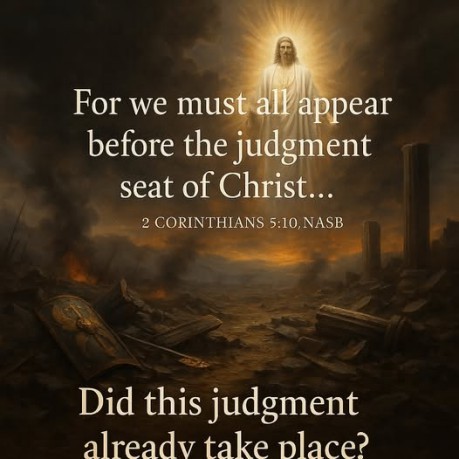
2
Corinthians 5:10 says: "For we must all appear before the
judgment seat of Christ, so that each one may receive compensation
for his deeds done through the body, in accordance with what he has
done, whether good or bad." At first glance, some link this to the
White Throne Judgment in Revelation 20:11-15, since both involve
judgment according to deeds. But here’s the key: the "judgment
seat of Christ" and the "White Throne" are related in
nature, but they are not separate future events spaced thousands of
years apart. From a fulfilled view: Both passages speak of covenantal
judgment. Both involve evaluation according to
works (not for salvation, but covenantal faithfulness). Both are directed at those who were
under the influence of the Old Covenant system. The "judgment seat of Christ"
in 2 Corinthians 5:10 refers to the same timeframe as the White
Throne Judgment. Paul was warning the first-century church about the
soon-coming judgment that Jesus Himself predicted in Matthew 16:27-28
and Matthew 24:30-34. So, does it have anything to do with
the White Throne Judgment? Yes - it's the same judgment scene viewed
from another angle. Paul uses personal language for the church, while
John in Revelation uses apocalyptic imagery to show the wider
covenantal fallout for Israel and the dead of that age. They both point to the same
first-century judgment that culminated in the fall of Jerusalem in 70
AD, marking the end of the Old Covenant age and the full arrival of
the New.
By Dan Maines
Links