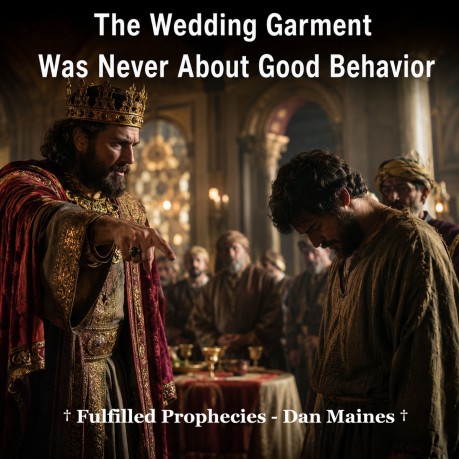
The
Wedding Garment Was Never About Good Behavior Introduction
Matthew 22:1-10 Matthew
22:11-13 Isaiah
61:10
Zechariah 3:1-5 Isaiah
64:6 Romans
3:21-22 Philippians
3:8-9
Romans 10:1-4 Galatians
3:26-27 Revelation
19:7-8 Historical References How It Applies To Us
Today Q & A Appendix † This is the fulfilled
perspective we proclaim at Fulfilled Prophecies † Source Index
By Dan Maines
†
Jesus' parable of the wedding feast has often been taught as though
the wedding garment represented our personal goodness or moral
performance. But that's not what the Scriptures reveal. The garment
represented the righteousness God Himself provided under the New
Covenant, not something man could produce by his own efforts. When we
compare Scripture with Scripture, the imagery becomes remarkably
clear.
Jesus
spoke to them again in parables, saying, "The kingdom of heaven
is like a king who held a wedding feast for his son. And he sent his
slaves to call those who had been invited to the wedding feast, and
they were unwilling to come. Again he sent other slaves, saying,
'Tell those who have been invited, "Behold, I have prepared my
dinner; my oxen and my fattened cattle are all butchered and
everything is ready. Come to the wedding feast!”' But they paid no
attention and went their separate ways, one to his own farm, another
to his business, and the rest seized his slaves and treated them
abusively, and then killed them. Now the king was angry, and he sent
his armies and destroyed those murderers and set their city on fire.
Then he said to his slaves, 'The wedding feast is ready, but those
who were invited were not worthy. So go to the main roads, and invite
whomever you find there to the wedding feast.' Those slaves went out
into the streets and gathered together all whom they found, both bad
and good; and the wedding hall was filled with dinner guests.
†
Jesus wasn't describing the end of the physical world. He was
describing the transition from the Old Covenant to the New Covenant
Kingdom. (Hebrews 8:13)
†
Those first invited represented covenant Israel, who rejected both
the prophets and ultimately God's Son. (Matthew 23:29-39)
†
Verse 7 is one of Jesus' clearest prophecies of Jerusalem's
destruction in AD 70. The King's armies destroyed their city exactly
as Jesus foretold. (Luke 21:20-22)
†
Only after Israel rejected the invitation did the call go out to all
nations, fulfilling God's promise to bless the Gentiles through
Christ. (Isaiah 49:6; Acts 13:46-48)
"But
when the king came in to look over the dinner guests, he saw a man
there who was not dressed in wedding clothes, and he said to him,
'Friend, how did you get in here without wedding clothes?' And the
man was speechless. Then the king said to the servants, 'Tie his
hands and feet, and throw him into the outer darkness; there will be
weeping and gnashing of teeth in that place.'
†
The issue was never that the man failed to behave well enough. The
king immediately noticed that he had rejected the garment prepared
for the occasion. (Isaiah 61:10; Romans 3:22)
†
The man's silence showed he had no defense. He couldn't claim
ignorance because the garment had been made available to every
invited guest. (Matthew 22:8-10)
†
This parable isn't teaching salvation by works. It teaches that
entrance into God's Kingdom required accepting the righteousness God
provided through Christ rather than trusting in one's own standing
under the Old Covenant. (Philippians 3:8-9; Galatians 2:16)
†
The wedding feast wasn't describing heaven thousands of years later.
Throughout Scripture, God portrayed His covenant relationship with
His people as a marriage. Jesus announced that the promised Messianic
wedding had arrived through Him. (Isaiah 54:5; Hosea 2:19-20;
Ephesians 5:25-32)
†
The outer darkness represented exclusion from the blessings of
Christ's New Covenant Kingdom. Those who rejected the Messiah
remained outside while the Kingdom was taken from them and given to a
people producing its fruit. (Matthew 8:11-12; Matthew 21:43)
I will
rejoice greatly in the Lord,
My
soul will be joyful in my God;
For He has clothed me with
garments of salvation,
He has wrapped me with a robe of
righteousness,
As a groom puts on a turban,
And as a bride
adorns herself with her jewels.
†
Long before Jesus told this parable, Isaiah identified the garment as
something God Himself provides.
†
The robe wasn't earned, it was given. God's righteousness has always
been His gift, never man's achievement. (Romans 4:5-8)
†
Jesus drew directly from this prophetic picture so His Jewish
audience would recognize that the promised salvation had arrived in
Him. (Luke 4:17-21)
Then
he showed me Joshua the high priest standing before the angel of the
Lord,
and Satan standing at his right to accuse him. And the Lord
said to Satan, "The Lord
rebuke you, Satan! Indeed, the Lord
who has chosen Jerusalem rebuke you! Is this not a log snatched from
the fire?” Now Joshua was clothed in filthy garments and was
standing before the angel. And he responded and said to those who
were standing before him, saying, "Remove the filthy garments
from him.” Again he said to him, "See, I have taken your guilt
away from you and will clothe you with festive robes.” Then I said,
"Have them put a clean headband on his head.” So they put the
clean headband on his head and clothed him with garments, while the
angel of the Lord
was standing by.
†
Joshua stood before God in filthy garments that represented
uncleanness and guilt.
†
God didn't tell Joshua to clean himself. God removed the filthy
garments and clothed him with clean garments.
†
This beautiful picture foreshadowed the righteousness God would later
provide through Christ rather than through the works of the Law.
For all of
us have become like one who is unclean,
And all our righteous
deeds are like a filthy garment;
And all of us wither like a
leaf,
And our wrongdoings, like the wind, take us away.
†
Our own righteousness could never make us acceptable before God.
†
Isaiah contrasts man's polluted garments with the robe of
righteousness God provides. (Isaiah 61:10)
†
The wedding garment was never something man could weave for himself.
It had to come from the King.
But now
apart from the Law the righteousness of God has been revealed, being
witnessed by the Law and the Prophets, but it is the righteousness of
God through faith in Jesus Christ for all those who believe; for
there is no distinction,
†
Paul declares that God's righteousness is apart from the Law.
†
The wedding garment points to this very righteousness that comes
through faith in Christ rather than through covenant law keeping.
†
Those who attempted to appear before God clothed in their own
righteousness were rejecting the garment God had graciously provided.
(Romans 10:3-4)
More than
that, I count all things to be loss in view of the surpassing value
of knowing Christ Jesus my Lord, for whom I have suffered the loss of
all things, and count them mere rubbish, so that I may gain Christ,
and may be found in Him, not having a righteousness of my own derived
from the Law, but that which is through faith in Christ, the
righteousness which comes from God on the basis of faith,
†
Paul abandoned confidence in his covenant status under the Law.
†
He desired only the righteousness that comes from God through
Christ.
†
This perfectly explains the man without the wedding garment. He
attempted to stand before the King clothed in something other than
God's provision.
Brothers
and sisters, my heart's desire and my prayer to God for them is for
their salvation. For I testify about them that they have a zeal for
God, but not in accordance with knowledge. For not knowing about
God's righteousness and seeking to establish their own, they did not
subject themselves to the righteousness of God. For Christ is the end
of the Law for righteousness to everyone who believes.
†
Paul describes the very attitude Jesus exposed in the wedding garment
parable.
†
Israel attempted to establish its own righteousness instead of
accepting the righteousness God provided through Christ.
†
The man without the wedding garment pictures this covenant reality.
He stood before the King clothed in his own righteousness instead of
God's.
For you
are all sons and daughters of God through faith in Christ Jesus. For
all of you who were baptized into Christ have clothed yourselves with
Christ.
†
Paul uses clothing language to describe salvation.
†
Believers don't merely imitate Christ, they are clothed with Him.
†
This perfectly explains the wedding garment. The garment ultimately
points to being found in Christ Himself. (Romans 13:14)
Let's
rejoice and be glad and give the glory to Him, because the marriage
of the Lamb has come, and His bride has prepared herself.” It was
given to her to clothe herself in fine linen, bright and clean; for
the fine linen is the righteous acts of the saints.
†
Even here the clothing is first described as something that was given
to the bride.
†
The righteous acts flow from those who have already been clothed by
God's grace.
†
The marriage imagery reaches its fulfillment in Christ and His
covenant people, showing the complete transition from the Old
Covenant to the New. (Ephesians 5:25-27; Hebrews 8:13)
†
Isaiah established the prophetic imagery of God clothing His people
with garments of salvation centuries before Christ. (Isaiah 61:10)
†
Jewish wedding customs commonly included garments supplied by the
host for honored guests, making Jesus' illustration immediately
understandable to His audience.
†
The destruction of Jerusalem in AD 70 marked the complete removal of
the Old Covenant system, leaving only the righteousness found in
Christ for entrance into God's everlasting Kingdom. (Hebrews 8:13;
Matthew 22:7)
†
Isaiah, Zechariah, and the prophets consistently used garments to
symbolize righteousness, cleansing, and covenant acceptance,
preparing Israel to understand Jesus' parable.
†
The marriage feast imagery fulfilled centuries of prophetic promises
that God would establish an everlasting covenant with His people
through the Messiah. (Isaiah 54:5; Hosea 2:19-20)
† Our
confidence isn't found in personal merit but in the righteousness God
has provided through Christ.
†
We don't attempt to improve our standing before God through religious
performance because we've already been clothed with His
righteousness.
†
Every believer can rest in the finished work of Christ, knowing that
acceptance before God has always depended upon His provision, never
our perfection.
Q:
What did the wedding garment represent?
A:
It represented the righteousness God provides through Christ, not
human goodness or works. (Isaiah 61:10; Romans 3:21-22; Philippians
3:8-9)
Q:
Why was the man cast out?
A:
Because he rejected God's provision and attempted to stand before the
King without the righteousness God supplied. (Matthew 22:11-13;
Romans 10:3-4)
Q:
Does this parable teach salvation by works?
A:
No. It teaches that God's righteousness is received through faith in
Christ rather than through the works of the Law. (Romans 3:21-22;
Galatians 2:16)
©
Fulfilled Prophecies - Dan Maines.
†
Matthew 22:11-13, Isaiah 61:10, Romans 3:21-22, Philippians 3:8-9,
Revelation 19:7-8
†
Isaiah, Matthew, Paul the Apostle, John the Apostle, First-century
Jewish wedding customs
Links