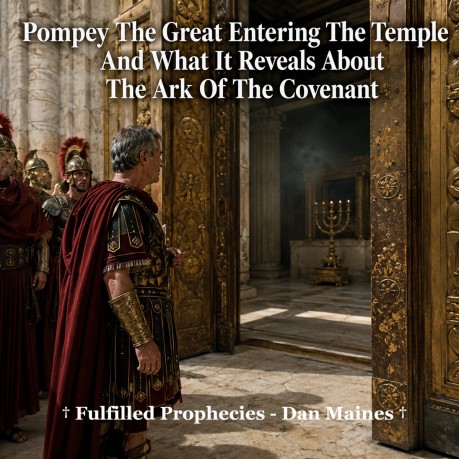
Pompey
The Great Entering The Temple And What It Reveals About The Ark Of
The Covenant Introduction † In 63 BC,
the Roman general Pompey the Great captured Jerusalem and entered the
temple, including the Holy of Holies. His actions shocked the Jewish
people because only the high priest was permitted to enter that
sacred place, and only once each year on the Day of Atonement.
Ancient historians record that Pompey expected to find Israel's most
sacred objects inside. Instead, he found the room empty. This
historical event agrees with the biblical evidence that the Ark of
the Covenant had disappeared centuries earlier and was never restored
to the Second Temple. Scripture never records the ark being returned
after the Babylonian destruction of Solomon's Temple in 586 BC. The
silence of Scripture, combined with the testimony of history, forms
powerful evidence that the ark was no longer present during the
Second Temple period. 2 Chronicles 35:3
He also said to the Levites who taught all Israel and who were holy
to the Lord, Put the
holy ark in the house which Solomon the son of David king of Israel
built; it will not be a burden on your shoulders. Now serve the Lord
your God and His people Israel. † This is the
last historical reference to the Ark of the Covenant before the
Babylonian destruction of Jerusalem. (2 Kings 25:8-17) Jeremiah 3:16
And it shall be in those days when you become numerous and are
fruitful in the land, declares the Lord,
they will no longer say, 'The ark of the covenant of the Lord.'
And it will not come to mind, nor will they remember it, nor miss it,
nor will it be made again. † Jeremiah
foretold a day when God's covenant people would no longer focus on
the Ark of the Covenant because God's purposes would move beyond that
symbol. (Hebrews 8:13) Ezra 1:7-11
Also King Cyrus brought out the articles of the house of the Lord,
which Nebuchadnezzar had carried away from Jerusalem and put in the
house of his gods; and Cyrus, king of Persia, had them brought out by
the hand of Mithredath the treasurer, and he counted them out to
Sheshbazzar, the leader of Judah. Now this was their number: thirty
gold dishes, a thousand silver dishes, twenty nine duplicates; thirty
gold bowls, 410 silver bowls of a second kind, and a thousand other
articles. All the articles of gold and silver totaled 5,400.
Sheshbazzar brought them all up with the exiles who went up from
Babylon to Jerusalem. † Ezra
carefully lists the sacred vessels that returned from Babylon. Haggai 2:3 Who is left among
you who saw this temple in its former glory? And how do you see it
now? Does it not seem to you like nothing in comparison? † Many who had
seen Solomon's Temple wept because the Second Temple lacked the glory
of the first. (Ezra 3:12-13) Hebrews 9:1-5
Now even the first covenant had regulations for divine worship and
the earthly sanctuary. For a tabernacle was equipped, the outer
sanctuary, in which were the lampstand, the table, and the sacred
bread; this is called the Holy Place. Behind the second veil there
was a tabernacle which is called the Most Holy Place, having a golden
altar of incense and the ark of the covenant covered on all sides
with gold, in which was a golden jar holding the manna, Aaron's staff
which budded, and the tablets of the covenant; and above it were the
cherubim of glory overshadowing the atoning cover; but about these
things we cannot now speak in detail. † The writer
describes the furniture of the original tabernacle, not the condition
of Herod's Temple in his own day. Hebrews 9:8
The Holy Spirit is signifying this, that the way into the holy place
has not yet been disclosed while the outer tabernacle is still
standing, † The writer
uses the tabernacle to explain the meaning of the old covenant
furniture. This is one of the strongest objections
futurists raise, so it's worth answering directly. Matthew 23:38
Behold, your house is being left to you desolate! † Jesus
declared that the temple had become their house, not God's dwelling
place. Historical References † Josephus
records that when Pompey entered the Holy of Holies in 63 BC, he
found no image, no sacred object, and nothing hidden within the
sanctuary, confirming the room was empty. (Josephus, Antiquities of
the Jews 14.4.4) How It Applies To Us
Today † Our faith
doesn't rest upon missing relics or sacred objects but upon the
finished work of Jesus Christ. (Hebrews 10:19-22) † Believers
today are God's dwelling place through the Spirit, fulfilling what
the temple and the ark only foreshadowed. (Ephesians 2:21-22; 1
Corinthians 3:16) Q & A Appendix Q:
Does the Bible ever say the Ark of the Covenant was returned to the
Second Temple? Q:
Why is Pompey's entrance into the Holy of Holies historically
important? Q:
Could the Ark have been hidden somewhere before Pompey entered the
temple? Q:
Didn't the glory return to the Second Temple? † This is the fulfilled
perspective we proclaim at Fulfilled Prophecies † Source Index † 2 Chronicles
35:3, Jeremiah 3:16, Ezra 1:7-11, Hebrews 9:1-5, Matthew 23:38
By Dan Maines
†
After this point, Scripture never records the ark being carried into
the rebuilt Second Temple. (Ezra 6:15-18)
†
The silence is significant because the return of the temple vessels
is carefully recorded, but the ark is never mentioned among them.
(Ezra 1:7-11)
†
The prophet even declared that another ark would never be made,
showing that the old covenant shadows were temporary. (Colossians
2:16-17)
†
God's presence would no longer be centered upon a physical object but
upon His covenant people. (Ephesians 2:19-22)
†
The Ark of the Covenant is noticeably absent from the inventory.
†
If the ark had been returned, it would have been the most important
object listed. Its omission strongly suggests it was already gone.
(Hebrews 9:1-5)
†
One reason was that several items present in Solomon's Temple were no
longer there, including the Ark of the Covenant.
†
This explains why the older generation immediately recognized that
something significant was missing.
†
This helps explain why the rebuilt temple was viewed as inferior.
†
His description teaches the significance of the old covenant
sanctuary without claiming those objects were still present.
†
By the first century, the Holy of Holies stood without the ark,
exactly as history records. (Matthew 23:38)
†
His purpose isn't to describe what physically stood inside Herod's
Temple but to explain what those furnishings represented.
†
This removes the common objection that Hebrews proves the ark still
existed in the first century. (Hebrews 8:13)
†
God's presence was no longer identified with a physical building or a
missing ark.
†
Christ Himself was the fulfillment of everything the ark represented.
(John 1:14, Colossians 2:9-10)
†
Tacitus likewise wrote that Pompey entered the sanctuary and found it
empty, confirming there was no Ark of the Covenant present. (Tacitus,
Histories 5.9)
†
The Jewish Mishnah later acknowledged that during the Second Temple
period the Holy of Holies contained only a foundation stone where the
ark had once rested. (Mishnah, Yoma 5:2)
†
The Babylonian inventory of temple treasures in Scripture never
mentions the Ark of the Covenant among the items carried to Babylon.
(2 Kings 25:13-17; Jeremiah 52:17-23)
†
If Nebuchadnezzar had taken the ark, Scripture almost certainly would
have recorded it because it was Israel's most sacred object.
†
The Talmud likewise acknowledges that during the Second Temple period
the Holy of Holies lacked the Ark of the Covenant, confirming an
ancient Jewish understanding independent of Josephus.
†
The absence of the ark reminds us that God's redemptive plan was
never dependent upon earthly objects but upon His eternal covenant
fulfilled in Christ. (John 19:30)
A:
No. Scripture records many temple vessels returning from Babylon, but
the ark is never included. (Ezra 1:7-11)
A:
Because both Josephus and Tacitus testify that the Holy of Holies was
empty, providing historical confirmation that the Ark of the Covenant
was no longer there. (Jeremiah 3:16; Matthew 23:38)
A:
It's possible it was hidden before the Babylonian destruction, but
Scripture never says where it went. What Scripture does show is that
it was never restored to the Second Temple, and both Jewish and Roman
historians confirm that the Holy of Holies was empty in 63 BC.
(Jeremiah 3:16; Ezra 1:7-11)
A:
Yes, but not because the Ark returned. The true glory entered when
Jesus Christ came into the temple. He fulfilled everything the ark
symbolized. (Haggai 2:7-9; John 2:19-21; Colossians 2:9)
©
Fulfilled Prophecies - Dan Maines.
†
Josephus, Antiquities of the Jews 14.4.4; Tacitus, Histories 5.9;
Mishnah, Yoma 5:2
Links