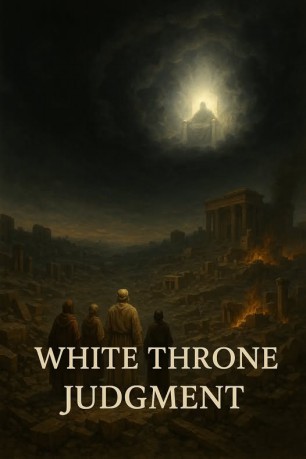
The
Fulfilled White Throne Judgment
Introduction: Many believers today are still
looking for a future judgment called the White Throne Judgment. But
as we take a closer look at scripture, we find that this judgment
was not only prophesied to happen soon, but was also fulfilled in
the first century. This was not a global event involving the entire
planet, but a covenantal judgment involving the dead and the living
of Old Covenant Israel. Main Text: Revelation 20:11-15
"Then I saw a great white throne and Him who sat upon it, from
whose presence earth and heaven fled, and no place was found for
them. And I saw the dead, the great and the small, standing before
the throne, and books were opened, and another book was opened,
which is the book of life; and the dead were judged from the things
which were written in the books, according to their deeds."
(Revelation 20:11-12) This judgment scene follows the defeat of the Beast and the False
Prophet in Revelation 19, and the binding of Satan in Revelation 20. The phrase "earth and heaven
fled" echoes Old Covenant language. This is the removal of the
covenantal heavens and earth, not the literal physical cosmos. The judgment is covenantal, not biological. These "dead"
are being judged based on the Old Covenant records, or "books." Time Indicators: The book of Revelation is
filled with time indicators pointing to its soon fulfillment. "The Revelation of Jesus
Christ, which God gave Him to show to His bond-servants, the things
which must soon take place" (Revelation 1:1) "Do not seal up the words of the prophecy of this book,
for the time is near" (Revelation 22:10) Compare this with Daniel 12, where
Daniel was told to seal up the vision because the time was far off.
John, however, was told not to seal it because the time had come. Jesus Promised a First-Century Judgment: "For the Son of Man is going to come in the glory of
His Father with His angels, and will then repay every person
according to his deeds. Truly I say to you, there are some of those
who are standing here who will not taste death until they see the
Son of Man coming in His kingdom." (Matthew 16:27-28) Jesus placed this judgment within the
lifetime of some of His audience. He was not referring to a distant
event thousands of years away. Paul and the Early Church Expected the Same: "Because He has set a day on
which He will judge the world in righteousness through a Man whom
He has appointed, having furnished proof to all people by raising
Him from the dead." (Acts 17:31) "From the blood of Abel to the blood of Zechariah... it
will be charged against this generation." (Luke 11:51) The judgment of that generation was
imminent. That was the generation that crucified the Son of God and
rejected the apostles. Jesus Judging the Nations: Matthew 25 In Matthew 25:31-46, Jesus speaks
of the Son of Man coming in His glory to judge the nations. This
judgment, like the others in the Olivet Discourse, was to happen in
that generation (Matthew 24:34). The nations (ethnos) are judged
based on how they treated "the least of these My brothers,"
referring to the apostles and disciples sent out to proclaim the
gospel. This is not a judgment of all
people at the end of the world, but a covenantal judgment on the
nations for how they responded to Christ through His body, the
early church. Those who received Christ’s messengers were counted as
righteous. Those who rejected them were cast into the outer
darkness, fulfilling the imagery of separation in Matthew 25. The Judgment Seat of Christ Is
the Same Event Paul spoke clearly of this same judgment: "For we must all appear before the judgment seat of
Christ, so that each one may receive compensation for his deeds
done through the body, in accordance with what he has done, whether
good or bad." (2 Corinthians 5:10) This was not a judgment thousands of
years in the future. Paul was warning living, first-century
believers of a soon-coming judgment. He was not introducing a
separate judgment event, but referring to the same White Throne
Judgment described later in Revelation 20. Jesus had already promised in Matthew 16:27-28 that some standing
with Him would see the Son of Man coming to judge. Paul simply
echoed this expectation. The language of appearing before
Christ and being judged according to deeds matches Revelation 20: "And the dead were judged from the things which were
written in the books, according to their deeds." (Revelation
20:12) The judgment seat of Christ in Paul's
letters and the White Throne in John's Revelation describe the same
covenantal judgment, just using different imagery and audiences.
This confirms that the judgment Paul warned of had to occur within
their generation, just as Jesus said. And it did, fully and finally,
in the events leading to 70 AD. Who Were the Dead? The White Throne scene
pictures the judgment of the dead. But which dead? These are not all physically dead from all of history, but
covenantally dead under the Old Covenant system. Hebrews 9:27-28: "And just as it is
destined for people to die once, and after this comes judgment, so
Christ... will appear a second time for salvation without reference
to sin, to those who eagerly await Him." This was written to Hebrew believers awaiting the full
transition out of the Old Covenant age. The Book of Life and the Lake of Fire: Revelation 20:15:
"If anyone's name was not found written in the book of life,
he was thrown into the lake of fire." This lake of fire represents
covenantal judgment and exclusion from the New Jerusalem. The judgment of those outside the book of life aligns with
the fate of those in Matthew 23:37-38: "Jerusalem,
Jerusalem... your house is left to you desolate!" A Covenant Warning to Israel: Hebrews 10:30-31
says, "For we know Him who said, 'Vengeance is Mine, I will
repay.' And again, 'The Lord will judge His people.' It is a
terrifying thing to fall into the hands of the living God." This was not a general warning to
future Gentile nations. This was a direct warning to
covenant-breaking Israel, who had rejected the Messiah and
persecuted the saints. The White Throne Judgment was the terrifying realization of
God's vengeance on a faithless generation. It was not aimed at the
whole world, but at those within the covenant who had rebelled. Conclusion: The White Throne Judgment was not a
yet-future event for us. It was the final judgment of the Old
Covenant world, fulfilled in the destruction of Jerusalem in 70 AD.
The books were opened, judgment was rendered, and those found in
Christ entered into the everlasting kingdom. The New Heavens and New Earth
were not postponed, they were established. The Bride, the New Jerusalem, is
now the dwelling place of God with His people. The throne is not empty, Christ reigns now. Let us not look forward to a judgment that has already occurred,
but rather walk in the victory and authority of a fully established
kingdom. "But according to His
promise we are looking for new heavens and a new earth, in which
righteousness dwells." (2 Peter 3:13) That promise has been fulfilled. Let us live like it. So what does this mean for us today? Unbelievers were judged in that
generation by the destruction of Jerusalem, the temple, and the
entire Old Covenant world. That judgment was final for that age.
Today, those who reject Christ remain outside the covenant, but
judgment in the New Covenant age is not about fire and wrath, it is
about being cut off from the life that is in Christ (John 3:36,
Ephesians 2:12). Christians are not under judgment, they are in Christ, and
judgment has already occurred. Yes, as believers in Christ, we are in the Book of Life.
Here's my case: John 5:24
"Truly, truly, I say to you, the one who hears My word, and
believes Him who sent Me, has eternal life, and does not come into
judgment, but has passed out of death into life." 1 John 4:17 "By
this, love is perfected with us, so that we may have confidence on
the day of judgment, because as He is, we also are in this world." Hebrews 9:28 "So
Christ... will appear a second time for salvation without reference
to sin, to those who eagerly await Him." 1 Thessalonians 1:10 "Jesus... rescues
us from the wrath to come." Again, judgment was for the Old Covenant world, not for those in
Christ. Believers have already been judged in Him at the cross
(Isaiah 53:5, 2 Corinthians 5:21), and now live under grace, not
condemnation. John 3:18 "The
one who believes in Him is not judged, the one who does not believe
has been judged already, because he has not believed in the name of
the only Son of God." 2 Corinthians 5:17
"Therefore if anyone is in Christ, this person is a new
creation, the old things passed away, behold, new things have
come." Romans 8:1 "Therefore there is now no
condemnation at all for those who are in Christ Jesus." So, Romans 8:1 stands true, there is no condemnation, but only
for those who are truly in Christ, through faith, repentance,
obedience, and union with Him under the New Covenant. Philippians 4:3
says, "whose names are in the book of life," referring to
living believers. Revelation 21:27 says, "only
those whose names are written in the Lamb's book of life"
enter the New Jerusalem, which is the church, the bride of Christ
(Revelation 21:2). So, it boils down to this: If
you're IN Christ you're saved forever. If you're not IN Christ, you
never were. If you are in Christ, you are part of His body, His bride,
and your name is in the Book of Life. This is not something we are
waiting for, it is a present reality under the fulfilled New
Covenant.
By Dan Maines
Links