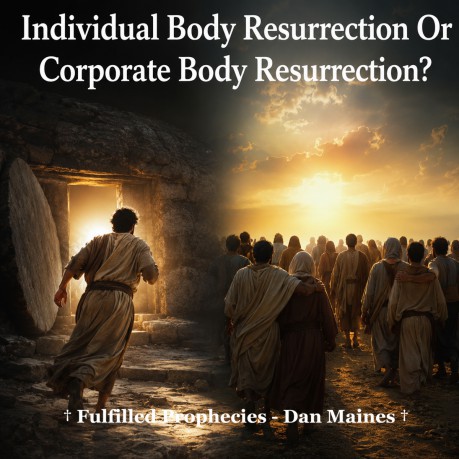
Individual
Body Resurrection Or Corporate Body Resurrection? Introduction What Does The Word
"Resurrection" Mean?
Ezekiel's Vision Of The Dry
Bones Isaiah's
Promise Of Resurrection Daniel's
Resurrection Prophecy Jesus Announced That The
Resurrection Had Begun
Raised Together With
Christ The
Body Of Christ Historical References How It Applies To Us
Today Q&A Appendix † This is the fulfilled
perspective we proclaim at Fulfilled Prophecies † Source Index
By Dan Maines
†
Many Christians automatically assume that every reference to
resurrection in the Bible speaks of individual physical bodies coming
out of graves. While the Bible certainly teaches that believers have
life in Christ beyond physical death, we should first ask what the
biblical writers meant by "resurrection" in its covenant
context.
†
Throughout the Old Testament, resurrection language was frequently
used to describe the restoration of God's covenant people from
spiritual death, exile, and covenant separation. The New Testament
builds upon that foundation rather than replacing it with an entirely
different concept.
†
This study examines whether the primary resurrection promise pointed
to countless individual bodies being raised from graves, or to the
corporate resurrection of God's covenant people into the New Covenant
through Jesus Christ.
†
The Greek word translated "resurrection" is anastasis,
meaning "a rising up" or "a standing again." By
itself, the word does not define what is being raised. The context
must determine whether Scripture is speaking of an individual, a
nation, a covenant people, or another subject. (Acts 24:15; John
11:24)
†
Throughout the Old Testament, God frequently used resurrection
language to describe the restoration of Israel after covenant
judgment. Israel was pictured as dead because of sin, exile, and
separation from God, yet He promised to raise His people again by
restoring them to covenant life. (Isaiah 26:19; Ezekiel 37:11-14;
Hosea 6:1-2)
†
When Jesus and the apostles spoke of resurrection, they did so upon
this established prophetic foundation. The New Testament does not
invent a new definition of resurrection but reveals the fulfillment
of what the prophets had long anticipated. (Luke 24:44; Acts
26:22-23)
Ezekiel 37:11-14
Then
He said to me, "Son of man, these bones are the entire house of
Israel; behold, they say, 'Our bones are dried up and our hope has
perished. We are completely cut off.' Therefore prophesy and say to
them, 'This is what the Lord God
says: "Behold, I am going to open your graves and cause you to
come up out of your graves, My people; and I will bring you into the
land of Israel. Then you will know that I am the Lord,
when I have opened your graves and caused you to come up out of your
graves, My people. And I will put My Spirit within you and you will
come to life, and I will place you on your own land. Then you will
know that I, the Lord,
have spoken and done it," declares the Lord.'"
†
God identified the dry bones as "the whole house of Israel."
The vision represents the restoration of the covenant nation, not
individual corpses leaving cemeteries.
†
The graves symbolize Israel's covenant death and exile. Their
resurrection pictures God restoring His people to covenant life.
(Isaiah 26:19; Hosea 6:1-2)
†
This establishes the Old Testament pattern for understanding
resurrection language.
Isaiah 26:19
Your
dead will live;
Their corpses will rise.
You who lie in the
dust, awake and shout for joy,
For your dew is as the dew of the
dawn,
And the earth will give birth to the departed spirits.
†
Isaiah uses the same covenant language as Ezekiel. The prophet is
speaking to God's covenant people, announcing that those considered
dead because of judgment would live again through God's saving
work.
†
The surrounding chapters describe God's judgment upon nations and His
deliverance of Israel. The context is covenant restoration, not a
worldwide resurrection of physical bodies thousands of years in the
future. (Isaiah 24-27)
†
Ezekiel and Isaiah together establish an important biblical
principle: resurrection language was already being used corporately
long before the New Testament was written.
Daniel 12:1-3
Now
at that time Michael, the great prince who stands guard over the sons
of your people, will arise. And there will be a time of distress such
as never occurred since there was a nation until that time; and at
that time your people, everyone who is found written in the book,
will be rescued. And many of those who sleep in the dust of the
ground will awake, these to everlasting life, but the others to
disgrace and everlasting contempt. And those who have insight will
shine like the glow of the expanse of heaven, and those who lead the
many to righteousness, like the stars forever and ever.
†
Daniel places the resurrection "at that time," during the
same time of unparalleled tribulation described in this chapter. The
resurrection cannot be separated from the time marker God Himself
provides.
†
Jesus deliberately quoted Daniel's prophecy when describing the Great
Tribulation. He declared that this unprecedented time of trouble
would occur within the generation of those who heard Him speak.
(Matthew 24:21,34)
†
Daniel's prophecy was given specifically concerning "thy
people," the covenant nation of Israel. The resurrection promise
is therefore rooted in God's covenant dealings with His people and
reaches its fulfillment as the Old Covenant passed away and the New
Covenant was fully established. (Hebrews 8:13)
†
The expression "sleep in the dust of the earth" follows the
same prophetic pattern found throughout the Old Testament. Israel had
become covenantally dead because of sin and judgment, yet God
promised to awaken His people and bring them into everlasting
covenant life through the Messiah. (Isaiah 26:19; Ezekiel 37:11-14;
Hosea 13:14)
†
Everlasting life was not merely endless existence but participation
in the everlasting New Covenant established through Christ. Those
written in the book entered into that covenant life, while those who
rejected the Messiah entered everlasting shame through the judgment
that came upon apostate Israel. (John 17:3; Hebrews 9:15)
†
The wise who shine like the brightness of the firmament echo Jesus'
own words that "the righteous shall shine forth as the sun in
the kingdom of their Father." Jesus applied this promise to the
establishment of His kingdom, confirming that Daniel's prophecy
belonged to the covenant transition fulfilled in His generation.
(Matthew 13:43)
†
Daniel 12 does not stand alone. It completes the prophetic
resurrection pattern begun in Isaiah and Ezekiel. All three prophets
describe God's covenant people being raised from death into renewed
covenant life, a promise brought to completion through Jesus Christ.
† This
would use John
5:24-25, where Jesus
says, "the hour has
come, and now is."
†
That passage is extremely important because it shows resurrection
life beginning during His earthly ministry, providing a direct bridge
from the Old Testament prophets to Paul's teaching in Ephesians and
Colossians. In my opinion, it's one of the strongest texts for the
Corporate Body View.
Ephesians 2:4-6
But
God, being rich in mercy, because of His great love with which He
loved us, even when we were dead in our wrongdoings, made us alive
together with Christ (by grace you have been saved), and raised us up
with Him, and seated us with Him in the heavenly places in Christ
Jesus,
†
Paul says believers had already been raised with Christ while they
were still physically alive.
†
This resurrection was spiritual and covenantal, bringing God's people
into the New Covenant and into union with Christ.
†
The resurrection life had already begun before AD 70 as the New
Covenant was being established.
1 Corinthians 12:27
Now
you are Christ's body, and individually parts of it.
†
Paul consistently describes believers as one corporate body in
Christ.
†
The resurrection united God's covenant people into one new man,
fulfilling what the prophets anticipated. (Ephesians 2:15-16)
†
The focus is not merely individual believers, but God's redeemed
covenant people living together as His body.
†
The Old Testament prophets regularly used death and resurrection
imagery to describe the fall and restoration of nations, especially
Israel.
†
Early Jewish expectation centered on the restoration of Israel and
the fulfillment of God's covenant promises through the coming
Messiah.
† Our
confidence rests in Christ's finished work, not in an event still
waiting to happen.
†
We are members of the living Body of Christ, sharing in the
resurrection life He secured for His people.
†
Because we are in Christ, we already share in the blessings of the
New Covenant and enjoy fellowship with Him as members of His living
Body.
Q:
Does the Bible speak about individual believers after physical
death?
A:
Yes. Believers depart to be with Christ. (Philippians 1:21-23; 2
Corinthians 5:6-8)
Q:
What is the primary focus of biblical resurrection prophecy?
A:
The covenant resurrection of God's people from the Old Covenant into
the New Covenant through Christ. (Ezekiel 37:11-14; Ephesians
2:4-6)
Q:
Does this deny eternal life for believers?
A:
No. Eternal life is found only in Christ, and those who belong to Him
continue to live in His presence. (John 11:25-26)
Q:
Doesn't 2 Corinthians 5 teach that believers receive a new body?
A:
Paul contrasts our earthly tent with the eternal dwelling from God
and expresses his confidence that to be absent from the body is to be
at home with the Lord. While many understand this passage to describe
an individual resurrection body, the text itself emphasizes the
believer's continued life with Christ and does not explicitly state
that a new individual body is received immediately upon physical
death. (2 Corinthians 5:1-8)
Q:
Do believers receive a better body through Christ?
A:
Yes. Through Christ, believers are no longer identified with the
perishable body of the Old Covenant but belong to His glorified Body,
the Body of Christ. We share in His resurrection life as members of
that one Body. Scripture also assures us that when believers die,
they are with Christ and at home with the Lord. (Ephesians 2:15-16; 1
Corinthians 12:27; Ephesians 2:4-6; 2 Corinthians 5:6-8)
Q:
Does the Corporate Body View deny life after physical death?
A:
No. The Corporate Body View fully affirms that believers continue to
live with Christ after physical death. It simply understands the
resurrection promises of Scripture to have been fulfilled corporately
in Christ through the establishment of the New Covenant. (Philippians
1:23; 2 Corinthians 5:8; John 11:25-26)
Q:
If the resurrection was fulfilled, what is the believer's hope
today?
A:
Our hope is not a future covenant resurrection because Christ has
already fulfilled that promise. Our hope is the eternal life we
already possess in Him, knowing that whether we live or die, we
belong to the Lord and nothing can separate us from His love. (John
5:24; Romans 8:38-39; 1 John 5:11-12)
Q:
If believers can recognize and speak with one another after physical
death, doesn't that imply individual existence?
A:
Yes. Scripture presents believers after physical death as conscious
individuals who can be recognized and communicate. Moses and Elijah
spoke with Jesus at the transfiguration. Jesus spoke of Abraham,
Isaac, and Jacob as living. Paul expected to depart and be with
Christ. The souls under the altar cried out to God. None of these
passages conflict with the Corporate Body View because the corporate
resurrection concerns God's covenant people being raised into the New
Covenant, while individual believers continue to live in the presence
of Christ after physical death. (Matthew 17:1-3; Matthew 22:31-32;
Philippians 1:21-23; Revelation 6:9-11)
©
Fulfilled Prophecies - Dan Maines.
†
Ezekiel 37:11-14; Ephesians 2:4-6; 1 Corinthians 12:27
†
Historical writers: Josephus; Eusebius
Links