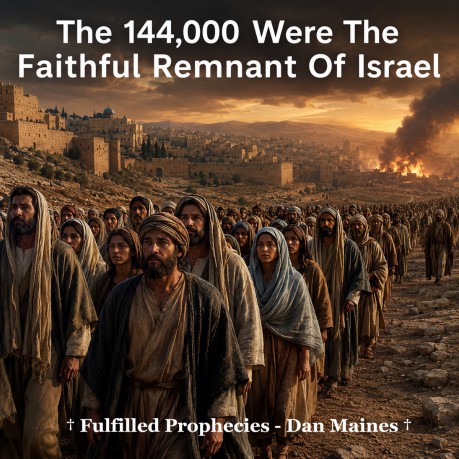
The
144,000 Were The Faithful Remnant Of Israel Introduction Revelation
7:2-4
Revelation
14:1-5 Romans
11:5 Historical
References How
It Applies To Us Today Q
& A Appendix †
This
is the fulfilled perspective we proclaim at Fulfilled Prophecies † Source
Index
By Dan Maines
†
The
144,000 are often presented as a future group of Jewish evangelists
during a coming tribulation. The Scriptures, however, identify them
as the faithful remnant of Israel living during the last days of the
Old Covenant. They were sealed before God's judgment fell upon
Jerusalem and were the firstfruits of redeemed Israel as the New
Covenant was being established.
And
I saw another angel ascending from the rising of the sun, holding the
seal of the living God; and he called out with a loud voice to the
four angels to whom it was granted to harm the earth and the sea,
saying, "Do not harm the earth, or the sea, or the trees until
we have sealed the bond-servants of our God on their foreheads."
And
I heard the number of those who were sealed: 144,000, sealed from
every tribe of the sons of Israel:
†
The
text plainly says the 144,000 were sealed out of the tribes of
Israel. It does not identify them as Gentiles or as a future
generation. (Revelation 7:4)
†
They
were sealed before judgment was poured out, just as Jesus warned His
disciples to flee Jerusalem before its destruction. (Matthew
24:15-21; Luke 21:20-22)
† The
seal identified them as God's covenant people who would be preserved
through the transition from the Old Covenant to the New Covenant.
(Ezekiel 9:4; Ephesians 1:13)
†
The
tribes are named because the judgment about to occur was a covenant
judgment upon Israel, not upon the Gentile nations. (Deuteronomy 28;
Matthew 23:35-38)
† The
sealing occurred before the winds of judgment were released,
demonstrating that God protects His own before covenant wrath is
poured out. (Ezekiel 9:4-6)
†
This
sealing parallels the blood placed upon the homes at Passover. God's
people were marked before judgment fell. (Exodus 12:7, 13)
†
The
number 144,000 is twelve times twelve times one thousand, symbolizing
the fullness and completeness of God's covenant remnant rather than a
literal census. (Revelation 21:12-17)
Then
I looked, and behold, the Lamb was standing on Mount Zion, and with
Him 144,000 who had His name and the name of His Father written on
their foreheads. And I heard a voice from heaven, like the sound of
many waters and like the sound of loud thunder, and the voice which I
heard was like the sound of harpists playing on their harps. And they
sang a new song before the throne and before the four living
creatures and the elders; and no one was able to learn the song
except the 144,000 who had been purchased from the earth. These are
the ones who have not defiled themselves with women, for they are
celibate. These are the ones who follow the Lamb wherever He goes.
These have been purchased from mankind as first fruits to God and to
the Lamb. And no lie was found in their mouths; they are blameless.
† They
stand victoriously with the Lamb on Mount Zion, showing that Christ
had gathered His faithful remnant. (Hebrews 12:22-24)
†
They
are called the firstfruits unto God, identifying them as the first
redeemed remnant from Israel, not the only redeemed people of God.
(James 1:18)
† Their
purity represents covenant faithfulness to Christ, a picture
frequently used throughout Scripture. (2 Corinthians 11:2)
†
Mount
Zion represents God's New Covenant kingdom, not an earthly political
kingdom. (Hebrews 12:22-24)
†
The
Father's name upon their foreheads contrasts with the mark of the
beast. One identifies those belonging to Christ, the other identifies
those aligned with apostate Israel. (Revelation 13:16-17)
†
The
new song celebrates redemption accomplished through Christ and could
only be sung by those who experienced that covenant transition.
(Psalm 40:3; Revelation 5:9)
†
Being
called virgins is symbolic language describing spiritual purity and
covenant faithfulness, just as the church is described as the pure
bride of Christ. (2 Corinthians 11:2)
†
Firstfruits
always point to the beginning of a greater harvest. These believers
were the first redeemed remnant of Israel before the gospel spread
throughout the nations. (James 1:18)
In
the same way then, there has also come to be at the present time a
remnant according to God's gracious choice.
†
Paul
said there was a remnant at that present time. The believing remnant
already existed during the first century. (Romans 11:1-5)
†
The
144,000 represent God's faithful remnant preserved while unbelieving
Israel faced covenant judgment. (Romans 9:27-29)
†
Paul
wrote "at this present time," placing the remnant in his
own lifetime, not thousands of years later.
†
God
has always preserved a faithful remnant even when the majority
rejected Him. (Isaiah 10:20-22)
†
The
144,000 beautifully picture that remnant preserved by grace during
Israel's final covenant generation.
†
The
remnant demonstrates that God did not reject His promises to Israel,
but fulfilled them through Christ and those who believed Him. (Romans
11:1)
† Josephus
records that the Roman siege devastated Jerusalem in AD 70,
fulfilling Jesus' warnings concerning that generation.
†
Josephus
describes the horrors of the Roman siege exactly as Jesus foretold.
†
Eusebius
records that the Jerusalem church fled to Pella before the city fell,
preserving Christ's faithful followers.
†
The
historical record harmonizes with Revelation's picture of God's
servants being preserved before Jerusalem's destruction.
†
God
always keeps His promises exactly as He declares.
†
Christ
faithfully preserved His covenant people during the last days of the
Old Covenant.
† Our
confidence is in the finished work of Christ, who fulfilled every
covenant promise at the appointed time.
†
We
can trust every time statement Jesus gave because history confirms He
fulfilled every one.
† God's
promises are never delayed beyond His appointed time.
†
Christ
has already established His everlasting kingdom, so believers live in
the confidence of His completed work.
†
Our
hope is not in waiting for the 144,000 to appear but in belonging to
Christ today.
† The
faithfulness of the 144,000 reminds us that God always preserves a
people for Himself.
† The
New Covenant is not awaiting completion. It is the covenant in which
believers now live.
† The
fulfilled work of Christ gives us confidence instead of fear when
reading Revelation.
† The
focus of Revelation is Christ's victory, not speculation about future
prophetic events.
Q:
Who
were the 144,000?
A:
They
were the faithful remnant of Israel sealed before the judgment upon
Jerusalem. (Revelation 7:2-4; Romans 11:5)
Q:
Were
they future evangelists?
A:
No.
Scripture places them among the tribes of Israel during the events
leading up to Jerusalem's destruction. (Revelation 7:4; Matthew
24:34)
Q:
Why
are they called firstfruits?
A:
Firstfruits
were the first portion of a harvest offered to God. The 144,000 were
the first redeemed remnant from Israel under the New Covenant,
pointing to the greater harvest that would include believers from
every nation. (Revelation 14:4; James 1:18)
Q:
Do
Christians become second fruits and part of the 144,000 today?
A:
No.
The 144,000 were the firstfruits of redeemed Israel during the
first-century transition from the Old Covenant to the New Covenant.
Believers today are not added to that number. We are members of
Christ's body and part of the great multitude from every nation that
belongs to Him. (Revelation 14:4; Revelation 7:9-17; Ephesians
2:11-22)
Q:
Is
the number 144,000 literal?
A:
The
book of Revelation is filled with symbolic numbers. The number
144,000, twelve times twelve times one thousand, represents the
complete covenant remnant of faithful Israel whom God sealed before
Jerusalem's judgment. (Revelation 7:4; Revelation 21:12-17)
Q:
Is
the great multitude the same as the 144,000?
A:
No.
The 144,000 are specifically identified as being from the tribes of
Israel. The great multitude is described as coming from every nation,
tribe, people, and tongue, showing the worldwide expansion of God's
redeemed people through the gospel. (Revelation 7:4-9)
Q:
Why
are they called virgins?
A:
Their
virginity is symbolic of spiritual purity and covenant faithfulness
to Christ. Throughout Scripture, God's faithful people are described
as a pure bride devoted to Him. (2 Corinthians 11:2; Ephesians
5:25-27)
Q:
Why
were they sealed?
A:
They
were sealed to show God's ownership and protection before covenant
judgment came upon Jerusalem. Their sealing parallels the marking of
the faithful in Ezekiel before judgment fell on the city. (Revelation
7:2-3; Ezekiel 9:4-6)
Q:
Doesn't
Scripture teach that when we become Christians we join the 144,000?
Aren't we in the same place as they are?
A:
No.
The 144,000 were a unique first-century remnant of Israel, sealed
before the destruction of Jerusalem and identified as the firstfruits
unto God and the Lamb. Their role was specific to the transition from
the Old Covenant to the New Covenant. Believers today share the same
salvation, the same Christ, and the same heavenly Mount Zion, but we
do not become part of the 144,000. We belong to the great multitude
from every nation that stands before the throne and the Lamb.
(Revelation 7:4-9; Revelation 14:1-4; Hebrews 12:22-24; Ephesians
2:11-22)
©
Fulfilled Prophecies - Dan Maines.
† Revelation
7:2-4, Revelation 14:1-5, Romans 11:5
†
Josephus,
The
Wars of the Jews;
Eusebius, Ecclesiastical
History
Links