Judgment
on the Nations
Introduction:
Many people read apocalyptic
passages in the Old Testament and assume they refer to the end of
the physical universe. But when we let scripture interpret
scripture, we see that language like stars falling and heavens
rolling up are symbolic ways of describing judgment on nations and
powers. Today we will examine Isaiah 34 and its context to show how
God judged the nations in time, and how this language was reused in
the New Testament to describe the fall of Jerusalem. Main Text: Isaiah 34:4 (NASB)
"And
all the heavenly lights will wear away, And the sky will be rolled
up like a scroll; All their lights will also wither away As a leaf
withers from the vine, Or as one withers from the fig tree." Isaiah 34 is a prophecy against
Edom, not the end of the planet. Isaiah 34:5
says:
"For My sword has drunk its fill in heaven;
Behold it shall descend for judgment upon Edom, And upon the people
whom I have designated for destruction." This is localized judgment, yet
described with cosmic language. This kind of language was common to describe political
powers falling, not literal stars. The host of heaven
refers to rulers and authorities. When the stars fall, it
symbolizes the fall of kings and nations. Isaiah 13:10
describes the fall of Babylon:
"For the stars of
heaven and their constellations Will not flash their light; The sun
will be dark when it rises, And the moon will not shed its light." Yet Babylon fell historically, not cosmically. It was an
earthly event with heavenly symbols. The same imagery appears in
Revelation 6:13-14:
"And the
stars of the sky fell to the earth... The sky was split apart like
a scroll when it is rolled up." This is not about the end of
creation, but about the end of Old Covenant Israel,
just like Isaiah described the end of Edom. Jesus used this same language in Matthew 24:29-30
when speaking of Jerusalem's fall:
"But
immediately after the tribulation of those days, the sun will be
darkened, and the moon will not give its light, and the stars will
fall from the sky." Isaiah, Jeremiah, Ezekiel, and
other prophets used judgment language repeatedly to describe how
God held nations accountable. These were not global
destructions, but specific judgments in history. Jeremiah 4:23-24 even echoes Genesis
creation language to describe the fall of Judah:
"I
looked at the earth, and behold, it was formless and void... I
looked, and behold, the mountains were quaking." The language of cosmic
destruction was symbolic of covenant change or
national collapse, not the end of time. By 70 AD, this same language
described the judgment on Old Covenant Israel, the
final transition to the New Covenant. Hebrews 12:26-28 confirms this:
"Yet
once more I will shake not only the earth, but also the heaven...
so that those things which cannot be shaken may remain." We must not misread judgment
passages as future events. God's justice was seen
historically, not in endless delay. Acts 17:31 says:
"Because
He has set a day on which He will judge the world in righteousness
through a Man whom He has appointed."
That day
was coming upon their generation, as Jesus said in
Matthew 24:34. Conclusion:
God
has judged the nations. He used apocalyptic language not to scare us
about the end of the world, but to signify the fall of the proud and
the passing of old systems. Isaiah 34 was fulfilled when Edom fell.
Likewise, the heavens rolled up in Revelation symbolized the end of
the Old Covenant world. We are now living in the unshakable Kingdom,
where Christ reigns and the nations are welcomed through the gospel. Revelation 21:1
"Then
I saw a new heaven and a new earth; for the first heaven and the
first earth passed away, and there is no longer any sea."
That
has already come. The judgment on the nations is history. Christ is
victorious. Amen.
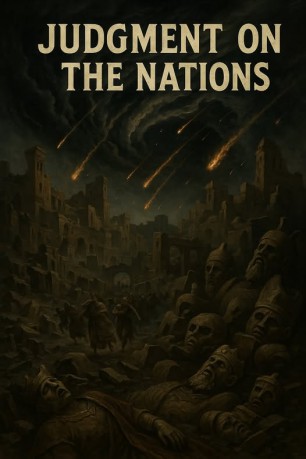
The statue looking figures in the image represent fallen
kings, rulers, and idols of the nations. This visual symbolism is
drawn from prophetic language in scripture where defeated powers are
often portrayed as shattered or fallen idols. For example: Isaiah 34:12
speaks of nobility being "nothing there to call a kingdom"
after judgment. Jeremiah 50:2:
"Bel has been put to shame, Marduk has been shattered; Her
images have been put to shame, her idols have been shattered." Ezekiel 30:13: "I will also destroy
the idols And make the images cease from Memphis." In the context of Isaiah 34 and other
judgment passages, these fallen statues represent the collapse of
human governments and false gods under divine judgment. There used
to symbolize the political and religious powers that were brought
low, as foretold in prophetic scripture.
By Dan Maines1. The
Context of Isaiah 34: Judgment on Edom
2. Heavenly
Imagery as Political Language
3. Parallel
with Revelation and Matthew
4. God Has
Always Judged Nations
5. Why
This Matters in a Fulfilled View
6. Our
Application Today
Links