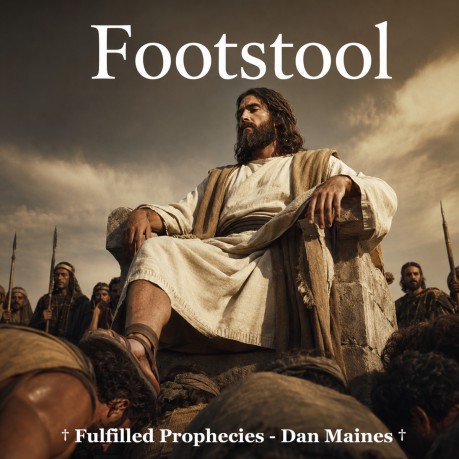
Footstool Introduction 1
Chronicles 28:2 Psalm
99:5 Psalm 110:1 Psalm
132:7 Isaiah 66:1 Lamentations 2:1 Ezekiel
43:7 Matthew
5:35 Matthew 22:44 Mark
12:36 Luke
20:43 Acts
2:35 Acts 7:49 Hebrews
1:13 Hebrews
10:13
1 Corinthians 15:25-28 James
2:3 Historical References How It Applies To Us
Today Q & A Appendix † This is the fulfilled
perspective we proclaim at Fulfilled Prophecies † Source Index
By Dan Maines
†
The word footstool appears throughout Scripture as a symbol of God's
authority, presence, kingdom, and the complete subjection of His
enemies. (Psalm 110:1; Isaiah 66:1; Hebrews 10:13)
†
The Old Testament introduces the imagery, and the New Testament
applies it directly to Christ's reign from the right hand of God.
(Psalm 110:1; Acts 2:35; Hebrews 1:13)
†
When all the passages are examined together, they present a
consistent picture of God's sovereign rule and the fulfillment of His
covenant purposes through Christ. (Psalm 110:1; Acts 2:35; Hebrews
10:13)
Then
King David rose to his feet and said, "Listen to me, my brothers
and my people; I had intended to build a permanent home for the ark
of the covenant of the Lord
and for the footstool of our God. So I had made preparations to build
it.
†
David described the temple as the place associated with God's
footstool and covenant presence. (Psalm 132:7; Psalm 99:5)
†
The temple pointed forward to a greater dwelling place that would be
established through Christ. (Ephesians 2:19-22; John 2:19-21)
†
God's presence was never permanently confined to a physical
structure. (Isaiah 66:1; Acts 7:49)
Exalt the
Lord
our God
And worship at His footstool;
Holy is He.
†
Worship at God's footstool acknowledges His holiness and authority.
(Isaiah 66:1; Revelation 4:10-11)
†
The focus is not the footstool itself but the One who reigns above
it. (Psalm 110:1; Hebrews 1:13)
†
Believers now approach God through Christ, our mediator. (Hebrews
12:22-24; 1 Timothy 2:5)
The
Lord
says to my Lord:
"Sit at My right hand
Until I make
Your enemies a footstool for Your feet."
†
This is the foundational footstool passage of Scripture. (Matthew
22:44; Acts 2:35)
†
Christ reigns from God's right hand while His enemies are being
subdued. (Acts 2:34-36; Hebrews 10:13)
†
The New Testament repeatedly applies this verse to Jesus. (Matthew
22:44; Mark 12:36; Luke 20:43; Hebrews 1:13)
Let's go
into His dwelling place;
Let's worship at His footstool.
†
God's footstool was associated with His dwelling among His covenant
people. (1 Chronicles 28:2; Psalm 99:5)
†
Under the New Covenant, God's dwelling is His people rather than a
physical temple. (Ephesians 2:21-22; 1 Corinthians 3:16)
†
The reality has replaced the shadow. (Colossians 2:16-17; Hebrews
8:5)
This
is what the Lord
says:
"Heaven is My
throne and the earth is the footstool for My feet.
Where then is
a house you could build for Me?
And where is a place that I may
rest?
†
God declares that heaven is His throne and earth is His footstool.
(Acts 7:49; Psalm 103:19)
†
No earthly building can contain the Creator. (Acts 17:24-25; 1 Kings
8:27)
†
This passage exposes the limitations of temple-centered thinking.
(Acts 7:48-50; John 4:21-24)
How
the Lord has covered the daughter of Zion
With a cloud in His
anger!
He has hurled
The glory of Israel from heaven to
earth,
And has not remembered His footstool
In the day of
His anger.
†
God's footstool was associated with covenant Israel and the temple
system. (Psalm 132:7; 1 Chronicles 28:2)
†
Jerusalem's destruction demonstrated that covenant privilege did not
remove accountability. (Matthew 23:37-38; Luke 21:20-22)
†
Judgment came upon the nation because of covenant unfaithfulness.
(Deuteronomy 28:58-63; Matthew 24:34)
And He
said to me, "Son of man, this is the place of My throne and the
place of the soles of My feet, where I will dwell among the sons of
Israel forever. And the house of Israel will not again defile My holy
name, neither they nor their kings, by their prostitution and by the
corpses of their kings when they die,
†
God's throne and footstool imagery are joined together in this
vision. (Isaiah 66:1; Psalm 99:5)
†
The ultimate fulfillment is found in God's dwelling with His redeemed
people. (Revelation 21:3; Ephesians 2:21-22)
†
Christ established the everlasting covenant dwelling place. (Hebrews
12:22-24; John 14:23)
nor by the
earth, for it is the footstool of His feet, nor by Jerusalem, for it
is the
city of the great King.
†
Jesus quoted Isaiah 66:1 and affirmed God's universal authority.
(Isaiah 66:1; Psalm 103:19)
†
The earth belongs to God because He is its Creator and King. (Psalm
24:1; Acts 17:24)
†
Christ directed attention away from religious traditions and toward
God's sovereignty. (John 4:21-24; Matthew 23:16-22)
'The
Lord said to my Lord,
"Sit
at My right hand,
Until
I put Your enemies under Your feet"'?
†
Jesus applied Psalm 110 directly to Himself. (Psalm 110:1; Mark
12:36)
†
He identified Himself as David's Lord. (Matthew 22:45; Acts
2:34-36)
†
The footstool promise belongs to the Messiah. (Psalm 110:1; Hebrews
1:13)
David
himself said in the Holy Spirit,'The
Lord said to my Lord,
"Sit
at My right hand,
Until
I put Your enemies under Your feet."'
†
Jesus affirmed the divine inspiration of Psalm 110. (2 Peter 1:21;
Psalm 110:1)
†
The Messiah is greater than David. (Matthew 22:45; Acts 2:34-36)
†
Christ's authority rests upon God's fulfilled promise. (Luke 1:32-33;
Hebrews 1:13)
Until
I make Your enemies a footstool for Your feet.
†
Christ's enemies were being subjected during His reign. (1
Corinthians 15:25; Hebrews 10:13)
†
The kingdom was already active in the apostolic age. (Colossians
1:13; Acts 2:36)
†
His victory was certain because God Himself guaranteed it. (Psalm
110:1; Hebrews 1:13)
Until
I make Your enemies a footstool for Your feet."'
†
Peter declared that Psalm 110 was being fulfilled through Christ's
exaltation. (Acts 2:33-36; Psalm 110:1)
†
Jesus was already reigning at God's right hand. (Acts 2:36; Ephesians
1:20-22)
†
The kingdom was not postponed. (Colossians 1:13; Revelation 1:9)
'Heaven
is My throne,
And
the earth is the footstool of My feet;
What
kind of house will you build for Me?'
says the Lord,
'Or
what place is there for My rest?
†
Stephen quoted Isaiah 66:1 before his martyrdom. (Isaiah 66:1; Acts
7:48)
†
He challenged the belief that God was confined to the temple. (Acts
17:24-25; John 4:21-24)
†
His message anticipated the end of the Old Covenant temple system.
(Matthew 24:1-2; Hebrews 8:13)
But to
which of the angels has He ever said,
"Sit
at My right hand,
Until
I make Your enemies
A
footstool
for Your feet"?
†
No angel has ever received the authority given to Christ. (Hebrews
1:3-4; Philippians 2:9-11)
†
The Son alone reigns at God's right hand. (Psalm 110:1; Ephesians
1:20-22)
†
The footstool promise belongs exclusively to Him. (Psalm 110:1; Acts
2:35)
waiting
from that time onward until
His enemies are made a footstool for His feet.
†
Christ sat down because His sacrificial work was complete. (Hebrews
10:12; John 19:30)
†
He reigns while His enemies are brought into subjection. (1
Corinthians 15:25; Psalm 110:1)
†
The Old Covenant opposition was judged within that generation.
(Matthew 24:34; Hebrews 8:13)
For
He must reign until He has put all His enemies under His feet. The
last enemy that will be abolished is death. For He
has put all things in subjection under His feet.
But when He says, "All things are put in subjection," it is
clear that this excludes the Father who put all things in subjection
to Him. When all things are subjected to Him, then the Son Himself
will also be subjected to the One who subjected all things to Him, so
that God may be all in all.
†
Paul explains the fulfillment of Psalm 110:1 by describing Christ
reigning until His enemies are placed beneath His feet. (Psalm 110:1;
Acts 2:34-35)
†
The footstool imagery represents complete subjection to Christ's
authority and kingdom. (Ephesians 1:20-22; Hebrews 1:13)
†
Christ's reign was already in progress when Paul wrote these words,
demonstrating that the kingdom had already been established.
(Colossians 1:13; Acts 2:36)
†
The passage presents Christ as a reigning King, not a future King
waiting to begin His reign. (Hebrews 10:12-13; Revelation 1:5)
and you pay
special attention to the one who is wearing the bright clothes, and
say, "You sit here in a good place," and you say to the
poor man, "You stand over there, or sit down by my footstool,"
†
James uses a footstool as an illustration of social discrimination.
(James 2:1-4)
†
The passage condemns favoritism among believers. (James 2:9;
Galatians 3:28)
†
God's kingdom is not based upon worldly status. (James 2:5; 1
Corinthians 1:26-29)
†
Josephus recorded the destruction of Jerusalem and the temple in AD
70, confirming the judgment that ended the Old Covenant age. (Matthew
24:1-2; Luke 21:20-24)
†
Eusebius viewed the fall of Jerusalem as divine judgment upon those
who rejected Christ. (Matthew 23:37-38; Matthew 24:34)
†
Early Christian writers consistently interpreted Psalm 110 as
referring to Christ's present heavenly reign. (Psalm 110:1; Acts
2:34-36)
†
Christ reigns now from the right hand of the Father. (Acts 2:34-36;
Hebrews 10:13)
†
We live under the authority of a victorious King. (Matthew 28:18;
Ephesians 1:20-22)
†
God's dwelling is with His people through Christ. (Ephesians 2:21-22;
Revelation 21:3)
†
Our confidence rests in Christ's completed work and present kingdom.
(Hebrews 12:28; Colossians 1:13)
Q:
What does footstool symbolize in Scripture?
A:
It symbolizes God's authority, presence, and the subjection of His
enemies. (Psalm 110:1; Isaiah 66:1)
Q:
Why is Psalm 110:1 important?
A:
It is the primary passage used by the New Testament to describe
Christ's reign from God's right hand. (Acts 2:34-35; Hebrews 1:13)
Q:
Is Christ reigning now?
A:
Yes. The New Testament consistently presents Christ as reigning now
from heaven. (Acts 2:36; Hebrews 10:13)
Q:
What is the believer's response?
A:
Worship, obedience, confidence, and faith in the reigning King.
(Psalm 99:5; Hebrews 12:28)
Q:
Are Christ's enemies still being made His footstool today?
A:
Scripture says Christ reigns until all enemies are subjected beneath
His feet. The New Testament presents that reign as already underway
in the first century. (Psalm 110:1; Acts 2:34-36; 1 Corinthians
15:25-28; Hebrews 10:13)
Q:
If Christ reigns until all enemies are placed under His feet, does
that mean He will stop reigning when the kingdom is handed over to
the Father?
A:
No. The word "until" marks the completion of a task, not
the end of Christ's reign. After all enemies are subjected, Christ
delivers the perfected kingdom to the Father and remains forever
united with the Father in that reign. His kingdom has no end. (1
Corinthians 15:24-28; Luke 1:32-33; Daniel 7:13-14; Revelation
11:15)
A:
Paul is describing a change in administration, not the termination of
Christ's kingship. The Son remains King while all things are brought
into their completed order under God. (1 Corinthians 15:27-28;
Ephesians 1:20-23; Philippians 2:9-11)
©
Fulfilled Prophecies - Dan Maines.
†
1 Chronicles 28:2, Psalm 99:5, Psalm 110:1, Psalm 132:7, Isaiah 66:1,
Lamentations 2:1, Ezekiel 43:7, Matthew 5:35, Matthew 22:44, Mark
12:36, Luke 20:43, Acts 2:35, Acts 7:49, Hebrews 1:13, Hebrews 10:13,
1 Corinthians 15:25-28, James 2:3
†
Josephus, Eusebius
Links