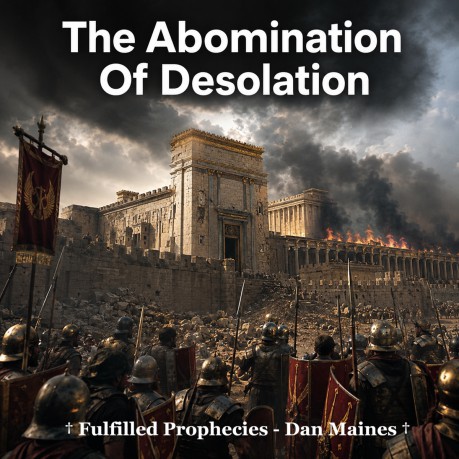
The
Abomination Of Desolation Introduction Daniel
9:26-27 Daniel
11:31 Daniel
12:11 Matthew
23:37-38 Matthew
24:1-2 Matthew
24:15-16 Mark 13:14
Luke 19:41-44 Luke
21:20-22 Revelation
17:16 Historical References Addressing Modern
Speculations How It Applies To Us
Today Q & A Appendix † This is the fulfilled
perspective we proclaim at Fulfilled Prophecies † Source Index
By Dan Maines
†
Few prophetic subjects have generated more speculation than the
Abomination Of Desolation. Some claim it will be a future antichrist
sitting in a rebuilt temple. Others claim it involves sexual acts
performed in a future temple. Yet Scripture itself provides the
answer. Rather than beginning with modern theories, we must begin
where Jesus began, with the writings of Daniel. (Matthew 24:15)
†
Jesus did not tell His disciples to look for modern prophecy
teachers. He pointed them directly to the prophet Daniel. Therefore,
if we are going to understand the Abomination Of Desolation
correctly, we must begin with Daniel and then follow the explanation
given by Jesus Himself. (Matthew 24:15)
†
As we shall see, the Bible consistently connects the Abomination Of
Desolation with the desolation of Jerusalem, the destruction of the
temple, and the judgment that fell upon first-century Israel. (Daniel
9:26-27; Luke 21:20-22)
Then
after the sixty-two weeks, the Messiah will be cut off and have
nothing, and the people of the prince who is to come will destroy the
city and the sanctuary. And its end will come with a flood; even to
the end there will be war; desolations are determined. And he will
confirm a covenant with the many for one week, but in the middle of
the week he will put a stop to sacrifice and grain offering; and on
the wing of abominations will come the one who makes desolate, until
a complete destruction, one that is decreed, gushes forth on the one
who makes desolate.
†
Daniel immediately connects the abomination with the destruction of
the city and the sanctuary. (Matthew 24:15)
†
The focus of the prophecy is Jerusalem and the temple. (Daniel
9:26)
†
The prophecy speaks of sacrifices ceasing and desolations being
determined. (Daniel 9:27)
†
Notice that the sanctuary is destroyed. The result of the abomination
is desolation. (Daniel 9:26-27)
†
The prophecy never speaks of a rebuilt temple thousands of years
later. The sanctuary under discussion is the sanctuary connected with
Jerusalem and the covenant people. (Daniel 9:26-27)
Forces
from him will arise, desecrate the sanctuary fortress, and do away
with the regular sacrifice. And they will set up the abomination of
desolation.
†
Here the abomination is associated with forces, armies, and the
profaning of the sanctuary. (Daniel 11:31)
†
The sanctuary is violated and the sacrifices are interrupted. (Daniel
11:31)
†
The emphasis is upon desecration leading to desolation. (Daniel
11:31)
†
Daniel continues the same theme introduced in chapter nine. (Daniel
9:26-27; Daniel 11:31)
And from
the time that the regular sacrifice is abolished and the abomination
of desolation is set up, there will be 1,290 days.
†
Daniel again links the abomination to the removal of sacrifice and
the resulting desolation. (Daniel 12:11)
†
The repeated emphasis is judgment upon the sanctuary. (Daniel 9:27;
Daniel 11:31; Daniel 12:11)
†
Nothing in the passage defines the abomination as a sexual act.
(Daniel 12:11)
†
Nothing in the passage defines the abomination as a future antichrist
sitting in a rebuilt temple. (Daniel 12:11)
Jerusalem,
Jerusalem, who kills the prophets and stones those who have been sent
to her! How often I wanted to gather your children together, the way
a hen gathers her chicks under her wings, and you were unwilling.
Behold, your house is being left to you desolate!
†
Before Jesus mentioned the Abomination Of Desolation, He first
pronounced desolation upon Jerusalem. (Matthew 23:38)
†
Jerusalem had rejected the prophets and rejected the Messiah.
(Matthew 23:37)
†
Jesus declared that their house would be left desolate. (Matthew
23:38)
†
This establishes the context for everything that follows in Matthew
24. (Matthew 23:38; Matthew 24:1-2)
Jesus
left the temple area and was going on His way when His disciples came
up to point out the temple buildings to Him. But He responded and
said to them, "Do you not see all these things? Truly I say to
you, not one stone here will be left upon another, which will not be
torn down."
†
The disciples pointed to the temple standing before them. (Matthew
24:1)
†
Jesus responded by predicting its destruction. (Matthew 24:2)
†
The temple under discussion was the first-century temple. (Matthew
24:1-2)
†
Jesus did not change the subject to a future temple thousands of
years later. (Matthew 23:38; Matthew 24:1-2)
Therefore
when you see the abomination
of desolation which
was spoken of through Daniel the prophet, standing in the holy place
- let the reader understand - then those who are in Judea must flee
to the mountains.
†
Jesus identifies Daniel's Abomination Of Desolation. (Daniel 9:26-27;
Daniel 11:31; Daniel 12:11)
†
He tells His disciples that they would see it. (Matthew 24:15)
†
The warning was directed to those living in Judea. (Matthew 24:16)
†
The command was immediate, flee. (Matthew 24:16)
†
The sign was not given to satisfy curiosity. It was given to save
lives. (Matthew 24:16)
Now
when you see the abomination
of desolation standing
where it should not be - let the reader understand - then those who
are in Judea must flee to the mountains.
†
Mark records the same warning. (Mark 13:14)
†
Once again those in Judea are told to flee. (Mark 13:14)
†
The audience remains first-century believers. (Mark 13:14)
When
He approached Jerusalem, He saw the city and wept over it, saying,
"If you had known on this day, even you, the conditions for
peace! But now they have been hidden from your eyes. For the days
will come upon you when your enemies will put up a barricade against
you, and surround you and hem you in on every side, and they will
level you to the ground, and throw down your children within you, and
they will not leave in you one stone upon another, because you did
not recognize the time of your visitation."
†
Jesus predicted Jerusalem would be surrounded by enemies. (Luke
19:43)
†
He predicted the city's destruction decades before it occurred. (Luke
19:43-44)
†
He warned that not one stone would remain upon another. (Luke 19:44)
But
when you see Jerusalem surrounded by armies, then recognize that her
desolation is near. Then those who are in Judea must flee to the
mountains, and those who are inside the city must leave, and those
who are in the country must not enter the city; because these are
days of punishment, so that all things which have been written will
be fulfilled.
†
Luke provides the inspired explanation of what Matthew and Mark call
the Abomination Of Desolation. (Matthew 24:15-16; Mark 13:14)
†
Jerusalem surrounded by armies was the sign. (Luke 21:20)
†
Notice the identical command to flee. (Matthew 24:16; Luke 21:21)
†
The same audience, the same warning, and the same result prove these
passages describe the same event. (Matthew 24:15-16; Mark 13:14; Luke
21:20-22)
†
Scripture interprets Scripture. Luke removes the mystery and
identifies the desolating event. (Luke 21:20)
And the
ten horns which you saw, and the beast, these will hate the
prostitute and will make her desolate and naked, and will eat her
flesh and will burn her up with fire.
†
Revelation continues the theme of covenant judgment and desolation.
(Revelation 17:16)
†
The harlot city is made desolate. (Revelation 17:16)
†
The judgment language is consistent with the warnings given by Jesus
and the prophets. (Matthew 23:38; Luke 21:20-22; Revelation 17:16)
†
Josephus recorded that Roman armies surrounded Jerusalem exactly as
Jesus foretold. (Luke 19:43; Luke 21:20)
†
Josephus described famine, civil war, bloodshed, and destruction
within the city. (Luke 21:20-24)
†
Josephus recorded the destruction of the temple during the Roman
assault. (Matthew 24:2)
†
The historical record confirms the fulfillment of Jesus' warnings.
(Matthew 24:15-16; Luke 21:20-22)
†
Some claim the Abomination Of Desolation is a future antichrist
sitting in a rebuilt temple. Scripture never defines it that way.
(Daniel 9:26-27; Matthew 24:1-2)
†
Some claim the Abomination Of Desolation is a sexual act performed in
a temple. Scripture never says this. (Daniel 9:26-27; Daniel 11:31;
Daniel 12:11)
†
Not one passage defining the Abomination Of Desolation mentions
sexual activity. (Daniel 9:26-27; Daniel 11:31; Daniel 12:11; Matthew
24:15)
†
Some historical writers describe pagan worship, pagan altars, idols,
and unclean sacrifices being introduced into the temple under
Antiochus Epiphanes. These sources describe idolatrous desecration,
not sexual acts. (1 Maccabees 1:54; 2 Maccabees 6:2)
†
1 Maccabees 1:54 states: "they set up the abomination of
desolation upon the altar." The historical source identifies a
pagan altar and idolatrous worship, not sexual activity.
†
Even if Antiochus Epiphanes is viewed as a historical foreshadowing,
Jesus applied the Abomination Of Desolation to a future event from
His perspective. (Matthew 24:15)
†
Luke identifies the sign as Jerusalem surrounded by armies. (Luke
21:20)
†
The identical command to flee proves Luke is describing the same
event as Matthew 24:15-16 and Mark 13:14. (Matthew 24:16; Mark 13:14;
Luke 21:21)
†
The Bible's own explanation is far simpler than modern theories.
Jerusalem surrounded by armies signaled that her desolation had
arrived. (Luke 21:20-22)
†
Scripture interprets Scripture. Daniel introduced the prophecy, Jesus
warned about it, and Luke explained what the disciples would actually
see. (Daniel 9:26-27; Matthew 24:15-16; Luke 21:20-22)
† We
should allow Scripture to define prophetic terms rather than relying
upon speculation. (2 Peter 1:20; Luke 21:20-22)
†
We should read passages in their context rather than importing modern
theories into the text. (Matthew 23:38; Matthew 24:1-2)
†
Jesus fulfilled His words exactly as He promised. (Matthew 24:34;
Luke 21:22)
†
Fulfilled prophecy strengthens our confidence in the reliability of
Scripture. (John 14:29)
Q:
What was the Abomination Of Desolation?
A:
Jesus identified it as the sign connected with Jerusalem's coming
desolation, which Luke explained as Jerusalem surrounded by armies.
(Luke 21:20-22)
Q:
Does Scripture teach that the Abomination Of Desolation is a sexual
act in a temple?
A:
No. Scripture never defines it that way. The biblical focus is
Jerusalem, the sanctuary, and the coming desolation. (Daniel 9:26-27;
Luke 21:20-22)
Q:
Why were believers told to flee?
A:
Because judgment was coming upon Jerusalem and those who recognized
the sign could escape. (Matthew 24:15-16; Luke 21:20-22)
Q:
Did Jesus' prophecy fail?
A:
No. The destruction of Jerusalem and the temple fulfilled His warning
exactly as He said it would. (Matthew 24:1-2; Luke 21:20-22)
Q:
What was the actual sign of the Abomination Of Desolation?
A:
Jesus said the sign would be seen by those living in Judea, but Luke
gives the explanation. The sign was Jerusalem surrounded by armies.
When believers saw that sign, they were to flee immediately because
her desolation was at hand. (Matthew 24:15-16; Luke 21:20-21)
Q:
Why does Luke not use the phrase "Abomination Of Desolation"?
A:
Luke was writing to explain the event more clearly. While Matthew and
Mark use the phrase from Daniel, Luke identifies what the disciples
would actually see, Jerusalem surrounded by armies. The three
accounts describe the same event from different perspectives.
(Matthew 24:15-16; Mark 13:14; Luke 21:20-22)
Q:
How do we know the Abomination Of Desolation was a first-century
event?
A:
Jesus told His disciples that they would see the sign and instructed
those living in Judea to flee. The warning had immediate relevance to
the generation He was addressing. (Matthew 24:15-16, 34; Mark 13:14;
Luke 21:20-22)
Q:
Were the Roman armies part of the Abomination Of Desolation?
A:
Yes. Luke identifies Jerusalem surrounded by armies as the sign that
her desolation was at hand. The Roman armies were the desolating
force that brought the judgment Jesus foretold. (Luke 19:43-44; Luke
21:20-22)
Q:
Does Scripture teach a future rebuilt temple is required for the
Abomination Of Desolation?
A:
No. Jesus was discussing the temple standing before Him and predicted
its destruction. The prophecy was fulfilled in connection with that
temple and Jerusalem's desolation. (Matthew 23:38; Matthew 24:1-2,
15-16; Luke 21:20-22)
Q:
Didn't historical writers connect the abomination with pagan worship
in the temple?
A:
Yes. Historical sources such as First Maccabees describe pagan
altars, idolatrous worship, and unclean sacrifices under Antiochus
Epiphanes. However, neither Scripture nor the historical sources
define the Abomination Of Desolation as a sexual act. Jesus applied
the prophecy to the coming desolation of Jerusalem, which Luke
identified as Jerusalem surrounded by armies. (Daniel 11:31; Matthew
24:15-16; Luke 21:20-22)
©
Fulfilled Prophecies - Dan Maines.
†
Daniel 9:26-27, Daniel 11:31, Daniel 12:11, Matthew 23:37-38, Matthew
24:1-2, Matthew 24:15-16, Mark 13:14, Luke 19:41-44, Luke 21:20-22,
Revelation 17:16
†
Josephus, The Jewish War
Links