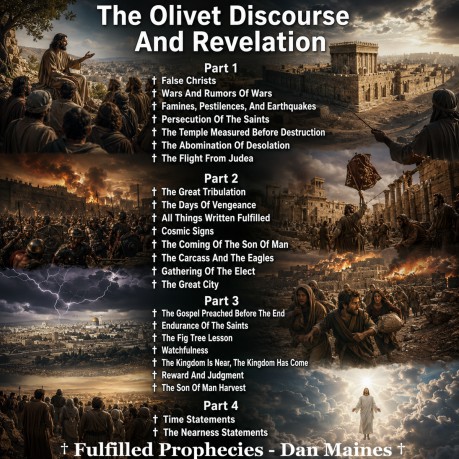
The
Olivet Discourse And Revelation (Part
4
of
4) Mark
13:30 Luke
21:32 Revelation
1:1-3 Revelation
22:6 THE
NEARNESS STATEMENTS Luke
21:31 Revelation
1:1 Revelation
1:3 Revelation
22:6 Revelation
22:10 Historical
References How
It Applies To Us Today Q
& A Appendix † This
is the fulfilled perspective we proclaim at Fulfilled Prophecies † Source
Index
By Dan Maines
Part
1 of 4
Part
2 of 4
Part
3 of 4
Part
4 of 4
Introduction
†
In the previous parts of this series we examined the many parallels
between the Olivet Discourse and the book of Revelation, including
false christs, wars, famines, persecution, tribulation, judgment, the
coming of the Son of Man, the gathering of the elect, the gospel
proclaimed to the nations, watchfulness, and the kingdom of God.
†
In this final part we turn our attention to one of the most important
aspects of the discussion, the time statements. These statements
establish when the events of the Olivet Discourse and Revelation were
expected to occur.
† Matthew, Mark, Luke, and
John repeatedly emphasize nearness, urgency, and imminence. These are
not isolated references but a consistent theme running throughout the
prophetic passages.
† The time statements
serve as the interpretive key for understanding the entire prophecy.
They reveal who the original audience was, when the events were
expected, and why the first-century context is so important.
†
As we compare these passages side by side, we will see that both the
Olivet Discourse and Revelation place their fulfillment within the
lifetime of the generation to whom these prophecies were originally
given.
TIME
STATEMENTS
Matthew 24:34
Truly
I say to you, this generation will not pass away until all these
things take place.
Truly
I say to you, this generation will not pass away until all these
things take place.
Truly
I say to you, this generation will not pass away until all things
take place.
The
Revelation of Jesus Christ, which God gave Him to show to His
bond-servants, the things which must soon take place; and He sent and
communicated it by His angel to His bond-servant John, who testified
to the word of God and to the testimony of Jesus Christ, everything
that he saw. Blessed is the one who reads, and those who hear the
words of the prophecy and keep the things which are written in it;
for the time is near.
And
he said to me, "These words are faithful and true"; and the
Lord, the God of the spirits of the prophets, sent His angel to show
His bond-servants the things which must soon take place.
†
Jesus
placed the fulfillment of these events within the lifetime of His
generation. (Matthew 24:34)
†
Matthew,
Mark, and Luke all preserve the exact same time statement.
†
John
twice declares that the events of Revelation would shortly come to
pass. (Revelation 1:1; 22:6)
†
Scripture
consistently places these events in the first century rather than
thousands of years later.
Matthew 24:33
so
you too, when you see all these things, recognize that He is near,
right at the door.
So
you too, when you see these things happening, recognize that the
kingdom of God is near.
The
Revelation of Jesus Christ, which God gave Him to show to His
bond-servants, the things which must soon take place; and He sent and
communicated it by His angel to His bond-servant John,
Blessed
is the one who reads, and those who hear the words of the prophecy
and keep the things which are written in it; for the time is near.
And
he said to me, "These words are faithful and true"; and the
Lord, the God of the spirits of the prophets, sent His angel to show
His bond-servants the things which must soon take place.
And
he said to me, "Do not seal up the words of the prophecy of this
book, for the time is near.
†
Jesus
taught that His disciples would recognize the nearness of these
events when they saw the signs. (Matthew 24:33)
†
John
repeatedly emphasizes that the fulfillment was near. (Revelation 1:3;
Revelation 22:10)
†
Daniel
was told to seal his prophecy because fulfillment was far off, but
John was told not to seal his because fulfillment was at hand.
(Daniel 12:4; Revelation 22:10)
†
The
language of imminence cannot honestly be stretched into thousands of
years.
†
Josephus
recorded false prophets, civil unrest, famine, internal fighting, and
the Roman siege that devastated Jerusalem.
†
Josephus
described conditions during the siege that match Jesus' warnings
concerning tribulation and distress.
†
Eusebius
recorded that Christians fled Jerusalem before the city's destruction
and escaped the judgment that followed.
†
Tacitus
recorded turmoil, wars, and instability throughout the Roman world
during this period.
†
These
historical accounts align remarkably well with the events described
in the Olivet Discourse and Revelation.
†
The
fulfillment of these prophecies demonstrates the absolute reliability
of Jesus Christ.
†
Every
major sign Jesus gave was fulfilled exactly as He foretold.
†
Revelation
is not disconnected from the Olivet Discourse, it expands upon it and
provides additional details.
†
We
do not live waiting for Christ to keep these promises, we live
because He already kept them.
†
The
kingdom is present, Christ reigns, and believers can live with
confidence in His completed work.
†
Fulfilled
prophecy strengthens our faith because it shows that God's Word never
fails.
Q
Why
compare Revelation to the Olivet Discourse?
A
Because
both contain the same sequence of events, false christs, wars,
famines, persecution, tribulation, judgment, the coming of the Son of
Man, the gathering of the elect, and first-century time statements.
Q
Which
Gospel best explains the Abomination of Desolation?
A
Luke
does. While Matthew and Mark mention the Abomination of Desolation,
Luke identifies the sign as Jerusalem surrounded by armies. (Luke
21:20)
Q
What
are the days of vengeance?
A
Jesus
said they were the days in which all things written would be
fulfilled. They refer to the judgment that came upon Jerusalem. (Luke
21:22)
Q
What
is one of the strongest fulfillment statements in Scripture?
A
Luke
21:22 where Jesus declared that all things written would be
fulfilled.
Q
What
is one of the strongest time statements in Scripture?
A
"This
generation shall not pass away, till all things be accomplished."
(Matthew 24:34; Mark 13:30; Luke 21:32)
Q
Why
is Revelation 11:8 important?
A
Because
it identifies the great city as the place where the Lord was
crucified, connecting Revelation's judgment directly to Jerusalem.
(Revelation 11:8)
Q
Did
Jesus predict events thousands of years beyond His audience?
A
No.
Jesus repeatedly addressed His first-century disciples and stated
that all these things would occur before that generation passed away.
(Matthew 24:34; Mark 13:30; Luke 21:32)
Q
Does
Revelation describe different events than the Olivet Discourse?
A
No.
Revelation expands upon the same events, judgments, tribulation,
coming, vindication, and fulfillment that Jesus described on the
Mount of Olives.
©
Fulfilled Prophecies - Dan Maines.
† Matthew
5:17-18; Matthew 24:1-7, 9, 15-16, 20-21, 28-34; Mark 13:1-9, 14-19,
24-30; Luke 17:37; Luke 21:5-12, 20-23, 25, 27-32; Revelation 1:1-3,
7; Revelation 6:1-13; Revelation 7:1-4, 14; Revelation 10:7;
Revelation 11:1-2, 8, 18; Revelation 12:6, 14; Revelation 16:19;
Revelation 17:18; Revelation 18:10, 20; Revelation 19:2, 17-18;
Revelation 22:6, 10
† Josephus,
Wars of the Jews 4.5.2; 5.5.3; 6.5.3; 6.9.4; Eusebius, Ecclesiastical
History 3.5.3; Tacitus, Histories 5.13.
Links