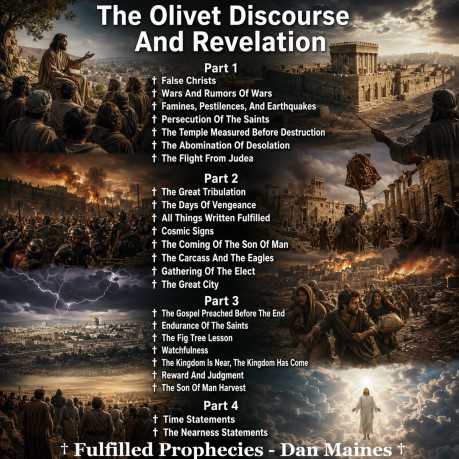
The
Olivet Discourse And Revelation (Part
2 of 4) † In Part 1 we examined the opening events
Jesus described in the Olivet Discourse, including false christs,
wars, famines, persecution, the Temple's coming destruction, the
Abomination of Desolation, and the flight from Judea. Mark
13:19 Luke
21:23 Revelation
7:14 THE
DAYS OF VENGEANCE Revelation
6:10 Revelation
11:18 Revelation
18:20 Revelation
19:2 ALL
THINGS WRITTEN FULFILLED Matthew
5:17-18 Revelation
10:7 COSMIC
SIGNS Mark
13:24-25 Luke
21:25 Revelation
6:12-13 THE
COMING OF THE SON OF MAN Mark
13:26 Luke
21:27 Revelation
1:7 THE
CARCASS AND THE EAGLES Luke
17:37 Revelation
19:17-18 GATHERING
OF THE ELECT Mark
13:27 Luke
21:28 Revelation
7:1-4 THE
GREAT CITY Revelation
11:8 Revelation
16:19 Revelation
17:18 Revelation
18:10 Historical
References How It Applies To Us Today Q & A Appendix Q What are the days of vengeance? A It reflects divine authority, judgment, and
vindication, fulfilling Old Testament prophetic imagery. (Matthew
24:30; Revelation 1:7) † This is the fulfilled perspective we proclaim at
Fulfilled Prophecies † Source Index † Historical Writers: Josephus, Tacitus
By Dan Maines
Part
1 of 4
Part
2 of 4
Part
3 of 4
Part
4 of 4
Introduction
†
In Part 2 we continue the comparison between Matthew, Mark, Luke, and
Revelation by examining the Great Tribulation, the Days of Vengeance,
the fulfillment of all things written, the cosmic signs, the coming
of the Son of Man, the gathering of the elect, and the judgment of
the great city.
† As these passages are
placed side by side, the similarities become increasingly difficult
to dismiss. The same events, the same judgments, the same time frame,
and the same audience appear throughout all four accounts.
†
Rather than describing separate events thousands of years apart,
these passages present a unified picture of the events leading to
Jerusalem's destruction and the fulfillment of Christ's prophetic
warnings.
† The further we progress through
the Olivet Discourse and Revelation, the more clearly we see that
John was expanding upon the very things Jesus foretold on the Mount
of Olives.
THE
GREAT TRIBULATION
Matthew 24:21
For
then there will be a great tribulation, such as has not occurred
since the beginning of the world until now, nor ever will again.
For
those days will be such a time of tribulation as has not occurred
since the beginning of the creation which God created until now, and
never will again.
Woe
to those women who are pregnant, and to those who are nursing babies
in those days; for there will be great distress upon the land, and
wrath to this people;
I
said to him, "My lord, you know." And he said to me, "These
are the ones who come out of the great tribulation, and they have
washed their robes and made them white in the blood of the Lamb.
†
Matthew,
Mark, and Luke all describe an unprecedented period of suffering
connected to Jerusalem's fall.
†
Luke
identifies the focus of the wrath as "this people,"
pointing directly to first-century Israel. (Luke 21:23)
†
Revelation
uses the exact phrase "the great tribulation," linking the
two accounts together. (Revelation 7:14)
†
Josephus
recorded suffering during the siege so severe that it surpassed
anything the nation had previously experienced.
Luke 21:22
because
these are days of punishment, so that all things which have been
written will be fulfilled.
and
they cried out with a loud voice, saying, "How long, O Lord,
holy and true, will You refrain from judging and avenging our blood
on those who live on the earth?"
And
the nations were enraged, and Your wrath came, and the time came for
the dead to be judged, and the time to reward Your bond-servants the
prophets and the saints and those who fear Your name, the small and
the great, and to destroy those who destroy the earth."
Rejoice
over her, O heaven, and you saints and apostles and prophets, because
God has pronounced judgment for you against her."
because
His judgments
are true
and righteous; for He has judged the great prostitute who was
corrupting the earth with her sexual immorality, and He has
avenged
the blood of His bond-servants
on
her."
†
Jesus
declared that Jerusalem's destruction would be the days of vengeance.
(Luke 21:22)
†
Revelation
repeatedly speaks of God avenging the blood of His servants.
(Revelation 6:10; 19:2)
†
The
judgment is not random, it is a response to covenant rebellion and
persecution.
†
Both
passages point to the same period of divine judgment.
Luke 21:22
because
these are days of punishment, so that all things which have been
written will be fulfilled.
Do
not presume that I came to abolish the Law or the Prophets; I did not
come to abolish, but to fulfill. For truly I say to you, until heaven
and earth pass away, not the smallest letter or stroke of a letter
shall pass from the Law, until all is accomplished!
but
in the days of the voice of the seventh angel, when he is about to
sound, then the mystery of God is finished, as He announced to His
servants the prophets.
†
Jesus
connected the days of vengeance with the fulfillment of all things
written. (Luke 21:22)
†
The
Law and the Prophets remained until all things were accomplished.
(Matthew 5:17-18)
†
Revelation
announces the completion of God's prophetic mystery. (Revelation
10:7)
†
The
theme is fulfillment, not postponement.
Matthew 24:29
But
immediately after the tribulation of those days the sun will be
darkened, and the moon will not give its light, and
the
stars will fall from
the sky, and the powers of the heavens will be shaken.
But
in those days, after that tribulation, the sun will be darkened and
the moon will not give its light, and the stars will be falling
from
heaven, and the powers that are in the heavens will be shaken.
There
will be signs in the sun and moon and stars, and on the earth
distress among nations, in perplexity at the roaring of the sea and
the waves,
And
I looked when He broke the sixth seal, and there was a great
earthquake; and the sun became as black as sackcloth made of hair,
and the whole moon became like blood; and the stars of the sky fell
to the earth, as a fig tree drops its unripe figs when shaken by a
great wind.
†
This
language comes from the Old Testament prophets. (Isaiah 13:10;
Ezekiel 32:7-8)
†
Heavenly
bodies often represented rulers, nations, and covenant powers.
†
Jesus
and John used the same prophetic imagery.
†
Revelation
expands upon the signs Jesus described on the Mount of Olives.
Matthew 24:30
And
then the sign of the Son of Man will appear in the sky, and then all
the tribes of the earth will mourn, and they will see the Son of Man
coming on the clouds of the sky
with
power and great glory.
And
then they will see the Son of Man
coming
in clouds with
great power and glory.
And
then they will see the Son of Man coming in a cloud with power and
great glory.
Behold,
He is coming with the clouds, and every eye will see Him, even those
who pierced Him; and all the tribes of the earth will mourn over Him.
So it is to be. Amen.
†
Jesus
drew upon Old Testament cloud-coming judgment language. (Isaiah 19:1;
Daniel 7:13-14)
†
The
coming in the clouds signifies divine authority, judgment, and
vindication.
†
Revelation
opens by announcing the same coming described in the Olivet
Discourse. (Revelation 1:7)
†
Those
who pierced Him are specifically mentioned, keeping the focus upon
the generation that rejected Him.
Matthew 24:28
Wherever
the corpse is, there the vultures will gather.
And
responding, they said to Him, "Where, Lord?" And He said to
them, "Where the body is, there also the vultures will be
gathered."
Then
I saw an angel standing in the sun, and he cried out with a loud
voice, saying to all the birds that fly in midheaven, "Come,
assemble for the great feast of God, so that you may eat the flesh of
kings and the flesh of commanders, the flesh of mighty men, the flesh
of horses and of those who sit on them, and the flesh of all people,
both free and slaves, and small and great."
†
Eagles
were prominently displayed on Roman military standards.
†
Jesus
used imagery that His audience would immediately recognize.
†
Revelation
continues the theme of judgment through birds gathering upon the
slain.
†
Both
passages portray the aftermath of divine judgment.
Matthew 24:31
And
He will send forth His angels with a great trumpet blast, and they
will gather together
His
elect from the four winds, from one end of the sky to the other.
And
then He will send forth the angels, and will gather together His
elect from the four winds, from the end of the earth to the end of
heaven.
But
when these things begin to take place, straighten up and lift up your
heads, because your redemption is drawing near."
After
this I saw four angels standing at the four corners of the earth,
holding back the four winds of the earth so that no wind would blow
on the earth, or on the sea, or on any tree. And I saw another angel
ascending from the rising of the sun, holding the seal of the living
God; and he called out with a loud voice to the four angels to whom
it was granted to harm the earth and the sea, saying, "Do not
harm the earth, or the sea, or the trees until we have sealed the
bond-servants of our God on their foreheads." And I heard the
number of those who were sealed: 144,000, sealed from every tribe of
the sons of Israel:
†
Matthew
and Mark emphasize the gathering of the elect.
†
Luke
emphasizes the redemption drawing near for believers. (Luke 21:28)
†
Revelation
depicts God's servants being identified, protected, and preserved.
(Revelation 7:1-4)
†
The
focus is not escape from the planet but God's care for His people
during judgment.
Luke 21:20
But
when you see Jerusalem surrounded by armies, then recognize that her
desolation is near.
And
their dead bodies will lie on the street of the great city which
spiritually is called Sodom and Egypt, where also their Lord was
crucified.
The
great city was split into three parts, and the cities of the nations
fell. Babylon the great was remembered in the sight of God, to give
her the cup of the wine of His fierce wrath.
The
woman whom you saw is the great city, which reigns over the kings of
the earth.
standing
at a distance because of the fear of her torment, saying, 'Woe, woe,
the great city, Babylon, the strong city! For in one hour your
judgment has come.'
†
Luke
identifies Jerusalem as the city facing judgment.
†
Revelation
identifies the great city as the place where the Lord was crucified.
(Revelation 11:8)
†
The
repeated references to the great city connect Revelation's judgment
to Jerusalem.
†
Both
accounts point to the same covenant city under divine judgment.
† Josephus
recorded the horrors of the Roman siege, including famine, internal
fighting, mass death, and the destruction of Jerusalem.
†
Josephus described unprecedented suffering during the war,
corresponding to Jesus' warnings concerning great tribulation.
†
Tacitus recorded turmoil throughout the Roman Empire during this
period, including civil unrest and warfare.
†
The destruction of Jerusalem and its Temple in AD 70 fulfilled the
judgments foretold by Jesus and reflected throughout Revelation.
†
These historical accounts provide strong confirmation of the events
described in both the Olivet Discourse and Revelation.
† God's
judgments are always righteous and faithful.
†
Jesus fulfilled His prophetic warnings exactly as He promised.
†
The destruction of Jerusalem demonstrated the end of the Old Covenant
system and the full establishment of Christ's kingdom.
†
Fulfilled prophecy strengthens our confidence in the truthfulness of
Scripture.
† We can trust God's promises
because He has proven faithful to His word.
A
Jesus said they were the days in which all things written would be
fulfilled through the judgment that came upon Jerusalem. (Luke
21:22)
Q Why does Revelation repeatedly speak
about avenging the blood of the saints?
A
Because God was bringing judgment upon those who had persecuted His
prophets, apostles, and people. (Revelation 6:10; Revelation 19:2)
Q
What is meant by the great city?
A Revelation
identifies the great city as the place where the Lord was crucified,
pointing to Jerusalem. (Revelation 11:8)
Q Why
are the cosmic signs important?
A They connect
Revelation directly to the prophetic judgment language used by Jesus
and the Old Testament prophets. (Matthew 24:29; Revelation 6:12-13)
Q
What is the significance of the Son of Man coming in the clouds?
© Fulfilled Prophecies - Dan
Maines.
† Luke 21:22-23, 27; Matthew
5:17-18, 24:21, 28-31; Mark 13:19, 24-27; Luke 17:37; Revelation 1:7;
Revelation 6:10, 12-13; Revelation 7:1-4, 14; Revelation 10:7;
Revelation 11:8, 18; Revelation 16:19; Revelation 17:18; Revelation
18:10, 20; Revelation 19:2, 17-18
Links