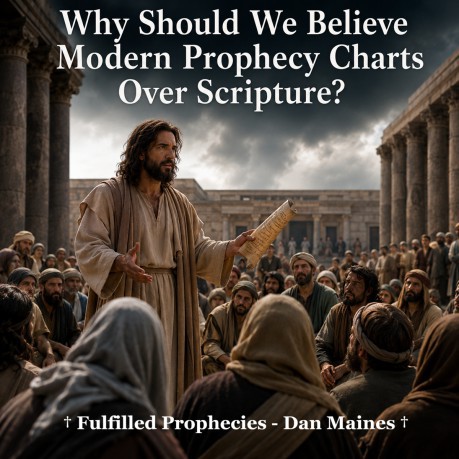
Why
Should We Believe Modern Prophecy Charts Over Scripture? Introduction † Many
prophecy systems today are built around events that were supposed to
happen thousands of years after the people who first received the
prophecies had already died. This Generation Matthew 24:34
Truly I say to you, this generation will not pass away until all
these things take place.
† Jesus didn't
say a future generation thousands of years later. He said this
generation. Some Standing Here Matthew 16:27-28 For
the Son of Man is going to come in the glory of His Father with His
angels, and will
then repay every person according to his
deeds. The Disciples Would Not
Finish Israel But whenever they
persecute you in one city, flee to the next; for truly I say to you,
you will not finish going through the cities of Israel until the Son
of Man comes.
† Jesus placed
His coming within the ministry of the disciples. The Time Is At Hand Revelation 1:3
Blessed is the one who reads, and those who hear the words of the
prophecy and keep the things which are written in it; for the time is
near.
† Revelation
opens by telling its readers that the events were near. Shortly Come To Pass Revelation 1:1 The Revelation of Jesus Christ,
which God gave Him to show to His bond-servants, the things which
must soon take place; and He sent and communicated it by His angel to
His bond-servant John, Do Not Seal The Book Revelation 22:10 And he said to me, Do not seal up
the words of the prophecy of this book, for the time is near. Shortly Come To Pass
Again Revelation 22:6
And he said to me, "These words are faithful and true"; and
the Lord, the God of the spirits of the prophets, sent His angel to
show His bond-servants the things which must soon take place.
† The book
closes exactly where it began. All Things Written
Fulfilled Luke 21:20-22
But when you see Jerusalem surrounded by armies, then recognize that
her desolation is near. Then those who are in Judea must flee to the
mountains, and those who are inside the city must leave, and those
who are in the country must not enter the city; because these are
days of punishment, so that all things which have been written will
be fulfilled.
† Jesus
identified the coming destruction of Jerusalem as the fulfillment of
all things written. A Very Little While Hebrews 10:37
For yet in a very little
while, † The writer
of Hebrews expected fulfillment soon. The Test Of A Prophet Deuteronomy 18:22
When the prophet speaks in the name of the Lord,
and the thing does not happen or come true, that is the thing which
the Lord has not
spoken. The prophet has spoken it presumptuously; you are not to be
afraid of him.
† God gave
Israel a simple test for prophetic claims. Historical References † Eusebius
recorded that Christians in Judea fled Jerusalem before its
destruction after receiving warnings and recognizing the signs Jesus
had given. How It Applies To Us
Today † We should
allow Scripture to define its own timing instead of forcing it into
modern prophecy systems. Q & A Appendix Q:
Why do many people believe Revelation is still future? † This is the fulfilled
perspective we proclaim at Fulfilled Prophecies † Source Index
By Dan Maines
†
Yet Jesus and the apostles repeatedly used time statements that
placed these events within their own generation.
†
The question isn't whether prophecy was fulfilled, the question is
whether we should believe the inspired time statements of Scripture
or the theories of later traditions.
†
The plain reading places the fulfillment within the lifetime of those
who heard Him speak. (Matthew 23:36)
†
When people redefine "generation" to mean something other
than the people living at that time, they move away from the natural
meaning of the text.
"Truly
I say to you, there are some of those who are standing here who will
not taste death until they see the Son of Man coming in His
kingdom."
†
Jesus connected His coming with people who were standing before Him
at that moment.
†
He specifically stated that some would still be alive when they
witnessed it.
†
That doesn't fit a fulfillment thousands of years later. It fits a
first-century fulfillment exactly as stated.
Matthew 10:23
†
He didn't tell them to expect a delay of thousands of years.
†
His audience understood these words as applying to their own
generation.
†
The book was written to real churches facing real circumstances in
their own time. (Revelation 1:11)
†
If the events were actually thousands of years away, the statement
that the time was at hand would lose its ordinary meaning.
†
Revelation doesn't merely say the events would happen someday.
†
It says they must shortly come to pass.
†
The opening statement establishes the time frame for understanding
the entire book.
†
The same statement appears at the end of Revelation as well as the
beginning.
†
God told John not to seal the prophecy because the time was near.
†
This stands in contrast to prophecies that were sealed because their
fulfillment was far away. (Daniel 12:4)
†
God repeated that the events would shortly come to pass.
†
Consistency requires that we allow these inspired time statements to
mean what they say.
†
He gave specific instructions to people living at that time because
they would witness these events.
†
The Roman siege of Jerusalem in AD 70 perfectly matches the warning
Jesus gave.
He who is
coming will come, and
will not delay.
†
"A very little while" doesn't naturally mean thousands of
years.
†
The original audience was told the coming event was near.
†
When predictions fail, the problem isn't with Scripture but with the
interpretation.
†
For nearly two thousand years many prophecy teachers have repeatedly
predicted events that never happened.
†
Scripture calls us back to what God actually said rather than what
later systems claim He meant. (Isaiah 8:20)
†
Josephus documented the events surrounding the Jewish War and the
destruction of Jerusalem in AD 70.
†
The historical record confirms that the generation Jesus warned
experienced the judgment He predicted.
†
Josephus described Jerusalem surrounded by Roman armies exactly as
Jesus foretold.
†
The first-century evidence aligns with the biblical time statements
rather than modern prophetic systems.
†
We can trust that Jesus kept every promise He made within the time
frame He gave.
†
We don't need to live in fear of endless prophetic speculation.
†
Our confidence rests in a faithful Savior who fulfilled His word
exactly as promised.
†
When Scripture and tradition disagree, Scripture must remain our
final authority.
†
The fulfillment of prophecy strengthens our confidence in every
promise God has made.
A:
Because they interpret Revelation through later prophetic systems
rather than the time statements found throughout the book.
(Revelation 1:1-3; Revelation 22:6-10)
Q:
Did Jesus say His coming would occur in the first century?
A:
Yes. He said "this generation shall not pass away" and that
some standing before Him would not die before seeing it. (Matthew
24:34; Matthew 16:27-28)
Q:
Was Revelation written to people living in John's day?
A:
Yes. It was addressed to seven real churches and repeatedly stated
that the events were near. (Revelation 1:3, 11; Revelation 22:10)
Q:
What did Jesus say would happen when Jerusalem was surrounded by
armies?
A:
He said its desolation was near and that those were the days of
vengeance in which all things written would be fulfilled. (Luke
21:20-22)
Q:
Does Revelation claim its prophecies were near?
A:
Yes. Revelation opens and closes by saying the events must shortly
come to pass and that the time was at hand. (Revelation 1:1-3;
Revelation 22:6-10)
Q:
Why should Scripture be our authority instead of prophecy charts?
A:
Because Scripture is inspired by God, while prophecy charts are
interpretations created by men. (2 Timothy 3:16; Isaiah 8:20)
©
Fulfilled Prophecies - Dan Maines. †
†
Matthew 24:34, Matthew 16:27-28, Matthew 10:23, Revelation 1:3,
Revelation 1:1, Revelation 22:10, Revelation 22:6, Luke 21:20-22,
Hebrews 10:37, Deuteronomy 18:22
†
Eusebius, Ecclesiastical History; Josephus, Wars of the Jews
Links