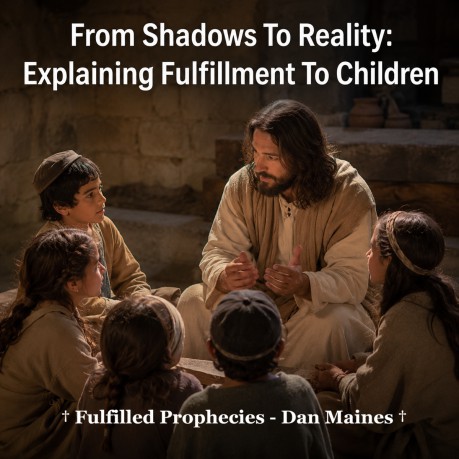
From
Shadows To Reality: Explaining Fulfillment To Children Introduction † Sometimes
children learn best by seeing the difference between a picture and
the real thing. The Bible teaches that many things in the Old
Covenant were pictures, shadows, and lessons that pointed forward to
Jesus Christ. When Christ came, the reality arrived. God did not give
Israel the Law because it was the final goal. He gave it to lead
people to Christ. The fulfilled view helps us understand that God's
plan moved from shadow to reality, from promise to fulfillment, and
from the Old Covenant to the New Covenant. Galatians
3:24-25 Colossians
2:16-17 Hebrews 10:1 Hebrews
8:5 John
1:17 Luke
24:44 Hebrews
8:13 Historical References How It Applies To Us
Today Q & A Appendix † This is the fulfilled
perspective we proclaim at Fulfilled Prophecies † Source Index
By Dan Maines
Therefore
the Law has become our guardian to lead us to Christ, so that we may
be justified by faith. But now that faith has come, we are no longer
under a guardian.
†
The Law was a teacher that pointed people to Jesus Christ.
†
A teacher's job is not to stay with a student forever. Once the
lesson is learned, the student moves forward.
†
God never intended the Law of Moses to be the final destination. It
was preparing people for Christ. (Romans 10:4)
Therefore,
no one is to act as your judge in regard to food and drink, or in
respect to a festival or a new moon, or a Sabbath day- things which
are only a shadow of what is to come; but the substance belongs to
Christ.
†
God specifically calls these Old Covenant things shadows.
†
A shadow is not the real object. It only points to something greater.
(Colossians 2:16-17)
†
Christ is the reality to which all those shadows pointed. (Colossians
2:16-17)
For
the Law, since it has only a shadow of the good things to come and
not the form of those things itself, can never, by the same
sacrifices which they offer continually every year, make those who
approach perfect.
†
The Law contained shadows of future blessings.
†
Animal sacrifices could never accomplish what Christ would
accomplish. (Hebrews 10:1-14)
†
Jesus fulfilled what the sacrifices, priests, and temple were
pointing toward. (Hebrews 9:11-12)
who serve a
copy and shadow of the heavenly things, just as Moses was warned by
God when he was about to erect the tabernacle; for, "See,"
He says, "that
you make all things by
the pattern which was shown to you on the mountain."
†
The tabernacle itself was a copy and shadow of a greater reality.
†
God designed the Old Covenant system to teach spiritual truths that
would be fulfilled in Christ. (Hebrews 8:5)
†
The earthly tabernacle pointed forward to the greater things found in
the New Covenant. (Hebrews 9:23-24)
For the
Law was given through Moses; grace and truth were realized through
Jesus Christ.
†
Moses brought the Law, but Jesus brought the fulfillment of God's
promises.
†
Grace and truth arrived through Christ because He was the One to whom
the Law pointed. (John 5:39)
†
The New Covenant provides the reality that the Old Covenant
anticipated. (Hebrews 8:6)
Now He
said to them, "These are My words which I spoke to you while I
was still with you, that all the things that are written about Me in
the Law of Moses and the Prophets and the Psalms must be fulfilled."
†
Jesus taught that the Law, the Prophets, and the Psalms were all
pointing to Him.
†
The Old Testament is not a separate story. It is the story that leads
to Christ. (Luke 24:44)
†
God's promises were fulfilled in Jesus exactly as He foretold. (Luke
24:44)
When He
said, "A new covenant," He has made the first obsolete. But
whatever is becoming obsolete and growing old is about to disappear.
†
The first covenant was growing old because a better covenant had
arrived.
†
God was transitioning His people from the shadow to the reality.
(Hebrews 8:6-13)
†
The destruction of Jerusalem and the temple completed that covenant
transition. (Luke 21:20-22)
†
Josephus recorded the destruction of Jerusalem and the temple in AD
70, bringing an end to the Old Covenant system that depended upon the
temple, priesthood, and sacrifices.
†
Eusebius wrote that the judgments foretold by Christ came upon
Jerusalem, confirming the fulfillment of those first-century covenant
promises and warnings.
†
Imagine drawing a picture of your mother while she is away. The
picture reminds you of her, but when she comes home you don't hug the
picture, you hug your mother. The Old Covenant was like the picture.
Jesus is the reality.
†
Think about training wheels on a bicycle. They help for a time, but
they are not meant to stay forever. The Law helped teach God's people
until Christ came.
†
Think about a blueprint for a house. The blueprint is important, but
nobody lives inside the blueprint. The finished house is what the
blueprint was pointing toward. Christ is the fulfillment of God's
plan.
†
Think about a shadow on the ground. You can tell someone is coming by
seeing the shadow, but the real person is much greater than the
shadow. Jesus is the reality that the shadows pointed toward.
†
When we read the Old Testament, we should look for how it points to
Jesus because He is the reality behind the shadows. (Luke 24:27)
Q:
What is a shadow in the Bible?
A:
A shadow is something that points to a greater reality that would
come later. The Law, sacrifices, feasts, and temple were shadows
pointing to Christ. (Colossians 2:16-17; Hebrews 10:1)
Q:
Why did God give Israel the Law?
A:
The Law was given to teach and guide people until Christ came.
(Galatians 3:24-25)
Q:
Did God make a mistake with the Old Covenant?
A:
No. The Old Covenant accomplished exactly what God intended. It
prepared the way for Christ and the New Covenant. (Galatians 3:24;
Hebrews 8:6)
Q:
What changed when Jesus came?
A:
The reality arrived. Jesus fulfilled the things that the Law,
sacrifices, priesthood, and temple represented. (Matthew 5:17;
Hebrews 9:11-12)
Q:
Are Christians under the Law of Moses today?
A:
No. Believers are under Christ and the New Covenant. (Galatians 3:25;
Romans 10:4)
Q:
How do we know the New Covenant is better?
A:
God calls it a better covenant established on better promises.
(Hebrews 8:6)
Q:
If the Old Covenant was a shadow, should we still read the Old
Testament?
A:
Yes. The Old Testament helps us understand who Jesus is and how God
fulfilled His promises through Him. (Luke 24:27, 44)
©
Fulfilled Prophecies - Dan Maines.
†
Galatians 3:24-25; Colossians 2:16-17; Hebrews 10:1; Hebrews 8:5;
John 1:17; Luke 24:44; Hebrews 8:13; Romans 10:4; Hebrews 9:11-12,
23-24; John 5:39; Hebrews 8:6-13; Luke 21:20-22; Luke 24:27; Matthew
5:17
†
Josephus, Eusebius
Links